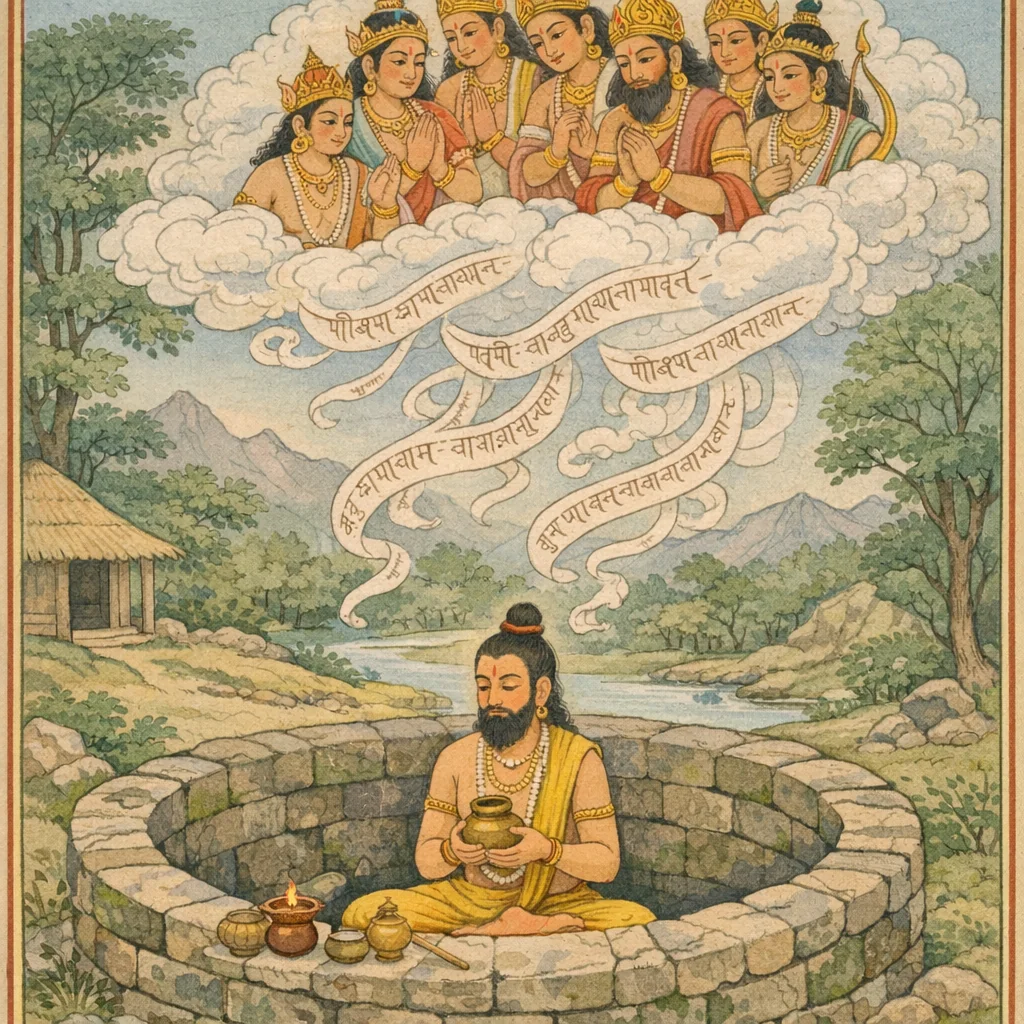
Adhyaya 36
सरस्वतीतीर्थानुक्रमः — बलरामस्य तीर्थयात्रा (Sarasvatī Tīrtha Itinerary — Balarāma’s Pilgrimage)
Upa-parva: Sarasvatī-Tīrtha-Yātrā (Balarāma’s pilgrimage sequence within Śalya-parva)
Vaiśaṃpāyana narrates Balarāma’s arrival at Vinaśana, so named because Sarasvatī is said to have ‘vanished’ there due to hostility directed toward Śūdra-Ābhīras. After ritual bathing, Balarāma proceeds to Subhūmika, described as an apsaras play-ground frequented periodically by devas and gandharvas. He then visits Gandharva-tīrtha and Gargasrota, where the sage Garga is credited with instituting auspicious and ominous temporal/astral ordinances; ṛṣis attend him for knowledge of time (kāla-jñāna). Moving onward to Śaṅkha-tīrtha, Balarāma observes a great conch-like mountain and a domain associated with yakṣas, vidyādharas, rākṣasas, and piśācas living under vows. He reaches Dvaitavana, then Nāgadhanvāna—Vāsuki’s seat—where devas consecrate Vāsuki and fear of serpents is said to be absent. At a major tīrtha where Sarasvatī turns to face east (prāṅmukhī), Janamejaya asks why the river reversed; Vaiśaṃpāyana explains that during a twelve-year Naimiṣeya satra in Kṛtayuga, overcrowding of ṛṣis led Sarasvatī, out of compassion, to create many groves and temporarily reverse course, producing the famed ‘Naimiṣeya’ bend. Balarāma again performs rites and gifts, then proceeds through a richly described sacred landscape toward Saptasārasvata, associated with the siddha Maṅkaṇaka.
Chapter Arc: बलराम मुसलधारी तीर्थ-यात्रा में एक ऐसे उदपान-तीर्थ पर पहुँचते हैं, जहाँ जल का स्पर्श करते ही एक प्राचीन, विस्मयकारी कथा जाग उठती है—त्रित मुनि का यज्ञ, कूप और देवताओं का आगमन। → वैशम्पायन त्रित की कथा खोलते हैं: यज्ञ-कुशल, वेद-निष्ठ तपस्वी त्रित अपने भाइयों (एकत और द्वित) के साथ चलते हैं; पीछे रह गए भाई पशुओं को हाँकते-हाँकते ईर्ष्या/कपट से त्रित को कूप में गिरा देते हैं। कूप के अँधेरे में भी त्रित धर्मपरायण रहकर यज्ञ का संकल्प नहीं छोड़ते और वहीं से सोम-यज्ञ आरम्भ कर देते हैं; स्वर्गलोक तक वेदमंत्रों का तुमुलनाद पहुँचता है और देवता चकित-उद्विग्न हो उठते हैं। → देवपुरोहित बृहस्पति मंत्र-ध्वनि सुनकर देवताओं से कहते हैं कि त्रित का यज्ञ हो रहा है—चलो। देवगण कूप के पास पहुँचकर देखते हैं कि भीतर दीक्षित महात्मा त्रित यज्ञ चला रहे हैं; भागार्थी देवता स्वयं उपस्थित होकर यज्ञ-भाग माँगते हैं—कूप की कैद के बीच भी त्रित की तप-शक्ति और यज्ञ-तेज का सार्वभौम स्वीकार। → देवताओं और पुण्यलक्षण मुनियों की उपस्थिति से त्रित का यज्ञ सिद्ध होता है; त्रित अपने साथ हुए अधर्म का स्मरण कर भाइयों को शाप देते हैं, जिससे भ्रातृ-द्रोह का फल सुनिश्चित होता है। कथा के श्रवण के बाद बलराम उस तीर्थ में दान, ब्राह्मण-पूजन और स्नान/आचमन कर आगे बढ़ते हैं—तीर्थ का माहात्म्य स्थापित होता है। → बलराम की तीर्थ-यात्रा आगे किन-किन प्राचीन प्रसंगों और तीर्थ-माहात्म्यों को उद्घाटित करेगी, यह जिज्ञासा बनी रहती है।
Shlokas
Verse 1
ऑपनआक्रात बछ। 2 षट्त्रिशो5ध्याय: उदपानतीर्थकी उत्पत्तिकी तथा त्रित मुनिके कूपमें गिरने, वहाँ यज्ञ करने और अपने भाइयोंको शाप देनेकी कथा वैशम्पायन उवाच तस्मान्नदीगतं चापि हुदपानं यशस्विन: । त्रितस्य च महाराज जगामाथ हलायुध:,वैशम्पायनजी कहते हैं--महाराज! उस चमसोद्धेद-तीर्थसे चलकर बलरामजी यशस्वी त्रितमुनिके उदपान तीर्थमें गये, जो सरस्वती नदीके जलमें स्थित है
Vaiśampāyana said: “O King, departing from that sacred spot situated in the river, Halāyudha (Balarāma) then went to the renowned well-shrine (udapāna-tīrtha) of the sage Trita, which lies within the waters of the Sarasvatī.”
Verse 2
तत्र दत्त्वा बहु द्रव्यं पूजयित्वा तथा द्विजान् | उपस्पृश्य च तत्रैव प्रह्ृष्टो मुसलायुध:,मुसलधारी बलरामजीने वहाँ जलका स्पर्श, आचमन एवं स्नान करके बहुत-सा द्रव्य दान करनेके पश्चात् ब्राह्मणोंका पूजन किया। फिर वे बहुत प्रसन्न हुए
There, after giving away abundant wealth and duly honoring the twice-born (brāhmaṇas), he performed ritual purification by touching water; and in that very place, the wielder of the mace-weapon (Balarāma) became filled with joy.
Verse 3
तत्र धर्मपरो भूत्वा त्रित: स सुमहातपा: । कूपे च वसता तेन सोम: पीतो महात्मना
There, steadfast in dharma, Trita—of exceedingly great austerity—while dwelling in a well, drank the Soma.
Verse 4
वहाँ महातपस्वी त्रितमुनि धर्मपरायण होकर रहते थे। उन महात्माने कुएँमें रहकर ही सोमपान किया था ।। तत्र चैनं समुत्सृज्य भ्रातरौ जम्मतुर्गहान् । ततस्तौ वै शशापाथ त्रितो ब्राह्मणसत्तम:,उनके दो भाई उस कुएँमें ही उन्हें छोड़कर घरको चले गये थे। इससे ब्राह्मणश्रेष्ठ त्रितने दोनोंको शाप दे दिया था
Vaiśampāyana said: There, after abandoning him, the two brothers went back home. Then Trita—the foremost of brāhmaṇas—pronounced a curse upon them.
Verse 5
जनमेजय उवाच उदपानं कथं ब्रह्मन् कथं च सुमहातपा: । पतित: कि च संत्यक्तो भ्रातृभ्यां द्विजसत्तम,एतदाचक्ष्व मे ब्रह्मन् श्रोतव्यं यदि मन्यसे । जनमेजयने पूछा--ब्रह्मन! उदपान तीर्थ कैसे हुआ? वे महातपस्वी त्रितमुनि उसमें कैसे गिर पड़े और द्विजश्रेष्ठ उनके दोनों भाइयोंने उन्हें क्यों वहीं छोड़ दिया था? क्या कारण था, जिससे वे दोनों भाई उन्हें कुएँमें ही त्यागकर घर चले गये थे? वहाँ रहकर उन्होंने यज्ञ और सोमपान कैसे किया? ब्रह्मन! यदि यह प्रसंग मेरे सुननेयोग्य समझें तो अवश्य मुझे बतावें
Janamejaya said: “O Brahmin, how did that well become a sacred ford (tīrtha)? And how did the great ascetic fall into it? O best of twice-born, why was he abandoned there by his two brothers—what was the reason that they left him in the well and went home? And while staying there, how did he perform sacrifice and drink Soma? O Brahmin, if you deem this episode fit to be heard, please tell it to me.”
Verse 6
कूपे कथं च हित्वैनं भ्रातरौ जग्मतुर्गृहान् । कथं च याजयामास पपौ सोम॑ च वै कथम्
Janamejaya asked: “How did the two brothers abandon him in the well and return home? And how did he later come to officiate at sacrifices for others, and how indeed did he drink the Soma?”
Verse 7
वैशम्पायन उवाच आसन पूर्वयुगे राजन् मुनयो भ्रातरस्त्रय:,ब्रह्मलोकजित: सर्वे तपसा ब्रह्मवादिन: । वैशम्पायनजीने कहा--राजन्! पहले युगमें तीन सहोदर भाई रहते थे। वे तीनों ही मुनि थे। उनके नाम थे एकत, द्वित और त्रित। वे सभी महर्षि सूर्यके समान तेजस्वी, प्रजापतिके समान संतानवान् और ब्रह्मवादी थे। उन्होंने तपस्याद्वारा ब्रह्मलोकपर विजय प्राप्त की भी
Vaiśampāyana said: “O King, in an earlier age there lived three brothers who were sages. All three were exponents of Brahman, and by the power of their austerities they attained victory—access—to the world of Brahmā.”
Verse 8
एकततक्ष द्वितश्रैव त्रितश्नादित्यसंनिभा: । सर्वे प्रजापतिसमा: प्रजावन्तस्तथैव च
Ekat, Dvit, and Trit—radiant like the sun. All were comparable to Prajāpati, mighty progenitors, and each likewise was endowed with offspring.
Verse 9
तेषां तु तपसा प्रीतो नियमेन दमेन च
But he was pleased with them because of their austerities, their disciplined observances, and their self-restraint.
Verse 10
स तु दीर्घेण कालेन तेषां प्रीतिमवाप्य च
In due course, after a long time had passed, he also won their goodwill and affection.
Verse 11
राजानस्तस्य ये ह्वासन् याज्या राजन् महात्मन:
Vaiśampāyana said: “O king, those rulers who were his rightful recipients of sacrificial honor—noble and great-souled—(were present/concerned in this matter).”
Verse 12
तेषां तु कर्मणा राजंस्तथा चाध्ययनेन च
Vaiśampāyana said: “But, O king, by their deeds—and likewise by their study (of sacred learning) as well—….”
Verse 13
तथा सर्वे महाभागा मुनय: पुण्यलक्षणा:
Thus, all those greatly fortunate sages—marked by holy signs and virtuous qualities—(were present/assembled), embodying the auspicious character that lends moral weight to the events being narrated.
Verse 14
अपूजयन् महाभागं यथास्य पितरं तथा । महान् सौभाग्यशाली और पुण्यात्मा सभी महर्षि भी महाभाग त्रितका उनके पिताके तुल्य ही सम्मान करते थे ।। कदाचिद्धि ततो राजन् भ्रातरावेकतद्वितौ,राजन्! एक दिनकी बात है, उनके दोनों भाई एकत और द्वित यज्ञ और धनके लिये चिन्ता करने लगे। शत्रुओंको संताप देनेवाले नरेश! उनके मनमें यह विचार उत्पन्न हुआ कि हमलोग त्रितको साथ लेकर यजमानोंका यज्ञ करावें और दक्षिणाके रूपमें बहुत-से पशु प्राप्त करके महान् फलदायक यज्ञका अनुष्ठान करें और उसीमें प्रसन्नतापूर्वक सोमरसका पान करें
Vaiśampāyana said: The great-souled Trita—fortunate and virtuous—was honored by all the seers just as they honored his father. Then, O king, it happened one day that his two brothers, Ekata and Dvita, began to deliberate about sacrifice and wealth. A thought arose in them: “Let us take Trita with us and conduct sacrifices for patrons; receiving many cattle as sacrificial fees, we shall perform rites that yield great fruit, and there, with glad hearts, drink the Soma.”
Verse 15
यज्ञार्थ चक्रतुश्निन्तां तथा वित्तार्थमेव च । तयोबुद्धि: समभवत् त्रितं गृह्य परंतप,राजन्! एक दिनकी बात है, उनके दोनों भाई एकत और द्वित यज्ञ और धनके लिये चिन्ता करने लगे। शत्रुओंको संताप देनेवाले नरेश! उनके मनमें यह विचार उत्पन्न हुआ कि हमलोग त्रितको साथ लेकर यजमानोंका यज्ञ करावें और दक्षिणाके रूपमें बहुत-से पशु प्राप्त करके महान् फलदायक यज्ञका अनुष्ठान करें और उसीमें प्रसन्नतापूर्वक सोमरसका पान करें
Vaiśampāyana said: Seeking both sacrificial merit and material gain, the two brothers began to deliberate. Then this resolve arose in them: “O king, subduer of foes, let us take Trita with us, officiate at patrons’ sacrifices, obtain many cattle as priestly fees, perform a great and fruitful rite, and there, with glad hearts, drink the Soma.”
Verse 16
याज्यान् सर्वानुपादाय प्रतिगृहा पशूंस्तत: । सोम पास्यामहे हृष्टा: प्राप्प यज्ञ महाफलम्,राजन्! एक दिनकी बात है, उनके दोनों भाई एकत और द्वित यज्ञ और धनके लिये चिन्ता करने लगे। शत्रुओंको संताप देनेवाले नरेश! उनके मनमें यह विचार उत्पन्न हुआ कि हमलोग त्रितको साथ लेकर यजमानोंका यज्ञ करावें और दक्षिणाके रूपमें बहुत-से पशु प्राप्त करके महान् फलदायक यज्ञका अनुष्ठान करें और उसीमें प्रसन्नतापूर्वक सोमरसका पान करें
Vaiśampāyana said: “Having taken up all the prospective sacrificers and then, from house to house, obtained cattle as fees, we shall joyfully drink the Soma—having secured the great reward of a sacrifice, O king.” (In context, this reflects a calculating intent: to use ritual service as a means to acquire wealth and then indulge in the sacrificial drink, raising an ethical tension between sacred duty and profit-driven motivation.)
Verse 17
चक्कुश्चैवं तथा राजन् भ्रातरस्त्रय एव च । तथा ते तु परिक्रम्य याज्यान् सर्वान् पशून् प्रति,प्राचीं दिशं महात्मान आजम्मुस्ते महर्षय: । राजन्! ऐसा विचार करके उन तीनों भाइयोंने वही किया। वे सभी यजमानोंके यहाँ पशुओंकी प्राप्तिके उद्देश्स्से गये और उनसे विधिपूर्वक यज्ञ करवाकर उस याज्यकर्मके द्वारा उन्होंने बहुतेरे पशु प्राप्त कर लिये। तत्पश्चात् वे महात्मा महर्षि पूर्वदिशाकी ओर चल दिये
Vaiśampāyana said: “O King, Cakku and his two brothers, having thus resolved, went about among all the eligible patrons, seeking livestock as their due. After duly conducting sacrifices for those sacrificers in accordance with rite, they obtained many animals through that priestly service. Thereafter, those great-souled seers set out toward the eastern direction.”
Verse 18
याजयित्वा ततो याज्यॉल्लब्ध्वा तु सुबहून् पशून् । याज्येन कर्मणा तेन प्रतिगृह् विधानत:
Vaiśampāyana said: “Having then officiated at the sacrifice for the patron, and having received very many cattle as the sacrificial fee, he accepted them in due form, in accordance with the prescribed rules for such a rite.”
Verse 19
त्रितस्तेषां महाराज पुरस्ताद् याति हृष्टवत्
Vaiśampāyana said: “O great king, Trita goes before them, moving ahead in front with an air of gladness and confidence.”
Verse 20
तयोश्विन्ता समभवद् दृष्टवा पशुगणं महत्
When the two of them beheld a vast herd of animals, a sudden eagerness for horses arose in them—an impulse shaped by the needs of the moment and the pressures of the war-situation.
Verse 22
त्रितो यज्ञेषु कुशलस्त्रितो वेदेषु निछ्ठित:
Vaiśampāyana said: “Trita was skilled in the performance of sacrifices, and Trita was firmly established in the Vedas.”
Verse 23
अन्यास्तु बहुला गावस्त्रित: समुपलप्स्यते । तदावां सहितौ भूत्वा गा: प्रकाल्य व्रजावहे
Vaiśampāyana said: “Other cows, in great number, will be found there in three days. Therefore, let us two go together; having driven the cows onward, let us proceed to the cattle-pen.”
Verse 24
त्रितो5पि गच्छतां काममावाभ्यां वै विना कृत: । “तत्रित यज्ञ करानेमें कुशल हैं, त्रित वेदोंके परिनिष्छित विद्वान् हैं, अतः वे और बहुत-सी गौएँ प्राप्त कर लेंगे। इस समय हम दोनों एक साथ होकर इन गौओंको हाँक ले चलें और त्रित हमसे अलग होकर जहाँ इच्छा हो वहाँ चले जायूँ” || २२-२३ $ ।। तेषामागच्छतां रात्रौ पथिस्थानां वृको5भवत्
Vaiśampāyana said: “Let Trita also go wherever he wishes; we have left him behind without us. He is skilled in conducting sacrifices and is a consummate knower of the Vedas; therefore he will obtain many cows as his reward. For now, let the two of us stay together and drive these cows onward, while Trita goes separately wherever he desires.” As they were returning at night, while they were on the road, a wolf appeared.
Verse 25
तत्र कूपो<विदूरे5 भूत् सरस्वत्यास्तटे महान् । रात्रिका समय था और वे तीनों भाई रास्ता पकड़े चले आ रहे थे। उनके मार्गमें एक भेड़िया खड़ा था। वहाँ पास ही सरस्वतीके तटपर एक बहुत बड़ा कुआँ था ।। अथ त्रितो वृकं दृष्टवा पथि तिष्ठन्तमग्रत:,त्रित अपने आगे रास्तेमें खड़े हुए भेड़ियेको देखकर उसके भयसे भागने लगे। भागते- भागते वे समस्त प्राणियोंके लिये भयंकर उस महाघोर अगाध कूपमें गिर पड़े
Vaiśampāyana said: “Nearby there was a great well on the bank of the Sarasvatī. Then Trita, seeing a wolf standing ahead on the path, fled in fear; and in their panic the brothers fell into that vast, dreadful, unfathomable well—an episode that underscores how fear and haste can drive one into greater peril than the threat itself.”
Verse 26
तद्धयादपसर्पन् वै तस्मिन् कूपे पपात ह । अगाधे सुमहाघोरे सर्वभूतभयंकरे,त्रित अपने आगे रास्तेमें खड़े हुए भेड़ियेको देखकर उसके भयसे भागने लगे। भागते- भागते वे समस्त प्राणियोंके लिये भयंकर उस महाघोर अगाध कूपमें गिर पड़े
Vaishampayana said: “Fleeing in that way, he indeed fell into that well—bottomless, exceedingly dreadful, and terrifying to all living beings. The episode underscores how panic and unexamined flight from fear can drive one into a far greater danger than the threat first perceived.”
Verse 27
त्रितस्ततो महाराज कूपस्थो मुनिसत्तम: । आर्तनादं ततश्नक्रे तौ तु शुश्रुवतुर्मुनी,महाराज! कुएँमें पहुँचनेपर मुनिश्रेष्ठ त्रितने बड़े जोरसे आर्तनाद किया, जिसे उन दोनों मुनियोंने सुना
Vaiśampāyana said: Then, O king, the excellent sage Trita, having reached the well, raised a loud cry of distress. That anguished call was heard by those two sages.
Verse 28
त॑ ज्ञात्वा पतितं कूपे भ्रातरावेकतद्वितौ । वृकत्रासाच्च लोभाच्च समुत्सृज्य प्रजग्मतु:,अपने भाईको कुएँमें गिरा हुआ जानकर भी दोनों भाई एकत और द्वित भेड़ियेके भय और लोभसे उन्हें वहीं छोड़कर चल दिये
Vaiśampāyana said: Knowing that their brother had fallen into a well, the two brothers, Ekat and Dvit, abandoned him there and went away—driven by fear of wolves and by greed.
Verse 29
भ्रातृभ्यां पशुलुब्धाभ्यामुत्सृष्टः स महातपा: । उदपाने तदा राजन् निर्जले पांसुसंवृते,राजन! पशुओंके लोभमें आकर उन दोनों भाइयोंने उस समय उन महातपस्वी त्रितको धूलिसे भरे हुए उस निर्जल कूपमें ही छोड़ दिया
Vaiśampāyana said: Driven by greed for cattle, his two brothers abandoned that great ascetic and left him there, O King—in a well that had no water, choked and covered with dust.
Verse 30
त्रित आत्मानमालक्ष्य कूपे वीरुतृतृणावृते । निमग्नं भरतश्रेष्ठ नरके दुष्कृती यथा,भरतश्रेष्ठ! जैसे पापी मनुष्य अपने-आपको नरकमें डूबा हुआ देखता है, उसी प्रकार तृण, वीर॒ुध और लताओंसे व्याप्त हुए उस कुएँमें अपने-आपको गिरा देख मृत्युसे डरे और सोमपानसे वंचित हुए विद्वान् त्रित अपनी बुद्धिसे सोचने लगे कि “मैं इस कुएँमें रहकर कैसे सोमरसका पान कर सकता हूँ?”
Vaiśaṃpāyana said: Seeing himself in a well overgrown with creepers and grass, Trita—O best of the Bharatas—felt as though he were a sinner sunk in hell. Struck by fear of death and deprived of the Soma-drink, the wise man began to reflect: “How can I drink Soma while remaining in this well?”
Verse 31
स बुद्धयागणयतु प्राज्ञो मृत्योर्भीतो हसोमप: । सोम: कथं तु पातव्य इहस्थेन मया भवेत्,भरतश्रेष्ठ! जैसे पापी मनुष्य अपने-आपको नरकमें डूबा हुआ देखता है, उसी प्रकार तृण, वीर॒ुध और लताओंसे व्याप्त हुए उस कुएँमें अपने-आपको गिरा देख मृत्युसे डरे और सोमपानसे वंचित हुए विद्वान् त्रित अपनी बुद्धिसे सोचने लगे कि “मैं इस कुएँमें रहकर कैसे सोमरसका पान कर सकता हूँ?”
Then the wise Trita—terrified of death and deprived of Soma—began to deliberate with his intellect: “O best of the Bharatas, how can Soma be drunk by me while I remain here?”
Verse 32
स एवमभिनिनश्ित्य तस्मिन् कूपे महातपा: । ददर्श वीरुध॑ तत्र लम्बमानां यदृच्छया,इस प्रकार विचार करते-करते महातपस्वी त्रितने उस कुएँमें एक लता देखी, जो दैवयोगसे वहाँ फैली हुई थी
Having thus resolved in his mind, the great ascetic (Trita), while in that well, happened to see a creeping vine hanging down there. In the midst of distress, providence presents even a slender support—an opening for effort and endurance rather than surrender.
Verse 33
पांसुग्रस्ते ततः कूपे विचिन्त्य सलिल॑ मुनि: । अग्नीन् संकल्पयामास होतूनात्मानमेव च,मुनिने उस बालूभरे कूपमें जलकी भावना करके उसीमें संकल्पद्वारा अग्निकी स्थापना की और होता आदिके स्थानपर अपने-आपको ही प्रतिष्ठित किया
Then, in a well choked with sand, the sage contemplated the presence of water; and by the power of resolve he established the sacred fires there, appointing himself alone to serve as the officiating priest. The passage highlights inner discipline and self-reliant ritual integrity even when external supports are lacking.
Verse 34
ततस्तां वीरुधं॑ सोम॑ संकल्प्य सुमहातपा: । ऋचो यजूंषि सामानि मनसा चिन्तयन् मुनि:,सोमस्याभिषवं कृत्वा चकार विपुलं ध्वनिम् । तत्पश्चात् उन महातपस्वी त्रितने उस फैली हुई लतामें सोमकी भावना करके मन-ही- मन ऋग्ू, यजु और सामका चिन्तन किया। नरेश्वर! इसके बाद कंकड़ या बालू-कणोंमें सिल और लोढ़ेकी भावना करके उसपर पीसकर लतासे सोमरस निकाला। फिर जलमें घीका संकल्प करके उन्होंने देवताओंके भाग नियत किये और सोमरस तैयार करके उसकी आहुति देते हुए वेद-मन्त्रोंकी गम्भीर ध्वनि की
Then that great ascetic, of exceedingly fierce austerities, mentally conceived that spreading creeper to be Soma. The sage, contemplating in his mind the Ṛk, Yajus, and Sāman hymns, performed the pressing of Soma and produced a mighty, resonant sound. The passage underscores the power of disciplined intention (saṅkalpa) and Vedic order: through inner purity, correct ritual knowledge, and focused mind, sacred action becomes effective even when external resources are minimal.
Verse 35
इस प्रकार श्रीमहाभारत शल्यपर्वके अन्तर्गत गदापव॑नें बलदेवजीकी तीर्थयात्राके प्रसंगमें प्रभासतीर्थका वर्णनविषयक पैतीसवाँ अध्याय पूरा हुआ,ग्रावाण: शर्करा: कृत्वा प्रचक्रेडभिषवं नृप । आज्यं च सलिलं चक्रे भागांश्व॒ त्रेदिवौकसाम्
Vaiśampāyana said: “O king, having made the pressing-stones into gravel, he set in motion the rite of extracting the Soma. He also apportioned clarified butter and water as due shares for the gods who dwell in the three heavens.” In the narrative frame of Baladeva’s pilgrimage connected with the mace-episode, this verse evokes the ideal of orderly ritual action: offerings are not seized for oneself but distributed according to prescribed portions, underscoring restraint, propriety, and reverence even amid the wider turmoil of the epic.
Verse 36
स चाविशद् दिवं राजन् पुन: शब्दस्त्रितस्य वै,उदार चित्तवाले बलरामजी सरस्वती नदीके अन्तर्गत उदपानतीर्थका दर्शन करके उसकी बारंबार स्तुति-प्रशंसा करते हुए वहाँसे विनशनतीर्थमें चले गये ।। इति श्रीमहाभारते शल्यपर्वणि गदापर्वणि बलदेवती र्थयात्रायां त्रिताख्याने षट्त्रिंशो5ध्याय:
Vaiśampāyana said: “O King, he (Trita) then entered heaven; and once again the report concerning Trita was heard. The noble-minded Balarāma, having beheld the sacred well-shrine situated within the river Sarasvatī, repeatedly praised and extolled it; thereafter he proceeded to the holy ford called Vināśana.” The passage underscores the sanctifying power of tīrtha-visitations and the ethical value of reverent remembrance of exemplary figures and places.
Verse 37
वर्तमाने महायज्ञे त्रितस्य सुमहात्मन:
Vaiśampāyana said: While the great sacrificial rite of the noble-souled Trita was in progress, the narrative turns to events unfolding in the midst of that solemn yajña, where ritual order and moral intention frame what follows.
Verse 38
ततः सुतुमुलं शब्द शुश्रावाथ बृहस्पति:
Then a tremendously loud roar was heard—so it is said—by Bṛhaspati, signaling a sudden surge of tumult in the unfolding conflict and the grave momentum of events.
Verse 39
श्र॒त्वा चैवाब्रवीत् सर्वान् देवान् देवपुरोहित: । त्रितस्य वर्तते यज्ञस्तत्र गच्छामहे सुरा:
Having heard this, the priest of the gods addressed all the deities: “A sacrifice of Trita is now in progress; let us, O gods, go there.”
Verse 40
तब देवपुरोहित बृहस्पतिजीने वेदमन्त्रोंक उस तुमुलनादको सुनकर देवताओंसे कहा --'देवगण! त्रित मुनिका यज्ञ हो रहा है, वहाँ हमलोगोंको चलना चाहिये ।। स हि क्रुद्ध: सृजेदन्यान् देवानपि महातपा: । “वे महान् तपस्वी हैं। यदि हम नहीं चलेंगे तो वे कुपित होकर दूसरे देवताओंकी सृष्टि कर लेंगे” ।। तच्छुत्वा वचनं तस्य सहिता: सर्वदेवता:
Vaiśampāyana said: Then Bṛhaspati, the priest of the gods, hearing that tumultuous sound accompanied by Vedic chants, addressed the deities: “O hosts of gods! The sage Trita is performing a sacrifice; we should go there. He is a great ascetic—if we do not go, he may become angry and even create other gods.” Hearing his words, all the deities, united together, responded by preparing to act accordingly.
Verse 41
प्रययुस्तत्र यत्रासौ त्रितयज्ञ: प्रवर्तते । बृहस्पतिजीका यह वचन सुनकर सब देवता एक साथ हो उस स्थानपर गये, जहाँ त्रितमुनिका यज्ञ हो रहा था ।। ते तत्र गत्वा विबुधास्तं कूप॑ं यत्र स त्रित:,ऊचुश्चैनं महाभागं प्राप्ता भागार्थिनो वयम् | वहाँ पहुँचकर देवताओंने उस कूपको देखा, जिसमें त्रित मौजूद थे। साथ ही उन्होंने यज्ञमें दीक्षित हुए महात्मा त्रितमुनिका भी दर्शन किया। वे बड़े तेजस्वी दिखायी दे रहे थे। उन महाभाग मुनिका दर्शन करके देवताओंने उनसे कहा--“'हमलोग यज्ञमें अपना भाग लेनेके लिये आये हैं!
Vaiśampāyana said: Hearing Bṛhaspati’s words, all the gods set out together for the place where Trita’s sacrifice was in progress. Reaching that spot, the celestials saw the well in which Trita was confined, and they also beheld the great-souled sage, consecrated for the rite and radiant with ascetic splendor. Having seen that illustrious one, they addressed him: “We have come seeking our allotted shares of the sacrifice.”
Verse 42
ददृशुस्तं महात्मान दीक्षितं यज्ञकर्मसु । दृष्टवा चैनं महात्मानं श्रिया परमया युतम्
They beheld that great-souled one, duly consecrated for the rites of sacrifice. And seeing that noble person adorned with supreme splendor, they recognized in him the dignity and sanctity that accompany disciplined, dharma-guided action.
Verse 43
अथाब्रवीदृषिर्देवान् पश्यध्वं मा दिवौकस:
Then the sage addressed the gods: “O dwellers of heaven, look upon me.” In the midst of the war’s unfolding moral tension, the seer calls the divine witnesses to attend—invoking higher oversight and accountability as events move toward their fated consequences.
Verse 44
ततस्त्रितो महाराज भागांस्तेषां यथाविधि
Then Trita, O great king, apportioned their respective shares in the manner prescribed—ensuring that the distribution followed due rule and rightful procedure.
Verse 45
ततो यथाविधि प्राप्तान् भागान् प्राप्प दिवौकस:
Then, having received their allotted shares in the proper, prescribed manner, the gods (the heavenly beings) obtained what was due to them—signaling that the rites and distributions were carried out according to rule and order.
Verse 46
सतु वत्रे वरं देवांस्त्रातुमहथ मामित:
Vaiśampāyana said: “But now, O excellent ones among the gods, you ought to protect me from here.” In the midst of peril and moral strain, the speaker turns to divine guardianship, seeking refuge and preservation when human strength and worldly supports are insufficient.
Verse 47
तत्र चोर्मिमती राजन्नुत्पपात सरस्वती
There, O king, the river Sarasvatī—surging with waves—rose up in a sudden swell.
Verse 48
तथेति चोकक््त्वा विबुधा जग्मू राजन् यथागता:
Vaiśampāyana said: “So be it,” they replied; and those celestial beings, O king, departed, returning the same way they had come—having assented and withdrawn without further contention, in keeping with the decorum of the divine.
Verse 49
क्रुद्धस्तु स समासाद्य तावृषी भ्रातरौ तदा
Vaiśampāyana said: Enraged, he then approached those two sage-brothers.
Verse 50
उवाच परुष॑ वाक्यं शशाप च महातपा: । पशुलुब्धौ युवां यस्मान्मामुत्सृज्य प्रधाविती
Vaiśampāyana said: The great ascetic spoke harsh words and pronounced a curse: “Because you two, driven by craving for game, ran off abandoning me…”
Verse 51
तस्माद् वृकाकृती रौद्रौ दंष्टिणावभितश्चरौ । भवितारौ मया शप्तौ पापेनानेन कर्मणा
Therefore, you two—wolf-shaped, fierce, and fanged, roaming on every side—are destined to become so, for I have cursed you because of this sinful deed.
Verse 52
प्रसवश्चैव युवयोगोलाड्गूलर्क्षवानरा: | उन महातपस्वीने कुपित हो अपने उन दोनों ऋषि भाइयोंके पास पहुँचकर कठोर वाणीमें शाप देते हुए कहा--“तुम दोनों पशुओंके लोभमें फँसकर मुझे छोड़कर भाग आये। इसलिये इसी पापकर्मके कारण मेरे शापसे तुम दोनों भाई महाभयंकर भेड़ियेका शरीर धारण करके दाँढ़ोंसे युक्त हो इधर-उधर भटकते फिरोगे। तुम दोनोंकी संतानके रूपमें गोलांगूल, रीछ और वानर आदि पशुओंकी उत्पत्ति होगी" || ४९--५१ ई ।। इत्युक्तेन तदा तेन क्षणादेव विशाम्पते
Vaiśampāyana said: “From you two will arise offspring such as the golāṅgūla, bears, and monkeys.” Having thus spoken, O lord of men, that great ascetic—angered that the two rishi brothers had abandoned him out of greed for animals—uttered a harsh curse: because of that sinful deed, by his imprecation the two brothers would at once assume the bodies of dreadful wolves, fanged, and would wander to and fro; and from their line would be born various animal kinds such as the golāṅgūla, bears, and monkeys.
Verse 53
तत्राप्यमितविक्रान्त: स्पृष्टवा तोयं हलायुध:
There too, the wielder of the plough-weapon—of immeasurable prowess—touched the water, performing a purificatory act in keeping with ritual propriety.
Verse 54
उदपानं च त॑ वीक्ष्य प्रशस्यथ च पुन: पुन:
Seeing that well, they praised it again and again.
Verse 55
नदीगतमदीनात्मा प्राप्तो विनशनं तदा
Vaiśampāyana said: Then, having entered the river, and with his spirit no longer shaken by fear or agitation, he reached Vinaśana.
Verse 63
एतदाचक्ष्व मे ब्रह्मन् श्रोतव्यं यदि मन्यसे । जनमेजयने पूछा--ब्रह्मन! उदपान तीर्थ कैसे हुआ? वे महातपस्वी त्रितमुनि उसमें कैसे गिर पड़े और द्विजश्रेष्ठ उनके दोनों भाइयोंने उन्हें क्यों वहीं छोड़ दिया था? क्या कारण था, जिससे वे दोनों भाई उन्हें कुएँमें ही त्यागकर घर चले गये थे? वहाँ रहकर उन्होंने यज्ञ और सोमपान कैसे किया? ब्रह्मन! यदि यह प्रसंग मेरे सुननेयोग्य समझें तो अवश्य मुझे बतावें
Janamejaya said: “O Brahmin, if you deem it fit to be heard, tell me this. How did that well become a sacred ford (tīrtha)? How did the great ascetic Trita fall into it, and why did his two brothers—best among the twice-born—abandon him there? For what reason did they leave him in the well and return home? And while dwelling there, how did he perform sacrifice (yajña) and drink Soma? If you consider this episode worthy of my hearing, please relate it to me.”
Verse 86
ब्रह्मलोकजित: सर्वे तपसा ब्रह्मवादिन: । वैशम्पायनजीने कहा--राजन्! पहले युगमें तीन सहोदर भाई रहते थे। वे तीनों ही मुनि थे। उनके नाम थे एकत, द्वित और त्रित। वे सभी महर्षि सूर्यके समान तेजस्वी, प्रजापतिके समान संतानवान् और ब्रह्मवादी थे। उन्होंने तपस्याद्वारा ब्रह्मलोकपर विजय प्राप्त की भी
Vaiśampāyana said: “O King, in a former age there were three brothers—Ekata, Dvita, and Trita—ascetic sages and exponents of Brahman. Radiant like the Sun and blessed with progeny like Prajāpati, they were steadfast in sacred discipline; by their austerities they won access to the world of Brahmā.”
Verse 96
अभवद् गौतमो नित्यं पिता धर्मरत: सदा । उनकी तपस्या, नियम और इन्द्रियनिग्रहसे उनके धर्म-परायण पिता गौतम सदा ही प्रसन्न रहा करते थे
Vaiśaṃpāyana said: Gautama, ever steadfast, was always a father devoted to dharma. Through austerity, disciplined observances, and mastery of the senses, he remained continually content.
Verse 103
जगाम भगवान् स्थानमनुरूपमिवात्मन: । उन पुत्रोंकी त्याग-तपस्यासे संतुष्ट रहते हुए वे पूजनीय महात्मा गौतम दीर्घकालके पश्चात् अपने अनुरूप स्थान (स्वर्गलोक)-में चले गये
Vaiśaṃpāyana said: The venerable sage, satisfied by the renunciation and austerities of his sons, departed after a long time to a realm befitting his own spiritual stature—his proper abode in heaven.
Verse 116
ते सर्वे स्वर्गते तस्मिंस्तस्य पुत्रानपूजयन् । राजन! उन महात्मा गौतमके यजमान जो राजा लोग थे, वे सब उनके स्वर्गवासी हो जानेपर उनके पुत्रोंका ही आदर-सत्कार करने लगे
Vaiśampāyana said: When that great one had departed to heaven, all those kings—who had formerly been the sacrificers patronizing Gautama—turned their reverence and hospitality toward his sons instead, O King.
Verse 126
त्रितः स श्रेष्ठतां प्राप यथैवास्थ पिता तथा । नरेश्वर! उन तीनोंमें भी अपने शुभ कर्म और स्वाध्यायके द्वारा महर्षि त्रितने सर्वश्रेष्ठ स्थान प्राप्त किया! जैसे उनके पिता सम्मानित थे, वैसे ही वे भी हो गये
Vaiśaṃpāyana said: O king, among those three as well, the sage Trita attained the highest eminence through his own auspicious deeds and devoted study of sacred learning. Just as his father had been honored, so too did Trita become honored.
Verse 183
प्राचीं दिशं महात्मान आजम्मुस्ते महर्षय: । राजन्! ऐसा विचार करके उन तीनों भाइयोंने वही किया। वे सभी यजमानोंके यहाँ पशुओंकी प्राप्तिके उद्देश्स्से गये और उनसे विधिपूर्वक यज्ञ करवाकर उस याज्यकर्मके द्वारा उन्होंने बहुतेरे पशु प्राप्त कर लिये। तत्पश्चात् वे महात्मा महर्षि पूर्वदिशाकी ओर चल दिये
Vaiśampāyana said: “O King, having reflected in this way, those three brothers acted accordingly. They went to the houses of various sacrificers with the aim of obtaining cattle; and, after having the sacrifices performed in due rite, they acquired many animals through that priestly service. Thereafter, those great-souled seers proceeded toward the eastern direction.”
Verse 206
कथं च स्युरिमा गाव आवाभ्यां हि विना त्रितम् । पशुओंके उस महान् समुदायको देखकर एकत और द्वितके मनमें यह चिन्ता समायी कि किस उपायसे ये गौएँ त्रितको न मिलकर हम दोनोंके ही पास रह जायँ
Vaiśaṃpāyana said: “How could these cows remain with us, without Trita?” Seeing that great herd of cattle, Ekata and Dvita were seized by a calculating worry—by what means might these cows not reach Trita, but stay instead with the two of them?
Verse 213
तावन्योन्यं समाभाष्य एकतक्ष द्वितश्ष ह 4 २१ ।। यदूचतुर्मिथ: पापौ तन्निबोध जनेश्वर | जनेश्वर! उन एकत और द्वित-दोनों पापियोंने एक-दूसरेसे सलाह करके परस्पर जो कुछ कहा, वह बताता हूँ, सुनो
Vaiśampāyana said: Having conferred with one another, those two—Ekatakṣa and Dvitakṣa—spoke together. O lord of men, listen now to what those two sinful ones said to each other.
Verse 353
सोमस्याभिषवं कृत्वा चकार विपुलं ध्वनिम् । तत्पश्चात् उन महातपस्वी त्रितने उस फैली हुई लतामें सोमकी भावना करके मन-ही- मन ऋग्ू, यजु और सामका चिन्तन किया। नरेश्वर! इसके बाद कंकड़ या बालू-कणोंमें सिल और लोढ़ेकी भावना करके उसपर पीसकर लतासे सोमरस निकाला। फिर जलमें घीका संकल्प करके उन्होंने देवताओंके भाग नियत किये और सोमरस तैयार करके उसकी आहुति देते हुए वेद-मन्त्रोंकी गम्भीर ध्वनि की
Vaiśampāyana said: Having performed the pressing of Soma, he raised a mighty sound. Thereafter, that great ascetic—mentally envisioning Soma within the grass and the spreading creeper—contemplated within himself the hymns of the Ṛg, Yajus, and Sāman. O king, then, imagining a grinding-stone and pestle in mere pebbles and grains of sand, he ground and pressed the creeper to draw out the Soma-juice. Next, taking water to be ghee by an act of sacred resolve, he assigned the portions due to the gods; and having prepared the Soma and offered it into the fire, he made the deep resonance of Vedic mantras resound.
Verse 366
समवाप्य च त॑ यज्ञ यथोक्तं ब्रह्म॒वादिभि: | राजन! ब्रह्मवादियोंने जैसा बताया है, उसके अनुसार ही उस यज्ञका सम्पादन करके की हुई त्रितकी वह वेदध्वनि स्वर्गलोकतक गूँज उठी
Vaiśampāyana said: O King, having duly completed that sacrifice exactly as the learned expounders of the Veda had prescribed, the Vedic resonance—raised through the ritual’s triple acclamation—reverberated upward, as though it reached even the world of heaven.
Verse 423
ऊचुश्चैनं महाभागं प्राप्ता भागार्थिनो वयम् | वहाँ पहुँचकर देवताओंने उस कूपको देखा, जिसमें त्रित मौजूद थे। साथ ही उन्होंने यज्ञमें दीक्षित हुए महात्मा त्रितमुनिका भी दर्शन किया। वे बड़े तेजस्वी दिखायी दे रहे थे। उन महाभाग मुनिका दर्शन करके देवताओंने उनसे कहा--“'हमलोग यज्ञमें अपना भाग लेनेके लिये आये हैं!
Vaiśaṃpāyana said: “They addressed that greatly fortunate sage, saying, ‘We have come seeking our rightful share (of the sacrifice).’” In the surrounding narrative, the gods arrive at the sacrificial scene, behold Trita—radiant and consecrated for the rite—and, upholding the sacrificial order, request their due portion, affirming that offerings must be distributed according to dharma and ritual entitlement.
Verse 436
अस्मिन् प्रतिभये कूपे निमग्नं नष्टचेतसम् । उस समय महर्षिने उनसे कहा--'देवताओ! देखो, मैं किस दशामें पड़ा हूँ। इस भयानक कूपमें गिरकर अपनी सुध-बुध खो बैठा हूँ"
Vaiśampāyana said: “Sunk in this dreadful well, my mind and awareness have been lost. Then the great sage addressed them, saying, ‘O gods, behold the condition into which I have fallen—having dropped into this terrifying pit, I have been deprived of clear consciousness.’”
Verse 446
मन्त्रयुक्तानू समददत् ते च प्रीतास्तदा भवन् । महाराज! तदनन्तर त्रितने देवताओंको विधिपूर्वक मन्त्रोच्चारण करते हुए उनके भाग समर्पित किये। इससे वे उस समय बड़े प्रसन्न हुए
Vaiśampāyana said: “Having duly accompanied the offerings with sacred mantras, he distributed them; and the gods, receiving their rightful portions according to ritual, became greatly pleased. O great king, thereafter he offered the prescribed shares to the deities with proper mantra-recitation—an act that affirms reverence for cosmic order and the ethics of giving what is due.”
Verse 456
प्रीतात्मानो ददुस्तस्मै वरान् यान् मनसेच्छति । विधिपूर्वक प्राप्त हुए उन भागोंको ग्रहण करके प्रसन्नचित्त हुए देवताओंने उन्हें मनोवांछित वर प्रदान किया
Vaiśampāyana said: “Pleased at heart, they granted him the boons he desired in his mind. Having duly received and accepted the allotted portions according to proper rite, the gods—now satisfied—bestowed upon him the wished-for blessings, affirming that rightful, disciplined acceptance of one’s due invites divine favor.”
Verse 463
यश्लेहोपस्पृशेत् कूपे स सोमपगतिं लभेत् । मुनिने देवताओंसे वर माँगते हुए कहा--“मुझे इस कूपसे आपलोग बचावें तथा जो मनुष्य इसमें आचमन करे, उसे यज्ञमें सोमपान करनेवालोंकी गति प्राप्त हो”
Vaiśampāyana said: “Whoever touches this well for purification will attain the blessed state of those who have drunk Soma in sacrifice.” Thus the sage, while requesting a boon from the gods, spoke: “Rescue me from this well, and grant that any person who sips water here as a rite of purification may obtain the same exalted destiny as the Soma-drinkers in a yajña.”
Verse 473
तयोत्क्षिप्त: समुत्तस्थौ पूजयंस्त्रिदिवौकस: । राजन! मुनिके इतना कहते ही कुएँमें तरंगमालाओंसे सुशोभित सरस्वती लहरा उठी। उसने अपने जलके वेगसे मुनिको ऊपर उठा दिया और वे बाहर निकल आये। फिर उन्होंने देवताओंका पूजन किया
Vaiśampāyana said: Lifted up by her force, the sage rose out and stood, offering worship to the dwellers of the three heavens. O King, as soon as these words were spoken, Sarasvatī—her waters adorned with rippling garlands of waves—surged within the well; by the rush of her current she raised the sage upward, and he emerged. Thereafter he performed reverent worship of the gods.
Verse 483
त्रितश्नाभ्यागमत् प्रीतः स्वमेव निलयं तदा । नरेश्वर! मुनिके माँगे हुए वरके विषयमें “तथास्तु” कहकर सब देवता जैसे आये थे, वैसे ही चले गये। फिर त्रित भी प्रसन्नतापूर्वक अपने घरको ही लौट गये
Vaiśampāyana said: Then Tṛta, pleased at heart, returned to his own dwelling. O king, just as the gods had come, so they departed after saying “So be it” regarding the boon requested by the sage. Thereafter Tṛta too, contented, went back to his home.
Verse 526
तथाभूतावदृश्येतां वचनात् सत्यवादिन: । प्रजानाथ! उनके इतना कहते ही वे दोनों भाई उस सत्यवादीके वचनसे उसी क्षण भेड़ियेकी शकलमें दिखायी देने लगे
Vaiśampāyana said: “O lord of the people! No sooner had he spoken thus than those two brothers, by the power of that truth-speaking man’s words, were instantly seen transformed—appearing in the very form of wolves.”
Verse 536
दत्त्वा च विविधान् दायान् पूजयित्वा च वै द्विजान् | अमित पराक्रमी बलरामजीने उस तीर्थमें भी जलका स्पर्श किया और ब्राह्मणोंकी पूजा करके उन्हें नाना प्रकारके धन प्रदान किये
Having bestowed various gifts and duly honored the twice-born (brāhmaṇas), Balarāma of immeasurable prowess also touched the waters at that tīrtha; and, worshiping the brāhmaṇas, he granted them wealth of many kinds.
Verse 1936
एकततक्न द्वितश्वैव पृष्ठ: कालयन् पशून् । महाराज! उनमें त्रित मुनि तो प्रसन्नतापूर्वक आगे-आगे चलते थे और एकत तथा द्वित पीछे रहकर पशुओंको हाँकते जाते थे
Vaiśampāyana said: “O great king, among them the sage Trita moved ahead with a serene and contented mind, while Ekata and Dvitata stayed behind, driving the cattle onward.”
Verse 3736
आविनन॑ त्रिदिवं सर्व कारणं च न बुद्धयते । महात्मा त्रितका वह महान् यज्ञ जब चालू हुआ, उस समय सारा स्वर्गलोक उद्विग्न हो उठा, परंतु किसीको इसका कोई कारण नहीं जान पड़ा
Vaiśampāyana said: When that great sacrifice began, the whole of the heavenly world was thrown into agitation; yet no one could discern the cause behind this disturbance. Thus, even in realms of power and privilege, anxiety arises when the roots of an event are hidden, and the ethical weight of an act is not yet understood.
Frequently Asked Questions
The chapter frames place-memory through ethical causality: Vinaśana is explained via hostility (dveṣa) and its consequences, while the Naimiṣeya bend is explained through compassion (kāruṇya) toward overcrowded ascetics—contrasting destructive and restorative dispositions.
Sacred geography is portrayed as an archive of dharma: disciplined rites (snāna, dāna, pūjā) and learned stewardship (kāla-jñāna) are presented as practices that sustain communal order and interpret historical upheaval through ethical meaning.
Rather than a standalone phalaśruti formula, the chapter employs etiological meta-commentary: it explains why sites are named and revered (e.g., Vinaśana, Gargasrota, Naimiṣeya), thereby functioning as an interpretive guide for ritual practice and cultural remembrance.