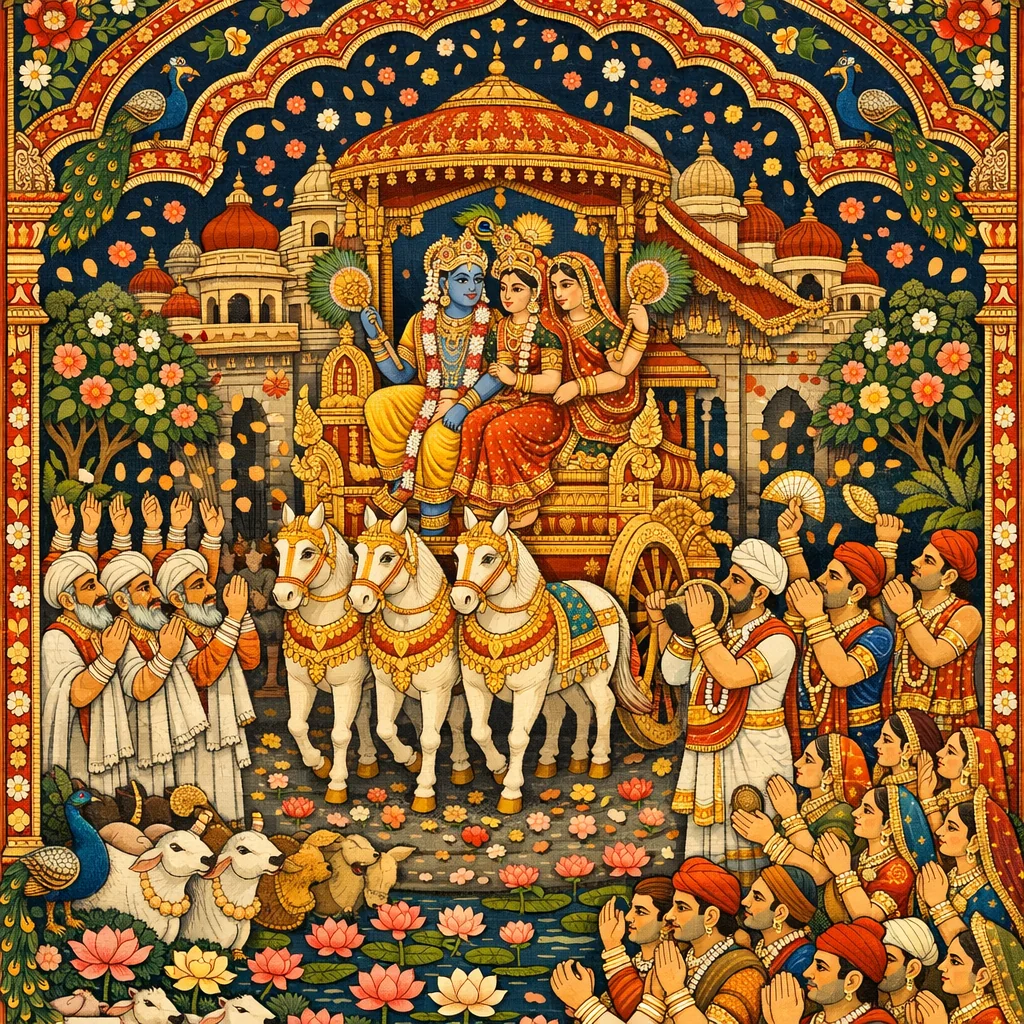
Adhyaya 71
Uddhava’s Counsel: The Jarāsandha Resolution and Kṛṣṇa’s Arrival at Indraprastha
After Nārada’s counsel and the Yadus’ deliberations, Uddhava proposes a decisive plan that both enables Yudhiṣṭhira’s Rājasūya and frees the imprisoned kings: Jarāsandha must be confronted. He explains that Jarāsandha’s power makes ordinary war costly, but his vow never to refuse brāhmaṇas provides a dharmic “entry”: Bhīma should go disguised as a brāhmaṇa and secure a single combat, with Śrī Kṛṣṇa’s presence ensuring victory. Uddhava presents the result as political necessity and divine providence, noting that even cosmic rulers act as instruments of the Lord’s kāla aspect. Kṛṣṇa gains unanimous approval, prepares a grand departure with queens, retinue, and military divisions, reassures the messenger of the captive kings, and travels to Indraprastha. There the Pāṇḍavas and citizens welcome Him with Vedic chants, music, and ecstatic embraces. The chapter ends by placing the visit within the larger movement toward the Rājasūya: Kṛṣṇa’s stay strengthens alliances and foreshadows Jarāsandha’s fall and the unfolding sacrifice.
Shlokas
Verse 1
श्रीशुक उवाच इत्युदीरितमाकर्ण्य देवर्षेरुद्धवोऽब्रवीत् । सभ्यानां मतमाज्ञाय कृष्णस्य च महामति: ॥ १ ॥
Śukadeva Gosvāmī said: Having thus heard Devarṣi Nārada’s words, and understanding both the assembly’s view and Lord Kṛṣṇa’s intention, the great-minded Uddhava began to speak.
Verse 2
श्रीउद्धव उवाच यदुक्तमृषिना देव साचिव्यं यक्ष्यतस्त्वया । कार्यं पैतृष्वस्रेयस्य रक्षा च शरणैषिणाम् ॥ २ ॥
Śrī Uddhava said: O Lord, as the sage has advised, You should assist Your cousin in fulfilling his plan to perform the Rājasūya sacrifice, and You should also protect the kings who beg shelter at Your feet.
Verse 3
यष्टव्यं राजसूयेन दिक्चक्रजयिना विभो । अतो जरासुतजय उभयार्थो मतो मम ॥ ३ ॥
O almighty one, only he who has conquered opponents in every direction can perform the Rājasūya sacrifice. Therefore, in my opinion, defeating Jarāsandha will accomplish both aims.
Verse 4
अस्माकं च महानर्थो ह्येतेनैव भविष्यति । यशश्च तव गोविन्द राज्ञो बद्धान् विमुञ्चत: ॥ ४ ॥
By this decision there will be great gain for us, and You will free the kings held in bondage. Thus, O Govinda, Your glory will be magnified.
Verse 5
स वै दुर्विषहो राजा नागायुतसमो बले । बलिनामपि चान्येषां भीमं समबलं विना ॥ ५ ॥
The invincible King Jarāsandha is as strong as ten thousand elephants. Even other mighty warriors cannot defeat him; only Bhīma is equal to him in strength.
Verse 6
द्वैरथे स तु जेतव्यो मा शताक्षौहिणीयुत: । ब्राह्मण्योऽभ्यर्थितो विप्रैर्न प्रत्याख्याति कर्हिचित् ॥ ६ ॥
He should be defeated in a single-chariot duel, not when he is backed by his hundred military divisions. Moreover, Jarāsandha is devoted to brahminical dharma and never refuses a request from brāhmaṇas.
Verse 7
ब्रह्मवेषधरो गत्वा तं भिक्षेत वृकोदर: । हनिष्यति न सन्देहो द्वैरथे तव सन्निधौ ॥ ७ ॥
Let Bhīma go to him disguised as a brāhmaṇa and beg alms. In this way he will gain single combat with Jarāsandha, and in Your presence Bhīma will surely slay him.
Verse 8
निमित्तं परमीशस्य विश्वसर्गनिरोधयो: । हिरण्यगर्भ: शर्वश्च कालस्यारूपिणस्तव ॥ ८ ॥
O Supreme Lord, in the creation and dissolution of the universe even Brahmā and Śiva serve only as Your instruments; ultimately all is accomplished by You in Your unseen aspect as Time.
Verse 9
गायन्ति ते विशदकर्म गृहेषु देव्यो राज्ञां स्वशत्रुवधमात्मविमोक्षणं च । गोप्यश्च कुञ्जरपतेर्जनकात्मजाया: पित्रोश्च लब्धशरणा मुनयो वयं च ॥ ९ ॥
In their homes, the virtuous wives of the imprisoned kings sing of Your pure and noble deeds—that You will slay their husbands’ enemy and deliver them. The gopīs too sing Your glory: how You destroyed the foe of Gajendra, the foe of Sītā, Janaka’s daughter, and even the foes of Your own parents. So do the sages who have taken shelter of You, and so do we.
Verse 10
जरासन्धवध: कृष्ण भूर्यर्थायोपकल्पते । प्राय: पाकविपाकेन तव चाभिमत: क्रतु: ॥ १० ॥
O Kṛṣṇa, the slaying of Jarāsandha will bring immense benefit. It is surely the ripened reaction of his former sins, and by it the sacrifice You desire will become possible.
Verse 11
श्रीशुक उवाच इत्युद्धववचो राजन् सर्वतोभद्रमच्युतम् । देवर्षिर्यदुवृद्धाश्च कृष्णश्च प्रत्यपूजयन् ॥ ११ ॥
Śukadeva said: O King, Uddhava’s proposal—wholly auspicious and unfailing—was welcomed by Devarṣi Nārada, the elders of the Yadu dynasty, and Lord Kṛṣṇa Himself.
Verse 12
अथादिशत् प्रयाणाय भगवान् देवकीसुत: । भृत्यान् दारुकजैत्रादीननुज्ञाप्य गुरून् विभु: ॥ १२ ॥
Then Bhagavān, the son of Devakī, gave the order to depart. Having respectfully sought permission from His elders, the all-powerful Lord instructed His servants, led by Dāruka and Jaitra, to make ready for the journey.
Verse 13
निर्गमय्यावरोधान्स्वान् ससुतान्सपरिच्छदान् । सङ्कर्षणमनुज्ञाप्य यदुराजं च शत्रुहन् । सूतोपनीतं स्वरथमारुहद् गरुडध्वजम् ॥ १३ ॥
O slayer of enemies, after arranging the departure of His wives with their children and baggage, Lord Kṛṣṇa took leave of Lord Saṅkarṣaṇa and King Ugrasena, and then mounted His chariot brought by His driver, bearing the banner of Garuḍa.
Verse 14
ततो रथद्विपभटसादिनायकै: करालया परिवृत आत्मसेनया । मृदङ्गभेर्यानकशङ्खगोमुखै: प्रघोषघोषितककुभो निरक्रमत् ॥ १४ ॥
Then Lord Kṛṣṇa set out, surrounded on every side by His fierce personal guard and accompanied by the commanders of His chariot, elephant, infantry, and cavalry divisions. The sky in all directions resounded with the booming of mṛdaṅgas, bherīs, kettledrums, conchshells, and gomukhas.
Verse 15
नृवाजिकाञ्चनशिबिकाभिरच्युतं सहात्मजा: पतिमनु सुव्रता ययु: । वराम्बराभरणविलेपनस्रज: सुसंवृता नृभिरसिचर्मपाणिभि: ॥ १५ ॥
Lord Acyuta’s faithful queens, together with their children, followed their Lord on golden palanquins carried by powerful men. Adorned with fine garments, ornaments, fragrant oils, and flower garlands, they were guarded on all sides by soldiers holding swords and shields.
Verse 16
नरोष्ट्रगोमहिषखराश्वतर्यन:- करेणुभि: परिजनवारयोषित: । स्वलङ्कृता: कटकुटिकम्बलाम्बरा- द्युपस्करा ययुरधियुज्य सर्वत: ॥ १६ ॥
On every side proceeded the finely adorned women attendants of the royal household, along with courtesans. They traveled on palanquins and on camels, bulls and buffalo, donkeys, mules, bullock carts, and elephants, their conveyances fully laden with grass tents, blankets, garments, and other supplies for the journey.
Verse 17
बलं बृहद्ध्वजपटछत्रचामरै- र्वरायुधाभरणकिरीटवर्मभि: । दिवांशुभिस्तुमुलरवं बभौ रवे- र्यथार्णव: क्षुभिततिमिङ्गिलोर्मिभि: ॥ १७ ॥
The Lord’s army was adorned with great flagpoles and fluttering banners, royal umbrellas and cāmara fans. By day the sun’s rays flashed upon their fine weapons, ornaments, helmets and armor; amid shouts and clatter the host appeared like an ocean churned by restless waves and timiṅgila fish.
Verse 18
अथो मुनिर्यदुपतिना सभाजित: प्रणम्य तं हृदि विदधद् विहायसा । निशम्य तद्व्यवसितमाहृतार्हणो मुकुन्दसन्दरशननिर्वृतेन्द्रिय: ॥ १८ ॥
Then Nārada Muni, honored by Śrī Kṛṣṇa, the lord of the Yadus, bowed down to Him. The sight of Mukunda fully satisfied all his senses. Having heard the Lord’s resolve and having been worshiped by Him, Nārada placed the Lord firmly within his heart and departed through the sky.
Verse 19
राजदूतमुवाचेदं भगवान् प्रीणयन् गिरा । मा भैष्ट दूत भद्रं वो घातयिष्यामि मागधम् ॥ १९ ॥
With pleasing words the Lord addressed the kings’ messenger: “Do not fear, dear envoy; may auspiciousness be upon you. I shall arrange the slaying of the king of Magadha. Be without anxiety.”
Verse 20
इत्युक्त: प्रस्थितो दूतो यथावदवदन्नृपान् । तेऽपि सन्दर्शनं शौरे: प्रत्यैक्षन् यन्मुमुक्षव: ॥ २० ॥
Thus addressed, the messenger departed and accurately conveyed the Lord’s message to the kings. They too, longing for liberation, waited with eager hope for their audience with Śaurī, Lord Kṛṣṇa.
Verse 21
आनर्तसौवीरमरूंस्तीर्त्वा विनशनं हरि: । गिरीन् नदीरतीयाय पुरग्रामव्रजाकरान् ॥ २१ ॥
As Lord Hari journeyed through Ānarta, Sauvīra, Marudeśa and Vinaśana, He crossed rivers and passed by mountains, cities, villages, cow pastures and stone quarries (ākara).
Verse 22
ततो दृषद्वतीं तीर्त्वा मुकुन्दोऽथ सरस्वतीम् । पञ्चालानथ मत्स्यांश्च शक्रप्रस्थमथागमत् ॥ २२ ॥
Then Mukunda crossed the rivers Dṛṣadvatī and Sarasvatī, passed through Pañcāla and Matsya, and at last arrived in Indraprastha.
Verse 23
तमुपागतमाकर्ण्य प्रीतो दुर्दर्शनं नृणाम् । अजातशत्रुर्निरगात् सोपध्याय: सुहृद्वृत: ॥ २३ ॥
Hearing that the Lord—so rarely seen by mortals—had arrived, King Yudhiṣṭhira (Ajātaśatru) rejoiced; accompanied by his priests and dear companions, he came out to welcome Śrī Kṛṣṇa.
Verse 24
गीतवादित्रघोषेण ब्रह्मघोषेण भूयसा । अभ्ययात्स हृषीकेशं प्राणा: प्राणमिवादृत: ॥ २४ ॥
Amid the sound of songs and instruments, and even more the mighty chanting of Vedic hymns, the King went forth with deep reverence to meet Lord Hṛṣīkeśa, as the senses move toward the very breath of life—consciousness.
Verse 25
दृष्ट्वा विक्लिन्नहृदय: कृष्णं स्नेहेन पाण्डव: । चिराद् दृष्टं प्रियतमं सस्वजेऽथ पुन: पुन: ॥ २५ ॥
Seeing Śrī Kṛṣṇa, his dearmost friend, after so long a separation, Yudhiṣṭhira’s heart melted with affection, and he embraced the Lord again and again.
Verse 26
दोर्भ्यां परिष्वज्य रमामलालयं मुकुन्दगात्रं नृपतिर्हताशुभ: । लेभे परां निर्वृतिमश्रुलोचनो हृष्यत्तनुर्विस्मृतलोकविभ्रम: ॥ २६ ॥
Embracing with both arms Mukunda’s divine body—the eternal abode of Goddess Śrī—the King was freed of all impurity. Tears filled his eyes, his body trembled in ecstasy, and he tasted the highest bliss, forgetting entirely the delusion of this world.
Verse 27
तं मातुलेयं परिरभ्य निर्वृतो भीम: स्मयन् प्रेमजलाकुलेन्द्रिय: । यमौ किरीटी च सुहृत्तमं मुदा प्रवृद्धबाष्पा: परिरेभिरेऽच्युतम् ॥ २७ ॥
Then Bhīma, his eyes brimming with tears of love, laughed in joy as he embraced his maternal cousin, Śrī Kṛṣṇa. Arjuna and the twins, Nakula and Sahadeva, also gladly embraced their dearmost friend—the infallible Lord Acyuta—and wept profusely.
Verse 28
अर्जुनेन परिष्वक्तो यमाभ्यामभिवादित: । ब्राह्मणेभ्यो नमस्कृत्य वृद्धेभ्यश्च यथार्हत: । मानिनो मानयामास कुरुसृञ्जयकैकयान् ॥ २८ ॥
After Arjuna embraced Him again and Nakula and Sahadeva offered their obeisances, Lord Śrī Kṛṣṇa bowed properly to the brāhmaṇas and elders present. Thus He honored the venerable members of the Kuru, Sṛñjaya, and Kaikaya clans.
Verse 29
सूतमागधगन्धर्वा वन्दिनश्चोपमन्त्रिण: । मृदङ्गशङ्खपटहवीणापणवगोमुखै: । ब्राह्मणाश्चारविन्दाक्षं तुष्टुवुर्ननृतुर्जगु: ॥ २९ ॥
Sūtas, Māgadhas, Gandharvas, panegyrists, jesters, and brāhmaṇas all glorified the lotus-eyed Lord—some reciting prayers, some dancing and singing—while mṛdaṅgas, conchshells, kettledrums, vīṇās, paṇavas, and gomukhas resounded.
Verse 30
एवं सुहृद्भि: पर्यस्त: पुण्यश्लोकशिखामणि: । संस्तूयमानो भगवान् विवेशालङ्कृतं पुरम् ॥ ३० ॥
Thus surrounded by His well-wishing relatives and praised on all sides, Lord Kṛṣṇa—the crest jewel of holy renown—entered the decorated city.
Verse 31
संसिक्तवर्त्म करिणां मदगन्धतोयै- श्चित्रध्वजै: कनकतोरणपूर्णकुम्भै: । मृष्टात्मभिर्नवदुकूलविभूषणस्रग्- गन्धैर्नृभिर्युवतिभिश्च विराजमानम् ॥ ३१ ॥ उद्दीप्तदीपबलिभि: प्रतिसद्मजाल- निर्यातधूपरुचिरं विलसत्पताकम् । मूर्धन्यहेमकलशै रजतोरुशृङ्गै- र्जुष्टं ददर्श भवनै: कुरुराजधाम ॥ ३२ ॥
The roads of Indraprastha were sprinkled with fragrant water, scented by the liquid flowing from elephants’ foreheads; colorful flags, golden gateways, and brimming waterpots heightened the city’s splendor. Men and young maidens shone in fine new garments, adorned with ornaments and flower garlands, anointed with aromatic sandalwood paste. In every home lamps blazed and respectful offerings were set out; incense drifted from latticed windows, further beautifying the scene. Banners waved, and the rooftops were crowned with golden domes upon broad silver bases and lofty finials. Thus Lord Śrī Kṛṣṇa beheld the royal city of the King of the Kurus.
Verse 32
संसिक्तवर्त्म करिणां मदगन्धतोयै- श्चित्रध्वजै: कनकतोरणपूर्णकुम्भै: । मृष्टात्मभिर्नवदुकूलविभूषणस्रग्- गन्धैर्नृभिर्युवतिभिश्च विराजमानम् ॥ ३१ ॥ उद्दीप्तदीपबलिभि: प्रतिसद्मजाल- निर्यातधूपरुचिरं विलसत्पताकम् । मूर्धन्यहेमकलशै रजतोरुशृङ्गै- र्जुष्टं ददर्श भवनै: कुरुराजधाम ॥ ३२ ॥
The roads of Indraprastha were sprinkled with fragrant water scented by the ichor flowing from elephants’ foreheads, and the city’s splendor was heightened by colorful flags, golden gateways, and brimming waterpots. Men and young girls shone in fine new garments, adorned with ornaments and flower garlands, and anointed with sandalwood fragrance. In every home lamps blazed and respectful offerings were set out, while incense drifted through latticed windows, beautifying all the more. Banners waved, and the rooftops were crowned with golden domes upon broad silver bases. Thus Lord Śrī Kṛṣṇa beheld the royal city of the Kuru king.
Verse 33
प्राप्तं निशम्य नरलोचनपानपात्र- मौत्सुक्यविश्लथितकेशदुकूलबन्धा: । सद्यो विसृज्य गृहकर्म पतींश्च तल्पे द्रष्टुं ययुर्युवतय: स्म नरेन्द्रमार्गे ॥ ३३ ॥
When the city’s young women heard that Lord Śrī Kṛṣṇa—the nectar of delight for human eyes—had arrived, they hurried to the royal road to see Him. At once they cast aside their household duties and even left their husbands in bed, and in their eagerness the knots of their hair and garments came loose.
Verse 34
तस्मिन् सुसङ्कुल इभाश्वरथद्विपद्भि: कृष्णं सभार्यमुपलभ्य गृहाधिरूढा: । नार्यो विकीर्य कुसुमैर्मनसोपगुह्य सुस्वागतं विदधुरुत्स्मयवीक्षितेन ॥ ३४ ॥
With the royal road crowded by elephants, horses, chariots, and foot soldiers, the city women climbed to their rooftops and from there caught sight of Lord Śrī Kṛṣṇa together with His queens. They showered the Lord with flowers, embraced Him within their hearts, and offered heartfelt welcome through broad, smiling glances.
Verse 35
ऊचु: स्त्रिय: पथि निरीक्ष्य मुकुन्दपत्नी- स्तारा यथोडुपसहा: किमकार्यमूभि: । यच्चक्षुषां पुरुषमौलिरुदारहास- लीलावलोककलयोत्सवमातनोति ॥ ३५ ॥
Seeing Mukunda’s wives upon the road like stars accompanying the moon, the women exclaimed, “What have these ladies done, that the crest-jewel of men grants their eyes a festival of joy through His generous smiles and His playful sidelong glances?”
Verse 36
तत्र तत्रोपसङ्गम्य पौरा मङ्गलपाणय: । चक्रु: सपर्यां कृष्णाय श्रेणीमुख्या हतैनस: ॥ ३६ ॥
In various places the citizens came forward holding auspicious offerings for Lord Śrī Kṛṣṇa and rendered worshipful service to Him. The sinless leaders of the occupational guilds also stepped forth to adore the Lord.
Verse 37
अन्त:पुरजनै: प्रीत्या मुकुन्द: फुल्ललोचनै: । ससम्भ्रमैरभ्युपेत: प्राविशद् राजमन्दिरम् ॥ ३७ ॥
With eyes wide in joy, the members of the royal household hurried forward in loving reverence to greet Lord Mukunda, and thus the Lord entered the royal palace.
Verse 38
पृथा विलोक्य भ्रात्रेयं कृष्णं त्रिभुवनेश्वरम् । प्रीतात्मोत्थाय पर्यङ्कात् सस्नुषा परिषस्वजे ॥ ३८ ॥
When Queen Pṛthā saw her nephew Kṛṣṇa, the Lord of the three worlds, her heart overflowed with love. Rising from her couch with her daughter-in-law, she embraced the Lord.
Verse 39
गोविन्दं गृहमानीय देवदेवेशमादृत: । पूजायां नाविदत्कृत्यं प्रमोदोपहतो नृप: ॥ ३९ ॥
King Yudhiṣṭhira respectfully brought Lord Govinda, the God of gods, into his private quarters. Overwhelmed with joy, the King could not recall all the proper rites of worship.
Verse 40
पितृष्वसुर्गुरुस्त्रीणां कृष्णश्चक्रेऽभिवादनम् । स्वयं च कृष्णया राजन्भगिन्या चाभिवन्दित: ॥ ४० ॥
O King, Lord Kṛṣṇa bowed to His paternal aunt and to the wives of His elders; then Draupadī and the Lord’s sister bowed down to Him.
Verse 41
श्वश्र्वा सञ्चोदिता कृष्णा कृष्णपत्नीश्च सर्वश: । आनर्च रुक्मिणीं सत्यां भद्रां जाम्बवतीं तथा ॥ ४१ ॥ कालिन्दीं मित्रविन्दां च शैब्यां नाग्नजितीं सतीम् । अन्याश्चाभ्यागता यास्तु वास:स्रङ्मण्डनादिभि: ॥ ४२ ॥
Urged on by her mother-in-law, Draupadī worshiped all of Lord Kṛṣṇa’s queens—Rukmiṇī, Satyabhāmā, Bhadrā, Jāmbavatī, Kālindī, Mitravindā of Śibi’s line, the chaste Nāgnajitī, and the other royal consorts present. She honored them with gifts of garments, flower garlands, ornaments, and more.
Verse 42
श्वश्र्वा सञ्चोदिता कृष्णा कृष्णपत्नीश्च सर्वश: । आनर्च रुक्मिणीं सत्यां भद्रां जाम्बवतीं तथा ॥ ४१ ॥ कालिन्दीं मित्रविन्दां च शैब्यां नाग्नजितीं सतीम् । अन्याश्चाभ्यागता यास्तु वास:स्रङ्मण्डनादिभि: ॥ ४२ ॥
Urged on by her mother-in-law, Draupadī devoutly worshiped all of Lord Śrī Kṛṣṇa’s queens—Rukmiṇī, Satyabhāmā, Bhadrā, Jāmbavatī, Kāлиндī, Mitravindā of Śibi’s line, the chaste Nāgnajitī, and the other royal consorts present—honoring them with gifts of garments, flower garlands, ornaments, and the like.
Verse 43
सुखं निवासयामास धर्मराजो जनार्दनम् । ससैन्यं सानुगामत्यं सभार्यं च नवं नवम् ॥ ४३ ॥
Dharmarāja Yudhiṣṭhira comfortably settled Janārdana Śrī Kṛṣṇa along with all who accompanied Him—His queens, soldiers, ministers, and attendants—and, as long as He stayed as the Pāṇḍavas’ guest, arranged each day’s reception with ever-new refinements.
Verse 44
तर्पयित्वा खाण्डवेन वह्निं फाल्गुनसंयुत: । मोचयित्वा मयं येन राज्ञे दिव्या सभा कृता ॥ ४४ ॥ उवास कतिचिन्मासान् राज्ञ: प्रियचिकीर्षया । विहरन् रथमारुह्य फाल्गुनेन भटैर्वृत: ॥ ४५ ॥
Wishing to please King Yudhiṣṭhira, the Lord stayed in Indraprastha for several months. During that time, with Phālguna (Arjuna) He satisfied the fire-god by offering the Khāṇḍava forest, and He rescued Maya Dānava, who then built the king a celestial assembly hall. The Lord also rode out with Arjuna upon His chariot, surrounded by an escort of soldiers.
Verse 45
तर्पयित्वा खाण्डवेन वह्निं फाल्गुनसंयुत: । मोचयित्वा मयं येन राज्ञे दिव्या सभा कृता ॥ ४४ ॥ उवास कतिचिन्मासान् राज्ञ: प्रियचिकीर्षया । विहरन् रथमारुह्य फाल्गुनेन भटैर्वृत: ॥ ४५ ॥
Wishing to please King Yudhiṣṭhira, the Lord stayed in Indraprastha for several months. During that time, with Phālguna (Arjuna) He satisfied the fire-god by offering the Khāṇḍava forest, and He rescued Maya Dānava, who then built the king a celestial assembly hall. The Lord also rode out with Arjuna upon His chariot, surrounded by an escort of soldiers.
Frequently Asked Questions
Rājasūya requires uncontested sovereignty—one must subdue rival kings in all directions. Jarāsandha is the principal imperial obstacle and also the oppressor imprisoning many kings. Removing him therefore achieves two dharmic ends at once: it clears the political requirement for Rājasūya and fulfills Kṛṣṇa’s role as protector of those seeking shelter. The Bhāgavatam presents this as utaya (divine intervention) harmonized with rāja-dharma (just governance).
Uddhava identifies Jarāsandha’s strong adherence to brāhmaṇa-honor as a binding vow: he will not refuse a brāhmaṇa’s request. By approaching in brāhmaṇa disguise and requesting a boon that results in single combat, Bhīma can avoid confronting Jarāsandha amid massive armies. The episode illustrates a classical Bhāgavatam theme: dharma itself can constrain even a powerful adharmic ruler, and the Lord’s plan uses that constraint without violating righteousness.
Yudhiṣṭhira, his priests, brothers (Bhīma, Arjuna, Nakula, Sahadeva), Kuntī (Pṛthā), Draupadī, elders, and the citizens receive Kṛṣṇa with Vedic hymns, music, offerings, and ecstatic embraces. The text likens the meeting to the senses meeting consciousness—signaling that Kṛṣṇa is Hṛṣīkeśa (master of the senses) and the inner life of all. Yudhiṣṭhira’s purification upon embracing Kṛṣṇa underscores the Bhāgavatam’s principle that contact with the Lord (darśana, saṅga) dissolves material contamination and awakens bliss.