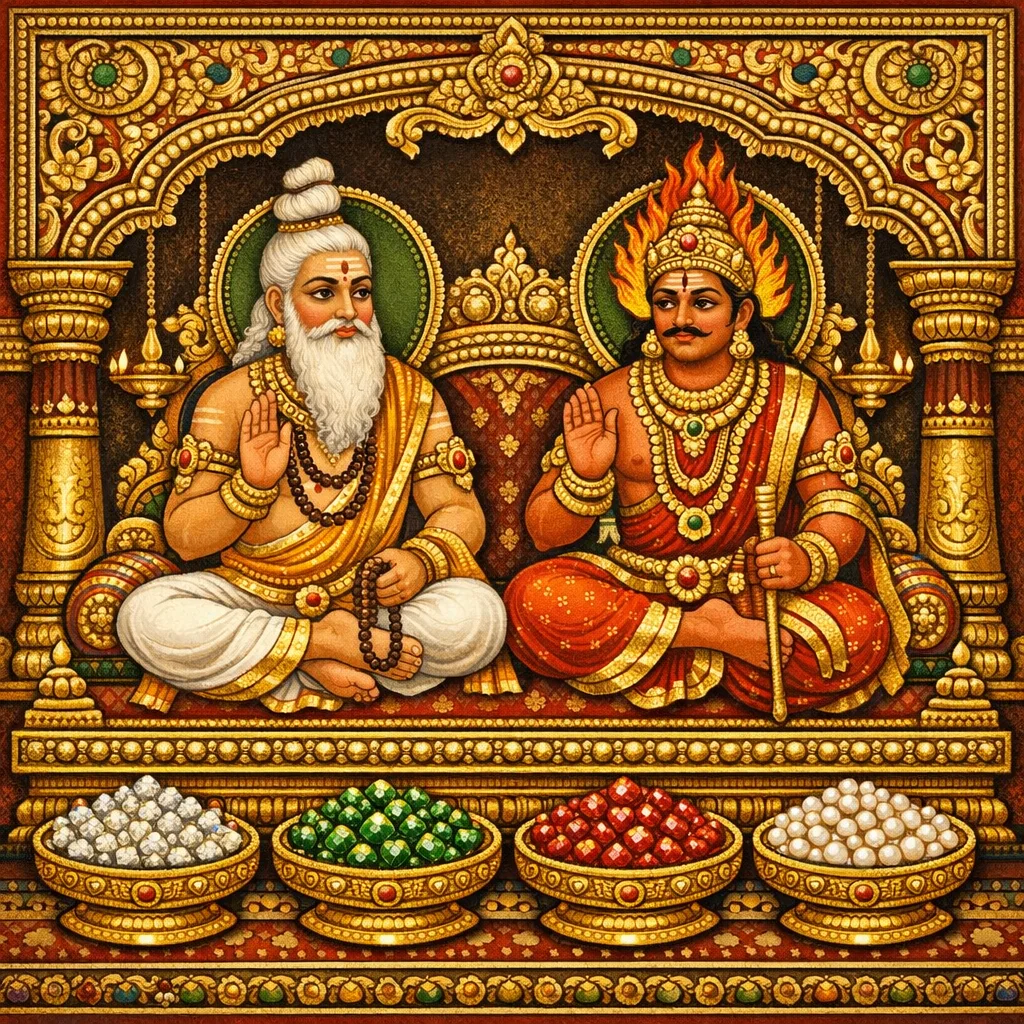
Adhyaya 245
Chapter 245 — रत्नपरीक्षा (Examination of Gems)
Lord Agni sets forth a royal curriculum of Ratna-parīkṣā (gem examination) for kings, treating adornment as a sign of sovereignty and a regulated material culture. The chapter catalogs major gems and substances—diamond, emerald, ruby, pearl, sapphires, cat’s-eye, moonstone, sunstone, crystal, and many named stones and organic/mineral items—useful for courtly appraisal and procurement. It then states the key tests: inner radiance, clarity, and well-formed shape, especially for gems set in gold. Diamonds are emphasized with strict bans on wearing flawed stones (dull, impure, fractured, gritty, or merely “repairable”) and an ideal portrait: hexagonal, rainbow-like, sun-bright, pure, and “unpierceable,” with emerald-like speckling and parrot-wing sheen cited as visual standards. Pearls receive a parallel taxonomy by origin (oyster, conch, tusk, fish, cloud), and their virtues—roundness, luster, clarity, and size—are linked to aesthetics, omens, and royal legitimacy.
Shlokas
Verse 1
इत्य् आग्नेये महापुराणे आयुधलक्षणादिर्नाम चतुश् चत्वारिंशदधिकद्विशततमो ऽध्यायः अथ पञ्चचत्वारिंशदधिकद्विशततमो ऽध्यायः रत्नपरीक्षा अग्निर् उवाच रत्नानां लक्षणं वक्ष्ये रत्नं धार्यमिदं नृपैः वज्रं मरकतं रत्नं पद्मरागञ्च मौक्तिकं
Thus, in the Agni Mahāpurāṇa ends the two-hundred-and-forty-fourth chapter, called “Characteristics of Weapons and Related Topics.” Now begins the two-hundred-and-forty-fifth chapter: “Examination of Gems.” Agni said: “I shall describe the characteristics of gems—gems fit to be worn by kings: the diamond, the emerald, the ruby (padmarāga), and the pearl (mauktika).”
Verse 2
इन्द्रनीलं महानीलं वैदूर्यं गन्धशस्यकं चन्द्रकान्तं सूर्यकान्तं स्फटिकं पुलकं तथा
Enumerated are: Indranīla (sapphire), Mahānīla (a deep-blue sapphire), Vaidūrya (cat’s-eye), Gandhaśasyaka (a fragrant, grass-hued stone), Candrakānta (moonstone), Sūryakānta (sunstone), Sphaṭika (rock-crystal), and likewise Pulaka (a speckled or rough-textured stone).
Verse 3
कर्केतनं पुष्परागं तथा ज्योतीरसं द्विज स्पटिकं राजपट्टञ्च तथा राजमयं शुभं
O twice-born one, these too are named: karketana (a red gem), puṣparāga (topaz), and also jyotīrasa; likewise sphaṭika (crystal), rājapaṭṭa, and the auspicious rājamaya.
Verse 4
सौगन्धिकं तथा गञ्जं शङ्खब्रह्ममयं तथा गोमेदं रुधिराक्षञ्च तथा भल्लातकं द्विज
“One should also consider saugandhika, as well as gañja; and likewise substances derived from the conch (śaṅkha) and those termed ‘brahma-maya’; also gomeda (hessonite), rudhirākṣa (a red-seeded bead), and likewise bhallātaka (marking-nut), O twice-born one.”
Verse 5
धूलीं मरकतञ्चैव तुथकं सीसमेव च पीलुं प्रवालकञ्चैव गिरिवज्रं द्विजोत्तम
O best of the twice-born, one should also recognize: dhūlī (fine dust or powder), emerald, tuthaka (blue vitriol), lead, pīlu, coral (pravāla), and girivajra (a hard mineral substance, “mountain-diamond”).
Verse 6
भुजङ्गममणिञ्चैव तथा वज्रमणिं शुभं टिट्टिभञ्च तथा पिण्डं भ्रामरञ्च तथोत्पलं
Also (are named) the Serpent-gem, and likewise the auspicious Vajra-gem; further, (the gems/amulets called) Ṭiṭṭibha, Piṇḍa, Bhrāmara, and also Utpala.
Verse 7
सुवर्णप्रतिबद्धानि रत्नानि श्रीजयादिके अन्तःप्रभत्वं वैमल्यं सुसंस्थानत्वमेव च
Gems that are set in gold—such as the Śrī, Jaya, and related types—should possess inner radiance, clarity (freedom from blemish), and well-formed proportions.
Verse 8
सुधार्या नैव धार्यास्तु निष्प्रभा मलिनास् तथा खण्डाः सशर्करा ये च प्रशस्तं वज्रधरणम्
Diamonds that are (merely) repairable should not be worn; likewise those that are lusterless, impure, fractured, or gritty (containing sandy granules). Wearing a commendable (faultless) diamond alone is approved.
Verse 9
अम्भस्तरति यद्वज्रमभेद्यं विमलं च यत् षट्कोणं शक्रचापाभं लघु चार्कनिभं शुभम्
That (sacred figure) is called the Vajra: it ‘crosses over the waters’, is unpierceable and pure; it is hexagonal, resembles Indra’s bow (the rainbow), is light, sun-like in radiance, and auspicious.
Verse 10
शुकपक्षनिभः स्निग्धः कान्तिमान्विमलस् तथा स्वर्णचूर्णनिभैः सूक्ष्मैर् मरकतश् च विन्दुभिः
It should resemble a parrot’s wing, be glossy, lustrous, and free from blemish; and it should also have tiny specks like gold-dust, along with emerald-like dots.
Verse 11
स्फटिकजाः पद्मरागाः स्यू रागवन्तो ऽतिनिर्मलाः जातवङ्गा भवन्तीह कुरुविन्दसमुद्भवाः
Padmarāga gems arising from sphaṭika (crystal) are richly coloured and exceedingly pure; here, those produced from kuruvinda are known as jātavaṅga.
Verse 12
सौगन्धिकोत्था काषाया मुक्ताफलास्तु शुक्तिजाः विमलास्तेभ्य उत्कृष्टा ये च शङ्खोद्भवा मुने
Pearls (muktāphala) arising from the saugandhika source are tawny-brown; yet pearls are also produced from śukti, the oyster shell. Those that are clear are superior to the rest—and, O sage, the finest are said to arise from the śaṅkha (conch-shell).
Verse 13
नागदन्तभवाश्चाग्र्याः कुम्भशूकरमत्स्यजाः वेणुनागभवाः श्रेष्ठा मौक्तिकं मेघजं वरं
Pearls arising from elephant tusks (nāgadanta) are foremost; those produced from the kumbha-fish, the boar, and fish are also recognized. Those originating from veṇunāga are the best; and the pearl born of clouds is excellent.
Verse 14
वृत्तत्वं शुक्रता स्वाच्छ्यंमहत्त्वं मौक्तिके गुणाः इन्द्रनीलं शुभं क्षीरे राजते भ्राजते ऽधिकं
Roundness, lustre, clarity, and largeness—these are the virtues of a pearl. A fine indranīla (sapphire) is auspicious; when placed in milk, it shines and gleams all the more.
Verse 15
रञ्जयेत् स्वप्रभावेण तममूल्यं विनिर्दिशेत् नीलरक्तन्तु वैदूर्यं श्रेष्ठं हारादिकं भजेत्
A gem’s value should be judged by how, through its own inherent brilliance, it takes on lustre and reveals colour, and thus its price is to be determined. Among vaidūrya (cat’s-eye stones), the blue and reddish varieties are held to be the finest and are fit for necklaces and similar ornaments.
Frequently Asked Questions
A structured rubric for gem quality: radiance (antaḥprabhā), clarity (vaimalya), proper form (susaṃsthāna), explicit diamond disqualifiers (fractures/grit/dullness), and pearl virtues (roundness, luster, clarity, size) plus origin-based grading.
It disciplines royal consumption: gems are not mere luxury but regulated symbols of authority, to be chosen by purity and auspicious qualities, aligning wealth-management with Dharma and social order.