Adhyaya 234
Prātyahika-Rāja-Karma (Daily Duties of a King)
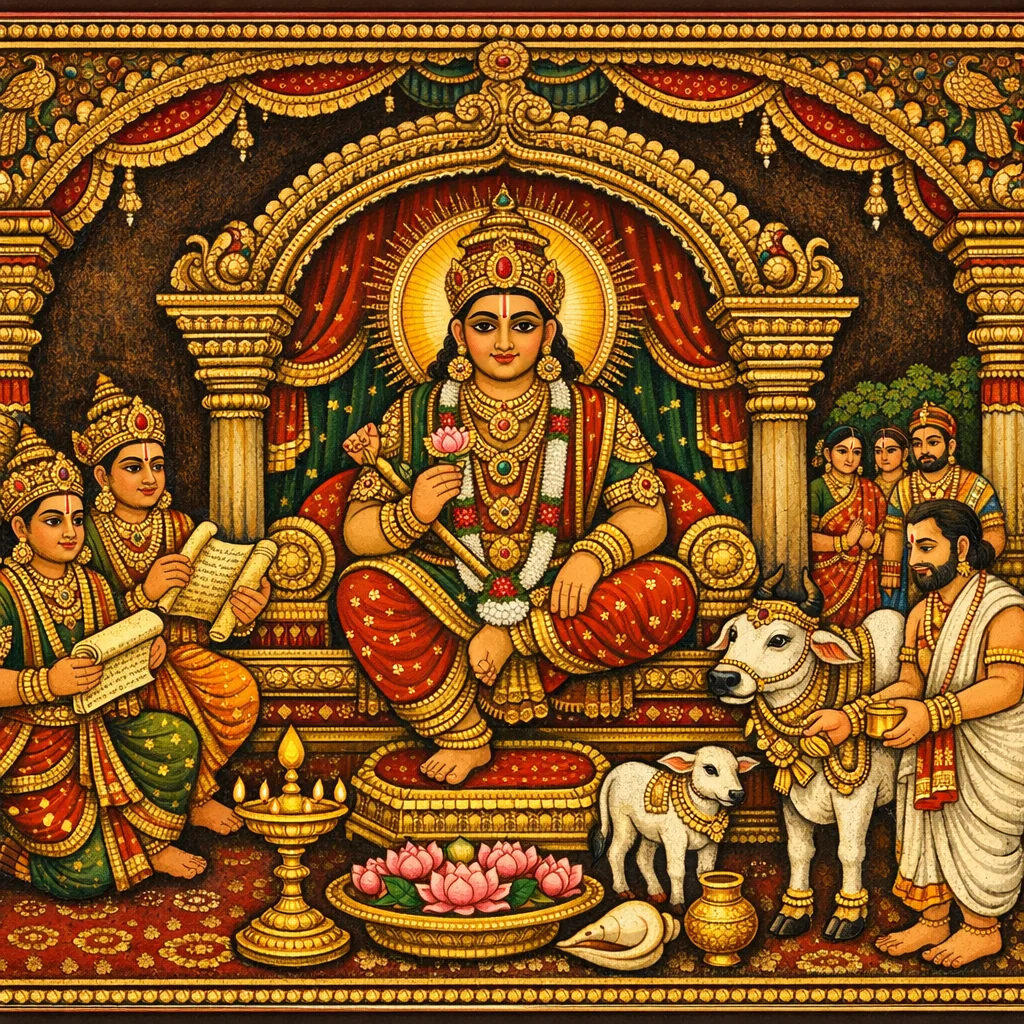
This chapter sets forth the king’s ideal daily regimen, portraying rājadharma as a disciplined union of personal purity, sacred observance, administrative scrutiny, and strategic discretion. Rising before dawn, the king checks for hidden or disguised persons amid ceremonial sounds, then first reviews revenue and expenditure, placing fiscal accountability at the head of governance. After purification and bathing, he performs sandhyā, japa, worship of Vāsudeva, fire-offerings, and ancestral libations, followed by charitable gifts to brāhmaṇas, grounding royal authority in ritual legitimacy and generosity. He then tends to health (medicine as prescribed by the physician), receives the guru’s blessing, and enters the assembly to meet brāhmaṇas, ministers, and leading representatives, deciding cases by precedent and counsel. The text stresses guarding the secrecy of counsel (mantra-rakṣā), avoiding both excessive solitude and excessive publicity, and reading subtle signs (ākāra/īṅgita) that may leak strategy. The day also includes military inspection and training (vehicles and weapons), careful food security, evening sandhyā, deliberation, deployment of spies, and guarded movement within the inner quarters—depicting kingship as continuous vigilance governed by dharma.
Shlokas
Verse 1
इत्य् आग्नेये महापुराणे उपायषड्गुणादिर्नाम त्रयस्त्रिंशदधिकद्विशततमो ऽध्यायः अथ चतुस्त्रिंशदधिकद्विशततमो ऽध्यायः प्रात्यहिकराजकर्म पुष्कर उवाच अजस्रं कर्म वक्ष्यामि दिनं प्रति यदाचरेत् द्विमुहूर्तावशेषायां रात्रौ निद्रान्त्यजेन्नृपः
Thus, in the Agni Mahāpurāṇa ends the two-hundred-and-thirty-third chapter, called “Upāya and the Six Measures (Ṣaḍguṇa), etc.” Now begins the two-hundred-and-thirty-fourth chapter: “Daily Duties of a King.” Puṣkara said: “I shall describe the constant routine—what a king should practice each day. When two muhūrtas of the night remain, the king should abandon sleep, that is, rise from his bed.”
Verse 2
वाद्यवन्दिस्वनैर् गीतैः पश्येद् गूढांस्ततो नरान् विज्ञायते न ये लोकास्तदीया इति केनचित्
By the sounds of musical instruments, the proclamations of bards, and by songs, one should discern men who are in disguise; for no one recognizes the people to whom they belong as “they are of that side/realm.”
Verse 3
आयव्ययस्य श्रवणं ततः कार्यं यथाविधि वेगोत्सर्गं ततः कृत्वा राजा स्नानगृहं व्रजेत्
Thereafter, the king should duly listen—according to proper procedure—to the account of revenue and expenditure; then, having attended to the necessary bodily evacuation, he should proceed to the bathing chamber.
Verse 4
स्नानं कुर्यान्नृपः पश्चाद्दन्तधावनपूर्वकं कृत्वा सन्ध्यान्ततो जप्यं वासुदेवं प्रपूजयेत्
Afterwards, the king should bathe; having first cleansed the teeth, he should then perform the Sandhyā rite, recite the prescribed japa, and worship Vāsudeva with due reverence.
Verse 5
वह्नौ पवित्रान् जुहुयात् तर्पयेदुदकैः पितॄन् बहुक्षयव्ययायामिति ख , छ , ट च आसीनः कर्मविच्छेदमित्यादिः, राजा समाश्रयेदित्यन्तः पाठः ज पुस्तके नास्ति दद्यात्सकाञ्चीं धेनुं द्विजाशीर्वादसंयुतः
He should offer purifying substances as oblations into the sacred fire, and he should satisfy the Pitṛs (ancestral spirits) with libations of water. (Some recensions add variant readings such as “in a time of great loss and expenditure …”; some also read phrases like “while seated … ‘interruption of rites’ …”; and in one manuscript the ending “the king should take refuge …” is absent.) He should then gift a cow adorned with a waist-belt, accompanied by the blessings of Brahmins.
Verse 6
अनुलिप्तो ऽलङ्कृतश् च मुखं पश्येच्च दर्पणे ससुवर्णे धृते राजा शृणुयाद्दिवसादिकं
Having anointed himself and adorned himself, the king should look at his face in a mirror; and, with gold upon his person or held in hand, he should then hear the day’s auspicious particulars and related calendaric indications.
Verse 7
औषधं भिषजोक्तं च मङ्गलालम्भनञ्चरेत् पश्चेद् गुरुं तेन दत्ताशीर्वदो ऽथ व्रजेत्सभां
He should take the medicine prescribed by the physician and perform the auspicious preliminary rite; thereafter, having approached the teacher and received his blessing, he should then proceed to the assembly.
Verse 8
तत्रस्थो ब्राह्मणान् पश्येदमात्यान्मन्त्रिणस् तथा प्रकृतीश् च महाभाग प्रतीहारनिवेदिताः
Standing there, O illustrious one, he should look upon the brāhmaṇas, the ministers and counsellors, and also the leading representatives of the realm, as they are announced by the chamberlain (door-keeper).
Verse 9
श्रुत्वेतिहासं कार्याणि कार्याणां कार्यनिर्णयम् व्यवहारन्ततः पश्येन्मन्त्रं कुर्यात्तु मन्त्रिभिः
Having heard the precedents (traditional accounts), he should determine the proper decision in matters (of state and disputes); he should examine the case up to its practical conclusion, and then hold counsel together with the ministers.
Verse 10
नैकेन सहितः कुर्यान्न कुर्याद्बहुभिः सह न च मूर्खैर् नचानाप्तैर् गुप्तं न प्रकटं चरेत्
One should not act in the company of a single person, nor should one act together with many; nor should one associate with fools or with the untrustworthy. One should conduct oneself neither by making one’s secrets known nor by living in an ostentatiously public manner.
Verse 11
मन्त्रं स्वधिष्ठितं कुर्याद्येन राष्ट्रं न बाधते आकारग्रहणे राज्ञो मन्त्ररक्षा परा मता
One should keep the royal counsel firmly under one’s own control, so that the kingdom is not harmed. In discerning (and guarding against) the outward signs of the king, the protection of counsel is regarded as paramount.
Verse 12
आकारैर् इङ्गितैः प्रज्ञा मन्त्रं गृह्णन्ति पण्डिताः सांवत्सराणां वैद्यानां मन्त्रिणां वचने रतः
By outward forms and subtle gestures, the wise discern the intended counsel; a learned man should remain attentive to the words of experienced physicians and ministers.
Verse 13
राजा विभूतिमाप्नोति धारयन्ति नृपं हि ते मन्त्रं कृत्वाथ व्यायामञ्चक्रे याने च शस्त्रके
A king attains prosperity and sovereign majesty, for they indeed uphold the ruler. Therefore, having performed the requisite counsel and strategic deliberation, he should undertake physical training—both in chariotry (vehicle-drill) and in the use of weapons.
Verse 14
निःसत्त्वादौ नृपः स्नातः पश्येद्विष्णुं सुपूजितं हुतञ्च पावकं पश्येद्विप्रान् पश्येत्सुपूजितान्
At the outset of the niḥsattva rite, the king—having bathed—should behold Viṣṇu duly worshipped; he should also behold the Fire (Pāvaka) into which oblations have been offered, and he should behold the brāhmaṇas, duly honoured.
Verse 15
गुप्तं चाप्रकटं चरेदिति ग , ज , ट च आकार ग्रहणे राज्ञो मन्त्ररक्षा परा मता इत्य् अस्य स्थाने आकारेङ्गिततत्त्वज्ञः कार्याकार्यविचक्षण इति ट पुस्तकपाठः राजाधिभूतिमाप्नोतीति ज भूषितो भोजनङ्कुर्याद् दानाद्यैः सुपरीक्षितं भुक्त्वा गृहीतताम्बूलो वामपार्श्वेन संस्थितः
He should move about discreetly and without self-display, remaining unobtrusive. In discerning the king’s outward expressions, the safeguarding of counsel is held to be paramount. (In one manuscript recension, in place of this, the reading is: “One who knows the truth of expressions and gestures, and who is discerning regarding what should and should not be done.” Another recension adds: “He attains pre-eminence over the king.”) Adorned appropriately, he should take food that has been thoroughly examined by gifts and other means (that is, by trusted verification); having eaten and taken betel (tāmbūla), he should stand at the king’s left side.
Verse 16
शास्त्राणि चिन्तयेद् दृष्ट्वा योधान् कोष्ठायुधं गृहं अन्वास्य पश्चिमां सन्ध्यां कार्याणि च विचिन्त्य तु
Having inspected the warriors, the armoury or storehouse of weapons, and the household establishment, he should reflect upon the śāstras; and after performing the evening twilight observance (paścimā sandhyā), he should also deliberate upon the matters to be done.
Verse 17
चरान् सम्प्रेष्य भुक्तान्नमन्तःपुरचरो भवेत् वाद्यगीतैर् अक्षितो ऽन्यैर् एवन्नित्यञ्चरेन्नृपः
Having dispatched spies and, after taking his meal, the king should move about within the inner apartments; guarded by instrumental music and song, and by other attendants and measures, the king should thus proceed in his daily routine.
Frequently Asked Questions
Mantra-rakṣā—protecting counsel and strategic intent—supported by disciplined conduct (avoiding extremes of solitude or publicity) and awareness that subtle gestures (ākāra/īṅgita) can reveal policy.
It sequences fiscal review and administrative duties alongside sandhyā, japa, Vāsudeva worship, homa, pitṛ-tarpaṇa, and dāna, presenting political authority as legitimate only when anchored in daily spiritual discipline and ethical responsibility.