Adhyaya 246
Chapter 246 — वास्तुलक्षणम् (Characteristics of Building-sites / Vāstu)
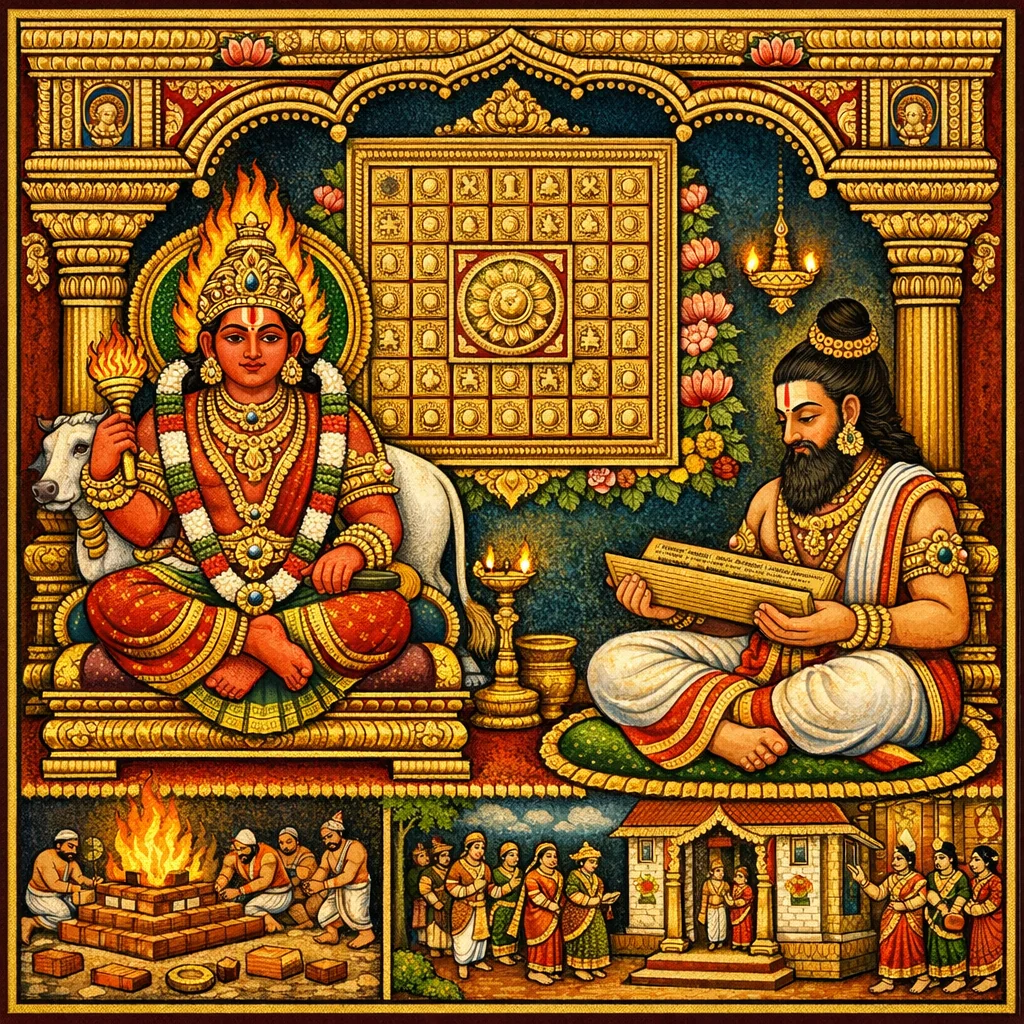
Lord Agni turns from royal arms and wealth to Vāstu-śāstra, the governance of dwelling-space. He first teaches varṇa-appropriate soil colours (white/red/yellow/black) and sensory tests by fragrance and taste as a diagnostic method for selecting land. He then prescribes the ritual sequence—worship with specified grasses, honoring brāhmaṇas, and commencing the excavation rite. The technical heart is the 64-square vāstu-maṇḍala: Brahmā occupies the central four squares, while deities and forces are assigned by directions and corners, including both protective powers and afflictions such as disease and wasting. Consecratory mantra-forms (Nandā, Vāsiṣṭhī, Bhārgavī, Kaśyapī) establish the house as a living sacred field under the lordship of land/city/house. Practical dharma extends to landscape and horticulture—auspicious tree placement by direction, seasonal dwelling guidance, and agronomic remedies (irrigation mixtures, drought care, fruit-drop cures, and species-specific treatments). Thus architecture, ritual, and ecology merge into one dharmic technology of habitation.
Shlokas
Verse 1
इत्य् आग्नेये महापुराणे रत्नपरीक्षा नाम पञ्चचत्वारिंशदधिकद्विशततमो ऽध्यायः अथ षट्चत्वारिंशदधिकद्विशततमो ऽध्यायः वास्तुलक्षणं अग्निर् उवाच वास्तुलक्ष्म प्रवक्ष्यामि विप्रादीनां च भूरिह श्वेता रक्ता तथा पीता कृष्णा चैव यथाक्रमम्
Thus ends, in the Agni Mahāpurāṇa, the two-hundred-and-forty-fifth chapter entitled “Examination of Gems.” Now begins the two-hundred-and-forty-sixth chapter, “Characteristics of Building-sites (Vāstu).” Agni said: “Here I shall set forth in detail the marks of vāstu for brāhmaṇas and the other social classes; the proper ground-colours are, in due order, white, red, yellow, and black.”
Verse 2
घृतरक्तान्नमद्यानां गन्धाढ्या वसतश् च भूः मधुरा च कषाया च अम्लाद्युपरसा क्रमात्
Ghee, blood, cooked food, and intoxicating drink are rich in fragrance; and the earth too, by its very nature, bears scent. As for the secondary tastes (uparasa), they proceed in order beginning with the sour; and among the primary tastes are also the sweet and the astringent.
Verse 3
कुशैः शरैस् तथाकाशैर् दूर्वाभिर्या च संश्रिता प्रार्च्य विप्रांश् च शिःशल्पां खातपूर्वन्तु कल्पयेत्
Having duly worshipped with offerings of kuśa-grass, arrows, the ākāśa-plant, and dūrvā-grass—together with whatever else is prescribed—one should honor the brāhmaṇas, and then arrange the śiḥśalpa rite, beginning with the digging (of the ritual pit or spot).
Verse 4
चतुःषष्टिपदं कृत्वा मध्ये ब्रह्मा चतुष्पदः प्राक् तेषां वै गृहस्वामी कथितस्तु तथार्यमा
Having laid out the sixty-four-square vāstu grid, Brahmā is placed in the middle as occupying four squares; and to the east of these it is taught that the Lord of the house (Gṛhasvāmin) is Aryaman.
Verse 5
दक्षिणेन विवस्वांश् च मित्रः पश्चिमतस् तथा उदङ्महीधरश् चैव आपवत्सौ च वह्निगे
To the south is Vivasvān; likewise to the west is Mitra. To the north is Mahīdhara; and Āpavatsa too belongs to the Fire-quarter (Agni’s direction), O Agni.
Verse 6
सावित्रश् चैव सविता जयेन्द्रौ नैरृते ऽम्बुधौ भ्राजते स्थितमिति छ , ज च भवेदिति ग , घ च रुद्रव्याधी च वायव्ये पूर्वादौ कोणगाद्वहिः
In the south-west (nairṛta) are placed Sāvitra and Savitā, and also Jaya and Indra; there too are Ambudhi (the ocean) and Bhrājate—so it is stated. Likewise, in textual variants it is read as “ja” (in one recension) and “ga/gha” (in others). In the north-west (vāyavya) are Rudra and Vyādhi (Disease). Beginning from the east, these deities are to be set in the diagonal, corner-to-corner sequence.
Verse 7
महेन्द्रश् च रविः सत्यो भृशः पूर्वे ऽथ दक्षिणे गृहक्षतो ऽर्यमधृती गन्धर्वाश्चाथ वारुणे
In the eastern direction are Mahendra, Ravi (the Sun), Satya, and Bhṛśa. Then, in the southern direction are Gṛhakṣata, Aryaman, and Dhṛti; and in the Varuṇa-quarter (the western direction) are the Gandharvas as well.
Verse 8
पुष्पदन्तो ऽसुराश् चैव वरुणो यक्ष एव च सौम्ये भल्लाटसोमौ च अदितिर्धनदस् तथा
Puṣpadanta, the Asuras as well, Varuṇa, and the Yakṣa; also Saumya, Bhallāṭa and Soma; likewise Aditi and Dhanada (Kubera) too.
Verse 9
नागः करग्रहश् चैशे अष्टौ दिशि दिशि स्मृताः आद्यन्तौ तु तयोर्देवौ प्रोक्तावत्र गृहेश्वरौ
In this vāstu arrangement, the Nāga and the Karagraha are remembered as eight—one in each direction. And here, the deities at their beginning and end are declared to be the two presiding lords of the house (Gṛheśvaras).
Verse 10
पर्जन्यः प्रथमो देवो द्वितीयश् च करग्रहः महेन्द्ररविसत्याश् च भृशो ऽथ गगनन्तथा
Parjanya is the first deity; the second is Karagraha. Likewise one should invoke Mahendra, Ravi (the Sun), Satya, then Bhṛśa, and also Gagana (the Sky).
Verse 11
पवनः पूर्वतश् चैव अन्तरीक्षधनेश्वरौ आग्नेये चाथ नैरृत्ये मृगसुग्रीवकौ सुरौ
In the East is stationed Pavana, the Wind-god; in the intermediate quarters are Antarikṣa and Dhaneśvara (Kubera); and in the south-east and south-west are the two deities Mṛga and Sugrīva.
Verse 12
रोगो मुख्यश् च वायव्ये दक्षिणे पुष्पवित्तदौ गृहक्षतो यमभृशौ गन्धर्वो नागपैतृकः
In the north-west are the influences called Roga and Mukhya; in the south are Puṣpa and Vittada. There are also Gṛhakṣata and Yamabhṛśa, and further Gandharva, Nāga, and Paitṛka—these being the named presences assigned in the directional scheme.
Verse 13
आप्ये दौवारिकसुग्रीवौ पुष्पदन्तो ऽसुरो जलं यक्ष्मा रोगश् च शोषश् च उत्तरे नागराजकः
In the watery quarter (āpyā, Varuṇa-related) are stationed the door-guardians Dauvārika and Sugrīva. There are also Puṣpadanta, the Asura, and Jala, the water-element; and there too are Yakṣmā (consumption), Roga (disease), and Śoṣa (wasting). In the northern direction is Nāgarājaka, the serpent-king.
Verse 14
मुख्यो भल्लाटशशिनौ अदितिश् च कुवेरकः नागो हुताशः श्रेष्ठो वै शक्रसूर्यौ च पूर्वतः
Facing the East are to be placed or remembered Mukhyā, Bhallāṭa and Śaśin (the Moon), and also Aditi and Kubera; likewise Nāga, Hutāśa (Agni), Śreṣṭha, and also Śakra (Indra) and Sūrya.
Verse 15
दक्षे गृहक्षतः पुष्प आप्ये सुग्रीव उत्तमः पुष्पदन्तो ह्य् उदग्द्वारि भल्लाटः पुष्पदन्तकः
On the right side is assigned Gṛhakṣata; in the watery quarter is Puṣpa; in Agni’s direction (the south-east) is Sugrīva; in the upper region is Uttama; at the northern doorway is Puṣpadanta; and there are also Bhallāṭa and Puṣpadantaka as associated presences/guardians.
Verse 16
शिलेष्टकादिविन्यासं मन्त्रैः प्रार्च्य सुरांश् चरेत् नन्दे नन्दय वासिष्ठे वसुभिः प्रजया सह
Having arranged the ritual layout beginning with the śileṣṭaka and the other placements, and having first worshipped with mantras, one should then proceed to worship the deities. O Vāsiṣṭha, in the rite called Nandā one should invoke “Nandaya,” together with the Vasus and with progeny—for offspring and prosperity.
Verse 17
भृगुरिति ज नागो हुताशनः श्रेष्ठ इति ख , छ च जये भार्गववदायादे प्रजानाञ्जयमाहवे पूर्णे ऽङ्गिरसदायादे पूर्णकामं कुरुध्व मां
“(He is) called Bhṛgu; (he is) the Nāga; (he is) Hutāśana, the consumer of oblations; (he is) Śreṣṭha, the Best.” In victory, in the Bhārgava lineage; in the begetting and conquering of progeny; in battle for triumph; in fulfillment in the Āṅgirasa lineage—make me one whose desires are completely fulfilled.
Verse 18
भद्रे काश्यपदायादे कुरु भद्रां मतिं मम सर्ववीजसमायुक्ते सर्वरत्नौषधैर् वृते
O Bhadra—heir to Kaśyapa’s lineage—make my intention auspicious. O you endowed with all bīja-mantras, enveloped by all jewels and healing herbs!
Verse 19
रुचिरे नन्दने नन्दे वासिष्ठे रम्यतामिह प्रजापतिसुते देवि चतुरस्रे महीमये
O Radiant One—O Nandā in the delightful Nandana-grove—O Vāsiṣṭhī! May you take pleasure and abide here. O Devī, daughter of Prajāpati, formed of the earth: be established upon this four-sided (square) sacred ground.
Verse 20
सुभगे सुव्रते भद्रे गृहे कश्यपि रम्यतां पूजिते परमाचार्यैर् गन्धमाल्यैर् अलङ्कृते
O auspicious one, of good vows—O gracious Bhadra—may Kaśyapī delight to dwell in this home, consecrated by the worship of the foremost teachers and adorned with fragrant perfumes and garlands.
Verse 21
भवभूतिकरे देवि गृहे भार्गवि रम्यतां अव्यङ्ग्ये चाक्षते पूर्णे मुनेरङ्गिरसः सुते
O Goddess who grants prosperity and well-being—O Bhārgavī—may you abide joyfully in this house. And may this akṣata, the unbroken whole rice-grain, complete in every respect, stand as the auspicious token (offered/placed), O daughter of the sage Aṅgiras.
Verse 22
इष्टके त्वं प्रयच्छेष्टं प्रतिष्टाङ्कारयम्यहं देशस्वामिपुरस्वामिगृहस्वामिपरिग्रहे
O iṣṭakā, consecration-brick, grant the desired boon; I now perform your pratiṣṭhā, your consecratory installation, within the rightful guardianship of the lord of the land, the lord of the city, and the lord of the house.
Verse 23
मनुष्यधनहस्त्यश्वपशुवृद्धिकरी भव गृहप्रवेशे ऽपि तथा शिलान्यासं समाचरेत्
May it become a bestower of increase in people (dependents), wealth, elephants, horses, and livestock. Likewise, when entering a newly built house, one should duly perform the rite of laying the foundation-stone (śilānyāsa) as well.
Verse 24
उत्तरेण शुभः प्लक्षो वटः प्राक् स्याद् गृहादितः उदुम्वरश् च याम्येन पश्चिमे ऽश्वत्थ उत्तमः
To the north, the plakṣa tree is auspicious; to the east of the house should be a vaṭa (banyan); to the south an udumbara; and to the west, the excellent aśvattha (sacred fig).
Verse 25
वामभागे तथोद्यानं कुर्याद्वासं गृहे शुभं सायं प्रातस्तु घर्माप्तौ शीतकाले दिनान्तरे
Likewise, one should make a garden on the left side (of the house). Dwelling in the house is auspicious: in hot weather one should stay there in the evening and in the morning; in the cold season, in the middle of the day.
Verse 26
वर्षारात्रे भुयः शोषे सेक्तव्या रोपितद्रुमाः विडङ्गघृटसंयुक्तान् सेचयेच्छीतवारिणा
On rainy nights, and again when severe drying occurs, newly planted trees should be watered. One should irrigate them with cool water mixed with viḍaṅga and ghee.
Verse 27
फलनाशे कुलत्थैश् च माषैर् मुद्गैस्तिलैर् यवैः विप्राणां जयमावहेति ख गन्धमाल्यैर् अलङ्कृतैर् इति ग , छ च घृतशीतपयःसेकः फलपुष्पाय दर्वदा
When fruits are being destroyed or dropping, one should employ horse-gram, black-gram, green-gram, sesame, and barley, and perform the rite with the utterance, “May victory come to the Brāhmaṇas,” adorned with fragrant substances and garlands. Also, for the sake of fruit and flowers, one should repeatedly perform sprinkling (seka) with ghee and cooled milk, as prescribed.
Verse 28
मत्स्याम्भसा तु सेकेन वृद्धिर्भवति शाखिनः आविकाजसकृच्चूर्णं यवचूर्णं तिलानि च
By irrigating with water in which fish have been kept, the growth of branching trees is promoted. One should also apply powdered sheep/goat dung, barley-flour, and sesame seeds.
Verse 29
गोमांसमुदकञ्चेति सप्तरात्रं निधापयेत् उत्सेकं सर्ववृक्षाणां फलपुष्पादिवृद्धिदं
One should keep a mixture of cow’s meat and water stored for seven nights; that liquid, when used as a drench for all trees, promotes the growth of fruits, flowers, and the like.
Verse 30
मत्स्योदकेन शीतेन आम्राणां सेक इष्यते प्रशस्तं चाप्यशोकानां कामिनीपादताडनं
For mango trees, irrigation with cool “fish-water” is recommended; and for aśoka trees, it is also considered beneficial to be struck or touched by the foot of a beloved woman.
Verse 31
खर्जूरनारिकेलादेर्लवणाद्भिर्विवर्धनं विडङ्गमत्स्यमांसाद्भिः सर्वेषु दोहदं शुभं
For the fulfillment of cravings (dauhṛda) in all cases, dates, coconut, and the like—taken with salty and watery foods—promote increase and nourishment. Likewise, with viḍaṅga, fish, and meat, the satisfaction of cravings is auspicious.
Frequently Asked Questions
The vāstu engineering blueprint: constructing the 64-square maṇḍala with Brahmā in the central four squares, followed by a dense directional devatā-vinyāsa (including protective and disease-related placements), plus prescribed rites (iṣṭakā-pratiṣṭhā, śilānyāsa, gṛhapraveśa) and directional landscaping rules.
It makes dwelling a sādhana: the home is ritually installed as a dharmic microcosm where space, deities, purity, and daily life are harmonized—supporting prosperity, protection, and disciplined living conducive to higher aims.