Adhyaya 235
Raṇadīkṣā (War-Consecration) — Agni Purāṇa Adhyāya 235
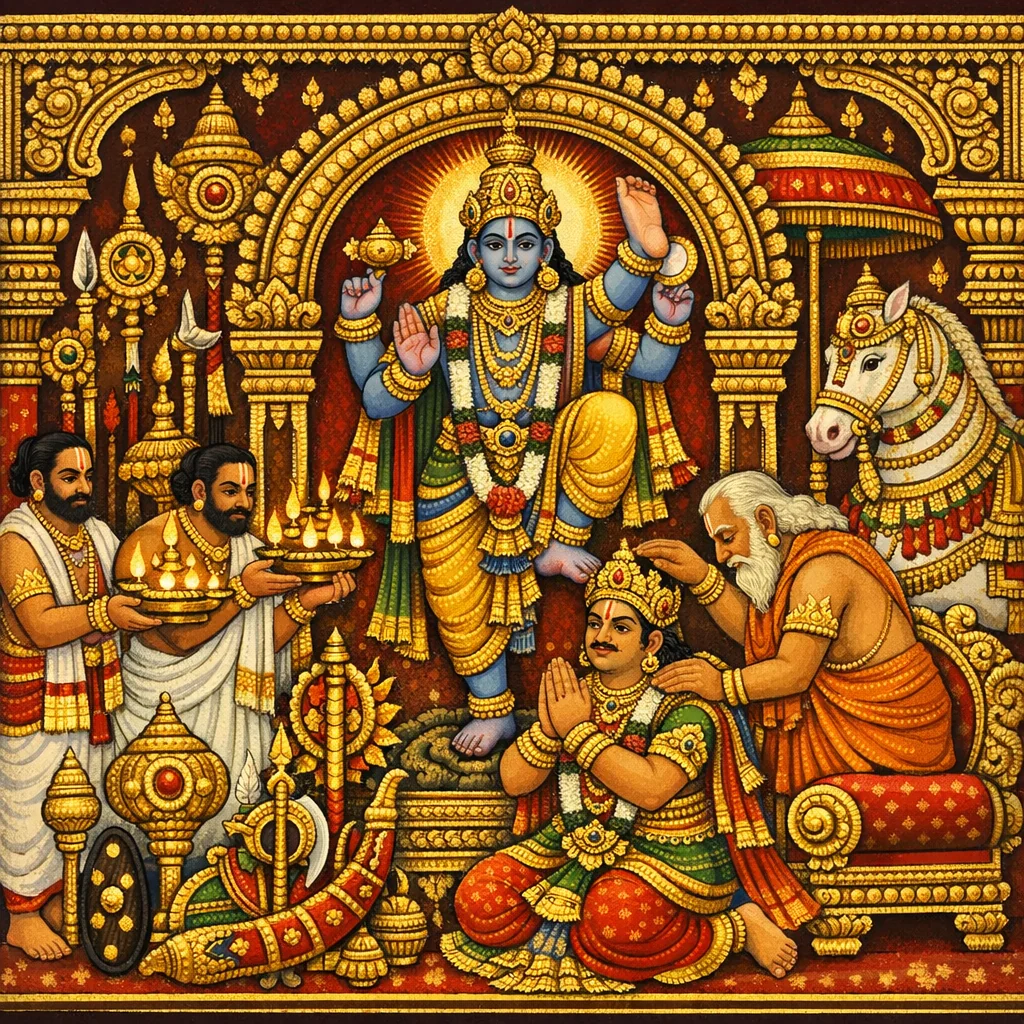
This chapter sets out a tightly ordered royal rite for launching a campaign within seven days, treating war as a dharmic act requiring ritual purity, divine alignment, and ethical rule. It begins with worship of Viṣṇu, Śiva, and Gaṇeśa, then day-by-day propitiation of the Dikpālas, Rudras, Grahas, and the Aśvins, with offerings to deities met on the road and to spirits at night. A mantra-based dream rite seeks omens of auspiciousness and danger, placing the king’s expedition under divine scrutiny. On the sixth day come the victory bath (vijaya-snāna) and abhiṣeka; on the seventh, worship of Trivikrama, nīrājana consecration of weapons and vehicles, and protective recitations as the king mounts elephant, chariot, horse, and draft animals without looking back. The latter half turns to Dhanurveda and rāja-nīti: strategic deception; classifications of vyūhas (animal/limb-based and object-based); named formations—Garuḍa, Makara, Cakra, Śyena, Ardhacandra, Vajra, Śakaṭa, Maṇḍala, Sarvatobhadra, Sūcī—and the fivefold division of the army. It warns against supply-line failure, advises the king not to fight personally, and details troop spacing, breach tactics, unit roles (shield-bearers, archers, chariots), terrain suitability by corps, morale incentives, and the theology of heroic death. Finally it codifies restraints: do not kill fugitives, noncombatants, the unarmed, or those who surrender; protect women; honor local customs after victory; distribute gains fairly; and safeguard soldiers’ families—concluding that this raṇadīkṣā ensures victory for a righteous king.
Shlokas
Verse 1
इत्य् आग्नेये महापुराणे आजस्रिकं नाम चतुस्त्रिंशदधिकद्विशततमो ऽध्यायः अथ पञ्चत्रिंशदधिकद्विशततमो ऽध्यायः रणदीक्षा पुष्कर उवाच यात्राविधानपूर्वन्तु वक्ष्ये साङ्ग्रामिकं विधिं सप्ताहेन यदा यात्रा भविष्यति महीपतेः
Thus, in the Agni Mahāpurāṇa ends the two-hundred-and-thirty-fourth chapter, called “Ājasrika.” Now begins the two-hundred-and-thirty-fifth chapter: “Raṇadīkṣā” (War-consecration). Puṣkara said: “I shall explain the procedure for warfare, preceded by the regulations for a royal expedition, when the king’s march is to take place within seven days.”
Verse 2
पूजनीयो हरिः शम्भुर्मोदकाद्यैर् विनायकः द्वितीये ऽहनि दिक्पालान् सम्पूज्य शयनञ्चरेत्
Hari (Viṣṇu) and Śambhu (Śiva) are to be worshipped; and Vināyaka (Gaṇeśa) with modakas and similar offerings. On the second day, having duly worshipped the Guardians of the Directions (Dikpālas), one should then observe the rite of lying down (ritual sleep).
Verse 3
शय्यायां वा तदग्रे ऽथ देवान् प्रार्च्य मनुं स्मरेत् नमः शम्भोः त्रिनेत्राय रुद्राय वरदाय च
Either while on the bed or before it at the proper place, having first worshipped the gods, one should recollect the mantra: “Homage to Śambhu, the Three-Eyed; to Rudra, the Bestower of boons.”
Verse 4
वामनाय विरूपाय स्वप्नाधिपतये नमः संविशेदिति ज भगवन्देवदेवेश शूलभृद्वृषवाहन
“Homage to Vāmana; homage to Virūpa; homage to the Lord of dreams.” Saying thus, one should lie down to sleep. O Bhagavān—God of gods, bearer of the trident, whose mount is the bull (Vṛṣavāhana)!
Verse 5
इष्टानिष्टे ममाचक्ष्व स्वप्ने सुप्तस्य शाश्वत यज्जाग्रतो दूरमिति पुरोधा मन्त्रमुच्चरेत्
“O Eternal One, tell me the auspicious and inauspicious results of the dream of one who sleeps.” Thus questioned, the family priest should recite the mantra: “That which is far away for one who is awake.”
Verse 6
तृतीये ऽहनि दिक्पालान् रुद्रांस्तान् दिक्पतीन्यजेत् ग्रहान् यजेच्चतुर्थे ऽह्नि पञ्चमे चाश्विनौ यजेत्
On the third day one should worship the guardians of the directions—those Rudras who preside over the quarters. On the fourth day one should worship the Grahas (planetary deities), and on the fifth day one should worship the Aśvins.
Verse 7
मार्गे या देवतास्तासान्नद्यादीनाञ्च पूजनं दिव्यान्तरीक्षभौमस्थदेवानाञ्च तथा बलिः
One should worship the deities encountered along the road, as well as rivers and the like; and likewise one should present bali-offerings to the gods abiding in heaven, in the mid-region (atmosphere), and on the earth.
Verse 8
रात्रौ भूतगणानाञ्च वासुदेवादिपूजनं भद्रकाल्याः श्रियः कुर्यात् प्रार्थयेत् सर्वदेवताः
At night one should also perform worship for the hosts of Bhūtas (spirit-beings), beginning with Vāsudeva; one should undertake the rite for the śrī (prosperity) of Bhadrakālī, and pray to all the deities.
Verse 9
वासुदेवः सङ्कर्षणः प्रद्युम्नश्चानिरुद्धकः नारायणो ऽब्जजो विष्णुर् नारसिंहो वराहकः
He is Vāsudeva; Saṅkarṣaṇa; Pradyumna; and Aniruddha. He is Nārāyaṇa; the Lotus-born (Brahmā); Viṣṇu; Narasiṃha; and Varāha.
Verse 10
शिव ईशस्तत्पुरुषो ह्य् अघोरो राम सत्यजः सूर्यः सोमः कुजश्चान्द्रिजीवशुक्रशनैश् चराः
Śiva, Īśa, Tatpuruṣa, and indeed Aghora; also Rāma and Satyaja—these are appellations of the Sun and the Moon; likewise Kuja (Mars) and the planetary deities: Budha (Moon-born), Bṛhaspati (Jīva), Śukra, and Śanaiścara.
Verse 11
राहुः केतुर्गणपतिः सेनानी चण्डिका ह्य् उमा लक्ष्मीः सरस्वती दुर्गा ब्रह्माणीप्रमुखा गणाः
Rāhu and Ketu, Gaṇapati, the divine Commander (Senānī), Caṇḍikā, indeed Umā, Lakṣmī, Sarasvatī, Durgā, and the hosts headed by Brahmāṇī—these deities are to be remembered and invoked.
Verse 12
रुद्रा इन्द्रादयो वह्निर् नागास्तार्क्ष्यो ऽपरे सुराः दिव्यान्तरीक्षभूमिष्ठा विजयाय भवन्तु मे
May the Rudras, Indra and the other gods, Agni, the Nāgas, Tārkṣya (Garuḍa), and the remaining deities—those abiding in the divine realm, in the midspace, and upon the earth—be for my victory.
Verse 13
मर्दयन्तु रणे शत्रून् सम्प्रगृह्योपहारकं सपुत्रमातृभृत्यो ऽहं देवा वः शरणङ्गतः
May they crush the enemies in battle, having seized the bringer of tribute/offerings. O gods, I—together with my sons, mother, and attendants—have come to you for refuge.
Verse 14
तत्पुरत इति ख रात्रावित्यादिः, सत्यज इत्य् अन्तः पाठः ग पुस्तके नास्ति मर्दयन्तु च मे शत्रूनिति घ , ञ च अवन्तु मां स्वभृत्यो ऽहमिति ज , ट च चामूनां पृष्ठतो गत्वा रिपुनाशा नमो ऽस्तु वः विनिवृत्तः प्रदास्यामि दत्तादभ्यधिकं बलिं
“‘In front of that’—so reads the Kha recension; ‘at night’ and so forth—is another reading. The ending ‘satyaja’ is not found in the Ga manuscript. ‘And may they crush my enemies’—so read Gha and Ña. ‘May they protect me; I am their own servant’—so read Ja and Ṭa. ‘Having gone behind the troops (cāmū), O destroyers of foes, salutations to you. Returning (safely), I shall offer you a bali-offering greater than what has been given (before).’”
Verse 15
षष्ठे ऽह्नि विजयस्नानं कर्तव्यं चाभिषेकवत् यात्रादिने सप्तमे च पूजयेच्च त्रिविक्रमं
On the sixth day one should perform the “victory-bath” (vijaya-snāna), and likewise carry out the abhiṣeka (consecratory anointing) in the manner of an installation rite. On the seventh day, the day of the yātrā (procession/festival), one should worship Trivikrama (Viṣṇu).
Verse 16
नीराजनोक्तमन्त्रैश् च आयुधं वाहनं यजेत् पुण्याहजयशब्देन मन्त्रमेतन्निशामयेत्
And with the mantras prescribed for nīrājana (the auspicious waving of lights), one should worship and consecrate one’s weapons and vehicle; and with the utterances “puṇyāha” (“may this day be auspicious”) and “jaya” (“victory”), one should recite and intone this mantra accordingly.
Verse 17
दिव्यान्तरीक्षभूमिष्ठाः सन्त्वायुर्दाः सुराश् च ते देवसिद्धिं प्राप्नुहि त्वं देवयात्रास्तु सा तव
May the divine ones who abide in the sky and upon the earth—the Devas, bestowers of life—be gracious to you. May you attain divine accomplishment (deva-siddhi); this indeed shall be your devayātrā, the divine journey and rite.
Verse 18
रक्षन्तु देवताः सर्वा इति श्रुत्वा नृपो व्रजेत् गृहीत्वा सशरञ्चापं धनुर्नागेति मन्त्रत
Having heard the utterance, “May all the deities protect (me),” the king should proceed, taking up the bow together with arrows, while reciting—according to mantra—the formula “dhanur-nāga.”
Verse 19
तद्विष्णोरिति जप्त्वाथ दद्याद्रिपुमुखे पदं दक्षिणं पदं द्वात्रिंशद्दिक्षु प्राच्यादिषु क्रमात्
Having recited the mantra beginning “tad viṣṇoḥ …”, one should then set the mantra-pada(s) facing the enemy; and one should place the “right” pada successively in the thirty-two directions, beginning with the east and proceeding in due order.
Verse 20
नागं रथं हयञ्चैव धुर्यांश् चैवारुहेत् क्रमात् आरुह्य वाद्यैर् गच्छेत् पृष्थतो नावलोकयेत्
He should mount, in proper sequence, the elephant, the chariot, the horse, and the draught-animals; and having mounted, he should proceed accompanied by musical instruments, and should not look back behind him.
Verse 21
क्रोशमात्रं गतस्तिष्ठेत् पूजयेद्देवता द्विजान् परदेशं व्रजेत् पश्चादात्मसैन्यं हि पालयन्
After proceeding only a krośa, he should halt and offer honor to the deities and to the twice-born; thereafter he should travel onward to a foreign region, while indeed safeguarding his own retinue (forces).
Verse 22
राजा प्राप्य देवेशन्तु देशपालन्तु पालयेत् देवानां पूजनं कुर्यान्न छिन्द्यादायमत्र तु
Having obtained sovereignty, the king should protect the Lord of the gods and the guardians of the land. He should perform the worship of the deities, and here he should not curtail their lawful revenue (endowments or dues).
Verse 23
नावमानयेत्तद्देश्यानागत्य स्वपुरं पुनः पृष्ठश् चैव रिपुनाशो भवेद्यथेति ट जित्वा शत्रुं प्रदास्यामीति ट जैत्रा यात्रास्त्विति ट प्राप्तविदेशस्तु इति ग , घ , ञ च देशाचारन्तु पालयेदिति ख देशाचारणेण पालयेदिति ग , घ , छ , ज , ञ च जयं प्राप्यार्चयेद्देवान् दद्याद्दानानि पार्थिवः
Having reached a foreign land, he should not insult the people of that country; and having returned again to his own city, he should see to it that the enemy is destroyed from the rear as is proper. “Having conquered the foe, I shall bestow gifts”—thus it is said. These are the victorious (jaitra) expeditions. When he has arrived in a foreign country, he should observe the local customs. Having obtained victory, the king should worship the gods and give charitable gifts.
Verse 24
द्वितीये अहनि सङ्ग्रामो भविष्यति यदा तदा स्नपयेद्गजमश्वादि यजेद्देवं नृपसिंहकं
If battle is to occur on the second day, then at that time one should perform a ritual bathing (lustration, snāpana) of the elephant, horses, and the like, and worship the deity Nṛpasiṁhaka (Narasimha, the Man-Lion Lord).
Verse 25
छत्रादिराजलिङ्गानि शस्त्राणि निशि वै गणान् प्रातर्नृसिंहकं पूज्य वाहनाद्यमशेषतः
At night one should worship the royal insignia beginning with the parasol, and the weapons; indeed, one should also worship the attendant hosts (gaṇas). In the morning, having worshipped Narasiṃha, one should then worship—without omission—everything beginning with the mounts (vāhanas) and the rest.
Verse 26
पुरोधसा हुतं पश्येद्वह्निं हुत्वा द्विजान्यजेत् गृहीत्वा सशरञ्चापं गजाद्यारुह्य वै व्रजेत्
He should have the oblation offered by the royal chaplain (purohita) and then behold the fire. After performing the fire-offering, he should honour the twice-born (brahmins). Taking up the bow together with arrows, he should mount an elephant or other mount and proceed forth.
Verse 27
देशे त्वदृश्यः शत्रूणां कुर्यात् प्रकृतिकल्पनां संहतान् योधयेदल्पान् कामं विस्तारयेद्बहून्
In a region where he remains unseen by the enemies, he should contrive a display of forces: he should make a small number fight as if they were massed together, and, as needed, make many appear spread out, so as to mislead.
Verse 28
सूचीमुखमनीकं स्यादल्पानां बहुभिः सह व्यूहाः प्राण्यङ्गरूपाश् च द्रव्यरूपाश् च कीर्तिताः
The battle-front called “sūcīmukha” (“needle-point”) is said to suit a small force when acting together with a larger one. Battle-formations (vyūhas) are described as of two kinds: those shaped like the limbs of living beings, and those based on material objects (inanimate models).
Verse 29
गरुडो मकरव्यूहश् चक्रः श्येनस्तथैव च अर्धचन्द्रश् च वज्रश् च शकटव्यूह एव च
The (battle) formations are: Garuḍa, Makara-formation, Cakra (wheel), Śyena (hawk), Ardhacandra (half-moon), Vajra (thunderbolt/diamond), and also the Śakaṭa-formation (cart/wagon array).
Verse 30
मण्डलः सर्वतोभद्रः सूचीव्यूहश् च ते नराः व्यूहानामथ सर्वेषां पञ्चधा सैन्यकल्पना
The circular formation, the “all-auspicious on every side” formation, and the needle (wedge) formation—these, O men; and moreover, for all formations, the arrangement of the army is of five kinds.
Verse 31
द्वौ पक्षावनुपक्षौ द्वावश्यं पञ्चमं भवेत् एकेन यदि वा द्वाभ्यां भागाभ्यां युद्धमाचरेत्
There should be two flanks and two supporting flanks; a fifth division must necessarily be present. One should conduct battle using either one division, or using two divisions, as required.
Verse 32
भागत्रयं स्थापयेत्तु तेषां रक्षार्थमेव च न व्यूहकल्पना कार्या राज्ञो भवति कर्हिचित्
He should establish a threefold division solely for their protection; for a king, the devising of battle-formations (vyūhas) should never be undertaken without necessity.
Verse 33
मूलच्छेदे विनाशः स्यान्न युध्येच्च स्वयन्नृपः सैन्यस्य पश्चात्तिष्ठेत्तु क्रोशमात्रे महीपतिः
If the root (the main support or supply-line) is cut, destruction will result. The king should not fight personally; rather, the lord of the earth should remain behind the army, at a distance of about one krośa.
Verse 34
भग्नसन्धारणं तत्र योधानां परिकीर्तितं प्रधानभङ्गे सैन्यस्य नाशस्थानं विधीयते
In that context, the “holding together of the broken” is described as a duty of the warriors; when the chief (leader or central unit) is shattered, the point of the army’s destruction is thereby determined.
Verse 35
न संहतान्न विरलान्योधान् व्यूहे प्रकल्पयेत् आयुधानान्तु सम्मर्दो यथा न स्यात् परस्परं
In arranging a battle-formation (vyūha), one should station the warriors neither too densely nor too sparsely, so that their weapons do not clash and become entangled with one another.
Verse 36
भेत्तुकामः परानीकं संहतैर् एव भेदयेत् भेदरक्ष्याः परेणापि कर्तव्याः संहतास् तथा
One who intends to break the enemy’s battle-line should pierce it only with troops advancing in close formation. Likewise, the opposing side must keep its units tightly massed to guard against a breach.
Verse 37
व्यूहं भेदावहं कुर्यात् परव्यूहेषु चेच्छया गजस्य पादरक्षार्थाश् चत्वारस्तु तथा द्विज
If he so desires, he should employ a formation that brings about a breach in the enemy’s formations. Likewise, O dvija (brāhmaṇa), four warriors are to be appointed for the protection of the elephant’s feet.
Verse 38
रथस्य चाश्वाश् चत्वारः समास्तस्य च चर्मिणः धन्विनश् चर्मिभिस्तुल्याः पुरस्ताच्चर्मिणो रणे
A chariot should have four horses, and with it there should be shield-bearers. The bowmen should equal the shield-bearers in number, and in battle the shield-bearers should be placed in front.
Verse 39
पृष्ठतो धन्विनः प्रश्चाद्धन्विनान्तुरगा रथाः रथानां कुञ्जराः पश्चाद्दातव्याः पृथिवीक्षिता
In the rear should be stationed the archers; behind the archers, the cavalry and chariots. Behind the chariots, elephants are to be placed—O king, protector of the earth.
Verse 40
पदातिकुञ्जराश्वानां धर्मकार्यं प्रयत्नतः शूराः प्रमुखतो देयाः स्कन्धमात्रप्रदर्शनं
For infantry, war-elephants, and cavalry, the meritorious duty (dharma) of the campaign must be carried out with diligent effort; the brave are to be rewarded first, even on the mere showing of the shoulder—i.e., by presenting themselves in the foremost line as proven fighters.
Verse 41
कर्तव्यं भीरुसङ्घेन शत्रुविद्रावकारकं दारयन्ति पुरस्तात्तु न देया भीरवः पुरः
A troop of timid men should be assigned a task that makes the enemy scatter; but the timid must not be placed in the front ranks, for at the forefront they break and give way.
Verse 42
प्रोत्साहन्त्येव रणे भीरून् शूराः पुरस्थिताः प्रांशवः शकुनाशाश् च ये चाजिह्मेक्षणा नराः
In battle, the heroes stationed in the rear encourage the timid—men of tall stature, those skilled in reading omens, and those whose gaze is straight, steadfast, and without guile.
Verse 43
संहतभ्रूयुगाश् चैव क्रोधना कलहप्रियाः नित्यहृष्टाः प्रहृष्टाश् च शूरा ज्ञेयाश् चकामिनः
Those whose brows are knit, who are prone to anger and fond of quarrel—yet ever cheerful and exuberant—are to be recognized as valiant; and they are also to be known as passionate, inclined to kāma (desire).
Verse 44
संहतानां हतानां च रणापनयनक्रिया प्रतियुद्धं गजानाञ्च तोयदानादिकञ्च यत्
It also teaches the procedures for removing the assembled troops and the slain from the battlefield, the counter-combat of elephants, and all that pertains to giving them water and other attendant measures.
Verse 45
शत्रुद्रावकारणमिति ख , ग , घ , ञ च ये च जिह्मेक्षणा इति ख , ग , घ , ञ च वलापनयनक्रियेति ज आयुधानयनं चैव पत्तिकर्म विधीयते रिपूणां भेत्तुकामानां स्वसैन्यस्य तु रक्षणं
“A cause for routing the enemy”—so read the recensions Kha, Ga, Gha, and Ña; and “those who are crooked-eyed”—so read Kha, Ga, Gha, and Ña; whereas J(a) reads “the procedure for removing the enemy’s force (vala).” In any case, the bringing of weapons is prescribed as an infantry-operation (pattikarma), for those who wish to break the foes and for the protection of one’s own army.
Verse 46
भेदनं संहतानाञ्च चर्मिणां कर्म कीर्तितं विमुखीकरणं युद्धे धन्विनां च तथोच्यते
Breaking (the enemy’s formation) is declared to be the proper operation for those who fight in a compact mass and for the shield-bearers; and likewise, in battle, causing the enemy to turn away (driving them back, forcing a retreat) is said to be the operation of the archers.
Verse 47
दूरापसरणं यानं सुहतस्य तथोच्यते त्रासनं रिपुसैन्यानां रथकर्म तथोच्यते
“Withdrawal to a distance” is called the movement (yāna) of one who has been badly struck; and “causing terror in the enemy armies” is also termed chariot-operation (ratha-karma).
Verse 48
भेदनं संहतानाञ्च भेदानामपि संहतिः प्राकारतोरणाट्टालद्रुमभङ्गश् च सङ्गते
In close engagement, one should employ the breaking up of compact enemy formations; also the re-forming (consolidation) of one’s own broken units; and, in the clash, the demolition of ramparts, gateways, battlement-towers, and even the felling of trees used for defense or obstruction.
Verse 49
पत्तिभूर्विषमा ज्ञेया रथाश्वस्य तथा समा सकर्दमा च नागानां युद्धभूमिरुदाहृता
The ground for infantry should be understood to be uneven; for chariots and horses, it should likewise be even. For elephants, a battlefield with mud is declared to be suitable.
Verse 50
एवं विरचितव्यूहः कृतपृष्ठदिवाकरः तथानुलोमशुक्रार्किदिक्पालमृदुमारुताः
Thus the battle-array should be formed—placing the Sun as the rear-guard; and then, in proper forward order, placing Venus, the Sun’s son (Saturn), the Guardians of the Directions, and the gentle Winds.
Verse 51
योधानुत्तेजयेत्सर्वान्नामगोत्रावदानतः भोगप्राप्त्या च विजये स्वर्गप्राप्त्या मृतस्य च
He should rouse and hearten all the warriors by proclaiming their names, lineages, and heroic deeds—assuring them of enjoyments and rewards if victorious, and of attaining heaven if they fall in battle.
Verse 52
जित्वारीन् भोगसम्प्राप्तिः मृतस्य च परा गतिः निष्कृतिः स्वामिपिण्डस्य नास्ति युद्धसमा गतिः
By conquering enemies one attains enjoyments; and for one who dies (in battle) there is the highest destiny. It is an expiation for the food received from one’s lord; there is no course of attainment equal to warfare.
Verse 53
शूराणां रक्तमायाति तेन पापन्त्यजन्ति ते धातादिदुःखसहनं रणे तत् परमन्तपः
When the blood of heroes is shed, by that they cast off their sins; and their endurance of pains such as wounds and other bodily afflictions in battle—this is the highest austerity, O scorcher of foes.
Verse 54
वराप्सरःसहस्राणि यान्ति शूरं रणे मृतं स्वामी सुकृतमादत्ते भग्नानां विनिवर्तिनां
Thousands of excellent Apsarases go to the hero who dies in battle; but the lord (king/commander) takes away the merit of those who, having broken ranks, turn back from the fight.
Verse 55
ब्रह्महत्याफलं तेषां तथा प्रोक्तं पदे पदे त्यक्त्वा सहायान् यो गच्छेद्देवास्तस्य विनष्टये
Thus, at every step, the fruit of brahmin-slaying is declared for them. He who abandons his companions and goes on alone—against him the gods act for his destruction.
Verse 56
अश्वमेधफलं प्रोक्तं शूराणामनिर्वर्तिनां धर्मनिष्ठे जयो राज्ञि योद्धव्याश् च समाः समैः
It is declared that for heroes who do not turn back from battle, the reward is equal to that of the Aśvamedha sacrifice. When a king is steadfast in dharma, victory is assured for him; and equals should fight with equals.
Verse 57
गजाद्यैश् च गजाद्याश् च न हन्तव्याः पलायिनः न प्रेक्षकाः प्रविष्टाश् च अशस्त्राः प्रतितादयः
Those who have fled are not to be slain—whether they are among the elephant-corps and the like, or other such troops. Nor should spectators, those who have entered without combatant intent, the unarmed, and those who have surrendered and the like be struck down.
Verse 58
शान्ते निद्राभिभूते च अर्धोत्तीर्णे नदीवने दुर्दिने कूटयुद्धानि शत्रुनाशार्थमाचरेत्
When the enemy is at ease, when overcome by sleep, when half-way across a river, in riverine woodland, and on days of foul weather—one should employ covert or irregular modes of warfare for the purpose of destroying the enemy.
Verse 59
बाहू प्रगृह्य विक्रोशेद्भग्ना भग्नाः परे इति प्राप्तं मित्रं बलं भूरि नायको ऽत्र निपातितः
Raising his arms, he should shout aloud, “The enemy is broken—broken!” Thus he proclaims that abundant allied forces have arrived, and that the enemy commander has been struck down here.
Verse 60
सेनानीर्निहताश्चायं भूपतिश्चापि विप्लुतः विद्रुतानान्तु योधानां मुखं घातो विधीयते
When the commander has been slain and the king too is thrown into disarray, then for the warriors who are fleeing, a blow to the front (i.e., striking them in the face/front) is prescribed.
Verse 61
धूपाश् च देया धर्मज्ञ तथा च परमोहनाः पताकाश् चैव सम्भारो वादित्राणाम् भयावहः
O knower of dharma, incense offerings (dhūpa) should also be provided, and likewise items that are supremely enchanting; and banners too—along with the full equipment of musical instruments—arranged in an awe-inspiring manner.
Verse 62
सम्प्राप्य विजयं युद्धे देवान्विप्रांश् च संयजेत् रत्नानि राजगामीनि अमात्येन कृते रणे
Having obtained victory in battle, one should duly worship the gods and honor the Brahmins; and the jewels and valuables that are destined for the king are to be brought to the king, even when the battle has been conducted by a minister.
Verse 63
तस्य स्त्रियो न कस्यापि रक्ष्यास्ताश् च परस्य च शत्रुं प्राप्य रणे मुक्तं पुत्रवत् परिपालयेत्
His women are not to be violated by anyone; indeed, the women of another are also to be protected. And having obtained an enemy who has been released (or has surrendered) in battle, one should maintain and protect him as one would a son.
Verse 64
पुनस्तेन न योद्धव्यं देशाचारादि पालयेत् ततश् च स्वपुरं प्राप्य ध्रुवे भे प्रविशेद् गृहं
One should not fight with him again; rather, one should uphold the customs and established practices of the land. Then, having reached one’s own city, one should enter the house at the auspicious, fixed time.
Verse 65
देवादिपूजनं कुर्याद्रक्षेद्योधकुटुम्बकं संविभागं प्रावाप्तैः कुर्याद् भृत्यजनस्य च
He should perform worship of the gods and other revered beings; he should protect the households of the soldiers; and, from what has been duly obtained, he should also allot a proper share to the body of servants and dependents.
Verse 66
रणादीक्षा मयोक्ता ते जयाय नृपतेर्ध्रुवा
This consecration for battle has been taught by me to you; for a king it is a sure means to victory.
Frequently Asked Questions
It prescribes a day-wise consecration: worship of Hari-Śambhu-Vināyaka; Dikpāla rites and ritual sleep with dream-mantras; further quarter-guardian/Rudra worship; Graha worship; Aśvin worship; then vijaya-snāna with abhiṣeka; and finally yātrā-day worship of Trivikrama with nīrājana consecration of weapons and vehicles.
The chapter invokes Viṣṇu and his forms (Vāsudeva, Saṅkarṣaṇa, Pradyumna, Aniruddha, Narasiṃha, Varāha), Śiva and Rudra-forms, Gaṇapati, Dikpālas, Grahas (Sun, Moon, Mars, Budha, Bṛhaspati, Śukra, Śani, plus Rāhu and Ketu), the Aśvins, Devīs (Caṇḍikā, Umā, Lakṣmī, Sarasvatī, Durgā, Brahmāṇī-gaṇas), Nāgas, and Garuḍa.
It lists Garuḍa, Makara, Cakra, Śyena, Ardhacandra, Vajra, Śakaṭa, Maṇḍala, Sarvatobhadra, and Sūcī formations, while also classifying vyūhas as living-limb-shaped and object-based.
It prohibits killing fugitives, noncombatants/spectators, the unarmed, and those who surrender; mandates protection of women (one’s own and the enemy’s); and instructs humane protection of a released/surrendered enemy like a son, alongside honoring local customs after victory.
It sacralizes statecraft and warfare by embedding them in worship, mantra, and restraint, presenting victory as dharma-aligned action and framing disciplined courage, protection of the vulnerable, and post-war charity as spiritually meritorious conduct.