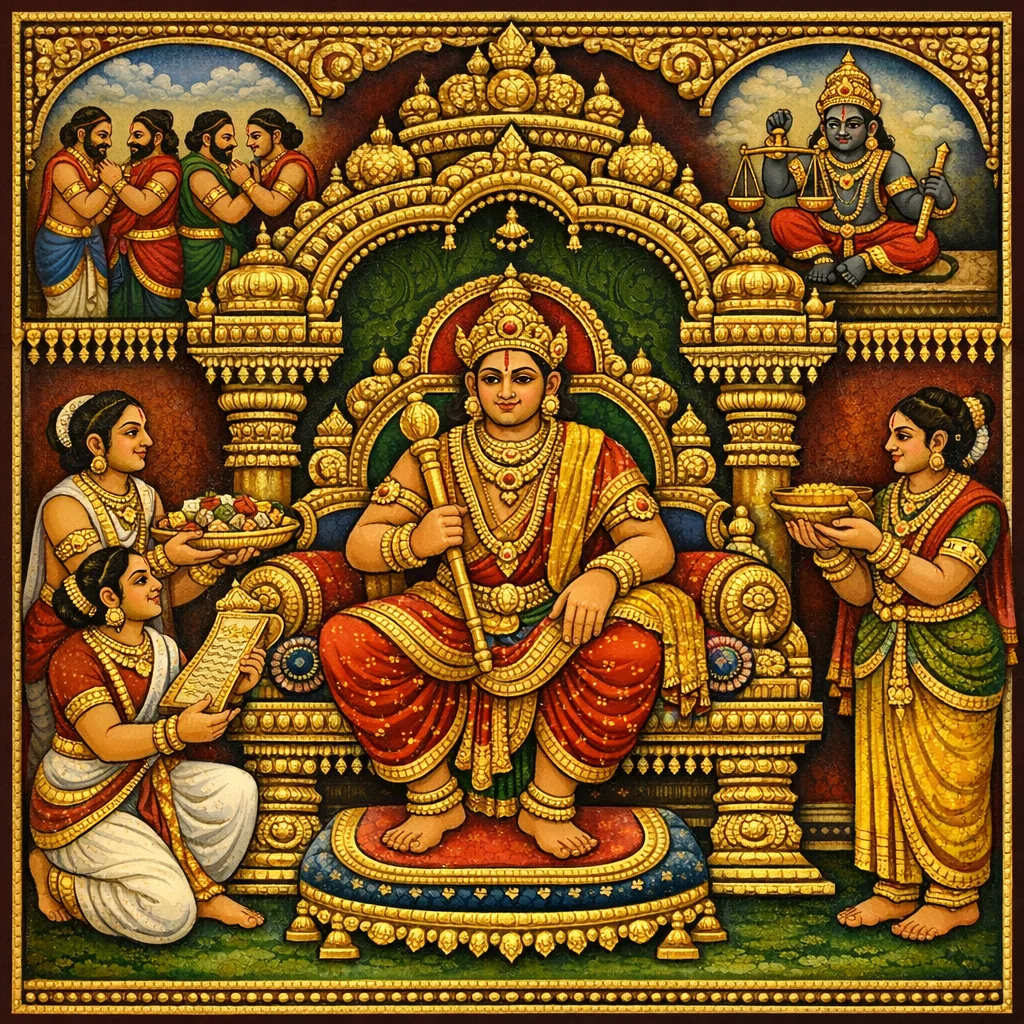
Adhyaya 225
Chapter 225 — राजधर्माः (The Duties of Kings): Daiva and Pौरुष (Effort), Upāyas of Statecraft, and Daṇḍa (Punitive Authority)
This chapter redefines “daiva” (fate) as the residue of one’s own past actions, thereby placing “pauruṣa” (human initiative and effort) at the center of success in kingship. Yet it offers a realist balance: results ripen in due time when effort is supported by favorable conditions, like cultivation aided by rainfall. It then sets out the king’s working instruments in Nīti-śāstra—first the four upāyas (sāma, dāna, bheda, daṇḍa), and then seven expedients including māyā (strategic deception), upekṣā (calculated indifference), and indrajāla (illusion/stratagem). The text advises using bheda among mutually hostile factions and securing internal and external resources (alliances, ministers, royal kin, treasuries) before confronting enemies. Dāna is praised as a supreme means of influence, while daṇḍa is upheld as the pillar of cosmic and social order, demanding precise and just application. Finally, the king is mapped to cosmic forces—Sun and Moon in majesty and accessibility, Wind through intelligence networks, and Yama through restraint of faults—uniting statecraft with Dharmic cosmology.
Shlokas
Verse 1
इत्य् आग्नेये महापुराणे राजधर्मो नाम चतुर्विंशत्यधिकद्विशततमो ऽध्यायः अथ पञ्चविंशत्यधिकद्विशततमो ऽध्यायः राजधर्माः पुष्कर उवाच स्वयमेव कर्म दैवाख्यं विद्धि देहान्तरार्जितं तस्मात् पौरुषमेवेह श्रेष्ठमाहुर्मनीषिणः
Thus, in the Agni Mahāpurāṇa ends the two-hundred-and-twenty-fourth chapter called “Rājadharma.” Now begins the two-hundred-and-twenty-fifth chapter on “The Duties of Kings.” Puṣkara said: Know that what is called “fate” (daiva) is nothing but one’s own action, accumulated in another body (a previous life). Therefore, the wise declare personal effort (pauruṣa) to be śreṣṭha—supreme—here, in this world.
Verse 2
प्रतिकूलं तथा दैवं पौरुषेण विहन्यते सात्त्विकात् कर्मणः पूर्वात् सिद्धिः स्यात्पौरुषं विना
Even adverse destiny is overcome by human effort; and success can arise, even without exertion, from prior sāttvika deeds performed in the past.
Verse 3
पौरुषं दैवसम्पत्त्या काले फलति भार्गव दैवं पुरुषकारश् च द्वयं पुंसः फलावहं
O Bhārgava, human effort bears fruit in due time when supported by divine favor; and for a person, both—divine dispensation (daiva) and personal exertion (puruṣakāra)—together are productive of results.
Verse 4
कृषेर्वृष्टिसमायोगात् काले स्युः फलसिद्धयः सधर्मं पौरुषं कुर्यान्नालसो न च दैववान्
Just as success in agriculture arises in due time from the conjunction of cultivation and rainfall, so results are accomplished in time. Therefore one should exert proper human effort in accordance with dharma—neither being lazy nor merely a believer in fate.
Verse 5
सामादिभिरुपायैस्तु सर्वे सिद्ध्यन्त्युपक्रमाः साम चोपप्रदानञ्च भेददण्डौ तथापरौ
All undertakings are successfully accomplished by the four means beginning with conciliation: sāma (conciliation), dāna (gifts), bheda (dissension), and daṇḍa (punishment/force) are the others as well.
Verse 6
मायोपेक्षेन्द्रजालञ्च उपायाः सप्त ताञ्छृणु द्विविधं कथितं साम तथ्यञ्चातथ्यमेव च
Hear these seven expedients—māyā (deception), upekṣā (strategic indifference), and indrajāla (jugglery/illusion), among them. Sāma (conciliation) is declared to be of two kinds: truthful and untruthful.
Verse 7
तत्राप्यतथ्यं साधूनामाक्रोशायैव जायते महाकुलीना ह्य् ऋजवो धर्मनित्या जितेन्द्रियाः
Even there, false speech about the virtuous arises only for the sake of abuse; for those of noble lineage are straightforward, ever-steadfast in dharma, and self-controlled.
Verse 8
सामसाध्या अतथ्यैश् च गृह्यन्ते राक्षसा अपि तथा तदुप्रकाराणां कृतानाञ्चैव वर्णनं
Even rākṣasas, too, can be brought under control by sāma (conciliation) and also by atathya (deceptive/false statements); and there is likewise a description of the various methods and the procedures that are performed for that purpose.
Verse 9
परस्परन्तु ये द्विष्टाः क्रुद्धभीतावमानिताः तेषान्भेदं प्रयुञ्जीत परमं दर्शयेद्भयं
But those who are mutually hostile—angry, fearful, or insulted—among them one should employ dissension (bheda, divide-and-separate) and display an extreme deterrent fear.
Verse 10
आत्मीयान् दर्शयेदाशां येन दोषेण बिभ्यति परास्तेनैव ते भेद्या रक्ष्यो वै ज्ञातिभेदकः
One should hold out a prospect (of gain) to one’s own people by pointing to the very fault they fear; by that same weakness they can be split from one another. Indeed, the instigator who creates divisions among kinsmen should be protected and kept secure.
Verse 11
सामन्तकोषो वाह्यस्तु मन्त्रामात्यात्मजादिकः अन्तःकोषञ्चोपशाम्य कुर्वन् शत्रोश् च तं जयेत्
The ‘external treasury’ consists of feudatory chiefs (sāmanta) and allied resources, along with counsellors, ministers, royal sons, and the like. By pacifying and securing the ‘internal treasury’ as well, one should then proceed against the enemy and conquer him.
Verse 12
उपायश्रेष्ठं दानं स्याद्दानादुभयलोकभाक् न सो ऽस्ति नाम दानेन वशगो यो न जायते
Giving (dāna) is indeed the finest means; through giving one becomes a sharer in both worlds (this world and the next). There is truly no one who does not become amenable by means of gifts.
Verse 13
परस्मादर्शयेद्भयमिति ञ मन्त्रामात्यानुजादिक इति ञ दानवानेव शक्नोति संहतान् भेदितुं परान् त्रयासाध्यं साधयेत्तं दण्डेन च कृतेन च
“One should make the enemy see fear”—so runs the maxim. “(Employ) counsel, ministers, allies/younger kinsmen and the like”—so runs another. Only a ruler endowed with resources and discernment can split opponents who stand united. What cannot be achieved by the three means (sāma, dāna, bheda) should be accomplished by daṇḍa (punishment/force) and by practical execution.
Verse 14
दण्डे सर्वं स्थितं दण्डो नाशयेद्दुष्प्रणीकृतः अदण्ड्यान् दण्डयन्नश्येद्दण्ड्यान्राजाप्यदण्डयन्
All order rests upon daṇḍa (punitive authority). If punishment is administered wrongly, it destroys the realm. One who punishes those who should not be punished perishes; and even a king who fails to punish those who deserve punishment also perishes.
Verse 15
दैवदैत्योरगनराः सिद्धा भूताः पतत्रिणः उत्क्रमेयुः स्वमर्यादां यदि दण्डान् न पालयेत्
Gods, demons, serpents, humans, Siddhas, spirits, and birds would transgress their own ordained limits if daṇḍa (punishment) were not duly maintained.
Verse 16
यस्माददान्तान् दमयत्यदण्ड्यान्दण्डयत्यपि दमनाद्दण्डनाच्चैव तस्माद्दण्ड विदुर्बुधाः
Because it restrains the unrestrained and can even punish those who ought not to be punished, and because it both disciplines and chastises—therefore the wise understand it as daṇḍa.
Verse 17
तेजसा दुर् निरीक्ष्यो हि राजा भास्करवत्ततः लोकप्रसादं गच्छेत दर्शनाच्चन्द्रवत्ततः
By his tejas (majesty), a king should be hard to gaze upon—like the Sun; yet by granting darśana (audience), he should win the people’s favor—like the Moon.
Verse 18
जगद्व्याप्नोति वै चारैर् अतो राजा समीरणः दोषनिग्रहकारित्वाद्राजा वैवस्वतः प्रभुः
By means of spies, he indeed pervades and keeps watch over the whole realm; therefore the king is called “Samīraṇa” (Wind). Because he restrains and suppresses faults—crime and wrongdoing—the king is the lord “Vaivasvata” (Yama-like, dispenser of justice).
Verse 19
यदा दहति दुर्बुद्धिं तदा भवति पावकः यदा दानं द्विजातिभ्यो दद्यात् तस्माद्धनेश्वरः
When one burns away wicked understanding, then one becomes like Fire, the Purifier. When one gives charity to the twice-born (dvija), by that act one becomes a lord of wealth.
Verse 20
धनधाराप्रवर्षित्वाद्देवादौ वरुणः स्मृतः क्षमया धारयंल्लेकान् पार्थिवः पार्थिवो भवेत्
Because he makes streams of wealth rain down, that deity is remembered first as Varuṇa. And the earthly ruler—supporting the worlds through forbearance—truly becomes a ‘pārthiva’, a king of the earth.
Verse 21
उत्साहमन्त्रशक्त्याद्यै रक्षेद्यस्माद्धरिस्ततः
Because the practitioner is protected by zeal, mantra, and power (and the like), therefore Hari (Viṣṇu) is called the Protector.
Frequently Asked Questions
Daiva is defined as one’s own past action from previous embodiment; therefore present effort is primary, though results mature in time and are strengthened when circumstances/divine favor align.
It begins with the four upāyas—sāma, dāna, bheda, daṇḍa—and extends to seven by adding māyā, upekṣā, and indrajāla, with sāma itself described as truthful or untruthful depending on context.
Daṇḍa sustains order, but misapplied punishment destroys the realm; both punishing the undeserving and failing to punish the deserving are portrayed as ruinous to the king.
The king should be formidable in tejas like the Sun (awe-inspiring authority) yet accessible in audience like the Moon (public goodwill through darśana).