Adhyaya 218
Rājābhiṣeka-kathana (Account of the Royal Consecration)
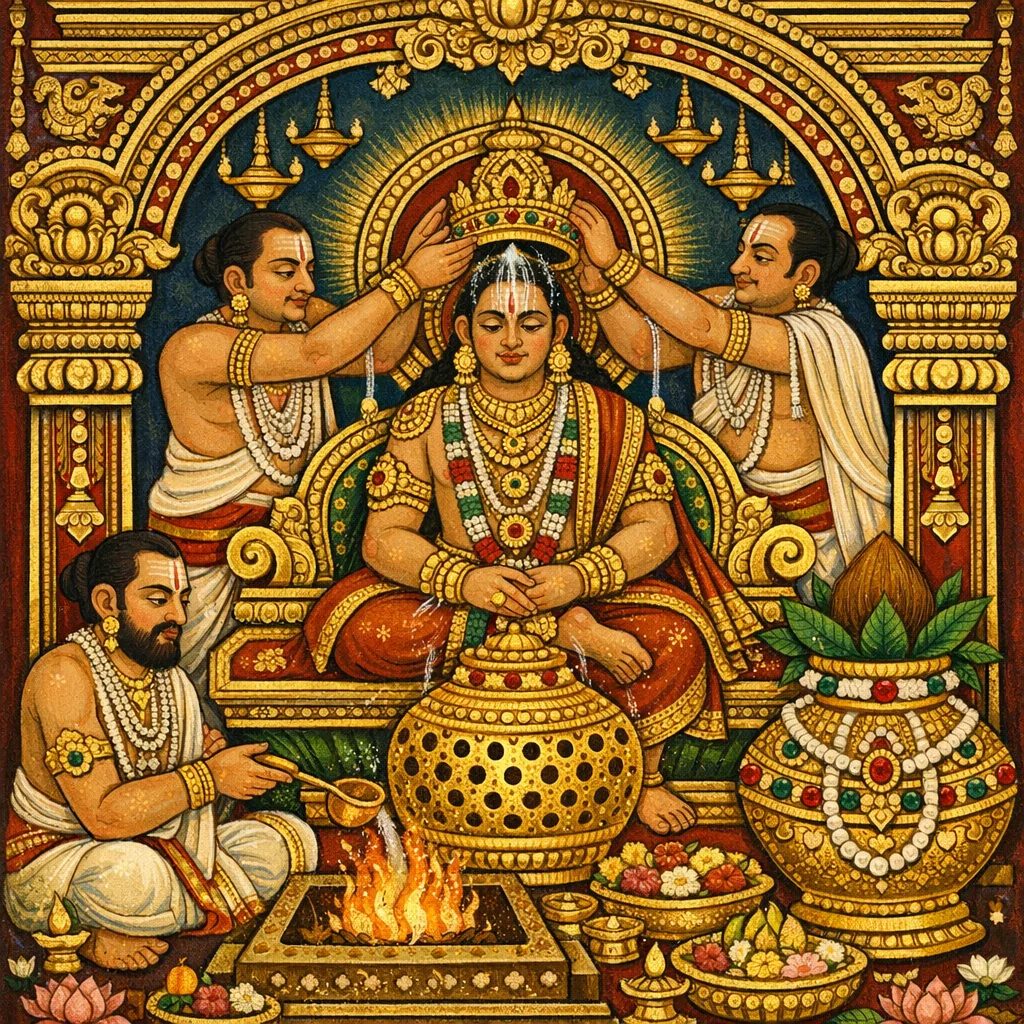
Agni resumes the teaching on rāja-dharma, prompted by Puṣkara’s question to Rāma, and conveys to Vasiṣṭha a stepwise protocol for rājābhiṣeka (royal consecration). Kingship is first defined by function—subduing enemies, protecting subjects, and using daṇḍa (punitive authority) with restraint—then by sacramental preparation: a year-long appointment of the purohita and qualified ministers, rules for the timing of succession, and expedited rites when a king dies. The chapter prescribes pre-abhiṣeka pacification (Aindrī-śānti), fasting, and homa with mantra-classes (Vaiṣṇava, Aindra, Sāvitrī, Vaiśvadeva, Saumya, Svastyayana) for welfare, longevity, and fearlessness. It details ritual apparatus (Aparājitā kalaśa, golden vessels, a hundred-holed sprinkling pot), fire-omens and ideal fire-marks, and a notable mṛd-śodhana regimen using earth from symbolically charged sites (anthill, temples, riverbanks, royal courtyard, etc.). The rite culminates in multi-varṇa ministerial sprinklings with distinct vessels, priestly recitations, protective rites for the assembly, gifts to brāhmaṇas, and public auspicious acts—mirror-gazing, binding the headband/crown, enthronement on animal hides, circumambulation, procession by horse and elephant, city-entry, donations, and formal dismissal—presenting coronation as both political investiture and a dharmic yajña.
Shlokas
Verse 1
वलिङ्गाय नामलिङ्गायेति ख , छ च नमो ऽनागतलिङ्गायेत्यादिः देवानुगतलिङ्गिने इत्य् अन्तः पाठः ज पुस्तके नास्ति परमात्मा परंविभो इति ज अथाष्टादशाधिकद्विशततमो ऽध्यायः राजाभिषेककथनं अग्निर् उवाच पुष्करेण च रामाय राजधर्मं हि पृच्छते यथादौ कथितं तद्वद्वशिष्ट कथयामि ते
[Variant readings:] “valiṅgāya, nāmaliṅgāya”—so read the Kha and Cha manuscripts; “namo ’nāgataliṅgāya…” and so forth. The concluding reading “devānugataliṅgine” is not found in the Ja manuscript; and the Ja manuscript reads “paramātmā paraṃvibho.” Now begins Chapter 218, the account of the royal consecration (rājābhiṣeka). Agni said: “Since Puṣkara has asked Rāma about rājadharma, the law and duty of kings, I shall relate it to you, O Vasiṣṭha, in the same manner as was stated at the beginning.”
Verse 2
पुष्कर उवाच राजधर्मं प्रवक्ष्यामि सर्वस्मात् राजधर्मतः राजा भवेत् शत्रुहन्ता प्रजापालः सुदण्डवान्
Puṣkara said: “I shall expound rājadharma, the king’s sacred duty, foremost among all royal duties. A king should destroy enemies, protect his subjects, and wield punishment (daṇḍa) with proper measure.”
Verse 3
पालयिष्यति वः सर्वान् धर्मस्थान् व्रतमाचरेत् संवत्सरं स वृणुयात् पुरोहितमथ द्विजं
He shall protect all your seats of dharma—courts and sacred institutions—and should undertake the vowed observance (vrata). For a full year he should appoint a twice-born Brahmin (dvija) as royal chaplain (purohita).
Verse 4
मन्त्रिणश्चाखिलात्मज्ञान्महिषीं धर्मलक्षणां संवत्सरं नृपः काले ससम्भारो ऽभिषेचनं
At the proper time, the king—supported by ministers who know all duties and the inner principles of polity, and by a chief queen bearing the marks of righteousness—should, after a full year of preparation, perform the consecration (abhiṣeka) with all requisite materials assembled.
Verse 5
कुर्यान्मृते नृपे नात्र कालस्य नियमः स्मृतः तिलैः सिद्धार्थकैः स्नानं सांवत्सरपुरोहितौ
When a king has died, the prescribed rite should be performed—for here no restriction of time is taught. The bath is to be done with sesame (tila) and white mustard (siddhārthaka); and the rite pertains to the yearly officiant-priest (sāṃvatsara) and the royal chaplain (purohita).
Verse 6
घोषयित्वा जयं राज्ञो राजा भद्रासने स्थितः अभयं घोषयेद् दुर्गान्मोचयेद्राज्यपालके
Having proclaimed the king’s victory, the king, seated upon the auspicious throne, should proclaim assurance of safety (abhaya); and from the forts he should release those confined and set free the officials/guards charged with protecting the realm.
Verse 7
पुरोधसाभिषेकात् प्राक् कार्यैन्द्री शान्तिरेव च उपवास्यभिषेकाहे वेद्यग्नौ जुहुयान्मनून्
Before the consecration (abhiṣeka) performed by the royal priest (purohita), the Indra-related rite of pacification, Aindrī-śānti, should indeed be carried out. Having observed a fast (upavāsa), on the day of consecration one should offer oblations into the altar-fire (vedyāgni), invoking the mantras (manūn).
Verse 8
राजा हरिति छ , ख , घ , ज , ञ , ट च पुरोहितमथर्त्विजमिति ख , घ , छ , ज , ट च जुहुयादमूनिति ङ वैष्णवानैन्द्रमन्त्रांस्तु सावित्रीन् वैश्वदैवतान् सौम्यान् स्वस्त्ययनं शर्मायुष्याभयदान्मनून्
The king should appoint the purohita and the officiating ṛtvij-priest, and then offer oblations with those mantras—namely the Vaiṣṇava and Aindra mantras, the Sāvitrī mantras, the Vaiśvadeva mantras, the Saumya mantras, and the Svastyayana formulas—bestowers of welfare (śarma), long life (āyuṣ), and freedom from fear (abhaya).
Verse 9
अपराजिताञ्च कलसं वह्नेर्दक्षिणपार्श्वगं सम्पातवन्तं हैमञ्च पूजयेद्गन्धपुष्पकैः
One should worship with perfumes and flowers the Aparājitā (Invincible) kalaśa placed on the southern side of the sacred fire, as well as the golden vessel called ‘sampātavat’, fit for the sprinkling of oblation.
Verse 10
प्रदक्षिणावर्तशिखस्तप्तजाम्बूनदप्रभः रथौघमेघनिर्घोषो विधूमश् च हुताशनः
Hutāśana (Agni), whose flame-tuft curls in a rightward spiral, who shines like heated Jāmbūnada-gold, whose roar is like the rumbling of masses of chariots and thunderclouds, and who is smokeless—should be contemplated in this manner.
Verse 11
अनुलोमः सुगन्धश् च स्वस्तिकाकारसन्निभः प्रसन्नार्चिर्महाज्वालः स्फुलिङ्गरहितो हितः
Auspicious is the ritual fire whose flame courses to the right, is fragrant, appears in the form of a svastika, shines with clear and cheerful radiance, blazes with a great flame, is free from sparks, and is beneficial for the rite.
Verse 12
न व्रजेयुश् च मध्येन मार्जारमृगपक्षिणः पर्वताग्रमृदा तावन्मूर्धानं शोधयेन्नृपः
Cats, wild animals, and birds should not pass through the middle (of the royal precinct or assembly). Until that is ensured, the king should cleanse his head with earth taken from a mountain peak.
Verse 13
वल्मीकाग्रमृदा कर्णौ वदनं केशवालयात् इन्द्रालयमृदा ग्रीवां हृदयन्तु नृपाजिरात्
With earth taken from the top of an anthill one should anoint the ears; the face with earth from a Viṣṇu temple; the neck with earth from Indra’s shrine; and the heart-region with earth from the king’s courtyard.
Verse 14
करिदन्तोद्धृतमृदा दक्षिणन्तु तथा भुजं वृषशृङ्गोद्धृतमृदा वामञ्चैव तथा भुजं
The right arm is to be cleansed with earth lifted up by an elephant’s tusk; and the left arm with earth lifted up by a bull’s horn.
Verse 15
सरोमृदा तथा पृष्ठमुदरं सङ्गमान् मृदा नदीतटद्वयमृदा पार्श्वे संशोधयेत्तथा
With earth from a lake he should cleanse the body; likewise the back and the belly with earth from a river confluence; and the two sides with earth taken from both banks of a river—thus he should purify himself.
Verse 16
वेश्याद्वारमृदा राज्ञः कटिशौचं विधीयते यज्ञस्थानात्तथैवोरू गोस्थानाज्जानुनी तथा
For a king, purification with earth is prescribed for the region of the waist; the earth should be taken from the threshold of a courtesan’s house. Likewise, for the thighs, earth should be taken from a sacrificial ground, and for the knees, from a cowshed.
Verse 17
अश्वस्थानात्तथा जङ्घे रथचक्रमृदाङ्घ्रिके मूर्धानं पञ्चगव्येन भद्रासनगतं नृपं
Then, taking earth from a horse-stable—likewise for the calf of the leg—and also earth touched by a chariot-wheel and by the feet, one should ritually anoint the head of the king, seated in the auspicious posture (bhadrāsana), with pañcagavya.
Verse 18
अभिषिञ्चेदमात्यानां चतुष्टयमथो घटैः चन्द्रालयमृदेति ज सरोमृदेत्यादिः संशोधयेत्तथेत्यन्तः पाठः ज पुस्तके नास्ति पूर्वतो हेमकुम्भेन घृतपूर्णेन ब्राहणः
Then he should consecrate (abhiṣeka) the set of four ministers by means of pots of consecration-water. (In the textual tradition, readings such as “candrālaya-mṛt” and “saro-mṛt,” etc., are to be critically corrected; and the concluding words “tathā …” are not found in the ‘ja’ manuscript.) At the outset, a brāhmaṇa should proceed with a golden pitcher filled with ghee.
Verse 19
रूप्यकुम्भेन याम्ये च क्षीरपूर्णेन क्षत्रियः दध्ना च ताम्रकुम्भेन वैश्यः पश्चिमगेन च
In the southern direction, a Kṣatriya should perform what is prescribed with a silver pot filled with milk; and a Vaiśya should do so with a copper pot containing curd, in the western direction as well.
Verse 20
मृण्मयेन जलेनोदक् शूद्रामात्यो ऽभिषिचयेत् ततो ऽभिषेकं नृपतेर्बह्वृचप्रवरो द्विजः
With water kept in an earthen vessel, a Śūdra minister should sprinkle the king. Thereafter, a brāhmaṇa—pre-eminent among the Bahvṛcas (Ṛgvedic reciters)—should perform the king’s consecration (abhiṣeka).
Verse 21
कुर्वीत मधुना विप्रश्छन्दोगश् च कुशोदकैः सम्पातवन्तं कलशं तथा गत्वा पुरोहितः
A brāhmaṇa should perform it with honey, and a Chāndoga priest with water infused with kuśa-grass; likewise the officiating priest, having gone to the rite, should prepare a consecrated water-pot (kalaśa) endowed with the ritual “sampāta” (sprinkling/empowerment).
Verse 22
विधाय वह्निरक्षान्तु सदस्येषु यथाविधि राजश्रियाभिषेके च ये मन्त्राः परिकीर्तिताः
Having performed the rite, let fire-protection (vahni-rakṣā) be carried out for the officiants and assembly-members in the prescribed manner; and let the mantras proclaimed for the royal-prosperity consecration (rājaśrī-abhiṣeka) be recited and applied.
Verse 23
तैस्तु दद्यान्महाभाग ब्राह्मणानां स्वनैस् तथा ततः पुरोहितो गच्छेद्वेदिमूलन्तदेव तु
With those offerings/fees, O greatly fortunate one, one should duly give to the brāhmaṇas; then the officiating priest should proceed, with measured steps, to the base of the sacrificial altar (vedi-mūla)—indeed, precisely so.
Verse 24
शतच्छिद्रेण पात्रेण सौवर्णेनाभिषेचयेत् या ओषधीत्योषधीभीरथेत्युक्त्वेति गन्धकैः
One should perform the abhiṣeka (consecratory bathing) using a golden vessel pierced with a hundred holes, while reciting the mantras beginning with “yā oṣadhīḥ…”, “oṣadhībhīḥ…”, and “rathe…”, together with fragrant substances (gandha).
Verse 25
पुष्पैः पुष्पवतीत्येव ब्राह्मणेति च वीजकैः रत्नैर् आशुः शिशानश् च ये देवाश् च कुशोदकैः
With flowers one should invoke as “Puṣpavatī”; with grains/seeds as “Brāhmaṇa”; with jewels as “Āśu” and “Śiśāna”; and with kuśa-water one should invoke the deities accordingly.
Verse 26
यजुर्वेद्यथर्ववेदी गन्धद्वारेति संस्पृशेत् शिरः कण्ठं रोचनया सर्वतीर्थोदकैर् द्विजाः
The Yajurvedin and the Atharvavedin should touch the body while reciting “gandha-dvāra” (the mantra beginning with those words); with rocanā they should touch the head and the throat, and perform purification with waters regarded as from all sacred tīrthas—O twice-born ones.
Verse 27
गीतवाद्यादिनिर्घोषैश्चामरव्यजनादिभिः सर्वौषधिमयं कुम्भं धारयेयुर्नृपाग्रतः
Amid the resonant sounds of songs and musical instruments, and with ritual honors such as yak-tail whisks, fans, and the like, they should carry before the king a consecration water-pot (kumbha) prepared with all medicinal herbs.
Verse 28
तं पश्येद्दर्पणं राजा घृतं वै मङ्गलादिकं अभ्यर्च्य विष्णुं ब्रह्माणमिन्द्रादींश् च ग्रहेश्वरान्
Having duly worshipped Viṣṇu, Brahmā, Indra, and the other lords of the planets, the king should then look upon that mirror, and upon ghee (ghṛta) and other auspicious substances, beginning with those that confer good fortune.
Verse 29
वेदिमूलन्तथैव तु इरि ख दीपकैर् इति ङ यजुर्वेद्यथ ऋग्वेदी इति ङ ग्रहादिकानिति ख , ग , घ च व्याघ्रचर्मोत्तरां शय्यामुपविष्टः पुरोहितः मधुपर्कादिकं दत्त्वा पट्टबन्धं प्रकारयेत्
Likewise, at the base of the altar (vedi) the prescribed lamps should be arranged. Then the officiating priest (purohita), seated on a couch spread with a tiger-skin, having offered madhuparka and other customary preliminaries, should have the ceremonial binding of the head-band (paṭṭa-bandha) performed.
Verse 30
राज्ञोमुकुटबन्धञ्च पञ्चचर्मोत्तरं ददेत् ध्रुवाद्यैर् इति च विशेद् वृषजं वृषदंशजं
He should also bestow upon the king the binding of the crown, along with the upper garment made of the five skins. Then, reciting the Dhruvā and the other prescribed mantras, he should enter the rite, invoking Vṛṣaja and Vṛṣadaṃśaja.
Verse 31
द्वीपिजं सिंहजं व्याघ्रजातञ्चर्म तदासने अमात्यसचिवादींश् च प्रतीहारः प्रदर्शयेत्
On that seat (the throne-seat) there should be a hide of a leopard, a lion, or a tiger; and the pratīhāra (door-warden) should present (introduce) the ministers, secretaries, and the like.
Verse 32
गोजाविगृहदानाद्यैः सांवत्सरपुरोहितौ पूजयित्वा द्विजान् प्रार्च्य ह्य् अन्यभूगोन्नमुख्यकैः
Having honored the annual officiating priests with gifts such as cows, goats, and houses, and having duly worshipped the twice-born (brāhmaṇas), one should also revere them with other offerings—especially with land and food-grain, and the like.
Verse 33
वह्निं प्रदक्षिणीकृत्य गुरुं नत्वाथ पृष्ठतः वृषमालभ्य गां वत्सां पूजयित्वाथ मन्त्रितं
Having circumambulated the sacred fire (clockwise), and then bowing to the teacher, he should thereafter proceed from behind: taking hold of a bull, and worshipping a cow along with her calf, he should then perform the rite with the prescribed mantras.
Verse 34
अश्वमारुह्य नागञ्च पूजयेत्तं समारुहेत् परिभ्रमेद्राजमार्गे बलयुक्तः प्रदक्षिणं
Mounting a horse, he should worship the elephant; then mounting it, he should proceed along the royal road, making a rightward (clockwise) circumambulation, endowed with strength.
Verse 35
पुरं विशेच्च दानाद्यैः प्रार्च्य सर्वान् विसर्जयेत्
Having entered the city, one should, by gifts and the like, duly honor them all, and then respectfully dismiss them.
Frequently Asked Questions
A complete rājābhiṣeka protocol: eligibility and preparation, Aindrī-śānti and homa, mantra-sets for welfare, ritual vessels and kalaśa procedures, purification (mṛd-śodhana, pañcagavya), graded ministerial sprinklings, protective rites, gifts (dakṣiṇā), enthronement markers, and public procession.
By embedding sovereignty within yajña-logic: the king’s authority is ritually generated, ethically constrained by daṇḍa as dharma, and publicly oriented to abhaya (fearlessness) and prajā-pālana (protection), aligning statecraft with cosmic and ritual order.