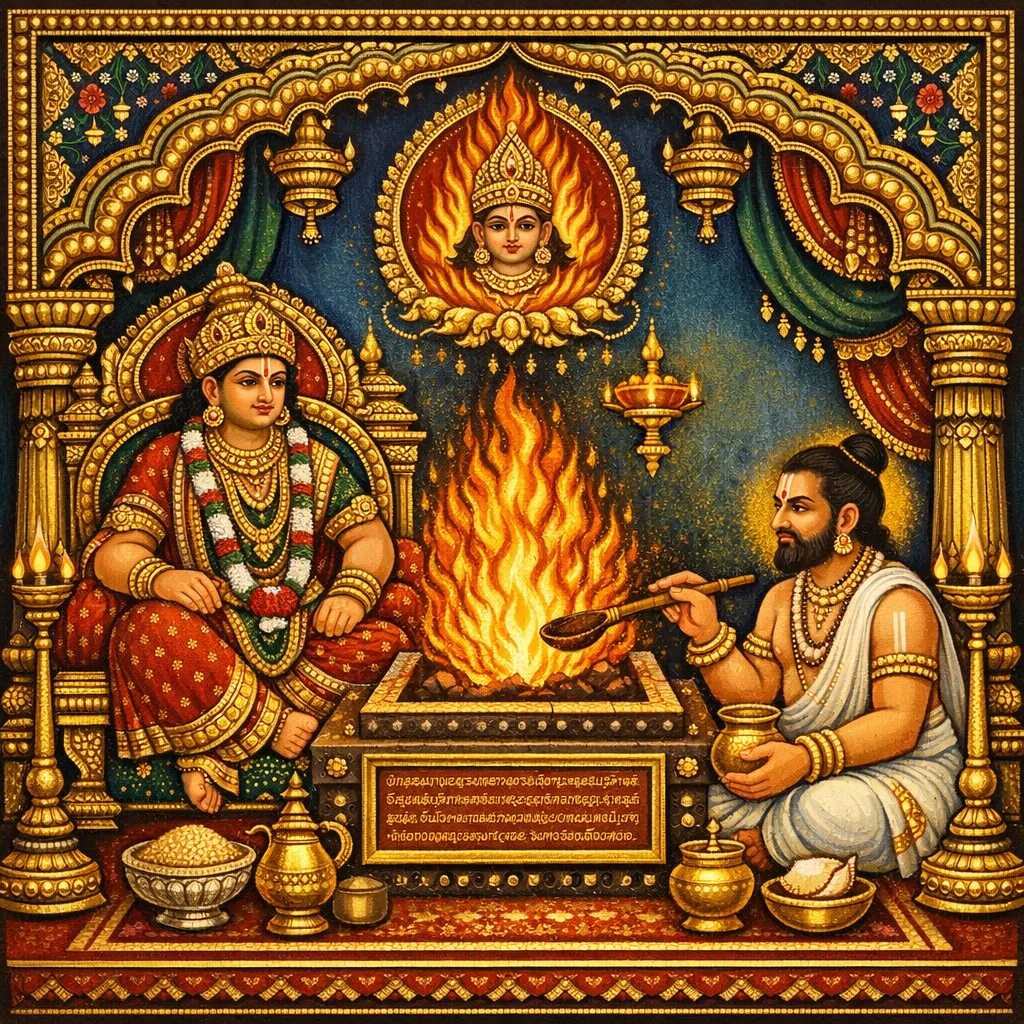
Adhyaya 228
Chapter 228 — स्वप्नाध्यायः (Svapnādhāyaḥ / Chapter on Dreams)
Puṣkara teaches a structured svapna-śāstra within rāja-dharma/nīti: dreams are classed as auspicious, inauspicious, or sorrow-dispelling, and bodily/social images are read as omens. The chapter lists adverse signs—dust/ash on the head, shaving, nakedness, soiled clothes, mud-smearing; falling from heights; and portents such as eclipses, Indra’s banner falling, re-entering the womb, mounting a pyre, disease, defeat, house-collapse, and transgressive acts—then prescribes ways to restore purity and order. Remedies include bathing, honoring brāhmaṇas and teachers, sesame homa, worship of Hari–Brahmā–Śiva–Sūrya–Gaṇas, hymn-recitation, and Puruṣa-sūkta japa. After noting manuscript variants, it says certain auspicious dreams (unctuous drinking/immersion, red garlands, anointments) are especially beneficial when not narrated. A timing doctrine links dream-time to fruition: first watch ≈ one year; then six months, three months, half-month; near dawn up to ten days. One should not sleep again after a good dream; prosperity-omens include seeing king/elephant/horse/gold at the dream’s end, white garments, clear water, fruitful trees, and a spotless sky. Thus omen-lore is joined to ritual discipline and governance-minded ethics: signs are not fatalism, but prompts for dharmic correction.
Shlokas
Verse 1
इत्य् आग्नेये महापुराणे यात्रा नाम सप्तविंशत्यधिकद्विशततमो ऽध्यायः अथाष्टाविंशत्यधिकशततमो ऽध्यायः स्वप्नाध्यायः पुष्कर उवाच स्वप्नं शौभाशुभं वक्ष्ये दुःखप्रहरणन्तथा नाभिं विनान्यत्र गात्रे तृणवृक्षसमुद्भवः
Thus, in the Agni Mahāpurāṇa, the two-hundred-and-twenty-seventh chapter entitled “Journey (Yātrā)” ends. Now begins the two-hundred-and-twenty-eighth chapter, the “Chapter on Dreams.” Puṣkara said: “I shall explain dreams—both auspicious and inauspicious—as well as those that dispel sorrow. (A rule is:) apart from the navel, if in any other part of the body there appears, in a dream, the sprouting of grass or trees, it should be understood as an omen.”}]}}
Verse 2
चूर्णं मूर्ध्नि कांस्यानां मुण्डनं नग्नता तथा मलिनाम्बरधारित्वमभ्यङ्गः पङ्कदिग्धता
Powder (dust/ash) upon the head, the use (or carrying) of bronze vessels, shaving the head, nakedness, wearing soiled garments, anointing the body, and being smeared with mud—these are enumerated as outward conditions/observances.
Verse 3
उच्चात् प्रपतनञ्चैव विवाहो गीतमेव च तन्त्रीवाद्यविनोदश् च दोलारोहणमेव च
Also included are leaping down from a height, marriage festivities, singing, amusement through stringed-instrument music, and riding on a swing.
Verse 4
अर्जनं पद्मलोहानां सर्पाणामथ मारणं शरद्यश्चेति ञ , ट च रक्तपुष्पद्रुमाणाञ्च चण्डालस्य तथैव च
“(Under the syllables) ña and ṭa are indicated: the acquisition/collection of padma-loha, the killing of snakes, and ‘śaradya’ (autumnal matters); likewise mention is made of red-flowering trees, and also of the caṇḍāla.”
Verse 5
वराहाश्वखरोष्ट्राणां तथा चारोहणक्रिया भक्षणं पक्षिमांसानां तैलस्य कृशरस्य च
Likewise, there are restrictions concerning the act of riding pigs, horses, donkeys, and camels, and the eating of the flesh of birds, as well as of oil and of kṛśara (a rice-and-pulse preparation).
Verse 6
मातुः प्रवेशो जठरे चितारोहणमेव च शक्रध्वजाभिपतनं पतनं शशिसूर्ययोः
Entering back into the mother’s womb, ascending the funeral pyre (citā), the falling of Śakra’s (Indra’s) banner, and the eclipse-like “falling” of the Moon and the Sun—these are reckoned as ominous portents.
Verse 7
दिव्यान्तरीक्षभौमानामुत्पातानाञ्च दर्शनं देवद्विजातिभूपानां गुरूणाङ्कोप एव च
The observation of portents (utpāta)—celestial, atmospheric, and terrestrial—and likewise the anger of the gods, the twice-born (dvija), kings, and teachers, should be understood as weighty ominous indicators.
Verse 8
नर्तनं हसनञ्चैव विवाहो गीतमेव च तन्त्रीवाद्यविहीनानां वाद्यानामपि वादनं
Dance and laughter, as well as wedding rites and song—and also the playing of instruments even without stringed (tantrī) accompaniment—are all counted as forms of musical performance.
Verse 9
स्रोतोवहाधोगमनं स्नानं गोमयवारिणा पङ्कोदकेन च तथा मशीतोयेन वाप्यथ
Purification is also effected by moving downstream along a flowing watercourse, and by bathing with water mixed with cow-dung; likewise with muddy water, or even with water mixed with ashes.
Verse 10
आलिङ्गनं कुमारीणां पुरुषाञ्च मैथुनं हानिश् चैव स्वगात्राणां विरेको वमनक्रिया
Embracing unmarried maidens (kumārīs), sexual intercourse with men, and likewise self-injury to one’s own body—such acts are (said to be) treated by purgation (vireka) and therapeutic emesis (vamana).
Verse 11
दक्षिणाशाप्रगमनं व्याधिनाभिभवस् तथा फलानामुपहानिश् च धातूनां भेदनं तथा
Movement toward the southern direction, being overpowered by disease, loss of the expected fruits (results), and likewise the disintegration or derangement of the bodily tissues (dhātus)—these are said to occur.
Verse 12
गृहाणाञ्चैव पतनं गृहसम्मार्जनन्तथा क्रीडा पिशाचक्रव्यादवानरान्त्यनरैर् अपि
There also occur the collapse of houses, the sweeping and cleansing of the dwelling, and playful mischief—brought about even by piśācas, flesh-eating beings, ādas, monkeys, and low or hostile men.
Verse 13
परादभिभवश् चैव तस्माच्च व्यसनोद्भवः काषायवस्त्रधारित्वं तद्वस्त्रैः क्रीडनं तथा
There is also defeat at the hands of others; from that arises misfortune born of vice. (Another sign is) the wearing of ochre garments, and likewise sporting about with such garments.
Verse 14
तन्त्रीवाद्यविनोदश्चेत्यादिः, तैलस्य कृशरस्य चेत्यन्तः पाठः छ , झ पुस्तकद्वये नास्ति विवाहोत्सव एव चेति ज तासामेव च मैथुनमिति ज हानिश् चैवेत्यादिः क्रीडनं तथेत्यन्तः पाठः ज पुस्तके नास्ति स्नेहपानावगाहौ च रक्तमाल्यानुलेपनं इत्यधान्यानि स्वप्नानि तेषामकथनं शुभं
“Beginning with ‘delight in the music of stringed instruments’ and ending with ‘(dreams of) oil and rice-gruel’—this reading is not found in the Cha and Jha manuscripts. The Ja manuscript reads: ‘only a wedding-festival’; and also: ‘sexual union with those very (women)’. The Ja manuscript lacks the passage beginning with ‘loss…’ and ending with ‘play’. As for (dreams such as) drinking ghee/oil, bathing or immersion in unctuous substances, wearing red garlands, and smearing the body with ointments—these and other such dreams are auspicious if they are not narrated (to others).
Verse 15
भूजश् च स्वपनं तद्वत् कार्यां स्नानं द्विजार्चनं तिलैर् होमो हरिब्रह्मशिवार्कगणपूजनं
One should also take food and likewise sleep (in due measure). One should perform bathing, worship of the twice-born (Brāhmaṇas), a fire-offering (homa) with sesame seeds, and worship of Hari (Viṣṇu), Brahmā, Śiva, the Sun, and the Gaṇas.
Verse 16
तथा स्तुतिप्रपठनं पुंसूक्तादिजपस् तथा स्वप्नास्तु प्रथमे यामे संवत्सरविपाकिनः
Likewise, one should recite hymns of praise (stuti), and perform japa of the Puruṣa-sūkta and similar Vedic formulas; and dreams that occur in the first watch of the night come to fruition after (about) a year.
Verse 17
षड्भिर्मासैर् द्वितीये तु त्रिभिर्मासैर् त्रियामिकाः चतुर्थे त्वर्धमासेन दशाहादरुणोदये
In the second grade, the result is attained in six months; in the third, in three months; in the fourth, within half a month; and in the highest case, within ten days—at the time of dawn (aruṇodaya).
Verse 18
एकस्यामथ चेद्रात्रौ शुभं वा यदि वाशुभं पश्चादृष्टस्तु यस्तत्र तस्य पाकं विनिर्दिशेत्
If, within a single night, an omen—auspicious or inauspicious—is seen, then the ripening of the result should be specifically predicted from whatever is seen there afterward.
Verse 19
तस्मात्तु शोभने स्वप्ने पश्चात्स्वापो न शस्यते शैलप्रासादनागाश्ववृषभारोहणं हितं
Therefore, after an auspicious dream, going back to sleep is not recommended. It is beneficial then to dream of mounting a mountain, a palace, an elephant, a horse, or a bull.
Verse 20
द्रुमाणां श्वेतपुष्पाणां गगने च तथा द्विज द्रुमतृणोद्भवो नाभौ तथा च बहुबाहुता
O twice-born one, dream-omens such as seeing trees with white blossoms in the sky, seeing the navel producing sprouts of trees and grasses, and possessing many arms—these are signs described in this context.
Verse 21
तथा च बहुशीर्षत्वं पलितोद्भव एव च सुशुक्रमाल्यधारित्वं सुशुक्लाम्बरधारिता
And likewise: being many-headed; the arising of grey-white hair; wearing a spotless white garland; and being clad in pure white garments.
Verse 22
चन्द्रार्कताराग्रहणं परिमार्जनमेव च शक्रध्वजालिङ्गनञ्च ध्वजोच्छ्रायक्रिया तथा
Also prescribed are observances connected with lunar, solar, and stellar/planetary eclipses; acts of cleansing and purification; the ceremonial embracing or touching of Indra’s banner; and likewise the rite of raising the flag.
Verse 23
भूम्यबुधाराग्रहणं शत्रूणाञ्चैव विक्रिया जयो विवादे द्यूते च सङ्ग्रामे च तथा द्विज
The gainful seizing of land and streams of water, and likewise the discomfiture of enemies—these portend victory in litigation, in gambling, and also in battle, O twice-born one.
Verse 24
भक्षणञ्चार्द्रमांसानाम्पायसस्य च भक्षणं दर्शनं रुधिरस्यापि स्नानं वा रुधिरेण च
Eating moist (raw/undried) meat, and also eating rice-milk (pāyasa); seeing blood; or bathing in blood as well—these are described here as adverse and inauspicious indications.
Verse 25
प्रथमे भागे इति ख भूम्यम्बुधीनां ग्रहणमिति क , छ , ञ च सरारुधिरमद्यानां पानं क्षीरस्य वाप्यथ अस्त्रैर् विचेष्टनं भूमौ निर्मलं गगनं तथा
In the first division of this teaching the syllable “kha” is stated; and “ka”, “cha”, and “ña” are taught as mantric signs for the seizing or control of earth and oceans. Thereafter it is said that one may drink intoxicants—liquor mixed with blood and the like—or even milk; and that, by weapons empowered with such mantras, one may cause abnormal movements upon the ground and likewise render the sky spotless and clear.
Verse 26
मुखेन दोहनं शस्तं महिषीणां तथा गवां सिंहीनां हस्तिनीनाञ्च बडवानां तथैव च
Milking by the mouth (drawing out milk through suction) is prescribed as appropriate for buffalo-cows and likewise for cows, and also for lionesses, she-elephants, and mares as well.
Verse 27
प्रसादो देवविप्रेभ्यो गुरुभ्यश् च तथा द्विज अम्भसा चाभिषेकस्तु गवां शृङ्गच्युतेन च
O twice-born, one should distribute sanctified offerings (prasāda) to the gods, to learned Brahmins, and likewise to one’s teachers; and one should perform the consecratory bathing (abhiṣeka) with water—also with water that has flowed from the tips of cows’ horns.
Verse 28
चन्द्राद् भ्रष्टेन वा राम ज्ञेयं राज्यप्रदं हि तत् राज्याभिषेकश् च तथा छेदनं शिरसो ऽप्यथ
O Rāma, even when (an omen is) fallen away from the Moon, it should be understood as bestowing kingship; likewise it signifies royal consecration (rājābhiṣeka)—and thereafter also the cutting off of the head.
Verse 29
मरणं वह्निलाभश् च वह्निदाहो गृहादिषु लब्धेश् च राजलिङ्गानां तन्त्रीवाद्याभिवादनं
Death; the gaining of fire; a fire-burning in one’s house and the like; the obtaining of royal insignia; and salutations accompanied by stringed instruments and other music—these are stated as significant omens/signs.
Verse 30
यस्तु पश्यति स्वप्नान्ते राजानं कुञ्जरं हयं हिरण्यं वृषभङ्गाञ्च कुटुम्बस्तस्य वर्धते
Whoever, toward the end of a dream, beholds a king, an elephant, a horse, gold, and also bulls and auspicious limbs (or marks), for that person the household and family prosper.
Verse 31
वृषेभगृहशैलाग्रवृक्षारोहणरोदनं घृटविष्ठानुलेपो वा अगम्यागमनं तथा
Crying out while climbing upon a bull, a house, a mountain-peak, or a tree-top; or smearing oneself with ghee (ghṛta) or with excrement; and likewise approaching what is forbidden to approach—these are listed as transgressive and impure acts.
Verse 32
सितवस्त्रं प्रसन्नाम्भः फली वृक्षो नभो ऽमलं
White garments, clear and tranquil water, a fruit-bearing tree, and a spotless sky—these are auspicious signs.
Frequently Asked Questions
Dreams are treated as śubha (auspicious), aśubha (inauspicious), and duḥkha-praharaṇa (sorrow-dispelling), with specific images and bodily/social scenarios mapped to predicted outcomes.
Bathing and purification, honoring brāhmaṇas and gurus, sesame homa, worship of Hari–Brahmā–Śiva–Sūrya–Gaṇas, hymn-recitation, and japa of the Puruṣa-sūkta and related formulas.
By the watch of the night: first watch results mature about a year later; second in six months; third in three months; fourth in half a month; and some culminate within ten days near dawn (aruṇodaya).
It presents a rule that certain prosperity-linked dreams (e.g., unctuous drinking/immersion, red garlands, anointments) retain auspicious potency when kept private, implying restraint and ritual containment of omen-power.
Examples include white garments, clear water, a fruit-bearing tree, a spotless sky, and—toward the end of a dream—seeing a king, elephant, horse, and gold, which is linked to household prosperity.