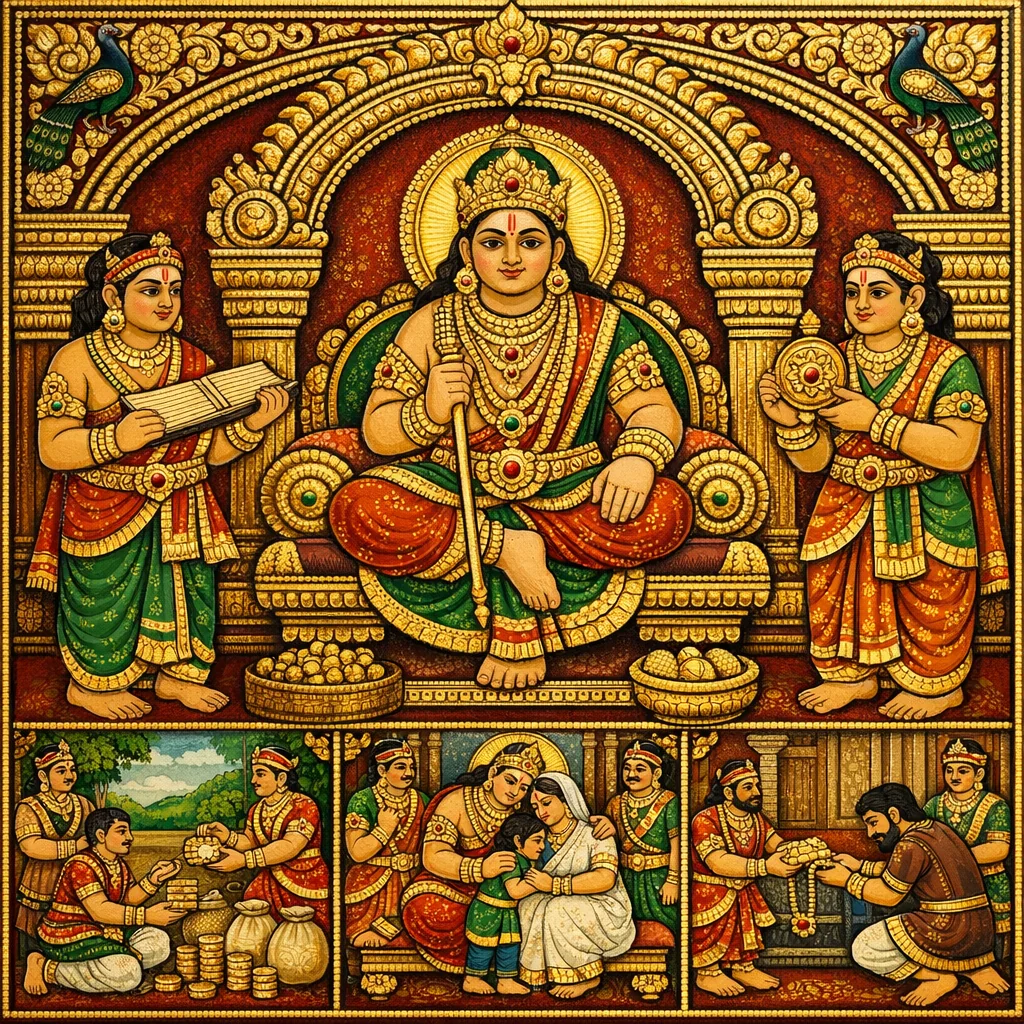
Adhyaya 222
Adhyaya 222 — राजधर्माः (Rājadharmāḥ): Duties of Kings (Administrative Order, Protection, and Revenue Ethics)
This chapter sets out a graded administrative order—village headman, overseer of ten villages, of a hundred villages, and a district governor—insisting that pay match performance and that conduct be continually audited through inspection. Governance is protection-first: the king prospers only when the realm is secure, and failure to protect makes royal religiosity hypocrisy. Artha (wealth) is the working basis of dharma and kāma, yet must be obtained through śāstric taxation and the suppression of the wicked. Legal-ethical duties are detailed: fines for false testimony, custody of ownerless property as a three-year deposit, standards of proof for ownership, and guardianship of minors, daughters, widows, and vulnerable women against unlawful seizure by relatives. The king must generally compensate theft (with recourse against negligent anti-theft officials), while limiting liability for theft within a household. Revenue norms follow: customs duties that allow fair merchant profit, ferry exemptions for women and renunciants, sectoral shares (grain, forest produce, livestock, gold, goods), and a strong welfare mandate—do not tax starving śrotriyas; instead support their livelihood, for their well-being is bound to the kingdom’s health.
Shlokas
Verse 1
आग्नेये महापुराणे राजधर्मो नाम एकविंशत्यधिकद्विशततमो ऽध्यायः तान्न हिंस्याद्यदैव तु इति ज सत्यवान् सुव्रतेन चेति घ , ञ च अथ द्वाविंशत्यधिकद्विशततमो ऽध्यायः राजधर्माः पुष्कर उवाच ग्रामस्याधिपतिं कुर्याद्दशग्रामाधिपं नृपः शतग्रामाधिपञ्चान्यं तथैव विषयेश्वरं
In the Agni Mahāpurāṇa begins the chapter entitled “Rājadharma,” namely Adhyāya 222. (Textual markers and recitational indices follow.) Then begins Adhyāya 223 on the Duties of Kings. Puṣkara said: “A king should appoint a headman for a village, a superintendent over ten villages, another over a hundred villages, and likewise a lord (governor) over a district (viṣaya).”
Verse 2
तेषां भोगविभागश् च भवेत् कर्मानुरूपतः नित्यमेव तथा कार्यं तेषाञ्चारैः परीक्षणं
Their allotment of enjoyments and emoluments should be made in accordance with their deeds and performance; likewise, their conduct should be examined continually through inspectors (spies).
Verse 3
ग्रामे दोषान् समुत्पन्नान् ग्रामेशः प्रसमं नयेत् अशक्तो दशपालस्य स तु गत्वा निवेदयेत्
When offences or disorders arise in a village, the village head should bring them to settlement. If he is unable, then he should go and report the matter to the daśapāla, the officer in charge of ten villages.
Verse 4
श्रुत्वापि दशपालो ऽपि तत्र युक्तिमुपाचरेत् वित्ताद्याप्नोति राजा वै विषयात्तु सुरक्षितात्
Even after hearing (the counsel), the ruler—though protected by the guardians of the ten directions—should still apply practical policy there; for a king truly obtains wealth and the like only from a well-protected realm.
Verse 5
धनवान्धर्ममाप्नोति धनवान् काममश्नुते उच्छिद्यन्ते विना ह्य् अर्थैः क्रिया ग्रीष्मे सरिद्यथा
A person endowed with wealth attains dharma; a person endowed with wealth enjoys kāma. For, without artha (material means), undertakings and rites come to a halt—just as a river dries up in summer.
Verse 6
विशेषो नास्ति लोकेषे पतितस्याधनस्य च पतितान्न तु गृह्णन्ति दरिद्रो न प्रयच्छति
In the world there is no real distinction between one who has fallen (in status or conduct) and one who is without wealth. People accept nothing from the fallen, and the poor person does not give (in charity).
Verse 7
धनहीनस्य भार्यापि नैका स्यादुपवर्तिनी राष्ट्रपीडाकरो राजा नरके वसते चिरं
Even the wife of a man devoid of wealth is not always a single-minded, faithful companion; and a king who oppresses the realm dwells in hell for a long time.
Verse 8
नित्यं राज्ञा तथा भाव्यं गर्भिणी सहधर्मिणी यहा स्वं सुखमुत्सृज्य गर्भस्य सुखमावहेत्
A king should always ensure that his pregnant consort, his partner in dharma, sets aside her own comforts and instead brings about the well-being of the fetus.
Verse 9
विना ह्य् अर्थमिति घ , ञ च नैव स्याद्वशवर्तिनीति ख , ट च नैव स्याद्वशवर्तिनीति घ , ज , ञ च सुखमाहरेदिति ज , ट च किं यज्ञैस्तपसा तस्य प्रजा यस्य न रक्षिताः सुरक्षिताः प्रजा यस्य स्वर्गस्तस्य गृहोपमः
“Without artha (material resources),” (so read some recensions); “she would not remain obedient/under control,” (so read some recensions); “he should bring about welfare/comfort,” (so read some recensions). Of what use are sacrifices and austerities to that ruler whose subjects are not protected? But for the one whose subjects are well-protected, heaven is as though within his own home.
Verse 10
अरक्षिताः प्रजा यस्य नरकं तस्य मन्दिरं राजा षड्भागमादत्ते सुकृताद्दुष्कृतादपि
For the king whose subjects remain unprotected, hell becomes his dwelling. A king takes a one-sixth share—both from their merit and even from their demerit.
Verse 11
धर्मागमो रक्षणाच्च पापमाप्नोत्यरक्षणात् सुभगा विटभीतेव राजवल्लभतस्करैः
By protection, righteousness is secured; by failure to protect, sin is incurred—like a fortunate woman who, fearing a procuress, is also threatened by the king’s favorites and by thieves.
Verse 12
भक्ष्यमाणाः प्रजा रक्ष्याः कायस्थैश् च विशेषतः
Subjects who are being preyed upon (oppressed/harassed) must be protected—especially by the kāyasthas (state scribes/administrative officers).
Verse 13
रक्षिता तद्भयेभ्यस्तु राज्ञो भवति सा प्रजाअप्_२२२०१२च्दरक्षिता सा भवति तेषामेवेह भोजनं दुष्टसम्मर्दनं कुर्याच्छास्त्रोक्तं करमाददेत्
When the people are protected from those fears, they truly belong to the king; when they are unprotected, they do not (truly) belong to him. From them alone, in this realm, the king has his sustenance; therefore he should suppress the wicked and collect taxes as prescribed by the śāstras.
Verse 14
कोषे प्रवेशयेदर्धं नित्यञ्चार्धं द्विजे ददेत् निधिं द्विजोत्तमः प्राप्य गृह्णीयात्सकलं तथा
One should deposit half into the treasury, and continually give the other half to a brāhmaṇa. Likewise, a foremost brāhmaṇa, upon discovering a treasure, may take it entirely.
Verse 15
चतुर्थमष्टमं भागं तथा षोडशमं द्विजः वर्णक्रमेण दद्याच्च निधिं पात्रे तु धर्मतः
A dvija (twice-born man) should, in the proper order of the social classes, give a fourth share, an eighth share, and likewise a sixteenth share; and he should bestow the treasure upon a worthy recipient, in accordance with dharma.
Verse 16
अनृतन्तु वदन् दण्ड्यः सुवित्तस्यांशमष्टमं प्रणष्टस्वामिकमृक्थं राजात्र्यब्दं निधापयेत्
One who speaks falsehood shall be punished with a fine amounting to one-eighth of his wealth. Property whose owner is lost or unknown shall be kept in deposit by the king for three years.
Verse 17
अर्वाक् त्र्यब्दाद्धरेत् स्वामी परेण नृपतिर्हरेत् ममेदमिति यो ब्रूयात् सो ऽर्थयुक्तो यथाविधि
Before three years have passed, the owner himself may recover it; after that, the king should recover it through due legal process. Whoever declares, “This is mine,” must do so with proper grounds and evidence, in the manner prescribed.
Verse 18
सम्पाद्य रूपसङ्ख्यादीन् स्वामी तद् द्रव्यमर्हति सत्प्रजा इति घ , ञ च सुभगा विटभीतेवेत्यादिः, करमाददेदित्यन्तः पाठः झ पुस्तके नास्ति द्विजे ऽर्पयेदिति ञ , ट च अमृतं वदतो ग्राह्यमिति ट बालदायादिकमृक्थं तावद्राजानुपालयेत्
Having ascertained the identifying marks—such as form and number (of the goods)—the rightful owner is entitled to that property. Until minor heirs and the like attain competence, the king should protect their inheritance (estate).
Verse 19
यावत्स्यात्स समावृत्तो यावद्वातीतशैशवः बालपुत्रासु चैवं स्याद्रक्षणं निष्कलासु च
Protection should be maintained until he has completed his period of studentship (brahmacarya) and has passed beyond childhood; in the same way, such guarding should be provided for young daughters as well, and likewise for women who are without (male) guardians.
Verse 20
पतिव्रतासु च स्त्रीषु विधबास्वातुरासु च जीवन्तीनान्तु तासां ये संहरेयुः स्ववान्धवाः
In the case of women devoted to their husbands, widows, and women who are ill—while they are still living—those who, even though their own relatives, seize their property or means of support commit a punishable wrong.
Verse 21
ताञ्छिष्याच्चौरदण्डेन धार्मिकः पृथिवीपतिः सामान्यतो हृतञ्चौरैस्तद्वै दद्यात् स्वयं नृपः
The righteous lord of the earth should punish them with the penalty prescribed for thieves; and whatever has been taken by thieves in general, the king himself should restore to the victims.
Verse 22
चौररक्षाधिकारिभ्यो राजापि हृतमाप्नुयात् अहृते यो हृतं ब्रूयान्निःसार्यो दण्ड्य एव सः
Even the king may recover stolen property from the officials charged with guarding against thieves. But one who, when nothing has been stolen, claims that it has been stolen is to be expelled and is certainly punishable.
Verse 23
न तद्राज्ञा प्रदातव्यं गृहे यद् गृहगैर् हृतं स्वराष्ट्रपण्यादादद्याद्राजा विंशतिमं द्विज
O brāhmaṇa, the king should not compensate for a loss stolen within a house by members of the household. From merchandise traded within his own realm, the king should take a twentieth share.
Verse 24
शुल्कांशं परदेशाच्च क्षयव्ययप्रकाशकं ज्ञात्वा सङ्कल्पयेच्छुल्कं लाभं वणिग्यथाप्नुयात्
Having ascertained the proper portion of customs duty—even for goods coming from foreign regions—and having understood the factors that reveal loss and expenditure, one should determine the duty so that the merchant may obtain a fair profit.
Verse 25
विंशांशं लाभमादद्याद्दण्डनीयस्ततो ऽन्यथा स्त्रीणां प्रव्रजितानाञ्च तरशुल्कं विवर्जयेत्
He should take one-twentieth of the profit as royal revenue; otherwise—if he acts contrary to this rule—he is liable to punishment. And he should remit the ferry-toll for women and for renunciants.
Verse 26
तरेषु दासदोषेण नष्टं दासांस्तु दापयेत् शूकधान्येषु षड्भागं शिम्बिधान्ये तथाष्टमं
If, in matters of crossings (ferries/boats), a loss occurs through the fault of a slave or servant, the slave should be made to pay. For ear-bearing grains (cereals) the due share is one-sixth, and for leguminous grains one-eighth.
Verse 27
राजा वन्यार्थमादद्याद्देशकालानुरूपकं पञ्चषड्भागमादद्याद् राजा पशुहिरण्ययोः
The king should levy a tax on forest produce in a manner suited to the region and the time. From livestock and gold, the king should take a share of one-fifth or one-sixth.
Verse 28
गन्धौषधिरसानाञ्च पुष्पमूलफलस्य च बालदायादिकं युक्तमिति ख , ग , घ , ञ च स्त्रीणाञ्चैव द्विजातीनामिति ट पत्रशाकतृणानाञ्च वंशवैणवचर्मणां
Fragrances, medicinal substances and their extracts/juices, as well as flowers, roots, and fruits, are to be included among the assessable goods. Likewise, matters concerning children, inheritance, and the like are to be duly regulated; and so too affairs concerning women and the twice-born (dvija). Further, leafy vegetables and grasses, as well as bamboo/reed products and hides/leather, are also to be reckoned within the enumerated categories.
Verse 29
वैदलानाञ्च भाण्डानां सर्वस्याश्ममयस्य च षड्भागमेव चादद्यान् मधुमांसस्य सर्पिषः
From wicker/bamboo articles and from vessels, and likewise from all items made of stone, one should take only a sixth share; and likewise from honey, meat, and ghee.
Verse 30
म्रियन्नपि न चादद्याद् ब्राह्मणेभ्यस् तथा करं यस्य राज्ञस्तु विषये श्रोत्रियः सीदति क्षुधा
Even if he were dying, he should not levy such a tax upon Brahmanas—a tax under whose royal jurisdiction a learned Vedic Brahmana (śrotriya) languishes from hunger.
Verse 31
तस्य सीदति तद्राष्ट्रं व्याधिदुर्भिक्षतस्करैः श्रुतं वृत्तन्तु विज्ञाय वृत्तिं तस्य प्रकल्पयेत्
Therefore his kingdom falls into distress through disease, famine, and thieves. Having heard and ascertained the true account of what occurred, the king should arrange for that person a proper livelihood and support.
Verse 32
रक्षेच्च सर्वतस्त्वेनं पिता पुत्रमिवौरसं संरक्ष्यमणो राज्ञा यः कुरुते धर्ममन्वहं
And the king should protect him on all sides, just as a father protects his own legitimate son; for one who is thus protected by the king practices dharma day after day.
Verse 33
तेनायुर्वर्धते राज्ञो द्रविणं राष्ट्रमेव च कर्म कुर्युर् नरेन्द्रस्य मासेनैकञ्च शिल्पिनः
By that arrangement, the king’s lifespan increases, and so do his wealth and the kingdom itself. Artisans should perform the king’s work for a month in turn, each for one month.
Verse 34
भुक्तमात्रेण ये चान्ये स्वशरीरोपजीयिनः
And those others who live only to the extent of what they have just eaten—sustaining themselves merely by the labor of their own bodies.
Frequently Asked Questions
A tiered system: a village headman, an officer over ten villages (daśapāla), another over a hundred villages, and a district governor (viṣayeśvara), with ongoing oversight of conduct and performance-based emoluments.
Protection (rakṣaṇa) is primary: a king gains prosperity from a well-protected realm, incurs sin by failure to protect, and even shares responsibility for the subjects’ merit and demerit.
Taxes must follow śāstric limits (including sixth shares and other sectoral fractions), customs duties should be set after assessing costs so merchants retain fair profit, and certain tolls (e.g., ferries) are waived for women and renunciants.
Ownerless property is held in royal deposit for three years; claims require proper grounds and identification marks (form, number, etc.); after three years, the king may take legal custody per procedure.
The king must protect minors’ estates until maturity, safeguard daughters and unguarded women, punish relatives who unlawfully seize widows’ or sick women’s support, and ensure śrotriya Brahmanas are not taxed into hunger—providing livelihood support instead.