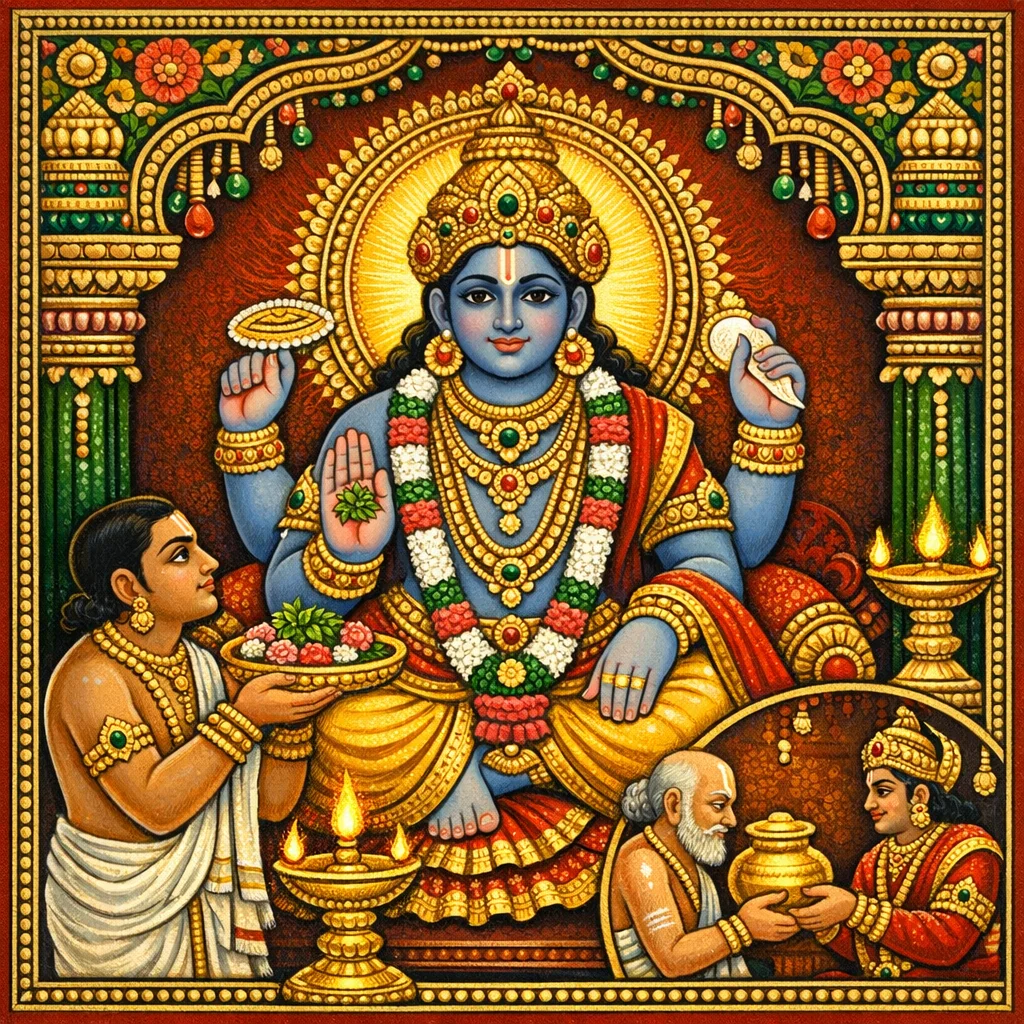
Adhyaya 247
Chapter 247 — पुष्पादिपूजाफलं (Fruits of Worship with Flowers and Other Offerings)
Lord Agni teaches a concise devotional-ritual practice: worship with flowers as a practical means to gain success (siddhi) in all undertakings through Viṣṇu. The chapter lists flowers and leaves approved for arcana—mālatī, mallikā, yūthī, pāṭalā, karavīra, aśoka, kunda, tamāla leaf, bilva and śamī leaves, bhṛṅgarāja, tulasī (in season), vāsaka, ketakī, lotus and red water-lily—while naming items to avoid (arka, unmattaka/dhattūra, kaṅkāñcī). It then links devotion with dāna-śāstra: gifting measured quantities of ghee yields immense merit, kingship, and heavenly attainments. In the Agni Purana’s characteristic synthesis, correct selection of dravyas and disciplined giving become a governance-friendly spirituality, where prosperity, legitimacy, and religious merit reinforce one another under Vaiṣṇava worship.
Shlokas
Verse 1
इत्य् आग्नेये महापुराणे वास्त्वादिर्नाम षट्तचत्वारिंशदधिकद्विशततमो ऽध्यायः अथ सप्तचत्वारिंशदधिकद्विशततमो ऽध्यायः पुष्पादिपूजाफलं अग्निर् उवाच पुष्पैस्तु पूजनाद्विष्णुः सर्वकार्येषु सिद्धिदः मालती मल्लिका यूथी पाटला करवीरकं
Thus, in the Agni Mahāpurāṇa ends the two-hundred-and-forty-sixth chapter entitled “Vāstu and Related Topics.” Now begins the two-hundred-and-forty-seventh chapter: “The fruits of worship with flowers and other offerings.” Agni said: “By worship with flowers, Viṣṇu becomes the bestower of success in all undertakings—offer mālatī, mallikā, yūthī, pāṭalā, and karavīraka.”
Verse 2
पावान्तिरतिमुक्तश् च कर्णिकारः कुराण्टकः सेकः उच्यते इति ख पावन्तिकातिमुक्तश्चेति ग कुब्जकस्तगरो नीपो वाणो वर्वरमल्लिका
‘Pāvānti’ and ‘Atimukta’, as well as ‘Karṇikāra’ and ‘Kurāṇṭaka’—(this plant/drug) is also called ‘Seka’ (so reads the Kha recension). In the Ga recension it reads: ‘Pāvantikā’ and ‘Atimukta’. (Further synonyms:) Kubjaka, Tagara, Nīpa, Vāṇa, and Varvara-mallikā.
Verse 3
अशोकस्तिलकः कुन्दः पूजायै स्यात्तमालजं बिल्वपत्रं शमीपत्रं पत्रं भृङ्गरजस्य तु
For ritual worship, the flowers aśoka, tilaka, and kunda are recommended; likewise the leaf of tamāla, bilva leaves, śamī leaves, and also the leaves of bhṛṅgarāja are prescribed.
Verse 4
तुलसीकालतुलसीपत्रं वासकमर्चने केतकीपत्रपुष्पं च पद्मं रक्तोत्पलादिकं
For worship (arcana), one should offer tulasī leaves—especially tulasī gathered in its proper season—along with vāsaka; also ketakī leaves and flowers, and lotus, red water-lily, and similar flowers.
Verse 5
नार्कन्नोन्मत्तकङ्काञ्ची पूजने गिरिमल्लिका कौटजं शाल्मलीपुष्पं कण्टकारीभवन्नहि
In worship one should not use arka, nor the madana–dhattūra flower, nor kaṅkāñcī. Instead, girimallikā is recommended. Likewise, one should use the flowers of kuṭaja and śālmali; and kaṇṭakārī too is acceptable here.
Verse 6
घृतप्रस्थेन विष्णोश् च स्नानङ्गोकोटिसत्फलं आढकेन तु राजा स्यात् घृतक्षीरैर् दिवं व्रजेत्
By gifting one prastha of ghee (ghṛta), one gains excellent merit equal to performing a koṭi (ten million) bath-rites (snāna) for Viṣṇu. By gifting one āḍhaka, one becomes a king; and by gifting ghee together with milk, one goes to heaven.
Frequently Asked Questions
A prescriptive arcana list (what to offer and what to avoid) plus measurable dāna metrics: one prastha of ghee equated to immense Viṣṇu-bath merit, one āḍhaka linked with kingship, and ghee-with-milk linked with heavenly attainment.
It operationalizes bhakti: disciplined offerings and charitable measures become repeatable practices that convert everyday materials into merit, success, and devotional alignment with Viṣṇu.