Adhyaya 224
Rāja-dharma (राजधर्माः) — Protection of the Heir, Discipline, Counsel, and the Seven Limbs of the State
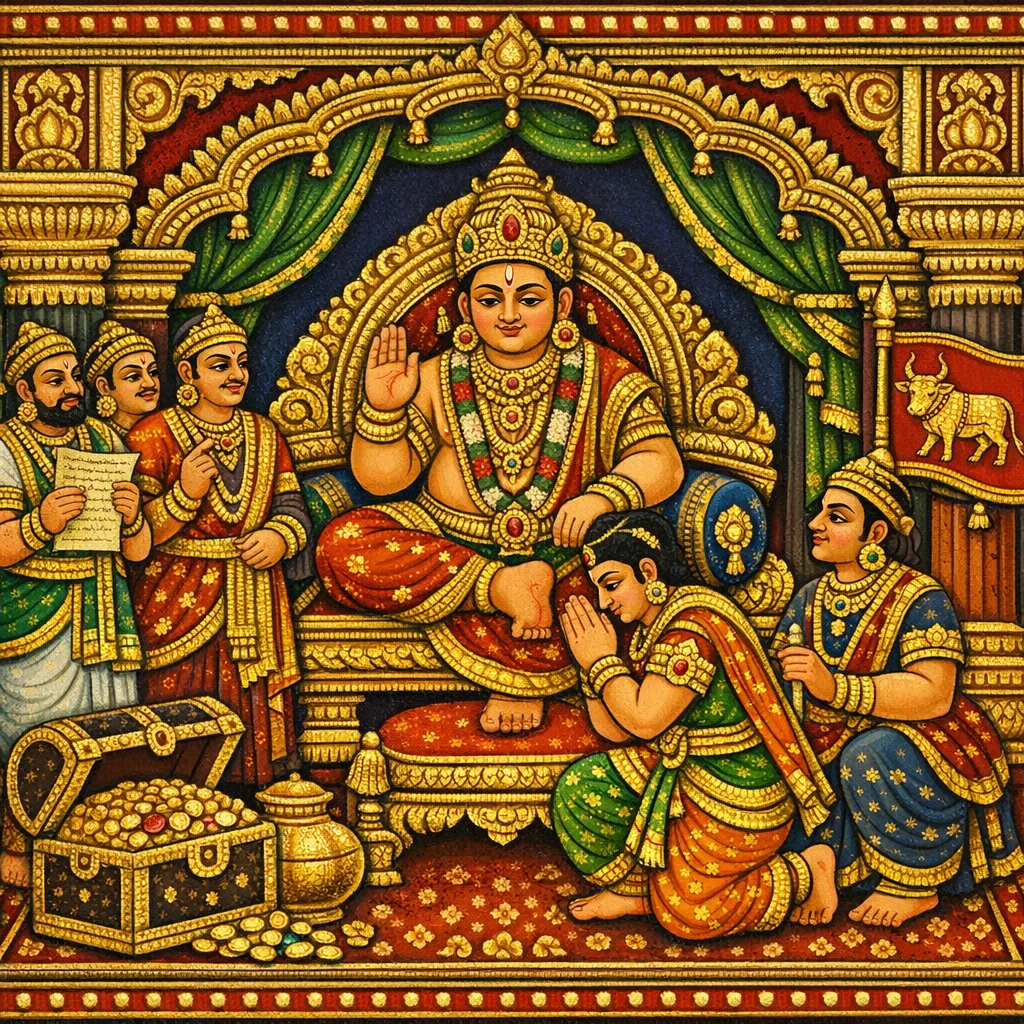
Continuing the Agneya Vidyā’s teaching on governance within rāja-dharma and nīti-śāstra, Puṣkara explains that a king safeguards the realm by first safeguarding the heir: educating the prince in dharma–artha–kāma and dhanurveda, surrounding him with trained and self-controlled influences, and preventing corrupt companionship. The chapter then moves from personal discipline to institutional discipline—appointing the vinīta (well-trained) to offices and renouncing addictions that ruin sovereignty (hunting, drink, dice), along with harsh speech, slander, and financial corruption. It warns against improper giving (wrong time/place/recipient) and urges conquest in graded order: disciplining servants, winning townsmen and countryside, then securing outer defenses (moats). Classical statecraft appears through a threefold typology of allies and the saptāṅga model of the state, with the king as the root needing maximal protection, and punishment calibrated to time and circumstance. A major nīti thread is mantra (counsel): read character through gestures, keep counsel secret, consult selectively and separately, and prevent leakage among ministers. Royal education includes ānvīkṣikī, artha-vidyā, and vārttā, grounded in jitendriyatā (sense-control). The chapter closes with welfare duties (supporting the vulnerable), cautious trust, animal-similes for royal conduct, and the culminating principle that royal prosperity arises from public affection.
Shlokas
Verse 1
इत्य् आग्नेये महाओपुराणे स्त्रीरक्षादिकामशास्त्रं नाम त्रयोविंशत्यधिकद्विशततमो ऽध्यायः अथ चतुर्विंशत्यधिकद्विशततमो ऽध्यायः राजधर्माः पुष्कर उवाच राजपुत्रस्य रक्षा च कर्तव्या पृथिवीक्षिता धर्मार्थकामशास्त्राणि धनुर्वेदञ्च शिक्षयेत्
Thus, in the Agni Mahāpurāṇa ends the two-hundred-and-twenty-third chapter, entitled “Treatise on the Protection of Women and Related Topics of Kāma-śāstra.” Now begins the two-hundred-and-twenty-fourth chapter on Rāja-dharma (the duties of kings). Puṣkara said: “O ruler of the earth, the protection of the prince must indeed be ensured; and he should be instructed in the treatises on dharma, artha, and kāma, as well as in Dhanurveda (the science of archery and warfare).”
Verse 2
शिल्पानि शिक्षयेच्चैवमाप्तैर् मिथ्याप्रियंवदैः शरीररक्षाव्याजेन रक्षिणो ऽस्य नियोजयेत्
Thus, he should be trained in the practical arts by trusted persons who speak agreeable—even if insincere—words; and, under the pretext of safeguarding his body, he should appoint guards for him.
Verse 3
न चास्य सङ्गो दातव्यः क्रुद्धलुब्धविमानितैः अशक्यन्तु गुणाधानं कर्तुं तं बन्धयेत् मुखैः
One should not grant him companionship with those who are wrathful, greedy, or arrogant. If it is impossible to instill virtues in him, then he should be restrained by firm admonitions and reproofs.
Verse 4
अधिकारेषु सर्वेषु विनीतं विनियोजयेत् मृगयां पानमक्षांश् च राज्यनाशंस्त्यजेन्नृपः
In all offices of responsibility, the king should appoint the disciplined and well-trained. A ruler should renounce hunting, drinking, and gambling with dice—vices that bring about the ruin of the kingdom.
Verse 5
दिवास्वप्नं वृथाट्याञ्च वाक्पारुष्यं विवर्जयेत् निन्दाञ्च दण्डपारुष्यमर्थदूषणमुत्सृजेत्
One should avoid sleeping during the day, pointless roaming, and harshness of speech; and one should also give up slander, cruelty in punishment, and the corruption or misappropriation of wealth.
Verse 6
आकाराणां समुछेदो दुर्गादीनामसत्क्रिया अर्थानां दूषणं प्रोक्तं विप्रकीर्णत्वमेव च
The mangling of word-forms, the improper handling of difficult and similar expressions, and the spoiling of meanings—these are declared as faults; and so too is diffuseness, a scattered and incoherent composition.
Verse 7
अदेशकाले यद्दानमपात्रे दानमेव च अर्थेषु दूषणं प्रोक्तमसत्कर्मप्रवर्तनं
A gift given at an improper place and time, and likewise a gift given to an unworthy recipient, is declared a blemish upon one’s wealth and becomes an incitement to unrighteous action.
Verse 8
कामं क्रोधं मदं मानं लोभं दर्पञ्च वर्जयेत् ततो भृत्यजयङ्कृत्वा पौरजानपदं जयेत्
One should renounce desire, anger, intoxication, pride, greed, and arrogance. Then, having first secured the loyalty and discipline of one’s servants and retainers, one should win over the townspeople and the inhabitants of the countryside.
Verse 9
जयेद्वाह्यानरीन् पश्चाद्वाह्याश् च त्रिविधारयः गुरवस्ते यथा पूर्वं कुल्यानन्तरकृत्रिमाः
Having first conquered the external enemies, one should thereafter secure the outer lines of defense by means of three kinds of moats. Their breadth and depth should be as stated earlier; the ditches are to be arranged in sequence, including those made artificially by excavation.
Verse 10
पितृपैतामहं मित्रं सामन्तञ्च तथा रिपोः कृत्रिमञ्च महाभाग मित्रन्त्रिविधमुच्यते
O noble one, a friend is said to be of three kinds: (1) hereditary—handed down from one’s father and grandfather; (2) the neighboring ally, a feudatory or adjacent ruler; and (3) an artificial friend—one formed by policy and advantage, even out of an enemy.
Verse 11
स्वाम्यमात्यञ्जनपदा दुर्गं दण्दस्तथैव च कोषो मित्रञ्च धर्मज्ञ सप्ताङ्गं राज्यमुच्यते
O knower of dharma, the kingdom is said to have seven limbs: the sovereign, the minister(s), the people and territory, the fortified stronghold, coercive authority (punishment/army), the treasury, and allies.
Verse 12
मूलं स्वामी स वै रक्ष्यस्तस्माद्राज्यं विशेषतः राज्याङ्गद्रोहिणं हन्यात्काले तीक्ष्णो मृदुर्भवेत्
The ruler is the very root (foundation); therefore he must indeed be protected—hence the kingdom, above all, must be safeguarded. One should punish, even slay, a traitor to the limbs of the state; yet, according to time and circumstance, one should be stern or gentle.
Verse 13
एवं लोकद्वयं राज्ञो भृत्यैर् हासं विवर्जयेत् भृत्याः परिभवन्तीह नृपं हर्षणसत्कथं
Therefore, the king’s servants should refrain from jesting at the king, for it imperils the king’s welfare in both worlds. Indeed, servants in this world come to slight the ruler when there is flattering talk intended to amuse him.
Verse 14
लोकसङ्ग्रहणार्थाय कृतकव्यसनो भवेत् स्मितपूर्वाभिभाषी स्यात् लोकानां रञ्जनं चरेत्
For the sake of uniting the people and securing their support, one should cultivate refined literary culture. One should speak only after first smiling, and act in ways that delight the people and win their hearts.
Verse 15
दीर्घसूत्रस्य नृपतेः कर्महानिर्ध्रुवं भवेत् रागे दर्पे च माने च द्रोहे पापे च कर्मणि
For a king who procrastinates and drags matters out, failure in governance is certain—especially when actions are driven by attachment, arrogance, pride, treachery, and sinful conduct.
Verse 16
अप्रिये चैव वक्तव्ये दीर्घसूत्रः प्रशस्यते सुप्तमन्त्रो भवेद्राजा नापदो गुप्तमन्त्रतः
Even when something unpleasant must be said, one who proceeds with deliberation is praised. A king should keep his counsel concealed; from guarded counsel, no calamities arise.
Verse 17
तस्माद्राष्ट्रमिति ख , ग , घ , छ , ज , ञ , ट च ज्ञायते हि कृतं कर्म नारब्धं तस्य राज्यकं आकारैर् इङ्गितैर् गत्या चेष्टया भाषितेन च
Therefore, from the syllables kha, ga, gha, cha, ja, ña, and ṭa, the term ‘rāṣṭra’ (realm/state) is understood. Indeed, a king’s accomplished deeds and his yet-unbegun royal enterprise are known through his facial expressions, gestures, gait, movements, and speech.
Verse 18
नेत्रवक्तविकाराभ्यां गृह्यते ऽन्तर्गतं पुनः नैकस्तु मन्त्रयेन् मन्त्रं न राजा बहुभिः सह
What is held inwardly is again inferred from changes in the eyes and in the expression of the face. Therefore, one should not deliberate on counsel (mantra) alone, nor should a king deliberate with many people together.
Verse 19
बहुभिर्मन्त्रयेत् कामं राजा मन्त्रान् पृथक् पृथक् मन्त्रिणामपि नो कुर्यान् मन्त्री मन्त्रप्रकाशनं
A king may, as he deems fit, deliberate on policies with many advisers, taking each matter separately; but a minister, even among fellow ministers, should not disclose the king’s counsel (mantra), i.e., confidential deliberations.
Verse 20
क्वापि कस्यापि विश्वासो भवतीह सदा नृणां निश् चयश् च तथा मन्त्रे कार्य एकेन सूरिणा
In this world, people may at times place trust in someone; but in matters of counsel (mantra), a firm decision should be carried out by a single wise person.
Verse 21
नश्येदविनयाद्राजा राज्यञ्च विनयाल्लभेत् त्रैविद्येभ्यस्त्रयीं विद्यां दण्डनीतिञ्च शाश्वतीं
A king perishes through lack of discipline; and through discipline he attains sovereignty. From the masters of the three Vedas he should learn the threefold Vedic knowledge, and also the perennial daṇḍanīti, the science of governance through punishment.
Verse 22
आन्वीक्षिकीञ्चार्थविद्यां वार्तारम्भांश् च लोकतः जितेन्द्रियो हि शक्नोति वशे स्थापयितुं प्रजाः
For only one who has conquered the senses (jiteindriya) can, through ānvīkṣikī (inquiry), artha-vidyā (the science of polity and wealth), and vārttā (practical undertakings of livelihood) learned from the world, succeed in bringing the subjects under orderly governance.
Verse 23
पूज्या देवा द्विजाः सर्वे दद्याद्दानानि तेषु च द्विजे दानञ्चाक्षयो ऽयं निधिः कैश्चिन्न नाश्यते
All the gods and all the twice-born are worthy of reverence; one should give gifts to them. A gift given to a twice-born is an inexhaustible treasure—by no means does it perish.
Verse 24
सङ्ग्रामेष्वनिवर्तित्वं प्रजानां परिपालनं दानानि ब्राह्मणानाञ्च राज्ञो निःश्रेयसम्परं
For a king, steadfastness without retreat in battles, the protection and proper governance of the subjects, and gifts—especially to Brahmins—these are the supreme means leading to final blessedness (niḥśreyasa).
Verse 25
कृपणानाथवृद्धानां विधवानाञ्च योषितां योगक्षेमञ्च वृत्तिञ्च तथैव परिकल्पयेत्
He should duly provide both protection and maintenance, and likewise means of livelihood, for the destitute, the unprotected, the aged, and for widowed women.
Verse 26
वर्णाश्रमव्यवस्थानं कार्यन्तापसपूजनं न विश्वसेच्च सर्वत्र तापसेषु च विश्वसेत्
One should uphold the proper ordering of varṇa and āśrama, and one should honor ascetics. Yet one should not place trust everywhere indiscriminately; rather, one should place trust in ascetics (who are truly disciplined).
Verse 27
विश्वासयेच्चापि परन्तत्त्वभूतेन हेतुना तस्य कर्मकमिति ख क्वचित् कस्यापि इति ख , ग , घ , ज , ट च वकविच्चिन्तयेदर्थं सिंहवच्च पराक्रमेत्
One should also inspire confidence in others by a reason grounded in the highest principle; this is his proper course of action. In certain cases (as the readings vary), the eloquent and discerning person should reflect upon the intended objective and then act with valor like a lion.
Verse 28
वृकवच्चावलुम्पेत शशवच्च विनिष्पतेत् दृढप्रहरी च भवेत् तथा शूकरवन्नृपः
Like a wolf he should seize and plunder; like a hare he should swiftly spring away; he should strike firmly and resolutely—and, like a boar, the king should press forward without relent.
Verse 29
चित्रकारश् च शिखिवद् दृढभक्तिस् तथाश्ववत् भवेच्च मधुराभाषी तथा कोकिलवन्नृपः
A painter should be steadfast in devotion like a peacock, and like a horse—disciplined and fit for service. The king, likewise, should speak sweetly, like a cuckoo.
Verse 30
काकशङ्की भवेन्नित्यमज्ञातां वसतिं वसेत् नापरीक्षितपूर्वञ्च भोजनं शयनं स्पृशेत्
One should always remain wary like a crow, dwell in a place whose conditions are understood, and not partake of food nor use a bed that has not been examined beforehand.
Verse 31
नाविज्ञातां स्त्रियं गच्छेन्नाज्ञातां नावमारुद्वेत् राष्ट्रकर्षी भ्रस्यते च राज्यार्थाच्चैव जीवितात्
One should not approach an unknown woman, nor board an unknown boat. For one who drains and exploits the kingdom falls away—losing the very purpose of sovereignty and even life itself.
Verse 32
भृतो वत्सो जातबलः कर्मयोग्यो यथा भवेत् तथा राष्ट्रं महाभाग भृतं कर्मसहं भवेत्
Just as a reared calf, once it has grown strong, becomes fit for work, so too, O noble one, a well-maintained kingdom becomes capable of bearing and accomplishing tasks.
Verse 33
सर्वं कर्मेदमायत्तं विधाने दैवपौरुषे तयोर्दैवमचिन्त्यं हि पौरुषे विद्यते क्रिया
All action in this world depends upon the ordained order comprising destiny (daiva) and human effort (pauruṣa). Of the two, destiny is indeed inscrutable; but in human effort, deliberate action is found.
Verse 34
जनानुरागप्रभवा राज्ञो राज्यमहीश्रियः
A king’s sovereignty and the great prosperity of his realm arise from the people’s affection and goodwill.
Frequently Asked Questions
It prioritizes the prince’s protection and education in dharma-artha-kāma śāstras and dhanurveda, appoints guards under the pretext of bodily safety, and restricts harmful companionship while enforcing virtue through firm admonition when needed.
Hunting, drinking, and gambling with dice are explicitly called causes of state-ruin, alongside day-sleep, aimless roaming, harsh speech, slander, cruelty in punishment, and corruption of wealth.
It lists: the sovereign (svāmī), ministers (amātya), people/territory (janapada), fort (durga), coercive power/punishment/army (daṇḍa), treasury (kośa), and allies (mitra), stressing the king as the root to be protected.
A king should not deliberate alone or with many at once; he may consult many advisers separately, but counsel must remain concealed, and ministers must not disclose deliberations—even among themselves.
It teaches that steadfastness in battle, protection of subjects, and charity—especially to the twice-born—lead to supreme welfare, integrating statecraft with dharmic and transcendent aims.