Adhyaya 231
Chapter 231 — शकुनानि (Śakunāni) | Omens in Governance, Travel, and War
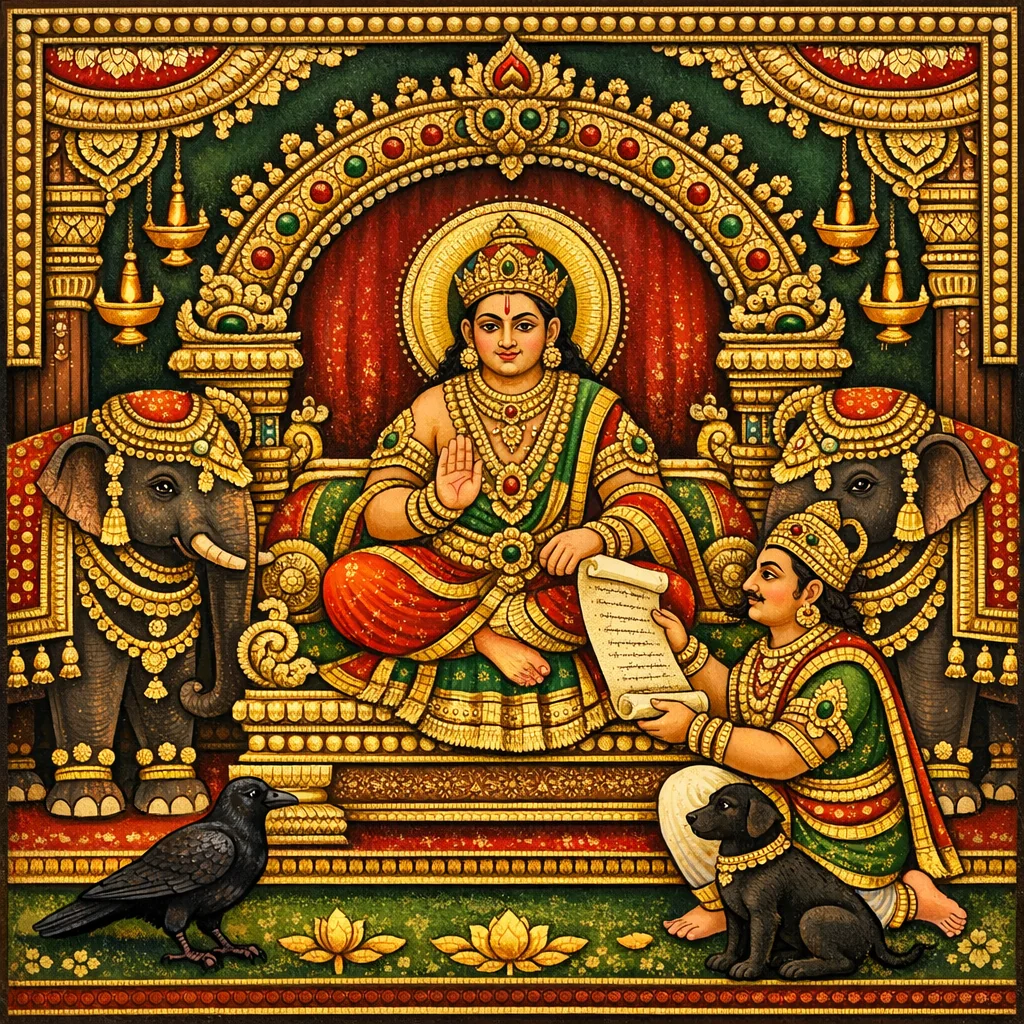
This chapter weaves omen-lore (śakuna-śāstra) into rāja-dharma and niti, treating signs as actionable intelligence for kings, commanders, and travellers. It begins with crow-omens tied to siegecraft and the capture of cities, then extends to camp and journey indicators: left/right placement, frontal approach, and patterns of calls. Practical social cautions are interlaced—such as suspicious “crow-like” movement near a doorway implying arson or deceit—and rules are given for handling evidentiary tokens and for interpreting gains and losses of property. A wider taxonomy follows: dog-omens (barking, howling, sniffing left/right), bodily and behavioral portents (trembling, bleeding, sleep patterns), and animal signs linked to royal fate (bulls, horses, elephants—especially musth, mating, or post-calving states). Battlefield and expedition outcomes are correlated with auspicious directions, winds, planetary conditions, and disruptions like falling umbrellas. The chapter culminates in victory and defeat markers: cheerful troops and favorable planetary motion promise success, while carrion-eaters and crows overwhelming warriors foretell realm-decay—thus placing omen-reading within strategic prudence and dhārmic kingship.
Shlokas
Verse 1
मल्लब्धेषु नवपुस्तकेषु प्रायः समान एव तेषामेकतमस्यापि साहाय्येन शोधितुं न स शक्यते अभिधानादिष्वपि तत्रत्यशब्दो नोपलभ्यन्ते अतस्तत्र विरतिः अथैकत्रिंशदधिकद्विशततमो ऽध्यायः शकुनानि पुष्कर उवाच विशन्ति येन मार्गेण वायसा बहवः पुरं तेन मार्गेण रुद्धस्य पुरस्य ग्रहणं भवेत्
In the newly obtained manuscripts the reading is almost the same; even with the help of any one of them it cannot be properly emended. Even in dictionaries and the like, the word occurring there is not found; therefore we desist at that point. Now begins the two-hundred-and-thirty-first chapter, “Omens.” Puṣkara said: “By whatever route many crows enter a city, by that very route the capture of a besieged city may be accomplished.”
Verse 2
सेनायां यदि वासार्थे निविष्टो वायसो रुवन् वामो भयातुरस्त्रस्तो भयं वदति दुस्तरं
If, in an army-camp set up for lodging, a crow settles there cawing on the left, distressed and startled, it foretells a formidable danger.
Verse 3
छायाङ्गवाहनोपानच्छत्रवस्त्रादिकुट्टने मृत्युस्तत्पूजने पूजा तदिष्टकरणे शुभं
If one strikes or damages (in anger or contempt) a shadow, a limb, a conveyance, footwear, an umbrella, clothing, and similar items, it is an omen of death; worship offered to those (items or their presiding powers) yields the fruit of worship, and the fulfillment of one’s desired aim is auspicious.
Verse 4
प्रोषितागमकृत्काकः कुर्वन् द्वारि गतागतं रक्तं दग्धं गृहे द्रव्यं क्षिपन्वह्निवेदकः
He is one who behaves like a crow, contriving pretexts for coming and going while the master is away; he keeps moving to and fro at the doorway, and he throws into the house substances that are red or burnt—thus indicating (or preparing) fire (i.e., arson).
Verse 5
न्यसेद्रक्तं पुरस्ताच्च निवेदयति बन्धनं पीतं द्रव्यं तथा रुक्म रूप्यमेव तु भार्गव
O Bhārgava, he should place a red token in front as evidence, and he should declare the pledge: namely, the yellow property (i.e., gold)—indeed gold and silver.
Verse 6
यच्चैवोपनयेद् द्रव्यं तस्य लब्धिं विनिर्दिशेत् द्रव्यं वापनयेद्यत्तु तस्य हानिं विनिर्दिशेत्
Whatever property a person brings in (and causes to be produced), that should be determined as his gain. But whatever property he causes to be taken away, that should be determined as his loss.
Verse 7
पुरतो धनलब्धिः स्यादाममांसस्य छर्दने भूलब्धिः स्यान् मृदः क्षेपे राज्यं रत्नार्पणे महत्
If (in a dream/omen) wealth appears in front, there will be gain of money. If one vomits raw flesh, there will be acquisition of land. If one throws clods of earth, (one attains) kingship; and by offering a jewel, (one attains) great prosperity and sovereign fortune.
Verse 8
यातुः काको ऽनुकूलस्तु क्षेमः कर्मक्षमो भवेत् न त्वर्थसाधको ज्ञेयः प्रतिकूलो भयावहः
For one setting out on a journey, a crow—if favorable—indicates safety and that the undertaking will proceed effectively; yet it should not be regarded as a sign of gaining wealth. If unfavorable, it is known to be fear-producing.
Verse 9
सम्मुखे ऽभ्येति विरुवन् यात्राघातकरो भवेत् वामः काकः स्मृतो धन्यो दक्षिणो ऽर्थविनाशकृत्
If a crow approaches from the front while crying, it becomes an omen that obstructs or harms the journey. A crow appearing on the left is remembered as auspicious and prosperity-giving, whereas one on the right causes loss of wealth.
Verse 10
दुष्करमिति ख , छ च दक्षिणो ऽन्नविनाशकृदिति ग , घ , ञ च वामो ऽनुलोमगः श्रेष्ठो मध्यमो दक्षिणः स्मृतः प्रतिलोमगतिर्वामो गमनप्रतिषेधकृत्
“Duṣkara” is the name of the metrical caesura/break in the cases of kha and cha; and in the cases of ga, gha, and ña it is called “Dakṣiṇa, the destroyer of food” (that is, of smooth recitation). The “Vāma” (left) movement that proceeds in the forward order (anuloma) is the best; the “Dakṣiṇa” is regarded as middling. The “Vāma” that proceeds in reverse order (pratiloma) causes obstruction to movement (hindering fluent metrical progression).
Verse 11
निवेदयति यात्रार्थमभिप्रेतं गृहे गतः एकाक्षरचरणस्त्वर्कं वीक्षमाणो भयावहः
If, after entering one’s house, a person announces the intended departure on a journey—and a one‑eyed man comes walking while staring at the sun—this is a fearsome omen, indicating danger.
Verse 12
कोटरे वासमानश् च महानर्थकरो भवेत् न शुभस्तूषरे काकः पङ्काङ्कः स तु शस्यते
One who dwells in a hollow (cavity) becomes a great cause of misfortune. A crow on dry chaff is not auspicious; but one marked with mud (having come from wet ground) is regarded as favorable.
Verse 13
अमेध्यपूर्णवदनः काकः सर्वार्थसाधकः ज्ञेयाः पतत्रिणो ऽन्ये ऽपि काकवद् भृगुनन्दन
The crow—its beak filled with impure matter—is to be known as an accomplisher of all aims (an auspicious omen of success). Other birds too should be understood in the same manner as the crow, O delight of Bhṛgu’s line.
Verse 14
स्कन्धावारापसव्यस्थाः श्वानो विप्रविनाशकाः इन्द्रस्थाने नरेन्द्रस्य पुरेशस्य तु गोपुरे
Dogs stationed on the apasavya (left/contrary, inauspicious) side of the army-camp are said to be destroyers of brāhmaṇas; this omen is noted at the king’s ‘Indra-position’ and at the city-lord’s gate-tower (gopura).
Verse 15
अन्तर्गृहे गृहेशस्य मरणाय भवेद्भषन् यस्य जिघ्रति वामाङ्गं तस्य स्यादर्थसिद्धये
If a dog barks within the house, it becomes an omen of death for the master of the household. But if it sniffs a person’s left side, that is said to bring success in gaining wealth (the desired object).
Verse 16
भयाय दक्षिणं चाङ्गं तथा भुजमदक्षिणं यात्राघातकरो यातुर्भवेत् प्रतिमुखागतः
If, for the traveller, twitching on the right side of the body (or a limb) signifies fear, and likewise twitching of the left arm is inauspicious, then one who comes facing him from the front becomes an obstacle that can hinder the journey.
Verse 17
मार्गावरोधको मार्गे चौरान् वदति भार्गव अलाभो ऽस्थिमुखः पापो रज्जुचीरमुखस् तथा
O Bhārgava, one who obstructs the roadway on the path is called a “road-blocker”; and another is one who points out or informs about thieves on the road. Likewise, there are offenders known as “Alābha”, “Asthimukha” (“bone-faced”), the sinful one (pāpa), and “Rajjucīramukha” (“rope-and-rag-faced”).
Verse 18
सोपानत्कमुखो धन्यो मांसपूर्णमुखो ऽपि च अमङ्गल्यमुखद्रव्यं केशञ्चैवाशुभं तथा
One whose mouth is seen together with a sandal at the threshold is regarded as auspicious; likewise, one whose mouth is filled with meat is also taken as auspicious. But substances that, when seen at the mouth, indicate inauspiciousness—and likewise hair—are inauspicious.
Verse 19
अवमूत्र्याग्रतो याति यस्य तस्य भयं भवेत् यस्यावमूत्र्य व्रजति शुभं देशन्तथा द्रुमं
If, after urinating, one proceeds straight ahead (leaving the urine behind), fear will arise for that person. But if, after urinating, one departs toward an auspicious place—likewise toward a sacred or fortunate tree—it is favorable.
Verse 20
नन्वर्थसाधक इत्य् आदिः, गृहे गत इत्य् अन्तःः पाठः ट पुस्तके नास्ति कोटरे इत्य् आदिः सर्वार्थसाधक इत्य् अन्तः पाठः टपुस्तके नास्ति मङ्गलञ्च तथा द्रव्यं तस्य स्यादर्थसिद्धये श्ववच्च राम विज्ञेयास् तथा वै जम्बुकादयः
“(Textual note:) From ‘nanv arthasādhaka…’ up to ‘gṛhe gata…’ this reading is not found in the ṭa-manuscript; and from ‘koṭare…’ up to ‘sarvārthasādhaka…’ this reading too is not found in the ṭa-manuscript. (Main verse:) Auspiciousness and material means should be secured for the accomplishment of one’s aim; and dogs—O Rāma—are to be understood in omen-lore, and so too jackals and the like.”
Verse 21
भयाय स्वामिनि ज्ञेयमनिमित्तं रुतङ्गवां निशि चौरभयाय स्याद्विकृतं मृत्यवे तथा
The causeless howling of dogs should be understood as a sign of danger to the master; at night it indicates fear from thieves; and if the sound is abnormal or distorted, it likewise signifies death.
Verse 22
शिवाय स्वामिनो रात्रौ बलीवर्दो नदन् भवेत् उत्सृष्टवृषभो राज्ञो विजयं सम्प्रयच्छति
If, at night, an ox bellows, it is auspicious for its master. A bull set loose grants victory to the king.
Verse 23
अभयं भक्षयन्त्यश् च गावो दत्तास् तथा स्वकाः त्यक्तस्नेहाः स्ववत्सेषु गर्भक्षयकरा मताः
Cows that have been given away—whether belonging to another or one’s own—when they feed on a plant called Abhayā, are regarded as losing their affection for their own calves and as causing miscarriage (loss of the fetus).
Verse 24
भूमिं पादैर् विनिघ्नन्त्यो दीना भीता भयावहाः आर्द्राङ्ग्यो हृष्टरोमाश् च शृगलग्नमृदः शुभाः
Striking the ground with their feet—wretched, frightened, and terrifying—(women) with damp limbs and bristling hair, and (those) whose bodies are smeared with jackal-clinging mud: these are auspicious omens.
Verse 25
महिष्यादिषु चाप्येतत् सर्वं वाच्यं विजानता आरोहणं तथान्येन सपर्याणस्य वाजिनः
All of this, too, should be properly proclaimed by one who knows the procedure in the case of the buffalo and the other mounts; likewise, in the case of a horse that is being duly honored and attended with service, the mounting should be done by another person.
Verse 26
जलोपवेशनं नेष्टं भूमौ च परिवर्तनं विपत्करन्तुरङ्गस्य सुप्तं वाप्यनिमित्ततः
Sitting down in water is inauspicious; likewise, rolling about on the ground. Moreover, for one whose body is moving toward calamity, sleep that arises without any evident cause is an ill omen.
Verse 27
यवमोदकयोर्द्वेषस्त्वकस्माच्च न शस्यते वदनाद्रुधिरोत्पत्तिर्वेपनं न च शस्यते
A sudden aversion to barley or to sweet cakes (modaka) is not regarded as auspicious. Likewise, the appearance of blood from the mouth and trembling are not considered favorable signs.
Verse 28
क्रीडन् वैकः कपोतैश् च सारिकाभिर्मृतिं वदेत् साश्रुनेत्रो जिह्वया च पादलेही विनष्टये
If a solitary bird is seen sporting with pigeons and mynas (sārika), it is said to foretell death. Likewise, one whose eyes are tearful, and one who licks the feet with the tongue, are portents of ruin.
Verse 29
वामपादेन च तथा विलिखंश् च वसुन्धरां स्वपेद्वा वामपार्श्वेन दिवा वा न शुभप्रदः
Likewise, one who scratches or marks the ground with the left foot, or sleeps on the left side, or sleeps during the daytime—these are not regarded as auspicious (they do not bring good results).
Verse 30
भयाय स्यात् सकृन्मूत्री तथा निद्राविलाननः सपर्यार्हस्येति साधुः विनाशकृदिति ज , ट च आरोहणं न चेद्दद्यात् प्रतीपं वा गृहं व्रजेत्
It portends fear if one urinates only once (at the outset) or if one’s face is dull with sleep. (At that time, if someone says) “He is worthy of honor and service,” it is auspicious; but the syllables “ja” and “ṭa” are said to bring destruction. If one does not grant (as is customary) a mount or vehicle for departure, or if something adverse occurs, one should turn back and go home.
Verse 31
यात्राविघातमाचष्टे वामपार्श्वं तथा स्पृशन् हेषमाणः शत्रुयोधं पादस्पर्शी जयावहः
If (the horse) touches its left flank, it foretells an obstruction to the journey. If it neighs and touches (the ground) with its hoof, it indicates combat with the enemy; a hoof-touching horse is a bringer of victory.
Verse 32
ग्रामे व्रजति नागश्चेन् मैथुनं देशहा भवेत् प्रसूता नागवनिता मत्ता चान्ताय भूपतेः
If an elephant enters a village, it signifies the land being laid waste; if it is in mating, it indicates the loss of territory. A she-elephant that has recently calved, or an elephant in musth—these are portents of the king’s end (death/destruction).
Verse 33
आरोहणं न चेद्दद्यात् प्रतीपं वा गृहं व्रजेत् मदं वा वारणो जह्याद्राजघातकरो भवेत्
If one does not provide a means for mounting (a seat or conveyance), or goes to a house in a hostile, oppositional manner, or causes an elephant to lose its musth, one becomes an agent and cause of the king’s death.
Verse 34
वामं दक्षिणपादेन पादमाक्रमते शुभः दक्षिणञ्च तथा दन्तं परिमार्ष्टि करेण च
It is auspicious when, with the right foot, one steps over (or places it upon) the left foot; and likewise when one wipes (rubs/cleans) the teeth on the right side with the hand.
Verse 35
वृषो ऽश्वः कुञ्जरो वापि रिपुसैन्यगतो ऽशुभः खण्डमेघातिवृष्ट्या तु सेना नाशमवाप्नुयात्
If a bull, a horse, or even an elephant enters the enemy’s army as an inauspicious sign, then—when there is excessive rainfall from broken, scattered clouds—the army would meet with destruction.
Verse 36
प्रतिकूलग्रहर्क्षात्तु तथा सम्मुखमारुतात् यात्राकाले रणे वापि छत्रादिपतनं भयं
But when the planets and lunar mansions (nakṣatras) are adverse, and likewise when a wind blows straight against one, then at the time of setting out on a journey—or even in battle—there is danger: the falling of an umbrella and the like is an inauspicious omen.
Verse 37
हृष्टा नराश्चानुलोमा ग्रहा वै जयलक्षणं काकैर् योधाभिभवनं क्रव्याद्भिर्मण्डलक्षयः
Men being cheerful, and the planets moving in a favorable direct course (anuloma)—these are indeed signs of victory. But if crows overpower the warriors and carrion-eaters prevail, it indicates the ruin of the maṇḍala, the circle of dominion.
Verse 38
प्राचीपश्चिमकैशानी शौम्या प्रेष्ठा शुभा च दिक्
The directions—East, West, and Īśāna (the north‑east)—are gentle, most beloved, and auspicious.
Frequently Asked Questions
It treats omens as situational indicators for decisions in siege, travel, and war—e.g., crow-entry routes for capturing a besieged city, and adverse winds/planetary conditions as signals to anticipate danger or delay action.
A recurring rule is vāma (left) as auspicious in many contexts (e.g., crow on the left; dog sniffing the left side), while frontal obstruction, distorted howling, adverse winds, and certain elephant states (musth, mating, post-calving) are strongly inauspicious for royal security.