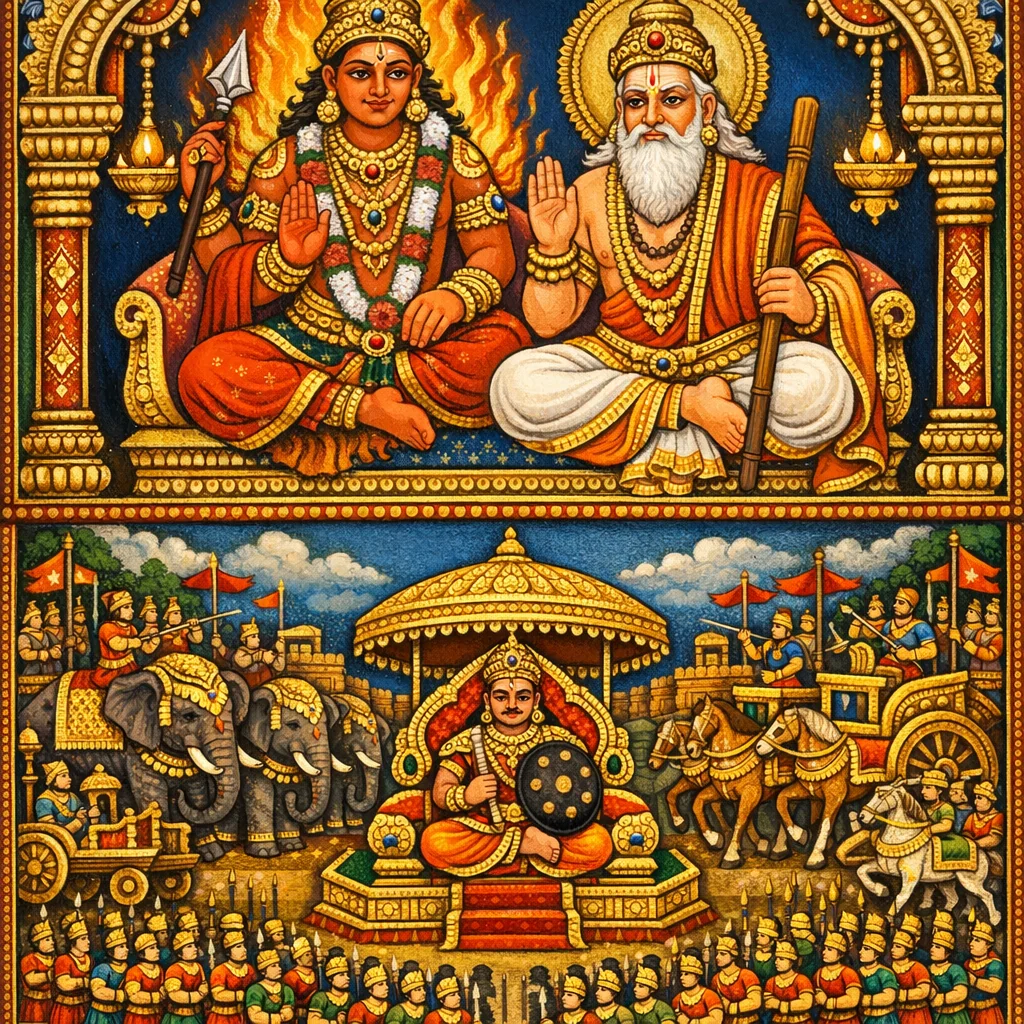
Adhyaya 241
Rājanīti (Statecraft): Ṣaḍvidha-bala, Vyūha-vidhāna, and Strategic Warfare
This chapter opens the Rājanīti section, defining royal power as a disciplined union of counsel (mantra), treasury (kośa), and the four arms of the army. Rāma teaches that war should begin with divine worship and with clear knowledge of the sixfold force: standing troops, levies, allies, defectors/hostile elements, and forest or tribal contingents, weighed by importance and vulnerability. It then sets out operational doctrine—how commanders move through dangerous terrain, safeguard the king, household, and treasury, and arrange layered flanks (horse–chariot–elephant–forest troops). Major battle formations are listed (makara, śyena, sūcī, vīravaktrā, śakaṭa, vajra, sarvatobhadra), along with guidance on when open battle or covert/deceptive warfare is proper, stressing timing, terrain, fatigue, supply strain, and psychological weakness. Finally, it codifies unit measures, the anatomy of formations (uras, kakṣā, pakṣa, madhya, pṛṣṭha, pratigraha), and a taxonomy of daṇḍa/maṇḍala/bhoga arrays, presenting war-craft as a dharmic science aimed at victory with order, protection, and strategic clarity.
Shlokas
Verse 1
इत्य् आग्नेये महापुराणे सामादिर्नाम चत्वारिंशदध्कद्विशततमो ऽध्यायः अथ एकचत्वारिंशदधिकद्विशततमो ऽध्यायः राजनीतिः राम उवाच षड्विधन्तु बलं व्यूह्य देवान् प्रार्च्य रिपुं व्रजेत् मौलं भूतं श्रोणिसुहृद्द्विषदाटविकं बलं
Thus, in the Agni Mahāpurāṇa, the two-hundred-and-fortieth chapter named “Sāmādi” ends. Now begins the two-hundred-and-forty-first chapter: “Rājanīti” (Statecraft). Rāma said: “Having arrayed the army in its sixfold composition, and after duly worshipping the gods, one should march against the enemy—namely the hereditary/standing troops, levies, allies and friendly contingents, hostile deserters/defectors, and forest-tribal forces—this constitutes the sixfold army strength.”
Verse 2
पूर्वं पूर्वं गरीयस्तु बलानां व्यसनं तथा षडङ्गं मन्त्रकोषाभ्यां पदात्यश्वरथद्विपैः
Each preceding element is weightier than the one that follows; likewise, the vulnerabilities of armies are to be understood. The sixfold royal power consists of counsel and treasury, together with infantry, cavalry, chariots, and elephants.
Verse 3
नद्यद्रवनदुर्गेषु यत्र यत्र भयं भवेत् सेनापतिस्तत्र तत्र गच्छेद्व्यूहीकृतैर् बलैः
In river-crossings, marshy tracts, and forts—wherever danger arises—the commander-in-chief should proceed to that very place, with troops arranged in battle-formation.
Verse 4
नायकः पुरतो यायात् प्रवीरपुरुषावृतः मध्ये कलत्रं स्वामी च कोषः फल्गु च यद्बलं
The commander should march in front, surrounded by proven heroes; in the middle should be placed the household (wives), the lord (king/master), and the treasury; and whatever is weak in strength should also be stationed there for protection.
Verse 5
पार्श्वयोरुभयोरश्वा वाजिनां पार्श्वयो रथाः रथानां पार्श्वयोर्नागा नागानां चाटवीबलं
On both flanks the horses are placed; on the flanks of the cavalry the chariots are stationed; on the flanks of the chariots the elephants are stationed; and on the flanks of the elephants is positioned the forest-troop (āṭavī-bala).
Verse 6
पश्चात् सेनापतिः सर्वं पुरस्कृत्य कृती स्वयं यायात्सन्नद्धसैन्यौघः खिन्नानाश्वासयञ्च्छनैः
Afterwards, the capable commander-in-chief, having arranged everything in proper order and set it forward, should himself proceed—his massed troops fully armed—moving slowly while encouraging and reassuring those who are weary.
Verse 7
यायाद्व्यूहेन महता मकरेण पुरोभये श्येनेनोद्धृतपक्षेण सूच्या वा वीरवक्त्रया
One should advance in a great battle-formation—either the Makara formation to strike the front from both sides, or the Śyena (hawk) formation with uplifted wings, or the Sūcī (needle) formation, or the Vīravaktrā (hero-faced) formation.
Verse 8
पश्चाद्भये तु शकटं पार्श्वयोर्वज्रसञ्ज्ञितं सर्वतः सर्वतोभद्रं भये व्यूहं प्रकल्पयेत्
When danger is expected from the rear, one should arrange the cart-shaped formation (Śakaṭa); on the flanks, the formation called “Vajra”; and when danger threatens from all sides, one should deploy the battle-array known as “Sarvatobhadra.”
Verse 9
कन्दरे शैलगहने निम्नगावनसङ्कटे दीर्घाध्वनि परिश्रान्तं क्षुत्पिपासाहितक्लमं
In a mountain cave, in a dense rocky wilderness, in a perilous low ravine and forest pass—he was exhausted by the long journey, worn down by fatigue attended by hunger and thirst.
Verse 10
व्याधिदुर्भिक्षमरकपीडितं दस्युविद्रुतं पङ्कांशुजलस्कन्धं व्यस्तं पुञ्जीकृतं पथि
A land/road afflicted by disease, famine, and epidemic death; thrown into panic by bandits; choked with mire, dust, and masses of water; and with its traffic scattered and heaped upon the roadway—these are signs of distress.
Verse 11
प्रसुप्तं भोजनव्यग्रमभूमिष्ठमसुस्थितं चौराग्निभयवित्रस्तं वृष्टिवातसमाहतं
One who is asleep; one distracted while eating; one lying on the ground; one unsteady; one terrified by fear of thieves or fire; and one struck by rain and wind—such persons are to be regarded as helpless and worthy of protection.
Verse 12
इत्यादौ स्वचमूं रक्षेत् प्रसैन्यं च घतयेत् विशिष्टो देशकालाभ्यां भिन्नविप्रकृतिर्बली
Thus, at the outset one should safeguard one’s own battle-formation and strike down (disrupt) the enemy’s forward-deployed forces. A strong commander is one who excels in adapting to place and time, and whose tactical disposition shifts with circumstances.
Verse 13
कुर्यात् प्रकाशयुद्धं हि कूटयुद्धं विपर्यये तेष्ववस्कन्दकालेषु परं हन्यात्समाकुलं
One should indeed wage open, declared battle; but when circumstances are contrary, one should employ clandestine, deceptive warfare. In such moments of sudden assault, one should strike down the enemy when he is thrown into confusion.
Verse 14
वज्रसङ्कटमिति ख , छ च अभूमिष्ठं स्वभूमिष्ठं स्वभूमौ चोपजायतः प्रकृतिप्रग्रहाकृष्टं पाशैर् वनचरादिभिः
“Vajrasaṅkaṭa” (the peril like a thunderbolt): thus the syllables ‘kha’ and ‘cha’. It protects one who is not on his own ground, one who is on his own ground, and one who is born/placed upon his own soil; it also protects one dragged by the force of circumstances and seized with nooses by forest-dwellers and the like.
Verse 15
हन्यात् प्रवीरपुरुषैर् भङ्गदानापकर्षणैः पुरस्ताद्दर्शनं दत्वा तल्लक्षकृतनिश् चयात्
He should strike (the enemy) by employing foremost heroic men skilled in breaking the opposing line, granting (feigned) concessions, and drawing the enemy out; after showing himself in front to be seen, he should act with a decision formed from observing their tell‑tale signs.
Verse 16
हन्यात्पश्चात् प्रवीरेण बलेनोपेत्य वेगिना पश्चाद्वा सङ्कुलीकृत्य हन्याच्छूरेण पूर्वतः
He should strike from the rear, approaching with a mighty hero endowed with strength and speed; or, having thrown the enemy into confusion from behind, he should then have a valiant warrior strike from the front.
Verse 17
आभ्यां पार्श्वाभिघातौ तु व्याख्यातौ कूटयोधने पुरस्ताद्विषमे देशे पश्चाद्धन्यात्तु वेगवान्
In the science of deceptive fighting (kūṭa-yodhana), these two lateral strikes are explained. In uneven terrain, the swift fighter should attack from the front first, and then strike from behind with force.
Verse 18
पुरः पश्चात्तु विषमे एवमेव तु पार्श्वयोः प्रथमं योधयित्वा तु दूष्यामित्राटवीबलौ
In uneven terrain, one should proceed in the same way—first engaging (the enemy) in front and in the rear, and likewise on the flanks—after initially deploying forces to check the enemy’s vanguard and the forest/guerrilla troops.
Verse 19
श्रान्तं मन्दन्निराक्रन्दं हन्यादश्रान्तवाहनं दूष्यामित्रबलैर् वापि भङ्गन्दत्वा प्रयत्नवान्
A resolute warrior should strike an enemy who is exhausted, sluggish, and no longer raising a battle-cry; and he should also strike one whose mount is not yet fatigued—either after first unsettling the enemy’s forces, or after causing a breach in their formation—acting with sustained effort.
Verse 20
जितमित्येव विश्वस्तं हन्यान्मन्त्रव्यपाश्रयः स्कन्धावारपुरग्रामशस्यस्वामिप्रजादिषु
Relying on mantra—strategic counsel and covert means—he should strike down one who has grown complacent and trusting merely because he thinks, “I have won,” whether in the army-camp, the city, the village, among crops and harvests, their owners, the people, and related spheres.
Verse 21
विश्रभ्यन्तं परानीकमप्रमत्तो विनाशयेत् अथवा गोग्रहाकृष्टं तल्लक्ष्यं मार्गबन्धनात्
When the opposing battle-formation has slackened and grown off-guard, the vigilant commander should destroy it. Or else, by blocking the routes, he should draw it out—like cattle seized and pulled—and then strike that very target.
Verse 22
अवस्कन्दभयाद्रात्रिपूजागरकृतश्रमः दिवासुप्तं समाहन्यान्निद्राव्याकुलसैनिकं
Because of fear of a sudden night-raid, when the enemy’s soldiers are wearied by staying awake at night on guard-duty and then sleep by day, one should strike them down while they are asleep—troops rendered helpless and confused by slumber.
Verse 23
निशि विश्रब्धसंसुप्तं नागैर् वा खड्गपाणिभिः प्रयाने पूर्वयायित्वं वनदुर्गप्रवेशनं
At night, when the target is unsuspecting and fast asleep, one should proceed with elephants or with sword-bearing men. On a march, one should send an advance party ahead, and then undertake entry into forest-forts.
Verse 24
अभिन्नानामनीकानां भेदनं भिन्नसङ्ग्रहः विभीषकाद्वारघातं कोषरक्षेभकर्म च
The methods include breaking up troops that are still united; gathering and reorganizing those already split; intimidating measures and the striking or forcing of gates; and also the duties and operations of the elephant-guard employed to protect the treasury.
Verse 25
अभिन्नभेदनं मित्रसन्धानं रथकर्म च वनदिङ्मार्गविचये वीवधासारलक्षणं
It teaches the method of splitting an enemy’s forces without causing open rupture, the art of forging alliances, chariot-operations, and the examination of directions and routes in forests, along with the defining characteristics of the essence of combat-killing (vīvadhā-sāra).
Verse 26
अनुयानापसरणे शीघ्रकार्योपपादनं दीनानुसरणं घातः कोटीनां जघनस्य च
It indicates a tendency toward following others and retreating, accomplishing tasks swiftly, keeping company with the lowly, and also injury—together with marks concerning the flanks and the buttocks.
Verse 27
अश्वकर्माथ पत्तेश् च सर्वदा शस्त्रधारणं शिविरस्य च मार्गादेः शोधनं वस्तिकर्म च
Likewise, there are duties relating to horses; and for the foot-soldier, the constant bearing of weapons; also the cleaning of the camp and of roads and the like; and the work of digging and maintaining trenches (defensive earthworks) as well.
Verse 28
संस्थूलस्थाणुवल्मीकवृक्षगुल्मापकण्टकं सापसारा पदातीनां भूर्नातिविषमा मता
Ground that is not crowded with thick stumps, anthills, trees, thickets, and minor thorny growths—and that has no lurking snakes—is regarded as not overly uneven for infantry.
Verse 29
स्वल्पवृक्षोपला क्षिप्रलङ्घनीयनगा स्थिरा निःशर्करा विपङ्का च सापसारा च वाजिभूः
Land with few trees and stones, easily traversed (not rugged), firm, free of gravel, not muddy, and possessing a natural outflow/drainage—such ground is deemed excellent, fit and “horse-bearing.”
Verse 30
निस्थाणुवृक्षकेदारा रथभूमिरकर्दमा मर्दनीयतरुच्छेद्यव्रततीपङ्कवर्जिता
A suitable site is free from stumps and obstructive trees, not cut up by irrigation embankments or field-ridges; its ground is firm enough for chariots, not muddy, level or compactable, has no trees that must be felled, and is devoid of ant-hills, steep banks, and mire.
Verse 31
निर्झरागम्यशैला च विषमा गजमेदिनी उरस्यादीनि भिन्नानि प्रतिगृह्णन् बलानि हि
There are terrains such as mountains cut by waterfalls and hard to access, uneven ground, and “elephant-land” (ground suited for an elephant corps). Such types of ground receive and affect forces in differing ways, especially with regard to the chest-front and other vulnerable points or formations.
Verse 32
प्रतिग्रह इति ख्यातो राजकार्यान्तरक्षमः तेन शून्यस्तु यो व्यूहः स भिन्न इव लक्ष्यते
That arrangement is known as “pratigraha,” being capable of covering the intervening space in royal operations; but any formation that is devoid of it is perceived as though broken.
Verse 33
जयार्थी न च युद्ध्येत मतिमानप्रतिग्रहः यत्र राजा तत्र कोषः कोषाधीना हि राजता
One who seeks victory should not rush into battle; the wise should remain unbribable and steadfast. Where the king is, there is the treasury; for kingship indeed depends upon the treasury.
Verse 34
योधेभ्यस्तु ततो दद्यात् किञ्चिद्दातुं न युज्यते द्रव्यलक्षं राजघाते तदर्धं तत्सुतार्दने
Thereafter, something should be given to the soldiers; it is not proper to give nothing at all. In the case of killing the king, the monetary fine is one lakh; for killing the king’s son, it is half of that.
Verse 35
सेनापतिबधे तद्वद्दद्याद्धस्त्यादिमर्दने अथवा खलु युध्येरन् प्रत्यश्वरथदन्तिनः
When the commander is to be slain, one should strike in that same manner; likewise, one should deliver blows for crushing elephants and the like. Otherwise, they should fight facing the opposing cavalry, chariots, and elephants.
Verse 36
निःशर्करा गम्यशैलेति ज किं हि दातुमिति घ , ञ च यथा भवेदसंबाधो व्यायामविनिवर्तने असङ्करेण युद्धेरन् सङ्करः सङ्कुलावहः
“(The commander should issue such code-commands as:) ‘(Move) over ground free of gravel’ and ‘(Advance) on a passable hill’; and also (commands like) ‘What is to be given (now)?’—so that, during manoeuvres and withdrawal, there is no crowding. Let them fight without intermixture of units, for intermixture (saṅkara) brings about confusion and disorder.”
Verse 37
महासङ्कुलयुद्धेषु संश्रयेरन्मतङ्गजं अश्वस्य प्रतियोद्धारो भवेयुः पुरुषास्त्रयः
In great, densely-confused battles, one should take shelter behind an elephant; and for counter-fighting (protecting) a horse, there should be three men.
Verse 38
इति कल्प्यास्त्रयश्चाश्वा विधेयाः कुञ्जरस्य तु पादगोपा भवेयुश् च पुरुषा दश पञ्च च
Thus, three horses are to be assigned (as the prescribed complement); and for an elephant, there should be foot-guards—namely, fifteen men.
Verse 39
विधानमिति नागस्य विहितं स्यन्दनस्य च अनीकमिति विज्ञेयमिति कल्प्या नव द्विपाः
“Vidhāna” is the prescribed technical term for an elephant-unit, and likewise for a chariot-unit. “Anīka” is to be understood as the battle-front or formation; therefore nine elephants are to be constituted as the stated measure.
Verse 40
तथानीकस्य रन्ध्रन्तु पञ्चधा च प्रचक्षते इत्यनीकविभगेन स्थापयेद् व्यूहसम्पदः
Likewise, the “gaps” or vulnerable intervals (randhra) in the battle-unit (anīka) are described as fivefold; therefore, by dividing the anīka accordingly, one should establish the proper excellence of the battle-array (vyūha).
Verse 41
उरस्यकक्षपक्षांस्तु कल्प्यानेतान् प्रचक्षते उरःकक्षौ च पक्षौ च मध्यं पृष्ठं प्रतिग्रहः
With regard to the “chest-region”, the divisions to be conceptually delineated and named are these: the chest (uras), the armpits/axillae (kakṣā), the flanks or wings (pakṣa), the middle (madhya), the back (pṛṣṭha), and the receiving/supporting region (pratigraha).
Verse 42
कोटी च व्यूहशास्त्रज्ञैः सप्ताङ्गो व्यूह उच्यते उरस्यकक्षपक्षास्तु व्यूहो ऽयं सप्रतिग्रहः
Experts in the science of battle-formations declare that the koṭī is a seven-limbed battle-array (vyūha). This formation consists of the central chest, the flanks/axillae, and the wings; it is a vyūha intended to receive and absorb an enemy’s onslaught.
Verse 43
गुरोरेष च शुक्रस्य कक्षाभ्यां परिवर्जितः तिष्ठेयुः सेनापतयः प्रवीरैः पुरुषैर् वृताः
According to this rule of the Teacher and of Śukra, the commanders of the army should take their positions while leaving the flanks (kakṣā) clear, and should be surrounded by elite heroes and capable men.
Verse 44
अभेदेन च युध्येरन् रक्षेयुश् च परस्परं मध्यव्यूहे फल्गु सैन्यं युद्धवस्तु जघन्यतः
They should fight without breaking formation and protect one another in mutual support. In the central battle-array (madhya-vyūha), the weaker contingent is to be placed, while the principal implements of war are to be positioned at the rear.
Verse 45
युद्धं हि नायकप्राणं हन्यते तदनायकं उरसि स्थापयेन्नागान् प्रचण्डान् कक्षयो रथान्
Battle indeed depends upon the commander’s life; when the commander is slain, the host becomes leaderless. Therefore one should station powerful elephants in front as a breast-guard, and place fierce chariots upon the flanks.
Verse 46
हयांश् च पक्षयोर्व्यूहो मध्यभेदी प्रकीर्तितः मध्यदेशे हयानीकं रथानीकञ्च कक्षयोः
When the cavalry is arranged on both wings, that battle-array is called the “center-splitting” (madhyabhedī) formation. In the central sector the cavalry divisions are placed, and on the flanks (kakṣa) the chariot divisions are stationed.
Verse 47
पक्षयोश् च गजानीकं व्यूहोन्तर्भेद्ययं स्मृतः रथस्थाने हयान् दद्यात् पदातींश् च हयश्राये
On the two flanks, the elephant-corps should be stationed; this is taught as a sub-division of the battle-array called “antarbhedya” (inner-penetrating/interlocking). In the position allotted to chariots one should place cavalry, and in the station of cavalry one should place infantry.
Verse 48
रथाभावे तु द्विरदान् व्यूहे सर्वत्र दापयेत् यदि स्याद्दण्डबाहुल्यमाबाधः सम्प्रकीर्तितः
If chariots are lacking, then in the battle-formation one should deploy elephants everywhere in their stead. If there is an excess of foot-soldiers, that is declared to be “ābādha”, an encumbrance or impediment to the formation.
Verse 49
मण्डलांसंहतो भोगो दण्डास्ते बहुधा शृणु तिर्यग्वृत्तिस्तु दण्डः स्याद् भोगो ऽन्यावृत्तिरेव च
A “bhoga” is a tightly compacted circular coil; and the “daṇḍa” has many varieties—listen. A transverse (sideways) turning is called “daṇḍa”, while “bhoga” is precisely the other mode of circular winding.
Verse 50
मण्डलः सर्वतोवृत्तिः पृथग्वृत्तिरसंहतः प्रदरो दृढको ऽसह्यः चापो वै कुक्षिरेव च
A bow is termed “maṇḍala” when it is circular; “sarvatovṛtti” when it is rounded on all sides; “pṛthagvṛtti” when it has separate or uneven curvatures; “asaṃhata” when it is not compacted or properly joined; “pradara” when it is split or cracked; “dṛḍhaka” when it is overly rigid; “asahya” when it is unmanageable to draw; and “kukṣi” when it has a bulging ‘belly’ in the middle.
Verse 51
प्रतिष्ठः सुप्रतिष्ठश् च श्येनो विजयसञ्जयौ विशालो विजयः शूची स्थूणाकर्णचमूमुखौ
He is called Pratiṣṭha, “Firmly Established,” and Supratiṣṭha, “Most Perfectly Established”; Śyena, “the Hawk” (swift and far-seeing); Vijaya and Sañjaya, “Victory” and “Giver of Victory”; Viśāla, “the Vast One”; Vijaya, “Victory itself”; Śūcī, “the Pure One”; Sthūṇākarṇa, “Pillar-Eared”; and Camūmukha, “Leader at the Head of the Army.”
Verse 52
सर्पास्यो वलयश् चैव दण्ड दण्डभेदाश् च दुर्जयाः अतिक्रान्तः प्रतिक्रान्तः कक्षाभ्याञ्चैकक्षपक्षतः
The weapons called Sarpāsya and Valaya, and the staff (daṇḍa) together with its various types, are hard to overcome. They are further distinguished as “atikrānta” (advanced) and “pratikrānta” (counter-advanced), and also by methods of holding or positioning at the two flanks (kakṣābhyām) or at a single flank (aika-kakṣa-pakṣataḥ).
Verse 53
अतिक्रान्तस्तु पक्षाभ्यां त्रयो ऽन्ये तद्विपर्यये पक्षोरस्यैर् अतिक्रान्तः प्रतिष्ठो ऽन्यो विपर्ययः
When the (measuring line) exceeds the two flanks (pakṣa), it is called Atikrānta; three other varieties are obtained by reversing that condition. When the (measuring line) exceeds the flanks and the chest (uras), it is called Pratiṣṭha; and another variety arises by the reverse of that condition.
Verse 54
स्थूणापक्षो धनुःपक्षो द्विस्थूणो दण्ड ऊर्ध्वगः द्विगुणोन्तस्त्वतिक्रान्तपक्षो ऽन्यस्य विपर्ययः
The arrangement called “sthūṇā-pakṣa” is the bow’s wing or limb; “dhanuḥ-pakṣa” is likewise another name for the bow-limb. The “daṇḍa” (staff/rod) is “two-pillared” (dvi-sthūṇa) and set upright. “Dviguṇa” is that whose inner part is doubled; “atikrānta-pakṣa” is that whose wing/limb extends beyond its proper limit. In the other case, the disposition is reversed.
Verse 55
द्विचतुर्दण्ड इत्य् एते ज्ञेया लक्षणतः क्रमात् गोमूत्रिकाहिसञ्चारीशकटो मकरस् तथा
These are to be understood in proper sequence by their defining marks: the patterns called Dvi-daṇḍa and Catur-daṇḍa; likewise Gomūtrikā, Ahi-sañcārī, Śakaṭa, and Makara.
Verse 56
भोगभेदाः समाख्यातास् तथा परिप्लवङ्गकः दण्डपक्षौ युगारस्यः शकटस्तद्विपर्यये
The divisions called Bhoga-bhedas have been explained; likewise the configurations named Pariplavaṅgaka, the two Daṇḍa-pakṣas (staff-wings), Yugārasya, and Śakaṭa—together with their reverse arrangement as well.
Verse 57
मकरो व्यतिकीर्णश् च शेषः कुञ्जरराजिभिः मण्डलव्यूहभेदौ तु सर्वतोभद्रदुर्जयौ
The “Makara” and the “Vyatikīrṇa”, and likewise the “Śeṣa”, are arranged with rows of elephants. These are varieties of the Maṇḍala-type battle array; among them the “Sarvatobhadra” and the “Durjaya” are noted as hard to overcome.
Verse 58
अष्टानीको द्वितीयस्तु प्रथमः सर्वतोमुखः अर्धचन्द्रक ऊर्ध्वाङ्गो वज्रभेदास्तु संहतेः
The second array is the “Aṣṭānīka” (“eight-pointed”). The first is the “Sarvatomukha” (“facing all directions”). Other arrays are the “Ardhacandraka” (“half-moon”), the “Ūrdhvāṅga” (“raised-limbed/upward-extended”), and the “Vajrabheda” (“vajra-splitting”)—these are the varieties of a compact, massed formation (Saṃhati).
Verse 59
तथा कर्कटशृङ्गी च काकपादौ च गोधिका त्रिचतुःसैन्यानां ज्ञेया आकारभेदतः
Likewise, the formations called Karkaṭaśṛṅgī (“crab-horned”), Kākapāda (“crow’s-foot”), and Godhikā (“lizard”) are to be understood—distinguished by their shapes—as arrays of three- and four-fold forces.
Verse 60
दण्डस्य स्युः सप्तदश व्यूहा द्वौ मण्डलस्य च असङ्घातस्य षट् पञ्च भोगस्यैव तु सङ्गरे
In battle, there are said to be seventeen battle-arrays of the Daṇḍa type, two of the Maṇḍala type, six of the Asaṅghāta type, and five of the Bhoga type.
Verse 61
पक्षादीनामथैकेन हत्वा शेषैः परिक्षिपेत् उरसा वा समाहत्य कोटिभ्यां परिवेष्टयेत्
Having struck down (the opponent) with a single blow using the flank and the like, one should then encircle him with the remaining limbs or holds. Or, having driven him back by a blow with the chest, one should wrap and restrain him with both hips (the two waist-sides).
Verse 62
परे कोटी समाक्रम्य पक्षाभ्यामप्रतिग्रहात् कोटिभ्याञ्जघनं हन्यादुरसा च प्रपीडयेत्
Having stepped in against the opponent’s flank (side/hip), and without allowing any counter-grip, one should strike the loins/hip-region with both hips and then press (crush) him with the chest.
Verse 63
यतः फल्गु यतो भिन्नं यतश्चान्यैर् अधिष्ठितं ततश्चारिबलं हन्यादात्मनश्चोपवृंहयेत्
From where the enemy force is weak, from where it is divided, and from where it is occupied by others—attacking from that very quarter one should strike down the enemy’s army and, at the same time, strengthen one’s own forces.
Verse 64
सारं द्विगुणसारेण फल्गुसारेण पीडयेत् संहतञ्च गजानीकैः प्रचण्डैर् दारयेद्बलं
One should press and overpower the enemy’s strong formation with a force twice as strong; and one should crush a weaker formation with one’s own compact, well-consolidated force. Likewise, an amassed enemy host should be split apart by fierce elephant-divisions, thereby breaking its strength.
Verse 65
स्यात् कक्षपक्षोरस्यश् च वर्तमानस्तु दण्डकः तत्र प्रयोगो डण्डस्य स्थानन्तुर्येण दर्शयेत्
When the (hand/weapon) position is held at the armpit and at the side of the chest, it is called the “daṇḍaka” stance. In that stance, one should demonstrate the application of the staff by indicating the successive placements in due order.
Verse 66
स्याद्दण्डसमपक्षाभ्यामतिक्रान्तो दृढः स्मृतः भवेत्स पक्षकक्षाभ्यामतिक्रान्तः प्रदारकः
If the (pulse/rate) surpasses the two measures known as ‘daṇḍa’ and ‘samapakṣa’, it is remembered as ‘dṛḍha’ (the firm type). If it surpasses ‘pakṣa’ and ‘kakṣā’, it is termed ‘pradāraka’ (the tearing, violent type).
Verse 67
कक्षाभ्याञ्च प्रतिक्रान्तव्यूहो ऽसह्यः स्मृतो यथा कक्षपक्षावधः स्थप्योरस्यैः कान्तश् च खातकः
A battle-formation that has withdrawn (or turned back) while being protected by its flanks (kakṣā) is remembered as ‘unassailable’. In that arrangement, one should station the flank-guards (kakṣa-pakṣa) and the breast/core troops; and the officers called Kānta and Khātaka are also to be placed in their proper positions.
Verse 68
द्वौ दण्डौ बलयः प्रोक्तो कान्तश् च खातकः दुर्जयश् चतुर्वलयः शत्रोर्बलविमर्दनः
A weapon with two rods is called Balaya; likewise there are those called Kānta and Khātaka. The four-ringed type is called Durjaya, a crusher of the enemy’s strength.
Verse 69
कक्षपक्षौरस्यैर् भोगो विषयं परिवर्तयन् कोटिभ्यां परिकल्पयेदिति घ , ञ च सर्पचारी गोमूत्रिका शर्कटः शकटाकृतिः
By movements of the flank (kakṣa), the wing/side (pakṣa), and the chest/front (uras), one should perform a turning sweep that rotates the line of engagement, arranging it with the two ends (koṭi) as the defining limits. These are among the named maneuvers/formations: Sarpa-cārī (Serpent-march), Go-mūtrikā (Cow’s-urine curve), Śarkaṭaḥ (Crab-like), and Śakaṭākṛtiḥ (Cart-shaped).
Verse 70
विपर्ययो ऽमरः प्रोक्तः सर्वशत्रुविमर्दकः स्यात् कक्षपक्षोरस्यानामेकीभावस्तु मण्डलः
“Viparyaya” is said to be the figure called “Amara”, regarded as a crusher of all enemies. And the uniting into one of the flanks (kakṣa), wings (pakṣa), and chest/front (uras) is called a “Maṇḍala”, a circular or encircling formation.
Verse 71
चक्रपद्मादयो भेदा मण्डलस्य प्रभेदकाः एवञ्च सर्वतोभद्रो वज्राक्षवरकाकवत्
Varieties such as the “Cakra” (Wheel) and “Padma” (Lotus) are the distinguishing sub-types of the maṇḍala. Likewise, the “Sarvatobhadra” (Auspicious on all sides) maṇḍala is to be formed in the manner of the Vajrākṣa and Varakāka patterns.
Verse 72
अर्धचन्द्रश् च शृङ्गाटो ह्य् अचलो नामरूपतः व्यूहा यथासुखं कर्याः शत्रूणां बलवारणाः
The battle arrays known as Ardhacandra (Half-moon), Śṛṅgāṭa (Horned/triangular wedge), and Acala (Immovable)—distinguished by their respective names and configurations—should be arranged as circumstances allow, in order to check and repel the enemy’s forces.
Verse 73
अग्निर् उवाचरामस्तु रावणं हत्वा अयोध्यां प्राप्तवान् द्विज रामोक्तनीत्येन्द्रजितं हतवांल्लक्ष्मणः पुरा
Agni said: O twice-born one, after slaying Rāvaṇa, Rāma returned to Ayodhyā. Earlier, Lakṣmaṇa killed Indrajit by following the strategy (nīti) taught by Rāma.
Frequently Asked Questions
It enumerates force as a sixfold aggregate: hereditary/standing troops (maula), levies/raised troops (bhūta), friendly/allied contingents (śroṇi-suhṛt), hostile defectors/deserters (dviṣad), and forest/tribal forces (āṭavika), framed as the operational strength to be arrayed before marching.
It presents a sixfold royal capability anchored in mantra (strategic counsel) and kośa (treasury), supported by the four arms of the army—infantry, cavalry, chariots, and elephants—implying that material force is effective only when guided by policy and funded by stable revenue.
It advises open battle as the norm, but prescribes kūṭa-yuddha in adverse or contrary situations—especially during raids, when exploiting confusion, fatigue, complacency, disrupted routes, or day-sleep after night vigilance.
For forward engagement it lists formations like Makara, Śyena, Sūcī, and Vīravaktrā; for rear-threat it recommends Śakaṭa (cart-shaped); for flank-threat Vajra; and for all-sided threat Sarvatobhadra.