Adhyaya 244
Chapter 244 — चामरादिलक्षणम् / आयुधलक्षणादि (Characteristics of the Fly-whisk and Related Royal Emblems; Weapon Characteristics)
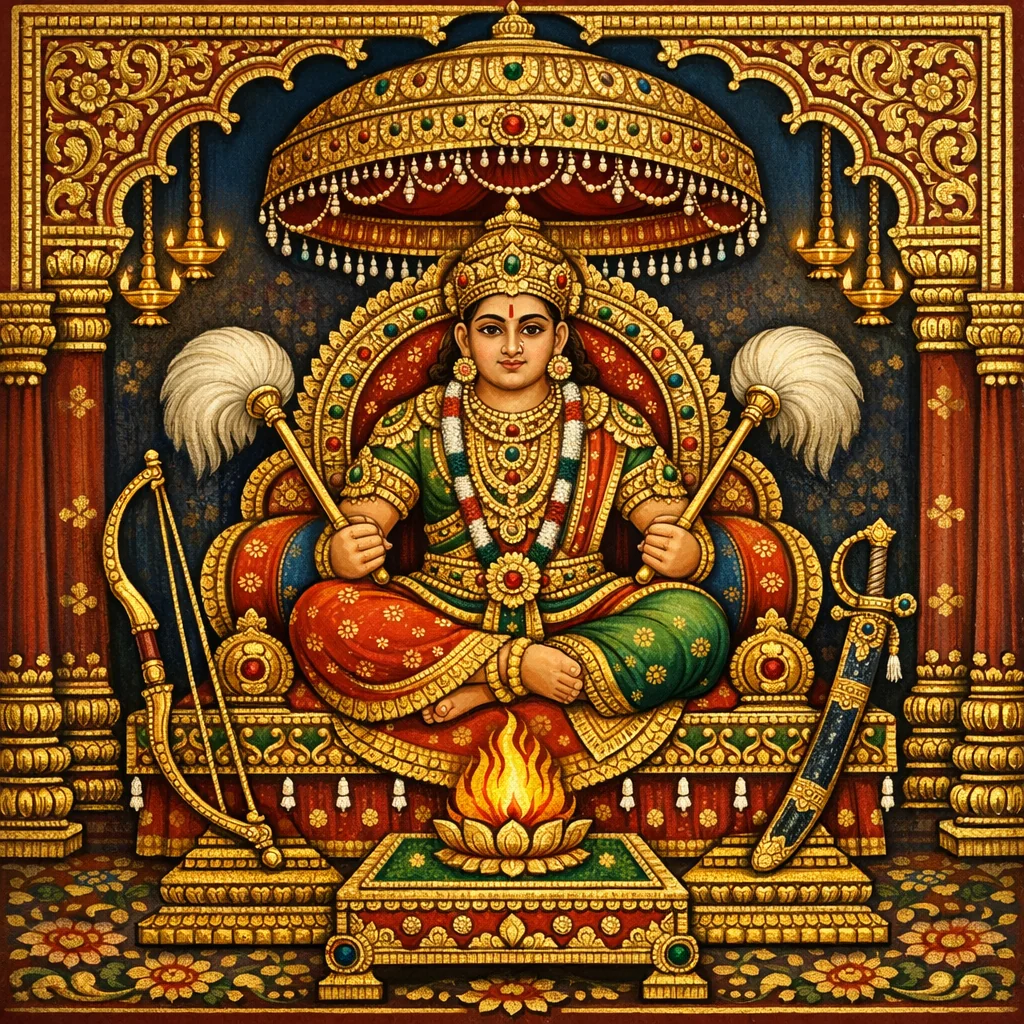
Lord Agni shifts from social observation to royal protocol, first laying down auspicious standards for the king’s emblems—the fly-whisk (chāmara) and parasol—as signs of legitimate sovereignty and refined court order. The chapter then turns technical in a Dhanurveda vein: counts of staffs and joints, measurements for throne and seat, and detailed rules for bow-making (materials, proportions, defects to avoid, stringing, and shaping horn-tips). Ritual emphasis culminates in worship of bow and arrows during royal processions and consecrations, teaching that martial implements must be sanctified, not merely employed. A mythic origin follows: Brahmā’s sacrifice is blocked by an iron demon, Viṣṇu appears with the sword Nandaka, and the slain bodies become iron—grounding metallurgy and weapon authority in divine history. Finally, standards for testing swords (length grades, a “sweet” ring, ideal blade form) and discipline codes (purity rules, taboos on reflections and price-talk at night) unite ethics, omenology, and statecraft into a single governance-ready manual.
Shlokas
Verse 1
इत्य् आग्नेये महापुराणे स्त्रीलक्षणं नाम त्रिचत्वारिंशदधिकद्विशततमो ऽध्यायः अथ चतुश् चत्वारिंशदधिकद्विशततमो ऽध्यायः चामरादिलक्षणम् अग्निर् उवाच चामरो रुक्मादण्डो ऽग्र्यः छत्रं राज्ञः प्रशस्यते हंसपक्षैर् विरचितं मयूरस्य शुकस्य च
Thus, in the Agni Mahāpurāṇa ends the chapter called “Characteristics of Women,” the 243rd chapter. Now begins the 244th chapter, “Characteristics of the Fly-whisk and Related (Royal Emblems).” Agni said: “The finest fly-whisk is the one with a golden handle. For a king, the royal parasol is praised—made from the feathers of swans, and also of peacocks and parrots.”
Verse 2
पक्षैर् वाथ बलाकाया न कार्यं मिश्रपक्षकैः न शथेति छ जठरमित्यादिः, ततो गुणा इत्य् अन्तः पाठः घ , ञ , पुस्तकद्वये नास्ति चतुरस्यं ब्राह्मणस्य वृत्तं राज्ञश् च शुक्लकं
With the wings of a balākā (crane) one should not attempt a task using mixed, mismatched wings. (Some manuscripts add readings such as “na śatheti … jaṭharam ityādiḥ”; and in two copies the concluding internal reading “tato guṇāḥ” is absent.) This is cited as an illustration (śuklaka) concerning the conduct of a clever brāhmaṇa and of a king.
Verse 3
त्रिचतुःपञ्चषट्सप्ताष्टपर्वश् च दण्डकः भद्रासनं क्षीरवृक्षैः पञ्चाशदङ्गुलोच्छ्रयैः
A staff (daṇḍaka) should have three, four, five, six, seven, or eight joints (nodes). The auspicious seat (bhadrāsana) should be made from milky trees, with a height of fifty aṅgulas.
Verse 4
विस्तारेण त्रिहस्तं स्यात् सुवर्णाद्यैश् च चित्रितं धनुर्द्रव्यत्रयं लोहं शृङ्गं दारु द्विजोत्तम
In its full measure, it should be three hands (in length), and it may be ornamented with gold and the like. The three materials for a bow are: metal, horn, and wood, O best of the twice-born.
Verse 5
ज्याद्रव्यत्रितयञ्चैव वंशभङ्गत्वचस् तथा दारुचापप्रमाणन्तु श्रेष्ठं हस्तचतुष्टयं
The three materials for the bowstring, as well as the prepared bamboo-strip bark used for binding and strengthening, are described; and the best standard measure for a wooden bow is four cubits (hastas).
Verse 6
तदेव समहीनन्तु प्रोक्तं मध्यकनीयसि मुष्टिग्राहनिमित्तानि मध्ये द्रव्याणि कारयेत्
That very procedure is also taught for an opponent of middling or lesser strength. For the purpose of seizing and controlling the fist-grip, one should have appropriate substances prepared and kept ready in between.
Verse 7
स्वल्पकोटिस्त्वचा शृङ्गं शार्ङ्गलोहमये द्विज कामिनीभ्रूलताकारा कोटिः कार्या सुसंयुता
O twice-born one, the horn-tip should be fashioned with a small measured point and covered with hide; on a bow made of śārṅga-iron, the tip (koṭi) should be made well-joined and shaped like the creeper-like eyebrow of a lovely woman.
Verse 8
पृथग्वा विप्र मिश्रं वा लौहं शार्ङ्गन्तु कारयेत् शार्ङ्गं समुचितं कार्यं रुक्मविन्दुविभूषितं
One should have the Śārṅga-bow made either of iron alone or of iron alloyed with vipra (a special bright metal). The Śārṅga is to be fashioned in proper proportion and adorned with golden, dot-like inlays.
Verse 9
कुटिलं स्फुटितञ्चापं सच्छिद्रञ्च न शस्यते सुवर्णं रजतं ताम्रं कृष्णायो धनुषि स्मृतं
A bow that is crooked, cracked, or full of holes is not recommended. For bows, gold, silver, copper, and black iron are recognized as suitable materials or metal fittings.
Verse 10
माहिषं शारभं शार्ङ्गं रौहिषं वा धनुःशुभं चन्दनं वेतसं सालं धावलङ्ककुभन्तरुः
For an excellent bow, woods such as māhiṣa, śārabha, śārṅga, or rauhiṣa are recommended; likewise suitable are sandalwood, vetasa (rattan/willow), sāla, dhāvala, and the trees called laṅkaka and kubhanta.
Verse 11
सर्वश्रेष्ठं धनुर्वंशैर् गृहीतैः शरदि श्रितैः पूजयेत्तु धनुः खड्गमन्त्रैस्त्रैलोक्यमोहनैः
In the autumn season, having procured the finest materials—bow-staves taken from bamboo or cane—one should ritually worship the bow with sword-mantras said to enchant the three worlds.
Verse 12
अयसश्चाथ वंशस्य शरस्याप्यशरस्य च ऋत्विजो हेमवार्णाभाः स्नायुश्लिष्टाः सुपत्रकाः
And components may be made of iron as well as of bamboo; likewise there are specifications for the arrow and even for the non-arrow (such as a bolt or dart). The properly prepared sinew-bindings should adhere firmly, be golden-hued, and be well fletched.
Verse 13
चतुरस्रमित्यादिः, पञ्चाशदङ्गुलोच्छ्रयैर् इत्यन्तः पाठः जपुस्तके नास्ति द्विहस्तमिति ट पूजयेत्तद्धनुरिति ग , घ , ञ च रुक्मपुङ्खाः सुपङ्कास्ते तैलधौताः सुवर्णकाः यात्रायामभिषेकादौ यजेद्वाणधनुर्मुखान्
Beginning with the words “(it is) quadrangular,” the reading that ends with “with a height of fifty aṅgulas” is not found in the Japu (recitation) manuscript. Another reading gives “two hands (as the measure).” Some manuscripts (ga, gha, ña) read, “one should worship that bow.” The arrows have golden metal fletchings, are well-fitted and smooth, oil-polished, and of golden appearance. On occasions such as a royal procession (yātrā) and at consecrations/ablutions (abhiṣeka) and the like, one should perform worship of the arrows, the bow, and the bow’s mouth/end (the nock-side).
Verse 14
सपताकास्त्रसङ्ग्राहसांवत्सरकरान्नृपः ब्रह्मा वै मेरुशिखरे स्वर्गगङ्गातटे ऽयजत्
O king, Brahmā—who established “the year” as the measure of time for acquiring and compiling the divine missile-weapons known as the ‘Sapatākā’ astras—performed a sacrifice on the peak of Meru, on the bank of the celestial Gaṅgā (Svarga-Gaṅgā).
Verse 15
लौहदैत्यं स ददृशे विध्नं यज्ञे तु चिन्तयन् तस्य चिन्तयतो वह्नेः पुरुषो ऽभूद्वली महान्
While contemplating the obstruction to the sacrifice, he beheld an “Iron Demon” as the impediment in the rite; and as he thus meditated, from Agni (Vahni) there arose a mighty, powerful Man—a personified force.
Verse 16
ववन्दे ऽजञ्च तन्देवा अभ्यनन्दन्त हर्षिताः तस्मात्स नन्दकः कड्गो देवोक्तो हरिरग्रहीत्
He bowed to the Unborn (Aja—Brahmā), and the gods, delighted, rejoiced. Therefore that sword—called “Nandaka” by the gods—was taken up by Hari (Viṣṇu).
Verse 17
तं जग्राह शनैर् देवो विकोषः सो ऽभ्यपद्यत खड्गो नीलो रत्नमुष्टिस्ततो ऽभूच्छतबाहुकः
The god took it up gradually; drawing it from the scabbard, he advanced. The sword appeared dark-blue, with a jewel-studded hilt; thereafter he manifested as Śatabāhuka, the Hundred-armed one.
Verse 18
दैत्यः स गदया देवान् द्रावयामास वै रणे विष्णुना खड्गच्छिन्नानि दैत्यगात्राणि भूतले
That Daitya, wielding a mace, indeed drove the gods into flight in the battle; yet upon the ground lay the limbs of the Daityas, cut down by Viṣṇu with his sword.
Verse 19
पतितानि तु संस्पर्शान्नन्दकस्य च तानि हि लोहभूतानि सर्वाणि हत्वा तस्मै हरिर्वरं
But those that had fallen—by the very contact of Nandaka—indeed became iron; having slain them all, Hari then granted him a boon.
Verse 20
ददौ पवित्रमङ्गन्ते आयुधाय भवेद्भुवि हरिप्रसादाद् ब्रह्मापि विना विघ्नं हरिं प्रभुं
He bestowed the “pavitra” (a consecrated protective thread/amulet) to be worn upon the limbs as a safeguard; on earth it becomes a means of protection. By the grace of Hari, even Brahmā attains his aim without obstacles—for Hari is the sovereign Lord.
Verse 21
पूजयामास यज्ञेन वक्ष्ये ऽथो खड्गलक्षणं खटीखट्टरजाता ये दशनीयास्तुते स्मृताः
He honoured it by a sacrificial rite. Now I shall explain the characteristics of the sword: O praised one, those swords that arise from the metals called khaṭī and khaṭṭara are remembered as “to be tested/inspected”.
Verse 22
कायच्छिदस्त्वाषिकाः स्युर्दृढाः सूर्पारकोद्भवाः तीक्ष्णाश्छेदसहा वङ्गास्तीक्ष्णाःस्युश्चाङ्गदेशजाः
Blades (āṣikā) from Sūrpāraka are said to be firm and able to cut through the body. Those from Vaṅga are sharp and can endure the stress of cutting; and those produced in the land of Aṅga are also said to be sharp.
Verse 23
शतार्धमङ्गुलानाञ्च श्रेष्ठं खद्गं प्रकीर्तितं लोहदैत्यमित्यादिः, हर्षिता इत्य् अन्तः पाठः ज पुस्तके नास्ति तस्मात्तु नन्दक इति घ , ञ च महादेव इति ज तदर्धं मध्यमं ज्ञेयं ततो हीनं न धारयेत्
A sword measuring one hundred and a half aṅgulas in length is proclaimed the best. (Here the text preserves variant readings such as “lohadaitya-…”, and notes that “harṣitā” is not found in the ‘ja’ manuscript; some manuscripts read “nandaka”, while the ‘ja’ manuscript reads “mahādeva”.) Half of that measure is to be understood as the middling grade; one should not carry a sword shorter than that.
Verse 24
दीर्घं सुमधुरं शब्दं युस्य खड्गस्य सत्तम किङ्किणीसदृशन्तस्य धारणं श्रेष्ठमुच्यते
O best of men, that sword whose sound is long-drawn and exceedingly sweet—like the ringing of a small bell (kiṅkiṇī)—is said to be the finest to wield and to wear.
Verse 25
खड्गः पद्मपलाशाग्रो मण्डलाग्रश् च शस्यते करवीरदलाग्राभो घृतगन्धो वियत्प्रभः
A sword whose point is like the tip of a lotus leaf, and whose end is rounded like a disc, is praised as excellent—its edge resembling the tip of a karavīra leaf, bearing the fragrance of ghee (ghṛta), and shining with a radiance like the sky.
Verse 26
समाङ्गुलस्थाः शस्यन्ते व्रणाः खद्गेषु लिङ्गवत् काकोलूकसवर्णाभा विषमास्ते न शोभनाः
Wounds upon the body that are even in extent, measurable by the breadth of a finger, are commended, bearing a clear mark as though made by a sword. But those that are irregular and of the colour of a crow or an owl are not auspicious and are not regarded as good signs.
Verse 27
खड्गे न पश्येद्वदनमुच्छिष्टो न स्पृशेदसिं मूल्यं जातिं न कथयेन्निशि कुर्यान्न शीर्षके
One should not look upon one’s face reflected in a sword. When in a state of impurity after eating (ucchiṣṭa), one should not touch the sword. At night one should not speak of its price or its provenance (lineage/type), and one should not place it at the head of the bed.
Frequently Asked Questions
Precise weapon metrics and quality-control: bow materials (metal/horn/wood), recommended woods, defects to reject (crooked/cracked/holed), best wooden bow measure (four hastas), sword best length (150 aṅgulas) with a minimum carry-length threshold, and even ‘sweet ringing’ sound as a diagnostic of excellence.
It sacralizes state power: royal insignia and weapons are treated as Dharma-instruments requiring worship, purity, restraint, and auspicious testing—turning governance and protection into disciplined service aligned with righteous kingship.