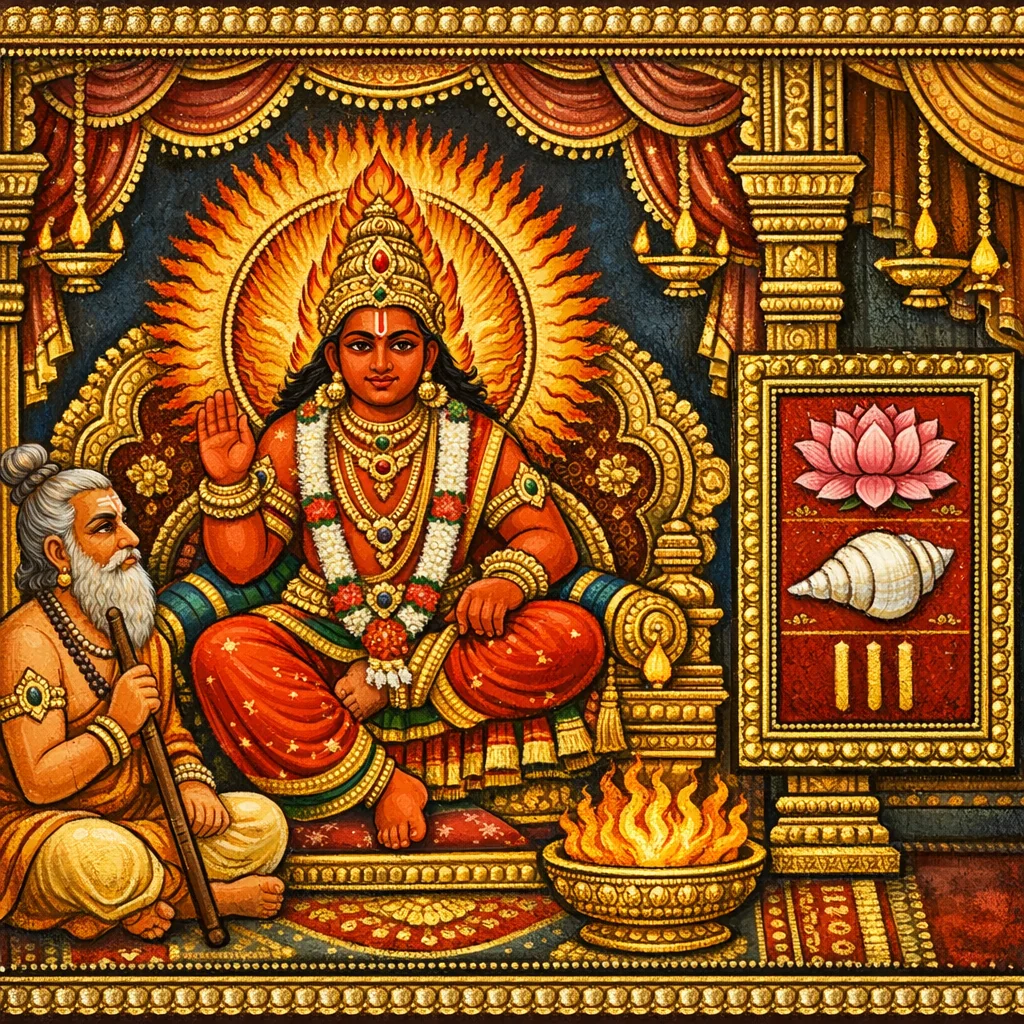
Adhyaya 243
Chapter 243 — Strī-lakṣaṇa (Characteristics of a Woman)
After concluding the discussion of puruṣa-lakṣaṇa, the text begins a new unit on strī-lakṣaṇa, framed as a nīti-śāstric and lakṣaṇa-śāstric guide for judging auspiciousness (śubhatva) in a prospective woman. Speaking as Samudra, it lists bodily and behavioral signs—graceful limbs, a measured elegant gait, well-set feet and breasts, and auspicious anatomical marks such as a clockwise-turning navel. It also warns against inauspicious traits—coarseness, disproportion, quarrelsomeness, greed, harsh speech, and even certain name-associations—showing social harmony as a dharmic criterion. Crucially, it subordinates outward beauty to conduct: even without ideal marks, noble guṇa and ācāra can make one “auspicious,” establishing an ethical hierarchy of true merit. The closing mention of a specific hand-mark serves as an apotropaic sign, linking physiognomy with longevity beliefs within the rāja-dharma social order.
Shlokas
Verse 1
इत्य् आग्नेये महापुराणे पुरुषलक्षणं नाम द्विचत्वारिंशदधिकद्विशततमो ऽध्यायः अथ त्रिचत्वारिंशदधिकद्विशततमो ऽध्यायः स्त्रीलक्षणं समुद्र उवाच शस्ता स्त्री चारुसर्वाङ्गी मत्तमातङ्गगामिनी गुरूरुजघना या च मत्तपारावतेक्षणा
Thus, in the Agni Mahāpurāṇa, ends the two-hundred-and-forty-second chapter entitled “Characteristics of a Man (Puruṣa-lakṣaṇa).” Now begins the two-hundred-and-forty-third chapter, “Characteristics of a Woman (Strī-lakṣaṇa).” Samudra said: “A commendable woman is one whose limbs are graceful in every part, whose gait is like that of an intoxicated female elephant, whose thighs and hips are full and weighty, and whose eyes are like those of an intoxicated dove.”
Verse 2
सुनीलकेशी तन्वङ्गी विलोमाङ्गी मनोहरा शुभा स्त्री इति ज समभूमिस्पृशौ पादौ संहतौ च तथा स्तनौ
A woman is called auspicious when she has glossy dark hair, a slender body, a well-proportioned frame (with the limbs properly oriented), and a charming appearance; and when her feet touch the ground evenly, and her breasts are firm and well-set.
Verse 3
नाभिः प्रदक्षिणावर्ता गुह्यमश्वत्थपत्रवत् गुल्फौ निगूढौ मध्येन नाभिरङ्गुष्ठमानिका
The navel is right-turning (clockwise); the genital region is shaped like an aśvattha (sacred fig) leaf; the ankles are well-concealed (not prominent); and the navel, at its center, is of the measure of a thumb.
Verse 4
जठरन्न प्रलम्बञ्च रोमरूक्षा न शोभना नर्क्षवृक्षनदीनाम्नी न सदा कलहप्रिया
She should not be pot-bellied, nor have pendulous limbs; she should not be rough-haired, nor lacking in comeliness. She should not bear a name associated with bears, trees, or rivers, and she should not be one who is always fond of quarrelling.
Verse 5
न लोलुपा न दुर्भाषा शुभा देवादिपूजिता गण्डैर् मधूकपुष्पाभैर् न शिराला न लोमशा
She is not greedy, nor foul-mouthed; she is auspicious and revered by the gods and others. Her cheeks are like madhūka blossoms; she is neither veiny nor excessively hairy.
Verse 6
न संहतभ्रूकुटिला पतिप्राणा पतिप्रिया अलक्षणापि लक्षण्या यत्राकारास्ततो गुणाः
She should not be one with knitted, crooked brows; she should make her husband her very life-breath and be dear to her husband. Even if she lacks outward marks of beauty, she is still ‘marked as auspicious’; for where there is noble conduct and demeanor, from that arise the virtues.
Verse 7
भुवङ्कनिष्ठिका यस्या न स्पृशेन्मृत्युरेव सा
She whose little finger bears the ‘bhuvaṅka’ mark is not touched by death itself.
Frequently Asked Questions
It outlines auspicious and inauspicious characteristics—both physical and behavioral—used within lakṣaṇa-śāstra and nīti-śāstra to evaluate suitability and harmony in social life, while emphasizing that virtuous conduct can outweigh mere external features.
The chapter discourages quarrelsomeness, greed, and harsh or foul speech, presenting social temperament as a dharmic indicator of auspiciousness.
It states that even if outward marks are lacking, one may still be considered auspicious when noble demeanor and conduct are present—because virtues arise from character and behavior.