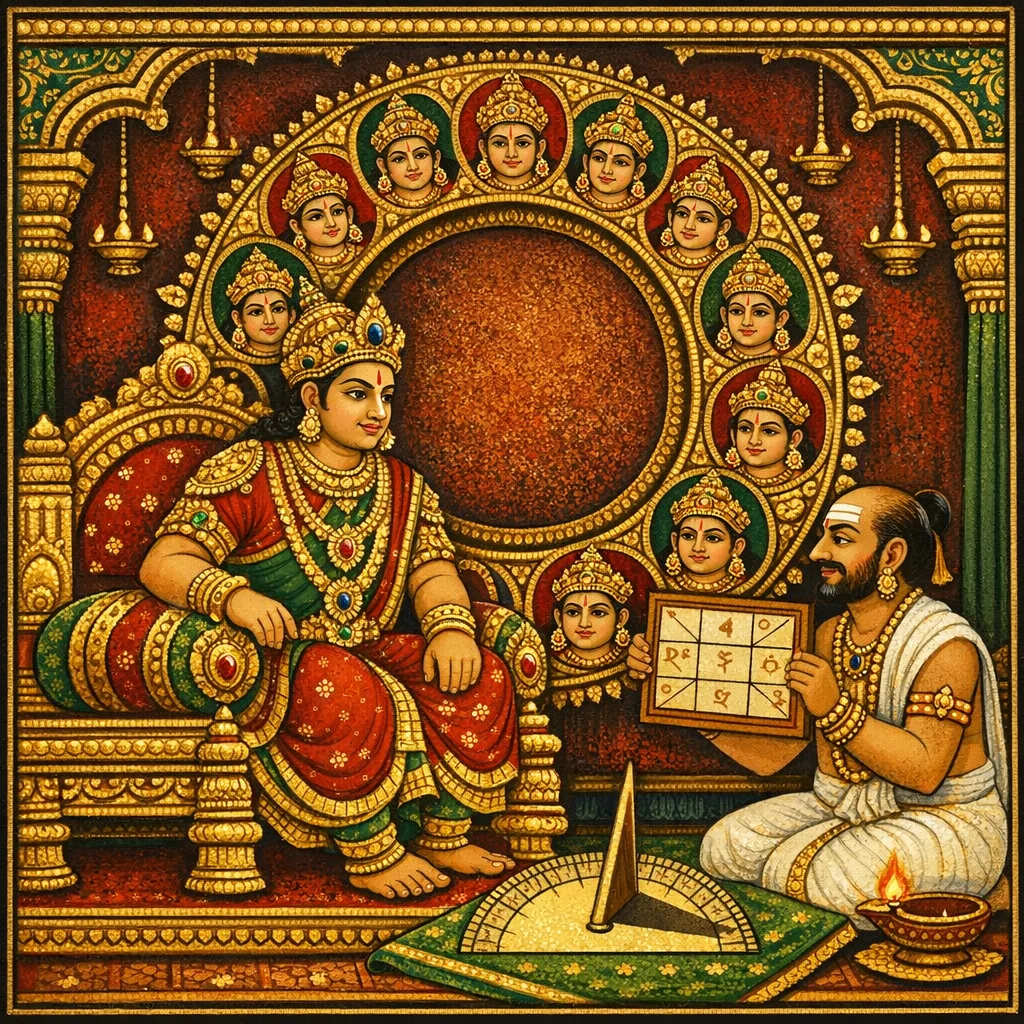
Adhyaya 232
Yātrā-Maṇḍala-Cintā and Rājya-Rakṣaṇa: Auspicious Travel Rules and the Twelve-King Mandala
This chapter links royal expeditions (yātrā) to rājadharma, treating the king’s and army’s movement as a dharmic act requiring astrological judgment and scrutiny of omens. It lists times when travel should be avoided: planetary debility, adverse motion and affliction, inimical rāśis, inauspicious yogas (Vaidhṛti, Vyatīpāta), karaṇas, nakṣatra dangers (janma, gaṇḍa), and riktā tithis. Direction is systematized through paired quarter-alliances (north–east; west–south), nakṣatra-to-direction correspondences, and gnomonic shadow counts by luminary/weekday, showing jyotiḥ-śāstra integrated into policy. When signs are favorable, the king proceeds for victory remembering Hari; the teaching then turns to state protection through the saptāṅga theory of the kingdom and the mandala doctrine of inter-polity relations. It outlines the twelve-king mandala, enemy types, rear-threat dynamics (pārṣṇigrāha), strategic formations (ākranda, āsāra), and the ideal strong ruler as an impartial arbiter who can punish and grant favor. The chapter culminates in an ethic of conquest by dharma: increasing power without terrorizing non-enemies, preserving public trust, and winning allegiance through righteous victory.
Shlokas
Verse 1
एये महापुराणे शकुनानि नाम एकत्रिंशदधिकद्विशततमो ऽध्यायः वामं दक्षिणेत्यादिः, सम्मुखमारुतादित्यन्तः पाठः झ पुस्तके नास्ति अथ द्वात्रिंशदधिकद्विशततमो ऽध्यायः यात्रामण्डलचिन्तादिः पुष्कर उवाच सर्वयात्रां प्रवक्ष्यामि राजधर्मसमाश्रयात् अस्तङ्गते नीचगते विकले रिपुराशिगे
In this Mahāpurāṇa there is the two-hundred-and-thirty-first chapter entitled “Omens (Śakuna)”, beginning with the words “to the left, to the right …”; the passage from “the wind in front …” up to “the sun …” is not found in the Jha manuscript. Then follows the two-hundred-and-thirty-second chapter, beginning with “consideration of the travel-diagram (yātrā-maṇḍala) …”. Puṣkara said: “Grounded in rājadharma, the principles of royal duty, I shall explain every rule for journey and expedition. A journey should be avoided or deemed inauspicious when the relevant planet is set, in debility (nīca), afflicted/defective, or placed in an enemy sign.”
Verse 2
प्रतिलोमे च विध्वस्ते शुक्रे यात्रां विसर्जयेत् प्रतिलोमे बुधे यात्रां दिक्पतौ च तथा च ग्रहे
If Venus (Śukra) is in an adverse, reverse course (pratiloma) and is also afflicted, one should abandon the journey. Likewise, one should abandon the journey when Mercury (Budha) is in an adverse course, and similarly when the directional lord (dikpati) and the relevant planet are unfavorable.
Verse 3
वैधृतौ च व्यतीपाते नागे च शकुनौ तथा चतुष्पादे च किन्तुघ्ने तथा यात्रां विवर्जयेत्
One should refrain from setting out on a journey during the inauspicious yogas Vaidhṛti and Vyatīpāta, as well as during Nāga and Śakuni, and likewise during Catuṣpāda and Kintughna; at such times travel is to be avoided.
Verse 4
विपत्तारे नैधने च प्रत्यरौ चाथ जन्मनि गण्डे विवर्जयेद्यात्रां रिक्तायाञ्च तिथावपि
One should avoid undertaking a journey when Vipattārā, Naidhana, or Pratyarī is operative, and also at the time of Janma (one’s birth-star), during Gaṇḍa (a perilous junction), and likewise on a Riktā tithi (an “empty” lunar day).
Verse 5
उदीची च तथा प्राची तयोरैक्यं प्रकीर्तितं पश्चिमा दक्षिणा या दिक् तयोरैक्यं तथैव च
The northern and the eastern directions are declared to be mutually allied (treated as a paired unity). Likewise, the western and the southern directions are also declared to be mutually allied.
Verse 6
वाय्वग्निदिक्समुद्भूतं परिघन्न तु लङ्घयेत् आदित्यचन्द्रशौरास्तु दिवसाश् च न शोभनाः
A parigha-type obstruction arising from wind, fire, or a particular direction should be stepped over (not passed through). Days marked by solar, lunar, or planetary (śaura) afflictions are likewise not auspicious.
Verse 7
कृत्तिकाद्यानि पूर्वेण मघाद्यानि च याम्यतः मैत्राद्यान्यपरे चाथ वासवाद्यानि वाप्युदक्
The lunar mansions beginning with Kṛttikā are placed toward the East; those beginning with Maghā toward the South; those beginning with Maitrā (i.e., Anurādhā) toward the West; and those beginning with Vāsavā (i.e., Śravaṇā, presided over by the Vasus) toward the North.
Verse 8
सर्वद्वाराणि शस्तानि छायामानं वदामि ते आदित्ये विंशतिर्ज्ञेयाश् चन्द्रे षोडश कीर्तिताः
All the directional doorways are regarded as auspicious. I shall explain to you the science of measuring by shadow (gnomonics): for the Sun, twenty (units/divisions) are to be understood; for the Moon, sixteen are declared.
Verse 9
भौमे पञ्चदशैवोक्ताश् चतुर्दश तथा बुधे विवर्जयेत् इति ख , ग , घ , ञ च दिक् पूर्वा या तथोदीचीति ज त्रयोदश तथा जीये शुक्रे द्वादश कीर्तिताः
On Tuesday, fifteen are stated; on Wednesday, fourteen—excluding the groups denoted by kha, ga, gha, and ña. The direction is said to be east and likewise north, and (the group denoted by) ja. On Thursday, thirteen are stated; and on Friday, twelve are declared.
Verse 10
एकादश तथा सौरे सर्वकर्मसु कीर्तिताः जन्मलग्ने शक्रचापे सम्मुखे न व्रजेन्नरः
The eleventh lunar day (Ekādaśī) and the Saura (solar day) are declared significant for all undertakings. If, at the time of one’s natal ascendant, Indra’s bow (the rainbow) appears facing one, a man should not set out on a journey.
Verse 11
शकुनादौ शुभे यायाज्जयाय हरिमास्मरन् वक्ष्ये मण्डलचिन्तान्ते कर्तव्यं राजरक्षणं
When auspicious omens such as bird-signs (śakuna) are observed, he should set out for victory while remembering Hari (Viṣṇu). Next I shall explain the royal protections to be performed after the contemplation of the political maṇḍala (circle of states).
Verse 12
स्वाम्यमात्यं तथा दुर्गं कोषो दण्डस्तथैव च मित्रञ्जनपदश् चैव राज्यं सप्ताङ्गमुच्यते
The state (rājya) is said to consist of seven limbs: the sovereign (svāmin), the minister(s) (amātya), the fort (durga), the treasury (kośa), coercive power/penal authority (daṇḍa), the ally (mitra), and the territory with its people (janapada).
Verse 13
सप्ताङ्गस्य तु राज्यस्य विघ्नकर्तॄन् विनाशयेत् मण्डलेषु च सर्वेषु वृद्धिः कार्या महीक्षिता
For the welfare of the seven-limbed kingdom, the king should destroy those who create obstacles; and in all the mandalas (provinces), the ruler should establish prosperity and growth.
Verse 14
आत्ममण्डलमेवात्र प्रथमं मण्डलं भवेत् सामन्तास्तस्य विज्ञेया रिपवो मण्डलस्य तु
Here, one’s own circle of power alone is to be regarded as the first mandala; the neighboring sāmantas (adjacent feudatories/rulers) are to be understood as enemies within the mandala system.
Verse 15
उपेतस्तु सुहृज् ज्ञेयः शत्रुमित्रमतः परं मित्रमित्रं ततो ज्ञेयं मित्रमित्ररिपुस्ततः
One who has come over to your side should be known as a suhr̥d, a well-wisher (ally). Beyond that is the ‘ally of an enemy’; then one should recognize the ‘ally of an ally’; and next, the ‘enemy of the ally of an ally’.
Verse 16
एतत्पुरस्तात् कथितं पश्चादपि निबोध मे पार्ष्णिग्राहस्ततः पश्चात्ततस्त्वाक्रन्द उच्यते
This has been explained earlier; now also understand from me what comes next. After that is the technique called pārṣṇigrāha, the ‘heel-grip’; and following that, the maneuver known as ākranda is described.
Verse 17
आसारस्तु ततो ऽन्यः स्यादाक्रन्दासार उच्यते जिगीषोः शत्रुयुक्तस्य विमुक्तस्य तथा द्विज
Another kind of deployment, distinct from the former, is called ākranda-āsāra. It is employed by a would-be conqueror when he is engaged with the enemy, or when he has broken free from encirclement or pressure, O twice-born (dvija).
Verse 18
नात्रापि निश् चयः शक्यो वक्तुं मनुजपुङ्गव निग्रहानुग्रहे शक्तो मध्यस्थः परिकीर्तितः
Even here, O best of men, no fixed rule can be stated; one who is capable of both restraint (punishment) and favor (reward) is declared to be a “madhyastha,” a neutral and impartial arbiter.
Verse 19
निग्रहानुग्रहे शक्तः सर्वेषामपि यो भवेत् उदासीनः स कथितो बलवान् पृथिवीपतिः
That lord of the earth is called truly powerful who, toward all people, is capable of both restraint (punishment) and favor (reward), and who remains impartial, detached from personal bias.
Verse 20
मण्डलेषु च सर्वेषु सुरेश्वरसमा हि ते इत्य् अर्धश्लोक आसारस्त्वित्यस्य पूर्वं ट पुस्तके वर्तते, परन्त्वसंलग्नः न कस्यचिद्रिपुर्मित्रङ्कारणाच्छत्रुमित्रके मण्डलं तव सम्प्रोक्तमेतद् द्वादशराजकं
“In all the circles (mandalas) you are indeed equal to the lord of the gods”—this half-verse occurs earlier in the Ṭa manuscript, but it is not connected to the present context. For no one is an enemy or a friend without a cause. Thus, O you who have both foes and allies, the political mandala consisting of twelve kings has been explained to you.
Verse 21
त्रिविधा रिपवो ज्ञेयाः कुल्यानन्तरकृत्रिमाः पूर्वपूर्वो गुरुस्तेषां दुश्चिकित्स्यतमो मतः
Enemies are to be understood as threefold: those arising from one’s own lineage (kinsmen), those who are close-by (immediate neighbors), and those that are artificially made (manufactured or instigated). Among these, each earlier-mentioned type is graver than the next and is considered the hardest to remedy.
Verse 22
अनन्तरो ऽपि यः शत्रुः सो ऽपि मे कृत्रिमो मतः पार्ष्णिग्राहो भवेच्छत्रोर्मित्राणि रिपवस् तथा
Even the enemy who is immediately adjacent is, in my view, an artificial (circumstantial) enemy. The “heel-seizer” (rear-attacker) becomes the enemy’s ally; likewise, the enemy’s allies are to be treated as one’s enemies.
Verse 23
पार्ष्णिग्राहमुपायैश् च शमयेच्च तथा स्वकं मित्रेण शत्रोरुच्छेदं प्रशंसन्ति पुरातनाः
By employing appropriate measures, he should also pacify the “heel-seizer” (the enemy who attacks from the rear); likewise, with one’s own ally he should bring about the enemy’s complete elimination—so the ancients commend.
Verse 24
मित्रञ्च शत्रुतामेति सामन्तत्वादनन्तरं शत्रुं जिगोषुरुच्छिन्द्यात् स्वयं शक्नोति चेद्यदि
A friend, by becoming a neighbouring power, soon turns into an enemy. Therefore, one who seeks to subdue an enemy should cut him off (strike and eliminate him) oneself—if one is able to do so.
Verse 25
प्रतापवृद्धौ तेनापि नामित्राज्जायते भयं यथास्य नोद्विजेल्लोको विश्वासश् च यथा भवेत्
Even while increasing his royal might, he should act so that no fear arises from him among non-enemies, so that the people are not distressed by him and so that trust may arise toward him.
Verse 26
जिगीषुर्धर्मविजयी तथा लोकं वशन्नयेत्
A would-be conqueror, victorious through righteousness (dharma), should in that very way bring the people under his allegiance.
Frequently Asked Questions
Travel is discouraged when relevant planets are set, debilitated, afflicted/defective, or in enemy signs; when Venus or Mercury are in adverse motion (especially with affliction); and during inauspicious yogas (Vaidhṛti, Vyatīpāta), certain karaṇas (e.g., Catuṣpāda, Kiṃtughna), dangerous junctions (gaṇḍa), janma-nakṣatra, and riktā tithis.
It frames expedition-planning and inter-kingdom strategy (mandala doctrine, saptāṅga state theory, enemy management) as rājadharma, adding devotional orientation—setting out for victory while remembering Hari—and insisting on dharma-vijaya that preserves public trust and avoids terrorizing non-enemies.