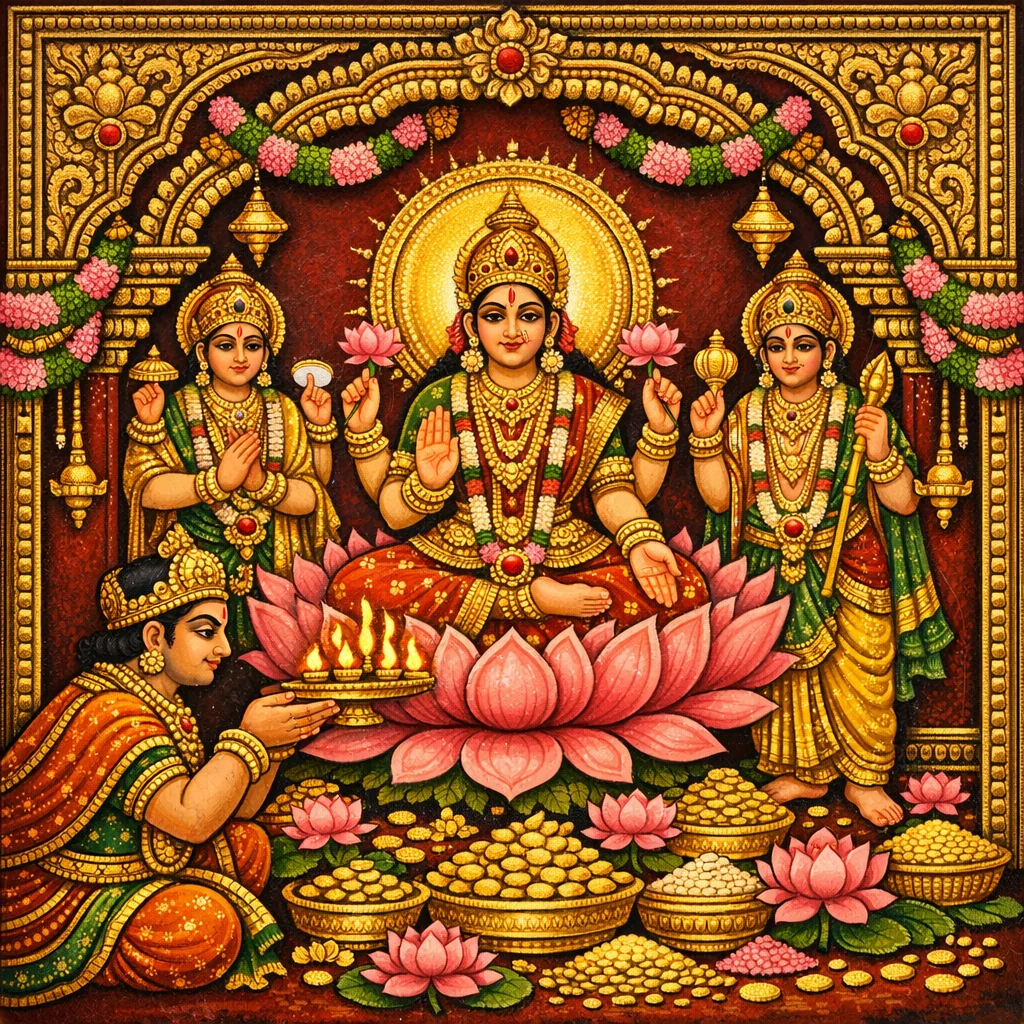
Adhyaya 236
Adhyaya 236 — श्रीस्तोत्रम् (Śrī-stotra) / Hymn to Śrī (Lakṣmī) for Royal Stability and Victory
The chapter begins with a brief transition noting variant colophons for the prior unit (Kṣā), then applies devotion to rāja-dharma: Puṣkara teaches that for the stability of rājya-lakṣmī (royal fortune) and for victory, a king should practice the hymn Indra once used to praise Śrī. Indra’s stotra proclaims Lakṣmī as the cosmic Mother and Viṣṇu’s inseparable śakti, the source of auspiciousness, prosperity, and the capacities that uphold civilization. She is lauded not only as wealth but as the embodiment of key vidyās and pillars of governance—Ānvīkṣikī (rational inquiry), Trayī (Vedic revelation), Vārtā (economy/livelihood), and Daṇḍanīti (statecraft)—explicitly binding political order to divine power. The hymn teaches moral-political causality: when Śrī withdraws, worlds decline and virtues collapse; when she casts her gracious glance, even the unqualified gain guṇa, lineage, and success. It concludes that reciting and hearing this Śrī-stotra grants both bhukti (prosperity/enjoyment) and mukti (liberation), and Puṣkara reports that Śrī’s Lord bestowed on Indra the boon of a stable kingdom and victory in battle.
Shlokas
Verse 1
क्षा नाम पञ्चत्रिंअशधिकद्विशततमो ऽध्यायः धर्मनिष्ठो जयो नित्य इति ख , छ च देवान् विप्रान् गुरून् यजेदिति घ , ज , ञ च अथ षट्त्रिंशदधिकद्विशततमो ऽध्यायः श्रीस्तोत्रं पुष्कर उवाच राज्यलक्ष्मीस्थिरत्वाय यथेन्द्रेण पुरा श्रियः स्तुतिः कृता तथा राजा जयार्थं स्तुतिमाचरेत्
(Colophon/transition note:) “Thus ends the two-hundred-and-thirty-fifth chapter, named ‘Kṣā’—(teaching that) ‘Victory is ever assured for one established in dharma,’ and (that) ‘one should worship the gods, the brāhmaṇas, and the gurus,’” (so read certain recensions). Now begins the two-hundred-and-thirty-sixth chapter: the Hymn to Śrī. Puṣkara said: “For the stability of royal fortune (rājya-lakṣmī), just as Indra formerly composed a praise of Śrī, so too should a king practice this hymn for the sake of victory.”
Verse 2
इन्द्र उवाच नमस्ये सर्वलोकानां जननीमब्धिसम्भवां श्रियमुन्निन्द्रपद्माक्षीं विष्णुवक्षःस्थलस्थितां
Indra said: I bow to Śrī (Lakṣmī)—the mother of all worlds, born from the ocean—whose lotus-like eyes surpass the lotus, and who abides upon Viṣṇu’s chest.
Verse 3
त्वं सिद्धिस्त्वं स्वधा स्वाहा सुधा त्वं लोकपावनि सन्धया रात्रिः प्रभा भूतिर्मेधा श्रद्धा सरस्वती
You are accomplishment (Siddhi); you are Svadhā; you are Svāhā; you are ambrosial nectar (amṛta). You are the purifier of the worlds. You are Sandhyā (the sacred juncture-prayer), you are Night, you are Radiance; you are Prosperity (Bhūti), Intelligence (Medhā), Faith (Śraddhā), and Sarasvatī.
Verse 4
यज्ञविद्या महाविद्या गुह्यविद्या च शोभने आत्मविद्या च देवि त्वं विमुक्तिफलदायिनी
O auspicious Goddess, you are the knowledge of yajña (sacrifice), the Great Knowledge, the secret knowledge, and the knowledge of the Self; O Devī, you bestow the fruit of liberation (mokṣa).
Verse 5
आन्वीक्षिकी त्रयी वार्ता दण्डनीतिस्त्वमेव च सौम्या सौम्यैर् जगद्रूपैस्त्वयैतद्देवि पूरितं
O gentle Goddess, you alone are Ānvīkṣikī (rational inquiry), the Trayī (the three Vedas), Vārtā (the science of livelihood), and Daṇḍanīti (statecraft). By you—through your auspicious forms as the very shape of the world—this entire universe is pervaded and filled.
Verse 6
का त्वन्या त्वामृते देवि सर्वयज्ञमयं वपुः अध्यास्ते देव देवस्य योगिचिन्त्यं गदाभृतः
O Goddess, who else—apart from you—could be the embodiment constituted of all yajñas, abiding in the Supreme God of gods, contemplated by yogins, and bearing the mace (gadā)?
Verse 7
त्वया देवि परित्यक्तं सकलं भुवनत्रयं विनष्टप्रायमभवत् त्वयेदानीं समेधितं
O Goddess, when you withdrew, the entire triple world was nearly ruined; but by you, now, it has been made to flourish again.
Verse 8
दाराः पुत्रास् तथागारं सुहृद्धान्यधनादिकं भवत्येतन्महाभागे नित्यं त्वद्वीक्षणान् नृणां
Wives, sons, a home, good friends, grain, wealth, and the like—O most fortunate one (mahābhāgā)—are continually secured for men through your gracious glance.
Verse 9
सर्वभूतानामिति घ , ज , ञ च जवनीमम्बुसम्भवामिति ज शरीरारोग्यमैश्वर्यमरिपक्षक्षयः सुखं देवि त्वद्दृष्टिदृष्टानां पुरुषाणां न दुर्लभं
“‘(You are) of all beings …’—so read the manuscripts (gha, ja, ña); and ‘the veiling power, born of the waters’—so reads (ja). O Goddess, for men upon whom your gaze has fallen, bodily health, sovereignty/prosperity, the destruction of the enemy’s faction, and happiness are not hard to obtain.”
Verse 10
त्वमम्बा सर्वभूतानां देवदेवो हरिः पिता त्वयैतद्वोइष्णुना चाम्ब जगद्व्याप्तं चराचरं
O Mother, you are the Mother of all beings; Hari (Vishnu), the God of gods, is the Father. O Mother, by you—and by that all-pervading Vishnu—this entire universe, both moving and unmoving, is pervaded.
Verse 11
मानं कोषं तथा कोष्ठं मा गृहं मा परिच्छदं मा शरीरं कलत्रञ्च त्यजेथाः सर्वपावनि
O all-purifying one, do not abandon honor, wealth, granaries, home, possessions, the body, or even the wife.
Verse 12
मा पुत्रान्मासुहृद्वर्गान्मा पशून्मा विभूषणं त्यजेथा मम देवस्य विष्णोर्वक्षःस्थलालये
Do not abandon your sons; do not abandon your circle of friends; do not abandon your cattle; do not abandon your ornaments—for I abide at the chest of my Lord, Vishnu, as his dwelling-place.
Verse 13
सत्त्वेन सत्यशौचाभ्यां तथा शीलादिभिर्गुणैः त्यजन्ते ते नरा सद्यः सन्त्यक्ता ये त्वयामले
Those men who have been abandoned by you, O Stainless One, are immediately forsaken by their own virtues—by sattva (purity of being), by truthfulness and cleanliness, and by good conduct and the like.
Verse 14
त्वयावलोकिताः सद्यः शीलाद्यैर् अखिलैर् गुणैः कुलैश्वर्यैश् च युज्यन्ते पुरुषा निर्गुणा अपि
Even men who are devoid of virtues become endowed—immediately, when looked upon by you—with all qualities beginning with good conduct, and also with noble lineage and prosperity.
Verse 15
स श्लाघ्यः स गुणी धन्यः स कुलीनः स बुद्धिमान् स शूरः स च विक्रान्तो यस्त्वया देवि वीक्षितः
He is praiseworthy; he is virtuous and fortunate; he is of noble lineage and intelligent; he is brave and also valiant—he whom you, O Goddess, have looked upon with approval.
Verse 16
सद्यो वैगुण्यमायान्ति शीलाद्याः सकला गुणाः पराङ्मुखी जगद्धात्री यस्य त्वं विष्णुवल्लभे
O beloved of Viṣṇu, for the one from whom you—Jagaddhātrī, the sustainer of the world—turn away, all virtues such as good conduct immediately become defective and decline.
Verse 17
न ते वर्णयितुं शक्ता गुणान् जिह्वापि वेधसः प्रसीद देवि पद्माक्षि नास्मांस्त्याक्षीः कदाचन
Even the tongue of the Creator (Brahmā) is not capable of describing your qualities. Be gracious, O Goddess, lotus-eyed one—never abandon us at any time.
Verse 18
पुष्कर उवाच एवं स्तुता ददौ श्रीश् च वरमिन्द्राय चेप्सितं सुस्थिरत्वं च राज्यस्य सङ्ग्रामविजयादिकं
Puṣkara said: Thus praised, Śrīśa (the Lord of Śrī) granted Indra the desired boon—firm stability of his kingdom, along with victory in battle and the like.
Verse 19
क्षयः स्वयमिति ख , ग , घ , झ च क्षयः शुभमिति छ देवदेवस्येति ट वक्षःस्थलाश्रये इति ख , ग , घ , ञ च स्वस्तोत्रपाठश्रवणकर्तॄणां भुक्तिमुक्तिदं श्रीस्तोत्रं सततं तस्मात् पठेच्च शृणुयान्नरः
Therefore, a man should always recite and also listen to this Śrī-stotra, which grants both worldly enjoyment (bhukti) and liberation (mukti) to those who undertake its recitation and hearing. (Manuscripts preserve variant readings such as “kṣayaḥ svayam…”, “kṣayaḥ śubham…”, “devadevasya…”, and “vakṣaḥsthalāśraye…”.)
Frequently Asked Questions
It is prescribed for stabilizing rājya-lakṣmī (royal prosperity/legitimacy) and securing victory (jaya), presenting devotion to Śrī as a dharmic support for governance.
Ānvīkṣikī, Trayī, Vārtā, and Daṇḍanīti; this frames rational inquiry, revelation, economy, and statecraft as emanations of divine śakti, sacralizing political order and administrative competence.