Adhyaya 24
कलियुग-प्रवृत्तिः, सप्तर्षि-गणना, धरणीगीताः, च वंश-समाप्तिः (Kali-yuga onset, Saptarṣi reckoning, Dharaṇī-gītā, and closure of the dynastic account)
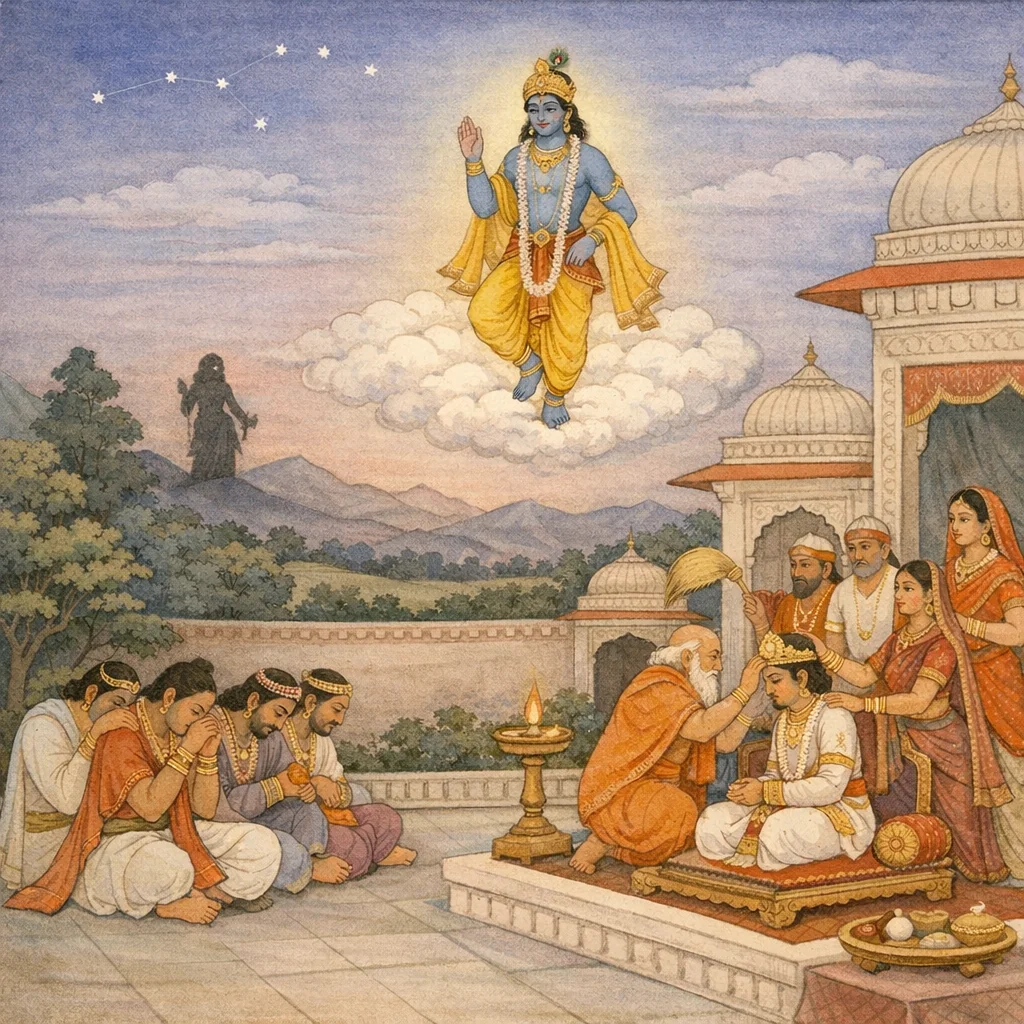
Parāśara closes the dynastic account by tying royal history to cosmic time. He says Kṛta-yuga will return at specific celestial conjunctions, summarizes kings past, present, and future, and gives the span from Parīkṣit’s birth to Nanda’s consecration. He explains the Saptarṣi cycle—stationed by a mid-star for a hundred human years—and places them in Maghā in Parīkṣit’s time. Kali-yuga begins on the very day Śrī Kṛṣṇa (Viṣṇu’s aṁśa) departs; while Kṛṣṇa touched the earth, Kali was powerless. After Kṛṣṇa’s departure, Yudhiṣṭhira renounces and Parīkṣit is installed amid ominous signs; later, when the seers shift to Pūrvāṣāḍhā, Kali increases from Nanda onward. Asked by Maitreya, Parāśara states Kali’s duration and notes Kṛta’s return after it ends. He then introduces the Dharaṇī-gītā (Āsita–Janaka): Earth exposes kings’ possessiveness, blindness to death, and the futility of conquest, praising self-conquest whose true fruit is mokṣa. The chapter ends by reaffirming that royal lineages are “portions of portions” of Viṣṇu, that devotional hearing purifies sin, and that wisdom abandons possessiveness toward family, property, and even the body.
Shlokas
Verse 22
यदा चन्द्रश् च सूर्यश् च यदा तिष्यबृहस्पती एकराशौ समेष्यन्ति भविष्यति तदा कृतम्
When the Moon and the Sun—and when Tiṣya together with Bṛhaspati—converge into a single zodiacal sign, then the Kṛta Yuga shall come into being again.
Verse 23
अतीता वर्तमानाश् च तथैवानागताश् च ये एते वंशेषु भूपालाः कथिता मुनिसत्तम
O best of sages, the kings of these dynasties—those who have passed away, those who reign now, and those yet to come—have thus been recounted.
Verse 24
यावत् परीक्षितो जन्म यावन् नन्दाभिषेचनम् एतद् वर्षसहस्रं तु ज्ञेयं पञ्चदशोत्तरम्
From the birth of Parīkṣit up to the consecration of Nanda, this span is to be understood as one thousand years, increased by fifteen.
Verse 25
सप्तर्षीणां तु यौ पूर्वौ दृश्येते उदितौ दिवि तयोस् तु मध्ये नक्षत्रं दृश्यते यत् समं निशि तेन सप्तर्षयो युक्तास् तिष्ठन्त्य् अब्दशतं नृणाम्
Of the Seven Sages, the two stars seen foremost as they rise in the sky—between them a star is beheld, evenly poised in the night. By that star the Seven Sages are reckoned as “joined” (aligned), and thus they remain in that station for a hundred years of men.
Verse 26
ते तु पारीक्षिते काले मघास्व् आसन् द्विजोत्तम तदा प्रवृत्तश् च कलिर् द्वादशाब्दशतात्मकः
But, O best of brahmins, in the time of Parīkṣit they were in the lunar mansion Maghā; and at that very juncture Kali set in—its measure, in that reckoning, being twelve hundred years.
Verse 27
यदैव भगवद्विष्णोर् अंशो यातो दिवं द्विज वसुदेवकुलोद्भूतस् तदैवात्रागतः कलिः
O brāhmaṇa, at the very moment that the manifested portion of Bhagavān Viṣṇu—born in the lineage of Vasudeva—departed for the heavenly realm, at that very same time Kali arrived here into the world.
Verse 28
यावत् स पादपद्माभ्यां पस्पर्शेमां वसुंधराम् तावत् पृथ्वीपरिष्वङ्गे समर्थो नाभवत् कलिः
So long as He—whose feet are like lotuses—continued to touch this earth, so long was Kali powerless to take the world into his embrace; for in the very presence of the Lord, the age of strife could not assert its dominion.
Verse 29
गते सनातनस्यांशे विष्णोस् तत्र भुवो दिवम् तत्याज सानुजो राज्यं धर्मपुत्रो युधिष्ठिरः
When that eternal portion of Viṣṇu had departed from the earth to heaven, Yudhiṣṭhira—the son of Dharma—renounced the kingdom as well, together with his younger brothers.
Verse 30
विपरीतानि दृष्ट्वा च निमित्तानि स पाण्डवः याते कृष्णे चकाराथ सो ऽभिषेकं परीक्षितः
Seeing ominous portents arise, that descendant of the Pāṇḍavas—after Śrī Kṛṣṇa had departed—performed the royal consecration and installed Parīkṣit as king.
Verse 31
प्रयास्यन्ति यदा चैते पूर्वाषाढां महर्षयः तदा नन्दात् प्रभृत्य् एष कलिर् वृद्धिं गमिष्यति
When these great seers depart for Pūrvāṣāḍhā, then—beginning with the reign of Nanda—this age of Kali will advance and grow in power.
Verse 32
यस्मिन् कृष्णो दिवं यातस् तस्मिन्न् एव तदाहनि प्रतिपन्नं कलियुगं तस्य संख्यां निबोध मे
On the very day when Śrī Kṛṣṇa departed for heaven, Kali-yuga began. O sage, teach me the reckoning and measure of that age.
Verse 33
त्रीणि लक्षाणि वर्षाणां द्विज मानुषसंख्यया षष्टिं चैव सहस्राणि भविष्यत्य् एष वै कलिः
O twice-born one, reckoned in human years, this Kali age will endure for three hundred and sixty thousand years.
Verse 34
शतानि तानि दिव्यानि सप्त पञ्च च संख्यया निःशेषेण ततस् तस्मिन् भविष्यति पुनः कृतम्
When those divine years—reckoned as seven hundred and five hundred (twelve hundred) in all—are fully completed, then, upon the exhaustion of that span, the Kṛta Yuga will arise once more.
Verse 35
ब्राह्मणाः क्षत्रिया वैश्याः शूद्राश् च द्विजसत्तम युगे युगे महात्मानः समतीताः सहस्रशः
O best of the twice-born, in every age, again and again, thousands of great-souled ones have arisen and passed on—among Brāhmaṇas, Kṣatriyas, Vaiśyas, and even Śūdras.
Verse 36
बहुत्वान् नामधेयानां परिसंख्या कुले कुले पुनरुक्तबहुत्वात् तु न मया परिकीर्तिता
In every lineage the names are so many that their full count becomes vast; and because such abundance would cause repeated mention, I have not recited them in detail.
Verse 37
देवापिः पौरवो राजा मरुश् चेक्ष्वाकुवंशजः महायोगबलोपेतौ कलापग्रामसंश्रयौ
Devāpi, the Paurava king, and Maru, born of the Ikṣvāku line—both endowed with the mighty power of yoga—abide in the village of Kalāpa.
Verse 38
कृते युग इहागत्य क्षत्रप्रावर्तकौ हि तौ भविष्यतो मनोर् वंशबीजभूतौ व्यवस्थितौ
In the Kṛta Yuga they came here, and indeed those two became the inaugurators of the Kṣatriya order—steadfastly established as the seed of the lineage of the future Manu.
Verse 39
एतेन क्रमयोगेन मनुपुत्रैर् वसुंधरा कृतत्रेतादिसंज्ञानि युगानि त्रीणि भुज्यते
By this orderly sequence, through the sons of Manu, the Earth is duly governed and sustained—passing through the three ages known as Kṛta, Tretā, and the rest, in their appointed course.
Verse 40
कलौ तु बीजभूतास् ते केचित् तिष्ठन्ति भूतले यथैव देवापिमरू साम्प्रतं समवस्थितौ
But in the age of Kali, a few of them remain upon the earth as seed-forms, preserving the possibility of renewal—just as Devāpi and Maru are said to abide in the world even now.
Verse 41
एष तूद्देशतो वंशस् तवोक्तो भूभुजां मया निखिलो गदितुं शक्यो नैव जन्मशतैर् अपि
Thus I have told you—only in summary—the lineage of the earth’s rulers. To recount it in its entirety is truly not possible, even across a hundred lifetimes.
Verse 42
एते चान्ये च भूपाला यैर् अत्र क्षितिमण्डले कृतं ममत्वं मोहान्धैर् नित्ये ऽनित्यकलेवरैः
These kings—and many others besides—upon this circle of earth, blinded by delusion, fashioned the notion of “mine,” though their bodies were perishable and their time was never truly their own.
Verse 43
कथं ममेयम् अचला मत्पुत्रस्य कथं मही मद्वंशस्येति चिन्तार्ता जग्मुर् अन्तम् इमे नृपाः
Tormented by anxious thoughts—“How shall this immovable earth be mine? How shall this land belong to my son? How shall it remain with my own lineage?”—these kings came at last to their end.
Verse 44
तेभ्यः पूर्वतराश् चान्ये तेभ्यस् तेभ्यस् तथापरे भविष्याश् चैव यास्यन्ति तेषाम् अन्ये च ये ऽध्य् अनु
Before them were others, and from them arose further successors; so too in time to come, more will yet arise and pass onward—others following after them in unbroken sequence.
Verse 45
विलोक्यात्मजयोद्योगयात्राव्यग्रान् नराधिपान् पुष्पप्रहासैः शरदि हसतीव वसुंधरा
Seeing the kings—intent on their sons’ victories and absorbed in the march of war—Earth herself, in autumn, seemed to laugh through the smiling abundance of her flowers.
Verse 46
मैत्रेय पृथिवीगीताः श्लोकाश् चात्र निबोध तान् यान् आह धर्मध्वजिने जनकायासितो मुनिः
O Maitreya, understand now these verses called the “Song of the Earth”—the very stanzas the sage Āsita once spoke to Janaka, that king whose banner was Dharma itself.
Verse 47
कथम् एष नरेन्द्राणां मोहो बुद्धिमताम् अपि येन फेनसधर्माणो ऽप्य् अतिविश्वस्तचेतसः
How does this delusion seize kings—even the intelligent—so that, though their state is as fleeting as foam, their minds become utterly confident and complacent?
Verse 48
पूर्वम् आत्मजयं कृत्वा जेतुम् इच्छन्ति मन्त्रिणः ततो भृत्यांश् च पौरांश् च जिगीषन्ते तथा रिपून्
First, having conquered the self, the wise ministers seek victory; then they strive to bring servants and townsmen under control—and only thereafter do they set out to subdue their enemies.
Verse 49
क्रमेणानेन जेष्यामो वयं पृथ्वीं ससागराम् इत्य् आसक्तधियो मृत्युं न पश्यन्त्य् अविदूरगम्
“By this step-by-step course we shall conquer the earth with its oceans,” think those whose minds cling to ambition; absorbed in that craving, they do not see Death standing close at hand.
Verse 50
समुद्रावरणं याति मन्मण्डलम् अथो वशम् कियद् आत्मजयाद् एतन् मुक्तिर् आत्मजये फलम्
By conquering oneself, even the whole sphere of the mind—bounded by the ocean-like expanse of sense-objects—comes under control. Yet what is the measure of such self-victory? Liberation (moksha) alone is the true fruit of self-mastery.
Verse 51
उत्सृज्य पूर्वजा याता यां नादाय गतः पिता तां ममेति विमूढत्वाज् जेतुम् इच्छन्ति पार्थिवाः
The realm that the ancestors abandoned and departed, and that the father left behind without taking with him—kings, in the delusion of “this is mine,” still long to conquer.
Verse 52
मत्कृते पितृपुत्राणां भ्रातॄणां चापि विग्रहाः जायन्ते ऽत्यन्तमोहेन ममत्वादृतचेतसाम्
Because of me—through the overpowering delusion born of possessiveness—quarrels arise even between fathers and sons, and between brothers as well, in minds that cling to “mine.”
Verse 53
पृथ्वी ममेयं सकला ममेयं मदन्वयस्यापि च शाश्वतेयम् यो यो मृतो ह्य् अत्र बभूव राजा कुबुद्धिर् आसीद् इति तस्य तस्य
“This earth is mine—this whole world is mine; it is forever mine and belongs to my lineage as well.” Yet every king who has died here, whoever he was, is remembered by that very claim as one of misguided understanding.
Verse 54
दृष्ट्वा ममत्वादृतचित्तम् एकं विहाय मां मृत्युपथं व्रजन्तम् तस्यान्वयस्थस्य कथं ममत्वं हृद्य् आस्पदं मत्प्रभवं करोति
Seeing that the mind, clinging to “mine,” abandons me and goes forth upon the road of death, how can possessiveness find a place in the heart of one who remains in my lineage, born of me?
Verse 55
पृथ्वी ममैषाशु परित्यजैनां वदन्ति ये दूतमुखैः स्वशत्रुम् नराधिपास् तेषु ममातिहासः पुनश् च मूढेषु दयाभ्युपैति
“This earth is mine—abandon her at once!” so proclaim kings, speaking to their own enemy through the mouths of messengers. Yet among such deluded rulers my tale is told again and again; in my heart compassion rises repeatedly, even for the bewildered.
Verse 56
इत्य् एते धरणीगीताः श्लोका मैत्रेय यैः श्रुतैः ममत्वं विलयं याति तापन्यस्तं यथा हिमम्
Thus, O Maitreya—whoever truly hears these verses known as the Earth’s Song finds the sense of “mine-ness” melting away, just as snow dissolves when placed in warmth.
Verse 57
इत्य् एष कथितः सम्यङ् मनोर् वंशो मया तव यत्र स्थितिप्रवृत्तस्य विष्णोर् अंशांशका नृपाः
Thus I have accurately recounted to you the lineage of Manu—that royal succession in which the kings are but portions of portions of Vishnu, the Lord who sustains the world and sets its order in motion.
Verse 58
शृणोति य इमं भक्त्या मनोर् वंशम् अनुक्रमात् तस्य पापम् अशेषं वै प्रणश्यत्य् अमलात्मनः
Whoever listens with devotion to this lineage of Manu, recounted in proper succession—of that pure-souled person, all sin indeed is utterly destroyed.
Verse 59
धनधान्यर्द्धिम् अतुलां प्राप्नोत्य् अव्याहतेन्द्रियः श्रुत्वैवम् अखिलं वंशं प्रशस्तं शशिसूर्ययोः इक्ष्वाकुजह्नुमान्धातृसगराविक्षितान् रघून्
With senses unbroken and untroubled, one attains incomparable prosperity—wealth and abundance of grain—simply by hearing in this manner the entire, well-praised lineage of the Moon and the Sun: the noble lines that include Ikṣvāku, Jahnu, Māndhātṛ, Sagara, Avikṣit, and the Raghus.
Verse 60
ययातिनहुषाद्यांश् च ज्ञात्वा निष्ठाम् उपागतान् महाबलान् महावीर्यान् अनन्तधनसंचयान्
Knowing that Yayāti, Nahuṣa, and the other kings had reached their appointed end, it was understood that those mighty, heroic rulers—heaped with immeasurable wealth—had also passed away in the onward course of Kāla, Time.
Verse 62
श्रुत्वा न पुत्रदारादौ गृहक्षेत्रादिके तथा द्रव्यादौ वा कृतप्रज्ञो ममत्वं कुरुते नरः
Having understood the truth, a man of settled wisdom no longer fastens the sense of “mine” upon son and wife, house and land, or even wealth and the rest.
Verse 63
तप्तं तपो यैः पुरुषप्रवीरैर् उद्बाहुभिर् वर्षगणान् अनेकान् इष्टाश् च यज्ञा बलिनो ऽतिवीर्याः कृतास् तु कालेन कथावशेषाः
Those foremost heroes among men—mighty and of surpassing prowess—performed arduous austerities, standing with arms upraised for countless years, and duly offered sacrifices; yet, in the passing of Kāla, their deeds were left as mere remnants of story.
Verse 64
पृथुः समस्तान् प्रचचार लोकान् अव्याहतो यो ऽरिविदारिचक्रः स कालवाताभिहतो विनष्टः क्षिप्तं यथा शाल्मलितूलम् अग्नौ
Pṛthu—whose power-wheel shattered his foes and who moved unobstructed through all the worlds—was at last struck by the wind of Kāla and destroyed, like the silky cotton of the śālmali tree flung into fire.
Verse 65
यः कार्तवीर्यो बुभुजे समस्तान् द्वीपान् समाक्रम्य हतारिचक्रः कथाप्रसङ्गेष्व् अभिधीयमानः स एव संकल्पविकल्पहेतुः
Kartavīrya—who overran all the continents, shattered the circles of his foes, and enjoyed sovereign rule—even when merely spoken of in the stream of tales, becomes a cause that stirs resolve and counter-resolve within the mind.
Verse 66
दशाननावीक्षितराघवाणाम् ऐश्वर्यम् उद्भासितदिङ्मुखानाम् भस्मापि जातं न कथं क्षणेन भ्रूभङ्गपातेन धिग् अन्तकस्य
How could the majesty of the Rāghavas—before which even Daśānana (Rāvaṇa) stood awed, and which made the very faces of the quarters blaze with its radiance—be reduced to ashes in a single instant, merely by the fall of Death’s frown? Fie upon that Antaka (Death)!
Verse 67
कथाशरीरत्वम् अवाप यद् वै मान्धातृनामा भुवि चक्रवर्ती श्रुत्वापि तं को हि करोति साधुर् ममत्वम् आत्मन्य् अपि मन्दचेताः
That universal monarch on earth, named Māndhātṛ, has truly become a ‘body of story’—a mere subject for narration. Even after hearing of him, what good person would still fashion possessiveness, even toward one’s own self?
Verse 68
भगीरथाद्याः सगरः ककुत्स्थो दशाननो राघवलक्ष्मणौ च युधिष्ठिराद्याश् च बभूवुर् एते सत्यं न मिथ्या क्व नु ते न विद्मः
Bhagīratha and the rest, Sagara, Kakutstha, Daśānana, and Rāghava with Lakṣmaṇa—and Yudhiṣṭhira and the others—all these indeed once were. This is truth, not falsehood; yet where are they now? We do not know.
Verse 69
ये साम्प्रतं ये च नृपा भविष्याः प्रोक्ता मया विप्रवरोग्रवीर्याः ये ते तथान्ये च तथाभिधेयाः सर्वे भविष्यन्ति यथैव पूर्वे
O best of Brahmins, of formidable spiritual vigor—those kings who exist now, and those who are yet to come, have been declared by me. And those others too, who are to be spoken of in the same manner—each and all will arise in their appointed order, just as the former ones did before them.
Verse 70
एतद् विदित्वा न नरेण कार्यं ममत्वम् आत्मन्य् अपि पण्डितेन तिष्ठन्तु तावत् तनयात्मजायाः क्षेत्रादयो ये तु शरीरतो ऽन्ये
Knowing this truth, a wise person should not cultivate the notion of “mine”—not even with regard to one’s own body. Let sons, grandsons, wife, fields, and the rest remain only so long as they do; for all these are other than the body, and therefore even more truly “not-Self.”
Frequently Asked Questions
Kali-yuga begins on the very day Śrī Kṛṣṇa—described as Viṣṇu’s manifested aṁśa born in the Vasudeva lineage—departs from the earth to heaven; while He remained on earth, Kali could not overpower the world.
Parāśara describes the Seven Sages as being ‘joined’ to a station indicated by a star seen between the two foremost among them; they remain associated with that station for one hundred human years, and in Parīkṣit’s time their station is said to be Maghā.
It teaches vairāgya by exposing mamatva: kings plan conquest and inheritance yet ignore death’s nearness; Earth ‘laughs’ at this delusion. True victory is ātmājaya (self-mastery), whose real fruit is mokṣa, not territorial possession.
He states that names across lineages are extremely numerous, and exhaustive enumeration would cause excessive repetition; therefore he provides an uddesha (summary) rather than a complete catalogue.
Parāśara declares that hearing the Manu lineage in proper sequence with bhakti destroys sin (pāpa-kṣaya) and is associated with prosperity (wealth and grain), while also leading the wise listener to relinquish possessiveness toward family, property, and the body.