Adhyaya 12
सोमचक्रः, ग्रह-रथाः, ध्रुवबन्धनं, शिशुमारसंनिवेशः, विष्णु-सर्वात्मकता (Moon, Planets, Dhruva-Tethering, Śiśumāra, and Vishnu as All)
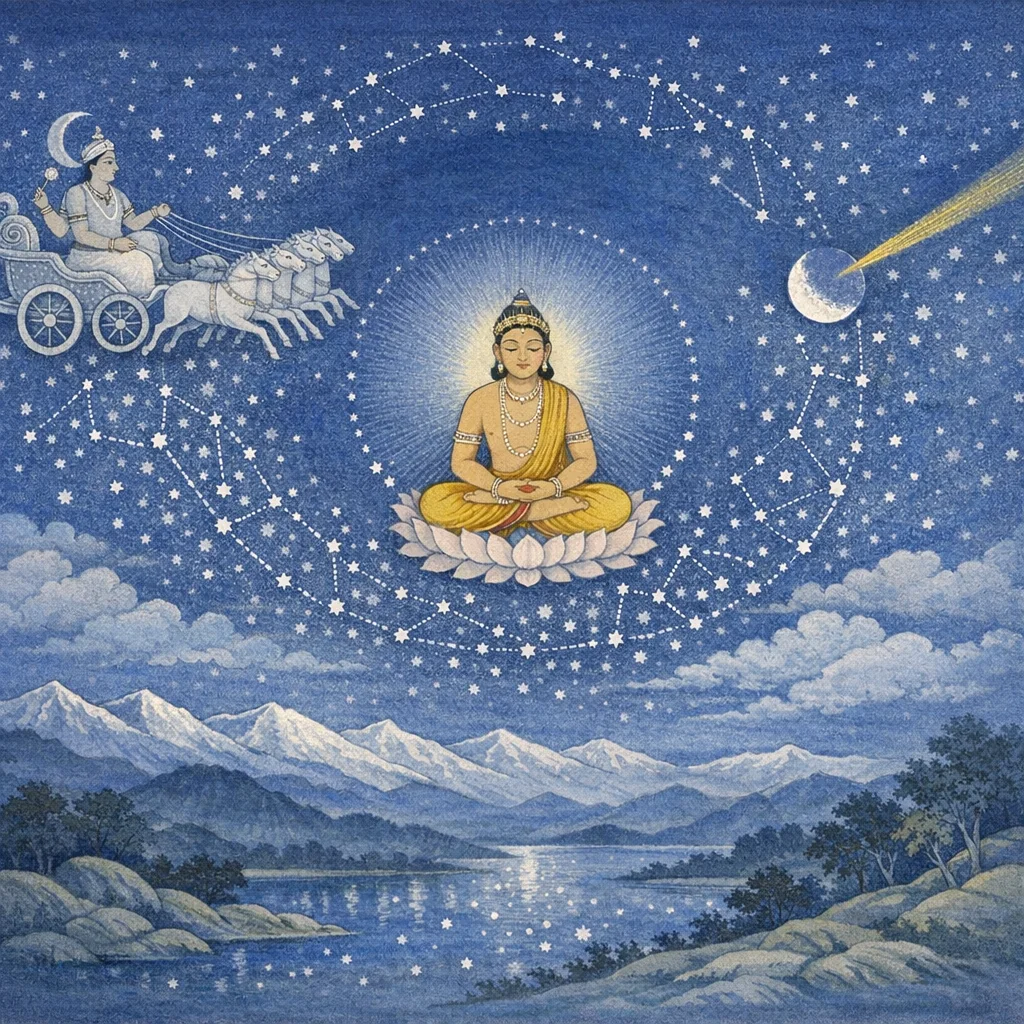
Parāśara describes Soma’s three-wheeled chariot with ten radiant horses, and explains the Moon’s waning and waxing: the Sun replenishes Soma with a single ray, while the Devas drink the gathered nectar through the two fortnights. At new moon Soma enters the Sun’s orb; the Moon’s passage through waters and plants is detailed, with a strict dharma warning not to harm vegetation then. The planetary chariots (Śukra, Bhoma, Bṛhaspati, Śanaiścara, Rāhu/Ketu) are surveyed, and the principle is taught that all luminaries are bound to Dhruva by wind-rays in the pravaha stream, with analogies explaining apparent motion. Parāśara then sets forth the Śiśumāra cosmic form and its deities as a merit-giving contemplation. The chapter culminates in the teaching that luminaries, worlds, rivers, and directions are Viṣṇu; distinctions are expansions of vijñāna, and pure knowledge alone is ultimately real, guiding the seeker into Vāsudeva.
Shlokas
Verse 1
रथस् त्रिचक्रः सोमस्य कुन्दाभास् तस्य वाजिनः वामदक्षिणतो युक्ता दश तेन चरत्य् असौ
The Moon’s chariot is three-wheeled; its steeds are radiant like jasmine. Ten horses are yoked to it, to the left and the right, and by them that luminary moves along its ordained course.
Verse 2
वीथ्याश्रयाणि ऋक्षाणि ध्रुवाधारेण वेगिना ह्रासवृद्धिक्रमस् तस्य रश्मीनां सवितुर् यथा
The constellations, abiding in their celestial tracks, are borne along in swift motion, upheld upon Dhruva as their axis. Their advance and recession proceed in measured order, like the waxing and waning of the Sun’s rays.
Verse 3
अर्कस्येव हि तस्याश्वाः सकृद्युक्ता वहन्ति ते कल्पम् एकं मुनिश्रेष्ठ वारिगर्भसमुद्भवाः
His steeds are like the Sun’s own: once yoked, O best of sages, they bear him onward through a single Kalpa. They are born from the womb of the waters, arising from the oceanic source.
Verse 4
क्षीणं पीतं सुरैः सोमम् आप्याययति दीप्तिमान् मैत्रेयैककलं सन्तं रश्मिनैकेन भास्करः
Maitreya, when Soma has been drained and diminished by the gods’ drinking, the radiant Sun restores and nourishes him with a single ray, even when only one digit of the Moon remains.
Verse 5
क्रमेण येन पीतो ऽसौ देवैस् तेन निशाकरम् आप्याययत्य् अनुदिनं भास्करो वारितस्करः
By the very measure in which the gods drink him in due course, the Sun—stealer of the waters—causes the Moon, maker of night, to wax and be replenished day after day.
Verse 6
संभृतं चार्धमासेन तत् सोमस्थं सुधामृतम् पिबन्ति देवा मैत्रेय सुधाहारा यतो ऽमराः
That nectar—sudhā, amṛta—gathered over a fortnight and lodged in Soma, O Maitreya, is drunk by the gods. For by subsisting on that ambrosia they are called “immortals”.
Verse 7
त्रयस् त्रिंशत्सहस्राणि त्रयस् त्रिंशच्छतानि च त्रयस् त्रिंशत् तथा देवाः पिबन्ति क्षणदाकरम्
Thirty-three thousand, thirty-three hundred, and likewise thirty-three—thus the gods are said to “drink” the night-making draught, a poetic measure of time by which the divine order counts the moments.
Verse 8
कलाद्वयावशिष्टस् तु प्रविष्टः सूर्यमण्डलम् अमाख्यरश्मौ वसति अमावास्या ततः स्मृता
When only two kalās remain, the Moon is said to enter the Sun’s orb and abide in a ray called ‘Amā’; from that state the day is remembered as Amāvāsyā, the new moon.
Verse 9
अप्सु तस्मिन्न् अहोरात्रे पूर्वं विशति चन्द्रमाः ततो वीरुत्सु वसति प्रयात्य् अर्कं ततः क्रमात्
Within that single day-and-night, the Moon first enters the waters; then it abides among the plants, and thereafter—step by step in ordained order—proceeds toward the Sun, according to the cosmic sequence upheld by the Supreme Lord.
Verse 10
छिनत्ति वीरुधो यस् तु वीरुत्संस्थे निशाकरे पत्रं वा पातयत्य् एकं ब्रह्महत्यां स विन्दति
Whoever cuts creeping plants—or causes even a single leaf to fall—when the Moon is stationed amid the vegetation, incurs the grave sin of brahmahatyā, guilt equal to slaying a brāhmaṇa.
Verse 11
शेषे पञ्चदशे भागे किंचिच्छिष्टे कलात्मके अपराह्णे पितृगणा जघन्यं पर्युपासते
As the afternoon nears its end—when only a slight remainder of the fifteenth division of time is left—the hosts of the Pitṛs wait upon that final, least portion, ready to receive the offerings made in the waning moments of the day.
Verse 12
पिबन्ति द्विकलं सोमं शिष्टा तस्य कला तु या सुधामृतमयी पुण्या ताम् इन्दोः पितरो मुने
They drink Soma in a double measure; and the remaining portion of his ray—holy, made of sudhā and amṛta—O sage, the Pitṛs partake of as the Moon’s own share.
Verse 13
निःसृतं तद् अमावास्यां गभस्तिभ्यः सुधामृतम् मासतृप्तिम् अवाप्याग्र्यां पितरः सन्ति निर्वृताः सौम्या बर्हिषदश् चैव अग्निष्वात्ताश् च ते त्रिधा
On the new-moon day (Amāvāsyā), that nectar—of the very essence of sudhā and amṛta—issues from the rays. Having gained from it the foremost satisfaction that endures for a month, the Pitṛs abide in serene contentment. The Pitṛs are said to be threefold: the Saumyās, the Barhiṣads, and the Agniṣvāttas.
Verse 14
एवं देवान् सिते पक्षे कृष्णपक्षे तथा पितॄन् वीरुधश् चामृतमयैः शीतैर् अप्परमाणुभिः
Thus, in the bright fortnight one should satisfy the gods, and in the dark fortnight likewise the Pitṛs; and with cool, nectar-like, exceedingly subtle drops, one also nourishes the plants.
Verse 15
वीरुधौषधिनिष्पत्त्या मनुष्यपशुकीटकान् आप्याययति शीतांशुः प्राकाश्याह्लादनेन तु
By bringing forth the growth of plants and medicinal herbs, the cool-rayed Moon nourishes human beings, animals, and even insects—sustaining them through his radiance and his power to delight and refresh.
Verse 16
वाय्वग्निद्रव्यसंभूतो रथश् चन्द्रसुतस्य च पिशङ्गैस् तुरगैर् युक्तः सो ऽष्टाभिर् वायुवेगिभिः
The chariot of the Moon’s son was fashioned from substances born of wind and fire; it was harnessed to eight tawny horses, swift as the very gale.
Verse 17
सवरूथः सानुकर्षो युक्तो भूसंभवैर् हयैः सोपासङ्गपताकस् तु शुक्रस्यापि रथो महान्
Fully harnessed, with pole and draw-gear set, and yoked to earth-born steeds, Śukra’s mighty chariot—adorned with its fittings and banner—moves onward along the divinely ordained course upheld by the Supreme Lord.
Verse 18
अष्टाश्वः काञ्चनः श्रीमान् भौमस्यापि रथो महान् पद्मरागारुणैर् अश्वैः संयुक्तो वह्निसंभवैः
Bhoma (Mars) too possessed a mighty, splendid golden chariot called ‘Aṣṭāśva’, yoked to fire-born horses, crimson like padmarāga, blazing in hue as they drew his great car.
Verse 19
अष्टाभिः पाण्डरैर् युक्तैर् वाजिभिः काञ्चने रथे तस्मिंस् तिष्ठति वर्षं वै राशौ राशौ बृहस्पतिः
Harnessed to eight pale steeds and borne upon a golden chariot, Bṛhaspati abides there—remaining a full year in each zodiacal sign, moving from sign to sign in the ordained order.
Verse 20
आकाशसंभवैर् अश्वैः शबलैः स्यन्दनं युतम् समारुह्य शनैर् याति मन्दगामी शनैश्चरः
Mounting a chariot yoked with dappled horses born of the sky itself, Śanaiścara—slow by very nature—moves onward gradually, advancing with measured pace.
Verse 21
स्वर्भानोस् तुरगा ह्य् अष्टौ भृङ्गाभा धूसरं रथम् सकृद्युक्तास् तु मैत्रेय वहन्त्य् अविरतं सदा
O Maitreya, Svarbhānu’s eight horses, dark as bees, once yoked, draw the grey-hued chariot without pause—unceasingly, forever.
Verse 22
आदित्यान् निःसृतो राहुः सोमं गच्छति पर्वसु आदित्यम् एति सोमाच् च पुनः सौरेषु पर्वसु
Breaking away from the Sun, Rāhu approaches the Moon at the lunar junctions; and departing from the Moon, he again advances upon the Sun at the solar junctions—thus, at the ordained nodes of time, he repeatedly returns to seize their light.
Verse 23
तथा केतुरथस्याश्वा अष्टौ ते वातरंहसः पलालधूमवर्णाभा लाक्षारसनिभारुणाः
Likewise, Keturatha has eight horses—swift as the wind—whose hue is like the smoke of burning chaff, and whose bodies shine with a ruddy glow, like liquid lac.
Verse 24
एते मया ग्रहाणां वै तवाख्याता रथा नव सर्वे ध्रुवे महाभाग प्रबद्धा वायुरश्मिभिः
Thus have I explained to you the nine chariots of the planets. All of them, O noble one, are fastened to Dhruva, bound by rays of wind.
Verse 25
ग्रहर्क्षताराधिष्ण्यानि ध्रुवे बद्धान्य् अशेषतः भ्रमन्त्य् उचितचारेण मैत्रेयानिलरश्मिभिः
All the planets, constellations, stars, and the celestial abodes are bound fast to Dhruva; and, O Maitreya, driven by the rays of the cosmic Wind, they revolve in their proper courses.
Verse 26
यावन्त्यश् चैव तारास् तास् तावन्तो वातरश्मयः सर्वे ध्रुवे निबद्धास् ते भ्रमन्तो भ्रामयन्ति तम्
As many as there are stars, so many are the wind-born rays; all of them are fastened to Dhruva. Moving in their own revolutions, they cause him too to appear as though he turns.
Verse 27
तैलपीडा यथा चक्रं भ्रमन्तो भ्रामयन्ति वै तथा भ्रमन्ति ज्योतींषि वातविद्धानि सर्वशः
As workers at an oil-press, moving themselves, set the wheel to whirl, so do the heavenly lights revolve on every side, as though driven onward by the force of the cosmic wind.
Verse 28
अलातचक्रवद् यान्ति वातचक्रेरितानि तु यस्माज् ज्योतींषि वहति प्रवहस् तेन स स्मृतः
Like the whirling circle traced by a firebrand, the heavenly lights move, impelled by the revolving wheel of the winds; and because that mighty current bears the luminaries along, it is remembered as Pravaha, the great carrying stream.
Verse 29
शिशुमारस् तु यः प्रोक्तः स ध्रुवो यत्र तिष्ठति संनिवेशं च तस्यापि शृणुष्व मुनिसत्तम
Now, that celestial form called the Śiśumāra, of which I have spoken—there indeed is the place where Dhruva stands fixed. Hear also, O best of sages, the ordered disposition of that Śiśumāra as well.
Verse 30
यद् अह्ना कुरुते पापं दृष्ट्वा तं निशि मुच्यते यावन्त्यश् चैव तारास् ताः शिशुमाराश्रिता दिवि तावन्त्य् एव तु वर्षाणि जीवत्य् अभ्यधिकानि च
Whatever sin a person commits by day, on beholding that Śiśumāra at night he is released from it. And as many as are the stars in heaven lodged in the Śiśumāra, for just so many years—indeed, even more—does he live.
Verse 31
उत्तानपादस् तस्याथ विज्ञेयो ह्य् उत्तरो हनुः यज्ञो ऽधरश् च विज्ञेयो धर्मो मूर्धानम् आश्रितः
Know that Uttānapāda is His upper jaw; His lower jaw is to be understood as Yajña, the sacrificial order. And Dharma abides as His very head.
Verse 32
हृदि नारायणश् चास्ते अश्विनौ पूर्वपादयोः वरुणश् चार्यमा चैव पश्चिमे तस्य सक्थिनी
In his very heart abides Nārāyaṇa; upon his fore-feet stand the Aśvins; and upon the back of his thighs are stationed Varuṇa and Aryaman—thus the cosmic powers are set in order within the all-pervading Person, whose body is the pattern of the universe.
Verse 33
शिश्नं संवत्सरस् तस्य मित्रो ऽपानं समाश्रितः
In that cosmic Person, the generative organ is the Year itself; and Mitra abides presiding over the downward-moving vital breath, Apāna.
Verse 34
पुच्छे ऽग्निश् च महेन्द्रश् च कश्यपो ऽथ ततो ध्रुवः तारका शिशुमारस्य नास्तम् एति चतुष्टयम्
At the tail of the Śiśumāra are Agni, Mahendra, and Kaśyapa—and then Dhruva. This fourfold group of luminaries belonging to the Śiśumāra never sets, remaining ever visible as fixed guides in the celestial order.
Verse 35
इत्य् एष संनिवेशो यः पृथिव्या ज्योतिषां तथा द्वीपानाम् उदधीनां च पर्वतानां च कीर्तितः
Thus has been described the ordered disposition of the earth—and likewise of the heavenly luminaries—together with the continents, the encircling oceans, and the ranges of mountains.
Verse 36
वर्षाणां च नदीनां च ये च तेषु वसन्ति वै तेषां स्वरूपम् आख्यातं संक्षेपाच् छ्रूयतां पुनः
Now hear again, in brief, the true character of the regions (varṣas) and the rivers, and of those beings who dwell within them—for their essential form has already been declared.
Verse 37
यद् अम्बु वैष्णवः कायस् ततो विप्र वसुंधरा पद्माकारा समुद्भूता पर्वताब्ध्यादिसंयुता
From that primeval water—Vishnu’s own manifested body—O Brahmin, the Earth arose: lotus-shaped in form, coming forth complete, endowed with mountains, oceans, and all such features.
Verse 38
ज्योतींषि विष्णुर् भुवनानि विष्णुर् वनानि विष्णुर् गिरयो दिशश् च नद्यः समुद्राश् च स एव सर्वं यद् अस्ति यन् नास्ति च विप्रवर्य
The luminaries are Vishnu; the worlds are Vishnu. The forests are Vishnu; the mountains and the directions are Vishnu. The rivers and the oceans too—He alone is all this: whatever exists, and even what is said not to exist, O best of Brahmins.
Verse 39
ज्ञानस्वरूपो भगवान् यतो ऽसाव् अशेषमूर्तिर् न तु वस्तुभूतः ततो हि शैलाब्धिधरादिभेदाञ् जानीहि विज्ञानविजृम्भितानि
Know that Bhagavān is of the very nature of pure consciousness: He is the form of all forms, yet not a thing among things. Therefore the distinctions such as mountain, ocean, and the supporting earth are to be understood as expansions manifested through His divine knowledge (vijñāna).
Verse 40
यदा तु शुद्धं निजरूपि सर्वं कर्मक्षये ज्ञानम् अपास्तदोषम् तदा हि संकल्पतरोः फलानि भवन्ति नो वस्तुषु वस्तुभेदाः
But when, with the exhaustion of karma, knowledge becomes pure—resting in its own essential nature, all-pervading, and free from every defect—then the fruits are like those of the wish-fulfilling tree: in reality there are no divisions of ‘thing’ and ‘thing’ within objects at all.
Verse 41
वस्त्व् अस्ति किं कुत्रचिद् आदिमध्य पर्यन्तहीनं सततैकरूपम् यच् चान्यथात्वं द्विज याति भूयो न तत् तथा तत्र कुतो हि तत्त्वम्
Is there anywhere any real entity that is without beginning, middle, or end—ever of one unbroken nature? For whatever again falls into alteration, O twice-born, is not truly such; and where there is change, how can there be the abiding truth of reality?
Verse 42
मही घटत्वं घटतः कपालिका कपालिका चूर्णरजस् ततो ऽणुः जनैः स्वकर्मस्तिमितात्मनिश्चयैर् आलक्ष्यते ब्रूहि किम् अत्र वस्तु
Earth becomes a pot; from the pot comes a shard; from the shard, powder and dust; from that, the atom itself. By people whose inner certainty is stilled and fixed through their own disciplined action, this is discerned. Tell me—what, in all this, is the real ‘thing’ (vastu)?
Verse 43
तस्मान् न विज्ञानम् ऋते ऽस्ति किंचित् क्वचित् कदाचिद् द्विज वस्तुजातम् विज्ञानम् एकं निजकर्मभेद विभिन्नचित्तैर् बहुधाभ्युपेतम्
Therefore, O twice-born one, at no place and at no time does any class of beings exist apart from true knowledge. Knowledge is one in itself; yet, through the differing divisions of one’s own actions (karma), it is taken up in many ways by minds that have become variously conditioned.
Verse 44
ज्ञानं विशुद्धं विमलं विशोकम् अशेषलोभादिनिरस्तसङ्गम् एकं सदैकं परमः परेशः स वासुदेवो न यतो ऽन्यद् अस्ति
He is pure consciousness—utterly stainless, untainted, and beyond sorrow; detached from all association, with every trace of greed and the like cast away. One alone, ever the One; the Supreme, the Lord of all lords—He is Vāsudeva, for apart from Him there exists nothing else.
Verse 45
सद्भाव एषो भवतो मयोक्तो ज्ञानं यथा सत्यम् असत्यम् अन्यत् एतत् तु यत् संव्यवहारभूतं तत्रापि चोक्तं भुवनाश्रितं ते
Thus have I explained to you the principle of true being: that knowledge alone is real, and whatever is other than that is unreal. Yet this world-transaction—this sphere of ordinary experience—also has been spoken of (by the wise) as having its basis in the ordered universe; and so, even there, a dependent reality is acknowledged for you to understand.
Verse 46
यज्ञः पशुर् वह्निर् अशेष-ऋत्विक् सोमः सुराः स्वर्गमयश् च कामः इत्यादिकर्माश्रितमार्गदृष्टं भूरादिभोगाश् च फलानि तेषाम्
Sacrifice, the victim, the fire, the full complement of officiating priests, Soma, the gods, heaven, fame, and the fulfillment of desire—such are the outcomes seen on the path that rests upon ritual action; and the enjoyments of Bhū (earth) and the other worlds are, indeed, the fruits that accrue to those who follow it.
Verse 47
यच् चैतद् भुवनगतं मया तवोक्तं सर्वत्र व्रजति हि कर्मवश्य एकः ज्ञात्वैवं ध्रुवम् अचलं सदैकरूपं तत् कुर्याद् विशति हि येन वासुदेवम्
This whole condition of embodied existence within the worlds, of which I have spoken to you, moves everywhere under the sway of karma alone. Therefore, knowing Reality to be certain, unmoving, and ever of one nature, one should undertake that practice by which one enters into Vāsudeva.
Frequently Asked Questions
Pravaha is the great ‘carrying stream’ of wind-ray forces described as binding planets, stars, and constellations to Dhruva and driving their revolutions—an explanatory principle for cosmic motion within Purāṇic astronomy.
After detailing lunar/planetary order, it culminates in sarvātmā-viṣṇu doctrine: all cosmic forms are manifestations sustained by Viṣṇu, while pure knowledge (vijñāna) is the ultimate reality—directing practice toward entering Vāsudeva.