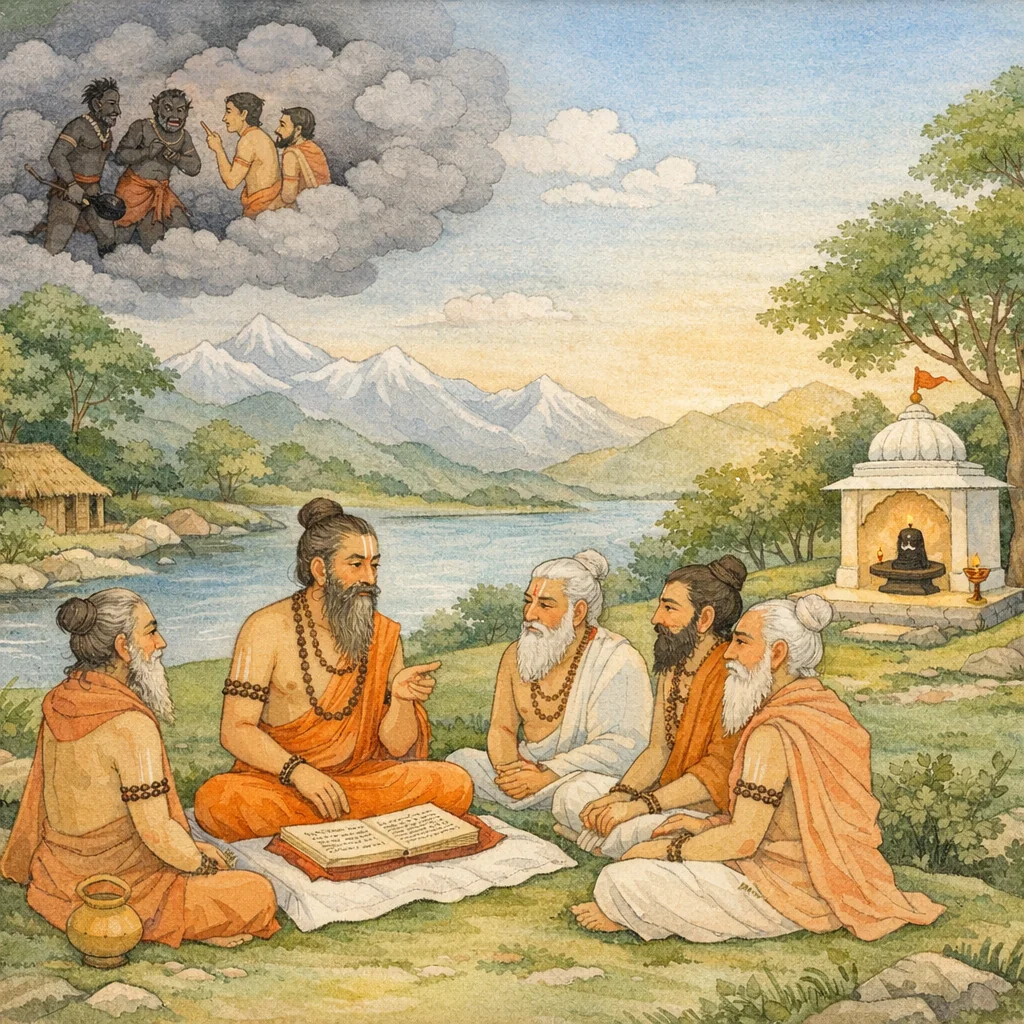
शिवपुराण-प्रशंसा (Praise of the Śiva Purāṇa) / Śivapurāṇa Māhātmya
This chapter presents Sūta’s authoritative reply to a well-formed question, begun with remembrance of the guru and a teaching intent for the welfare of the three worlds (trailokya-hita). It extols the Śiva Purāṇa as the essence of Vedānta (vedānta-sāra) and the foremost Śaiva Purāṇa, declaring it a salvific means that destroys accumulated sins and grants the supreme meaning (paramārtha) beyond death. A recurring conditional refrain—“so long as the Śiva Purāṇa does not arise/spread in the world”—diagnoses Kali-yuga: sins multiply (including brahmahatyā and other grave faults), ominous disturbances roam, śāstra systems quarrel, Śiva’s true nature remains hard to grasp even for the great, and Yama’s punitive agents move unchecked. By contrast, the chapter implies that the Purāṇa’s appearance, teaching, and study reverse these conditions, bestowing auspicious destiny (susadgati) and clarifying Śiva’s subtle ontology. Thus the adhyāya serves as a charter of Śaiva scriptural authority and an epistemic claim that right knowledge of Śiva is mediated through this Purāṇic revelation and its disciplined reception.
Shlokas
Verse 1
सूत उवाच । साधुपृष्टं साधवो वस्त्रैलोक्यहितकारकम् । गुरुं स्मृत्वा भवत्स्नेहाद्वक्ष्ये तच्छृणुतादरात्
Sūta said: “O virtuous ones, you have asked well—your question is indeed beneficial to the welfare of the three worlds. Remembering my Guru, and moved by your affectionate regard, I shall explain it; listen with reverence.”
Verse 2
इति श्रीशिवमहापुराणे विद्येश्वरसंहितायां द्वितीयोऽध्यायः
Thus ends the Second Chapter in the Vidyeśvara-saṃhitā of the Śrī Śiva Mahāpurāṇa.
Verse 3
कलिकल्मषविध्वंसि यस्मिञ्छिवयशः परम् । विजृम्भते सदा विप्राश्चतुर्वर्गफलप्रदम्
O brāhmaṇas, in that sacred teaching/recital wherein the supreme glory of Śiva ever shines forth, the sins of the Kali age are destroyed, and it bestows the fruits of the four human aims—dharma, artha, kāma, and mokṣa.
Verse 4
तस्याध्ययनमात्रेण पुराणस्य द्विजोत्तमाः । सर्वोत्तमस्य शैवस्य ते यास्यंति सुसद्गतिम्
O best of the twice-born, merely by studying that Purāṇa—the supremely excellent Śaiva scripture—they will attain the most auspicious and noble state of liberation.
Verse 5
तावद्विजृंभते पापं ब्रह्महत्यापुरस्सरम् । यावच्छिवपुराणं हि नोदेष्यति जगत्यहो
So long does sin keep spreading—foremost among them the grievous sin of brahmin-slaying—until the Śiva Purāṇa indeed arises and is proclaimed in the world.
Verse 6
तावत्कलिमहोत्पाताः संचरिष्यंति निर्भयाः । यावच्छिवपुराणं हि नोदेष्यति जगत्यहो
So long will the dreadful portents of the Kali age roam about without fear—until, indeed, the Śiva Purāṇa rises (is proclaimed) in the world, alas!
Verse 7
तावत्सर्वाणि शास्त्राणि विवदंति परस्परम् । यावच्छिवपुराणं हि नोदेष्यति जगत्यहो
So long do all the scriptures dispute with one another—until, indeed, the Śiva Purāṇa rises in the world; then, alas, their contention is stilled by its decisive teaching on Śiva, the Supreme Lord (Pati).
Verse 8
तावत्स्वरूपं दुर्बोधं शिवस्य महतामपि । यावच्छिवपुराणं हि नो देष्यति जगत्यहो
So long does Shiva’s true nature remain hard to comprehend—even for the great—until the Shiva Purana itself is bestowed upon us in this world.
Verse 9
तावद्यमभटाः क्रूराः संचरिष्यंति निर्भयाः । यावच्छिवपुराणं हि नोदेष्यति जगत्यहो
So long as the Śiva Purāṇa has not yet arisen and been proclaimed in this world, the cruel attendants of Yama will roam the earth without fear.
Verse 10
तावत्सर्वपुराणानि प्रगर्जंति महीतले । यावच्छिवपुराणं हि नोदेष्यति जगत्यहो
So long as the Śiva Purāṇa has not arisen and manifested in the world, all the Purāṇas will roar upon the face of the earth.
Verse 11
तावत्सर्वाणि तीर्थानि विवदंति महीतले । यावच्छिवपुराणं हि नोदेष्यति जगत्यहो
So long do all the sacred tīrthas on the earth contend with one another—until, alas, the Śiva Purāṇa arises and manifests in the world.
Verse 12
तावत्सर्वाणि मंत्राणि विवदंति महीतले । यावच्छिवपुराणं हि नोदेष्यति महीतले
So long do all mantras contend with one another upon the earth, until indeed the Śiva Purāṇa rises and is proclaimed upon the earth.
Verse 13
तावत्सर्वाणि क्षेत्राणि विवदंति महीतले । यावच्छिवपुराणं हि नोदेष्यति महीतले
So long do all the sacred kṣetras and pilgrimage-places contend with one another upon the earth—until, indeed, the Śiva Purāṇa rises and manifests upon the earth.
Verse 14
तावत्सर्वाणि पीठानि विवदंति महीतले । यावच्छिवपुराणं हि नोदेष्यति महीतले
So long do all the sacred seats of doctrine contend upon the earth—until, indeed, the Śiva Purāṇa rises and is proclaimed upon the earth.
Verse 15
तावत्सर्वाणि दानानि विवदंति महीतले । यावच्छिवपुराणं हि नोदेष्यति महीतले
So long do all charitable gifts remain a matter of dispute upon the earth—until indeed the Śiva Purāṇa is proclaimed upon the earth.
Verse 16
तावत्सर्वे च ते देवा विवदंति महीतले । यावच्छिवपुराणं हि नोदेष्यति महीतले
All those gods continued disputing upon the earth, so long as the Śiva Purāṇa had not yet arisen and been proclaimed in the world.
Verse 17
तावत्सर्वे च सिद्धान्ता विवदंति महीतले । यावच्छिवपुराणं हि नोदेष्यति महीतले
So long will all doctrinal systems continue to dispute upon the earth, until the Śiva Purāṇa is proclaimed and rises forth in the world.
Verse 18
अस्य शैवपुराणस्य कीर्तनश्रवणाद्द्विजाः । फलं वक्तुं न शक्नोमि कार्त्स्न्येन मुनिसत्तमाः
O twice-born ones, O best of sages—through the recitation and the hearing of this Śaiva Purāṇa, the merit that arises is such that I cannot describe, in full, its fruit in its entirety.
Verse 19
तथापि तस्य माहात्म्यं वक्ष्ये किंचित्तु वोनघाः । चित्तमाधाय शृणुत व्यासेनोक्तं पुरा मम
Even so, O sinless ones, I shall speak a little of His glory, the glory of Lord Śiva. With minds made steady, listen—this was once spoken to me by Vyāsa.
Verse 20
एतच्छिवपुराणं हि श्लोकं श्लोकार्द्धमेव च । यः पठेद्भक्तिसंयुक्तस्स पापान्मुच्यते क्षणात्
Indeed, whoever recites this Śiva Purāṇa with devotion—even a single verse, or even half a verse—is freed from sins in an instant.
Verse 21
एतच्छिवपुराणं हि यः प्रत्यहमतंद्रि तः । यथाशक्ति पठेद्भक्त्या स जीवन्मुक्त उच्यते
Indeed, whoever recites this Śiva Purāṇa every day without laziness, and reads it with devotion according to one’s capacity, is said to be jīvanmukta—liberated while still living.
Verse 22
एतच्छिवपुराणं हि यो भक्त्यार्चयते सदा । दिने दिनेऽश्वमेधस्य फलं प्राप्नोत्यसंशयम्
Indeed, whoever continually venerates this Śiva Purāṇa with devotion attains—day after day, without doubt—the spiritual fruit of performing the Aśvamedha sacrifice.
Verse 23
एतच्छिवपुराणं यस्साधारणपदेच्छया । अन्यतः शृणुयात्सोऽपि मत्तो मुच्येत पातकात्
Whoever hears this Śiva Purāṇa—even with an ordinary motive, desiring common worldly gains—if he listens to it from another reciter, he too is released from sin through Me, Śiva.
Verse 24
एतच्छिवपुराणं यो नमस्कुर्याददूरतः । सर्वदेवार्चनफलं स प्राप्नोति न संशयः
Whoever bows in reverence to this Śiva Purāṇa—even from afar—surely attains the merit that comes from worshipping all the gods; of this there is no doubt.
Verse 25
एतच्छिवपुराणं वै लिखित्वा पुस्तकं स्वयम् । यो दद्याच्छिवभक्तेभ्यस्तस्य पुण्यफलं शृणु
Having personally written out this Śiva Purāṇa as a book, whoever donates it to devotees of Śiva—listen to the meritorious fruit that accrues to him.
Verse 26
अधीतेषु च शास्त्रेषु वेदेषु व्याकृतेषु च । यत्फलं दुर्लभं लोके तत्फलं तस्य संभवेत्
By studying the śāstras and the Vedas, and by mastering their clearly articulated teachings, one attains that very fruit which is rare and difficult to obtain in this world.
Verse 27
एतच्छिवपुराणं हि चतुर्दश्यामुपोषितः । शिवभक्तसभायां यो व्याकरोति स उत्तमः
Indeed, one who fasts on the fourteenth lunar day and expounds this Śiva Purāṇa in the assembly of Śiva’s devotees—such a person is the most excellent.
Verse 28
प्रत्यक्षरं तु गायत्रीपुरश्चर्य्याफलं लभेत् । इह भुक्त्वाखिलान्कामानं ते निर्वाणतां व्रजेत्
For each syllable of this sacred mantra, one gains merit equal to completing the full puraścaraṇa of the Gāyatrī. Having enjoyed all desired aims in this very life, one finally proceeds to nirvāṇa—liberation in Śiva.
Verse 29
उपोषितश्चतुर्दश्यां रात्रौ जागरणान्वितः । यः पठेच्छृणुयाद्वापि तस्य पुण्यं वदाम्यहम्
Whoever, having fasted on the fourteenth lunar day and kept vigil through the night, either recites this sacred account or listens to it—of that person’s merit I shall now declare.
Verse 30
कुरुक्षेत्रादिनिखिलपुण्यतीर्थेष्वनेकशः । आत्मतुल्यधनं सूर्य्यग्रहणे सर्वतोमुखे
Even if one again and again gives away wealth equal to one’s very life at all holy pilgrimage-fords—Kurukṣetra and the rest—during a solar eclipse seen in every direction, that merit is still surpassed by the higher Śaiva merit taught here.
Verse 31
विप्रेभ्यो व्यासमुख्येभ्यो दत्त्वायत्फलमश्नुते । तत्फलं संभवेत्तस्य सत्यं सत्यं न संशयः
Whatever spiritual merit one attains by giving in charity to brāhmaṇas—especially to sages headed by Vyāsa—that very merit surely arises for him. It is truth, truth indeed—there is no doubt.
Verse 32
एतच्छिवपुराणं हि गायते योप्यहर्निशम् । आज्ञां तस्य प्रतीक्षेरन्देवा इन्द्र पुरो गमाः
Indeed, whoever recites this Śiva Purāṇa day and night—the gods, led by Indra, wait upon his command.
Verse 33
एतच्छिवपुराणं यः पठञ्छृण्वन्हि नित्यशः । यद्यत्करोति सत्कर्म तत्कोटिगुणितं भवेत्
Whoever regularly recites and listens to this Śiva Purāṇa—whatever righteous act (satkarma) he performs thereafter becomes multiplied a crore-fold, by the grace and sanctifying power of Śiva’s sacred teaching.
Verse 34
समाहितः पठेद्यस्तु तत्र श्रीरुद्र संहिताम् । स ब्रह्मघ्नोऽपि पूतात्मा त्रिभिरेवादिनैर्भवेत्
Whoever, with a collected and steady mind, recites there the sacred Rudra Saṁhitā—even if he be a slayer of a brāhmaṇa—becomes purified in spirit within just three days.
Verse 35
तां रुद्र संहितां यस्तु भैरवप्रतिमांतिके । त्रिः पठेत्प्रत्यहं मौनी स कामानखिलां ल्लभेत्
Whoever, observing silence, recites that Rudra-saṃhitā three times each day in the presence of Bhairava’s sacred image, attains all desired aims—through the grace of Lord Śiva in His awe-inspiring, protective form.
Verse 36
तां रुद्र संहितां यस्तु सपठेद्वटबिल्वयोः । प्रदक्षिणां प्रकुर्वाणो ब्रह्महत्या निवर्तते
Whoever recites that Rudra-saṃhitā before a banyan and a bilva tree, and performs pradakṣiṇā (devotional circumambulation), is freed from the sin of brahmahatyā—the grievous fault of slaying a brāhmaṇa.
Verse 37
कैलाससंहिता तत्र ततोऽपि परमस्मृता । ब्रह्मस्वरूपिणी साक्षात्प्रणवार्थप्रकाशिका
Among them, the Kailāsa Saṃhitā is remembered as even more supreme. It is verily of the very nature of Brahman itself, directly illuminating the true meaning of the Praṇava (Om).
Verse 38
कैलाससंहितायास्तु माहात्म्यं वेत्ति शंकरः । कृत्स्नं तदर्द्धं व्यासश्च तदर्द्धं वेद्म्यहं द्विजाः
Of the greatness of the Kailāsa-saṃhitā, Śaṅkara (Lord Śiva) alone knows it in full. Vyāsa knows half of that entirety, and I know half of what Vyāsa knows—O twice-born sages.
Verse 39
तत्र किंचित्प्रवक्ष्यामि कृत्स्नं वक्तुं न शक्यते । यज्ज्ञात्वा तत्क्षणाल्लोकश्चित्तशुद्धिमवाप्नुयात्
In this matter I shall speak only a little, for it is not possible to state it in full. Knowing this, a person attains purity of mind at once.
Verse 40
न नाशयति यत्पापं सा रौद्री संहिता द्विजाः । तन्न पश्याम्यहं लोके मार्गमाणोऽपि सर्वदा
O twice-born sages, I do not see anywhere in this world—though I have searched at all times—any sin that is not destroyed by the Raudrī Saṃhitā.
Verse 41
शिवेनोपनिषत्सिंधुमन्थनोत्पादितां मुदा । कुमारायार्पितां तां वै सुधां पीत्वाऽमरो भवेत्
If one drinks that very nectar—joyfully brought forth by Śiva by churning the ocean of the Upaniṣads, and offered to the Kumāra—one becomes deathless.
Verse 42
ब्रह्महत्यादिपापानां निष्कृतिं कर्तुमुद्यतः । मासमात्रं संहितां तां पठित्वा मुच्यते ततः
One who is intent on performing expiation for sins such as brahma-hatyā (the slaying of a brāhmaṇa) is freed thereafter by reciting that Saṃhitā for only one month.
Verse 43
दुष्प्रतिग्रहदुर्भोज्यदुरालापादिसंभवम् । पापं सकृत्कीर्तनेन संहिता सा विनाशयेत्
Sins arising from improper acceptance of gifts, forbidden or impure food, harsh and harmful speech, and similar faults—this Saṃhitā destroys them by even a single act of recitation or praise.
Verse 44
शिवालये बिल्ववने संहितां तां पठेत्तु यः । स तत्फलमवाप्नोति यद्वाचोऽपि न गोचरे
Whoever recites that Saṃhitā in a Śiva-temple, in a bilva-grove, attains a fruit so great that it lies beyond the reach even of speech to describe.
Verse 45
संहितां तां पठन्भक्त्या यः श्राद्धे भोजयेद्द्विजान् । तस्य ये पितरः सर्वे यांति शंभोः परं पदम्
Whoever, reciting that Saṃhitā with devotion, feeds the twice-born (brāhmaṇas) at a śrāddha—all of that person’s ancestors attain the supreme abode of Śambhu (Lord Śiva).
Verse 46
चतुर्दश्यां निराहारो यः पठेत्संहितां च ताम् । बिल्वमूले शिवः साक्षात्स देवैश्च प्रपूज्यते
Whoever, fasting on the fourteenth lunar day, recites that Saṃhitā—he becomes verily Śiva Himself at the root of the bilva tree, and is honored and worshipped even by the gods.
Verse 47
अन्यापि संहिता तत्र सर्वकामफलप्रदा । उभे विशिष्टे विज्ञेये लीलाविज्ञानपूरिते
There is also another Saṃhitā there, bestowing the fruits of all worthy desires. Know that both are exceptional, filled with divine līlā and true spiritual vijñāna.
Verse 48
तदिदं शैवमाख्यातं पुराणं वेदसंमितम् । निर्मितं तच्छिवेनैव प्रथमं ब्रह्मसंमितम्
This indeed is the Śaiva Purāṇa, declared to be in full accord with the Vedas. It was first composed by Śiva Himself, and was initially set forth as the Brahma-saṃhitā, the recension entrusted to Brahmā.
Verse 49
विद्येशंच तथारौद्रं वैनायकमथौमिकम् । मात्रं रुद्रै कादशकं कैलासं शतरुद्र कम्
“(The Purāṇa contains) the Vidyeśvara Saṃhitā and likewise the Rudra Saṃhitā; also the Vaināyaka and the Aumika, the Mātra, the Rudraikādaśaka, the Kailāsa, and the Śatarudraka.”
Verse 50
कोटिरुद्र सहस्राद्यं कोटिरुद्रं तथैव च । वायवीयं धर्मसंज्ञं पुराणमिति भेदतः
By classification, it is spoken of as the Purāṇa called “Dharma” (the righteous teaching), namely the Vāyavīya; and it is also reckoned as the Koṭirudra—likewise with the division beginning with the Sahasrakoṭirudra.
Verse 51
संहिता द्वादशमिता महापुण्यतरा मता । तासां संख्यां ब्रुवे विप्राः शृणुतादरतोखिलम्
This Saṃhitā is held to have twelve divisions and is regarded as exceedingly meritorious. O Brahmin sages, I shall now state their enumeration—listen to all of it with reverent attention.
Verse 52
विद्येशं दशसाहस्रं रुद्रं वैनायकं तथा । औमं मातृपुराणाख्यं प्रत्येकाष्टसहस्रकम्
“The Vidyeśvara section is of ten thousand verses; likewise the Rudra and the Vaināyaka. The Auma and the one known as the Mātṛpurāṇa—each of these is said to be eight thousand verses.”
Verse 53
त्रयोदशसहस्रं हि रुद्रै कादशकं द्विजाः । षट्सहस्रं च कैलासं शतरुद्रं तदर्द्धकम्
O twice-born sages, the Rudraikādaśa (the elevenfold Rudras) is said to comprise thirteen thousand verses. The Kailāsa section consists of six thousand; and the Śatarudra consists of half of that, i.e., three thousand.
Verse 54
कोटिरुद्रं त्रिगुणितमेकादशसहस्रकम् । सहस्रकोटिरुद्रा ख्यमुदितं ग्रंथसंख्यया
In terms of textual count, the Koṭirudra portion is said to be threefold, amounting to eleven thousand verses; and that which is called “Sahasra-koṭi-rudra” is also stated according to the enumeration of the text.
Verse 55
वायवीयं खाब्धिशतं घर्मं रविसहस्रकम् । तदेवं लक्षसंख्याकं शैवसंख्याविभेदतः
In the Śaiva mode of enumeration, a hundred “sky-oceans” is called vāyavīya, and a thousand suns is called gharma. Thus, through these distinct Śaiva numerical terms, the count is expressed up to the measure of a lakṣa (one hundred thousand).
Verse 56
व्यासेन तत्तु संक्षिप्तं चतुर्विंशत्सहस्रकम् । शैवं तत्र चतुर्थं वै पुराणं सप्तसंहितम्
Then Vyāsa abridged that (Purāṇic corpus) into twenty-four thousand verses. Among them, the Śaiva Purāṇa is indeed the fourth, and it consists of seven Saṃhitās.
Verse 57
शिवे संकल्पितं पूर्वं पुराणं ग्रन्थसंख्यया । शतकोटिप्रमाणं हि पुरा सृष्टौ सुविस्मृतम्
Formerly, O Śivā (Pārvatī), this Purāṇa was first conceived by Śiva in the measure of its many sections; indeed, in the ancient creation it extended to a hundred crores (of verses), but later it became greatly forgotten.
Verse 58
व्यस्तेष्टादशधा चैव पुराणे द्वापरादिषु । चतुर्लक्षेण संक्षिप्ते कृते द्वैपायनादिभिः
In the Dvāpara age and the ages thereafter, the Purāṇa was also arranged in eighteen divisions; and when it had been condensed into four hundred thousand verses, it was compiled by Dvaipāyana (Vyāsa) and other sages.
Verse 59
प्रोक्तं शिवपुराणं हि चतुर्विंशत्सहस्रकम् । श्लोकानां संख्यया सप्तसंहितं ब्रह्मसंमितम्
Indeed, the Śiva Purāṇa has been declared to contain twenty-four thousand verses; by the count of its ślokas it is arranged into seven saṃhitās and is of the measure (authority) of Brahmā’s revelation.
Verse 60
विद्येश्वराख्या तत्राद्या रौद्री ज्ञेया द्वितीयिका । तृतीया शतरुद्रा ख्या कोटिरुद्रा चतुर्थिका
Among these, the first is known as the Vidyeśvara-saṃhitā. The second should be understood as the Raudrī. The third is called the Śatarudrā, and the fourth is the Koṭirudrā.
Verse 61
पंचमी चैव मौमाख्या षष्ठी कैलाससंज्ञिका । सप्तमी वायवीयाख्या सप्तैवं संहितामताः
The fifth is indeed called the Umā Saṃhitā; the sixth is known as the Kailāsa Saṃhitā. The seventh is called the Vāyavīya Saṃhitā—thus, the tradition recognizes seven Saṃhitās in the Śiva Purāṇa.
Verse 62
ससप्तसंहितं दिव्यं पुराणं शिवसंज्ञकम् । वरीवर्ति ब्रह्मतुल्यं सर्वोपरि गतिप्रदम्
This divine Purāṇa, known as the Śiva Purāṇa and consisting of seven saṃhitās, shines forth as equal to Brahman; it stands above all and bestows the highest spiritual goal—liberation (mokṣa).
Verse 63
एतच्छिवपुराणं हि सप्तसंहितमादरात् । परिपूर्णं पठेद्यस्तु स जीवन्मुक्त उच्यते
Indeed, whoever reverently studies this Śiva Purāṇa—complete in its seven Saṃhitās—in full is declared to be a jīvanmukta, liberated while still living.
Verse 64
श्रुतिस्मृतिपुराणेतिहासागमशतानि च । एतच्छिवपुराणस्य नार्हंत्यल्पां कलामपि
Even hundreds of Śrutis, Smṛtis, Purāṇas, Itihāsas, and Āgamas are not worthy to equal even a small fraction of this Śiva Purāṇa.
Verse 65
शैवं पुराणममलं शिवकीर्तितं तद्व्यासेन शैवप्रवणेन न संगृहीतम् । संक्षेपतः सकलजीवगुणोपकारे तापत्रयघ्नमतुलं शिवदं सतां हि
This Śaiva Purāṇa is stainless, proclaimed by Lord Śiva; it was not compiled by Vyāsa, though he was devoted to Śiva. In concise form it benefits the virtues of all beings, destroys the threefold afflictions, is incomparable, and truly bestows “Śiva”—auspiciousness and liberation—upon the righteous.
Verse 66
विकैतवो धर्म इह प्रगीतो वेदांतविज्ञानमयः प्रधानः । अमत्सरांतर्बुधवेद्यवस्तु सत्कॢप्तमत्रैव त्रिवर्गयुक्तम्
Here the pure, non-deceptive Dharma is proclaimed—supreme, grounded in the realized wisdom of Vedānta. It is a reality known only to the wise whose hearts are free from envy; and it is firmly established right here, harmonizing the three aims of life (dharma, artha, and kāma) while leading toward the highest good.
Verse 67
शैवं पुराणतिलकं खलु सत्पुराणं । वेदांतवेदविलसत्परवस्तुगीतम् । यो वै पठेच्च शृणुयात्परमादरेण शंभुप्रियः स हि लभेत्परमां । गतिं वै
This Śaiva Purāṇa is truly the crown-jewel among the Purāṇas—the noble scripture that sings of the Supreme Reality, resplendent in the Vedas and the Vedānta. Whoever reads it or listens to it with the highest reverence becomes dear to Śambhu and surely attains the supreme goal: final liberation.
Frequently Asked Questions
Rather than a single mythic episode, the chapter advances a theological argument for textual efficacy: the Śiva Purāṇa is declared the Vedānta-essence and the supreme Śaiva Purāṇa whose dissemination curbs Kali-yuga disorders—sin, doctrinal conflict, and spiritual ignorance.
The key “symbol” is the Purāṇa itself as a salvific medium: its presence in the world is treated as an ontological intervention that restrains adharma and clarifies the ‘durbodha’ nature of Śiva—implying revelation (śabda) as a direct instrument of liberation.
No distinct iconographic form (e.g., Liṅga, Sadāśiva, or Pārvatī/Gaurī forms) is foregrounded in the sample verses; the emphasis is on Śiva’s supreme nature and fame (śiva-yaśas) as revealed and stabilized through the Śiva Purāṇa.