Sarasvatī-avatāra-prasaṅgaḥ (Account of Sarasvatī’s Manifestation and the Humbling of the Devas)
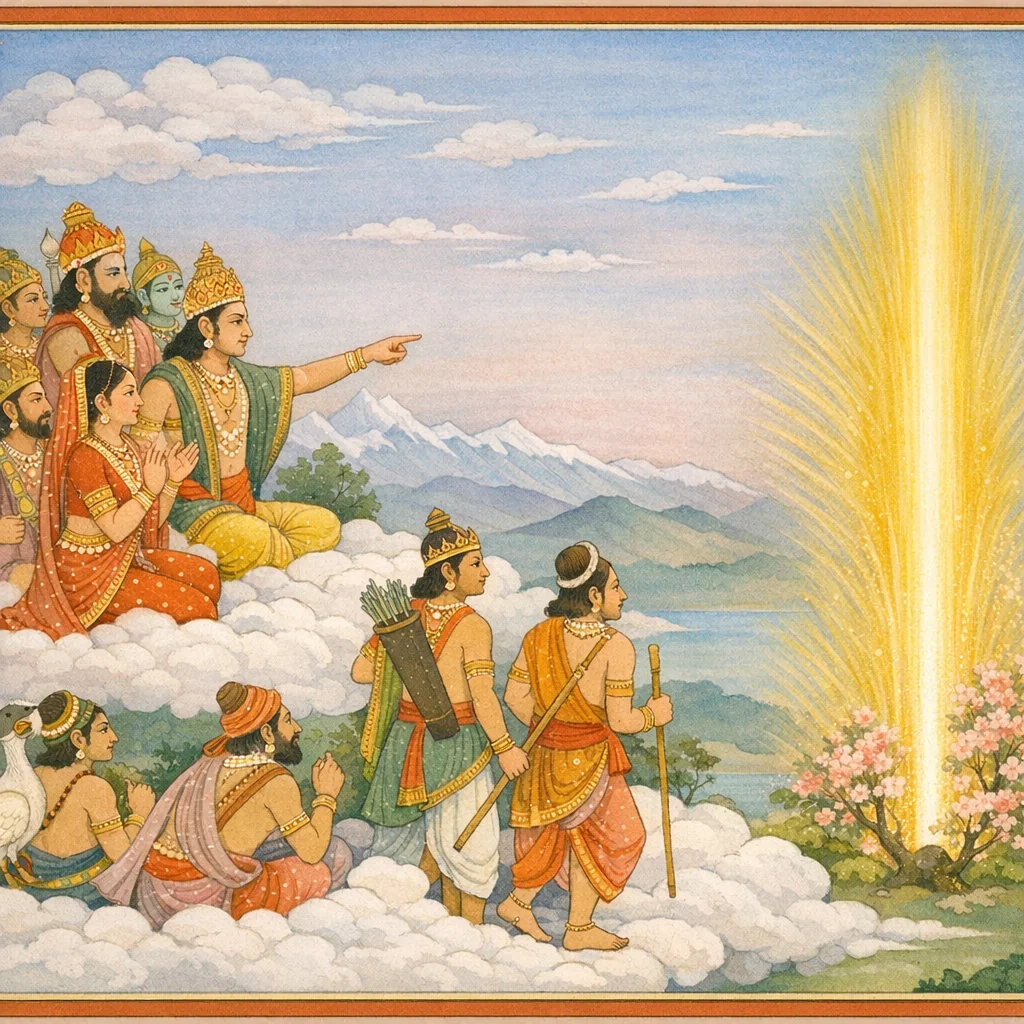
Adhyāya 49 begins with the sages asking Sūta to explain the avatāra connected with Umā/Bhuvaneśānī, especially the circumstance in which Sarasvatī manifests. Sūta frames the teaching of Śakti by stressing that the supreme Prakṛti is both nirākāra (formless) and sākāra (with form), eternal and auspicious, and that mere understanding of this account leads toward the highest goal. In the narrative, the devas defeat the dānavas through the influence of Mahāmāyā, then grow intoxicated with self-praise and pride. A mysterious, unprecedented tejas (radiant power) appears in an enigmatic form, leaving the gods stunned; unable to recognize it, their speech falters. Their leader orders them to investigate and report the truth. The inner lesson critiques divine ego and re-centers agency in Mahāmāyā/Śakti, preparing for the avatāra explanation and reaffirming the supremacy of Śiva–Śakti over contingent celestial power.
Shlokas
Verse 1
मुनय ऊचुः । उमाया भुवनेशान्यास्सूत सर्वार्थवित्तम । अवतारं समाचक्ष्व यतो जाता सरस्वती
The sages said: “O Sūta, knower of the meaning of all things—tell us clearly of the avatāra of Umā, the sovereign Lady of the worlds, from whom Sarasvatī came to be born.”
Verse 2
या गीयते परब्रह्ममूलप्रकृतिरीश्वरी । निराकारापि साकारा नित्या नन्दमथी सती
She who is praised as the sovereign Goddess—the primal Prakṛti rooted in the Supreme Brahman—though formless, also assumes form. Eternal, she is Satī, she who churns forth bliss (ānanda).
Verse 3
सूत उवाच । तापसाः शृणुत प्रेम्णा चरित्रं परमं महत् । यस्य विज्ञानमात्रेण नरो याति परां गतिम्
Sūta said: “O ascetics, listen with loving devotion to this supremely great sacred account—by the mere right understanding of which a person attains the highest state (liberation).”}]}}
Verse 4
देवदानवयोर्युद्धमेकदासीत्परस्परम् । महामायाप्रभावेणामराणां विजयोऽभवत्
Once, a fierce battle arose between the Devas and the Dānavas. Yet, through the overpowering influence of Mahāmāyā, victory came to the immortals—the Devas.
Verse 5
ततोऽवलिप्ता अमरास्स्वप्रशंसां वितेनिरे । वयं धन्या वयं धन्या किं करिष्यंति नोऽसुराः
Then the Devas, swollen with pride, began to praise themselves: “We are blessed—indeed, we are blessed! What can the Asuras possibly do to us now?”
Verse 6
ये प्रभावं समालोक्यास्माकं परमदुःसहम् । भीता नागालयं याता यातयातेति वादिनः
Seeing our overpowering might—utterly unbearable to them—they grew afraid and fled to the abode of the Nāgas, crying again and again, “Drive them off! Strike them down!”
Verse 7
अहो बलमहो तेजो दैत्यवंशक्षयंकरम् । अहो भाग्यं सुमनसामेवं सर्वेऽभ्यवर्णयन्
“Ah, what strength! Ah, what splendor—truly able to bring about the destruction of the Daitya clans! Ah, how fortunate the noble-minded are!”—thus all of them praised and proclaimed.
Verse 8
तत आविरभूत्तेजः कूटरूपन्तदैव हि । अदृष्टपूर्वं तद्दृष्ट्वा विस्मिता अभवन्सुराः
Then, at that very moment, a radiant splendor (tejas) manifested in a wondrous form never seen before. Beholding that unprecedented vision, the devas were struck with amazement.
Verse 9
किमिदं किमिदं चेति रुद्धकण्ठास्समब्रुवन । अजानन्तः परं श्यामानु भावं मानभञ्जनम्
Choked in their throats, they cried again and again, “What is this, what is this?”—for they did not comprehend the supreme, dark and mysterious majesty of Śyāmā, the Shatterer of pride.
Verse 10
तत आज्ञापयद्देवान्देवानामधिनायकः । यात यूयं परीक्षध्वं याथातथ्येन किन्विति
Then the overlord of the gods commanded the devas: “Go, all of you—investigate and ascertain the truth exactly as it is: what indeed is this?”
Verse 11
सुरेन्द्रप्रेरितो वायुर्महसः सन्निधिं गतः । कस्त्वं भोरिति सम्बोध्यावोचदेनं च तन्महः
Urged by Indra, Vāyu drew near to the Presence of that radiant Splendour. Addressing it, “Who are you, O venerable one?”, that very Effulgence then spoke to him.
Verse 12
इति पृष्टस्तदा वायुर्महसातिगरीयसा । वायुरस्मि जगत्प्राणस्साभिमानोऽब्रवीदिदम्
Thus questioned then by the exceedingly radiant and venerable one, Vāyu—swollen with pride—replied: “I am Vāyu, the very life-breath of the world.”
Verse 13
जंगमाजंगमं सर्वमोतप्रोतमिदं जगत् । मय्येव निखिलाधारे चालयाम्यखिलं जगत्
This entire universe—of the moving and the unmoving—is woven through and through. Resting in Me alone, the all-supporting foundation, I set the whole cosmos in motion and govern it.
Verse 14
तदोवाच महातेजः शक्तोऽसि यदि चालने । धृतमेतत्तृणं वायो चालयस्व निजेच्छया
Then the mighty, radiant one said: “O Vāyu, if you are truly able to move, I am holding this blade of grass—move it by your own will.”
Verse 15
ततः सर्वप्रयत्नेनाकरोद्यत्नं सदागतिः । न चचाल यदा स्थानात्तदासौ लज्जितोऽभवत
Then, with every possible effort, that ever-restless one exerted himself; but when (the other) did not move from his place at all, he became ashamed.
Verse 16
तूष्णीं भूत्वा ततो वायुर्जगामेन्द्रं सभां प्रति । कथयामास तद् वृत्तं स्वकीयाभिभवान्वितम्
Then Vāyu fell silent, and went to Indra’s royal assembly. There he recounted that entire incident—how he himself had been overpowered.
Verse 17
सर्वेशत्वं वयं सर्वे मृषैवात्मनि मन्महे । न पारयामहे किंचिद्वि धातुं क्षुद्रवस्त्वपि
All of us merely imagine within ourselves that we are ‘lords of all’—but that is indeed false. We are not capable of accomplishing even the smallest thing by our own power.
Verse 18
ततश्च प्रेषयामास मरुत्वान्सकलान्सुरान् । न शेकुस्ते यदा ज्ञातुं तदेन्द्रः स्वयमभ्यगात्
Then Marutvān (Indra) dispatched all the gods. But when they were unable to ascertain it, Indra himself went there in person.
Verse 19
मघवन्तमथायान्तं दृष्ट्वा तेजोतिदुःसहम् । बभूवान्तर्हितं सद्यो विस्मितोऽभूच्च वासवः
Then, seeing Maghavan (Indra) approaching, that radiance—too unbearable to behold—vanished at once from sight; and Vāsava (Indra) was struck with astonishment.
Verse 20
चरित्रमीदृशं यस्य तमेव शरणं श्रये । इति संचिन्तयामास सहस्राक्षः पुनःपुनः
“He whose conduct is of such a kind—him alone I take refuge in.” Thinking thus again and again, Sahasrākṣa (Indra) reflected repeatedly.
Verse 21
एतस्मिन्नंतरे तत्र निर्व्याजकरुणातनुः । तेषामनुग्रहं कर्तुं हर्तुं गर्वं शिवांगना
Just then, the consort of Śiva—whose very form is unfeigned compassion—appeared there, intending to bestow grace upon them and to remove their pride.
Verse 22
चैत्रशुक्लनवम्यां तु मध्याह्नस्थे दिवाकरे । प्रादुरासीदुमा देवी सच्चिदानन्दरूपिणी
On Navamī, the ninth lunar day of the bright fortnight of Caitra, when the sun stood at midday, Goddess Umā manifested—she whose very nature is Existence, Consciousness, and Bliss (sat–cit–ānanda).
Verse 23
महोमध्ये विराजन्ती भासयन्ती दिशो रुचा । बोधयन्ती सुरान्सर्वान्ब्रह्मैवाहमिति स्फुटम्
Shining in the very midst of that great radiance, she illumined the quarters with her splendor and awakened all the gods, clearly proclaiming, “I am indeed Brahman.”
Verse 24
चतुर्भिर्दधती हस्तैर्वरपाशांकुशाभयान् । श्रुतिभिस्सेविता रम्या नवयौवनगर्विता
With four hands she bore the boons-giving gesture, the noose, the goad, and the sign of fearlessness. Attended upon by the Vedas themselves, she appeared supremely beautiful—radiant with the proud fullness of fresh youth.
Verse 25
रक्ताम्बरपरीधाना रक्तमाल्यानुलेपना । कोटिकंदर्प्पसंकाशा चन्द्रकोटिसमप्रभा
She wore red garments and was adorned with red garlands and unguents. Her beauty rivaled that of millions of Kāma-devas, and her radiance was equal to that of ten million moons.
Verse 26
व्याजहार महामाया सर्वान्तर्य्यामिरूपिणी । साक्षिणी सर्वभूतानां परब्रह्मस्वरूपिणी
Then Mahāmāyā spoke—she whose form is the Inner Ruler (Antaryāmin) within all, the witness of every being, and whose very nature is the Supreme Brahman.
Verse 27
उमोवाच । न ब्रह्मा न सुरारातिर्न पुरारातिरीश्वरः । मदग्रे गर्वितुं किंचित्का कथान्यसुपर्वणाम्
Umā said: “Neither Brahmā, nor the foe of the gods, nor the Lord who slew the three cities—none of them can display even the slightest pride before me. What then can be said of others, of lesser occasion and lesser stature?”
Verse 28
परं ब्रह्म परं ज्योतिः प्रणवद्वन्द्वरूपिणी । अहमेवास्मि सकलं मदन्यो नास्ति कश्चन
I am the Supreme Brahman, the Supreme Light, whose very form is the sacred Pranava (Oṃ) with its paired aspects. I alone am all that exists; apart from Me there is no one whatsoever.
Verse 29
निराकारापि साकारा सर्वतत्त्वस्वरूपिणी । अप्रतर्क्यगुणा नित्या कार्यकारणरूपिणी
Though formless, She also assumes form; She is the very essence of all tattvas (principles of reality). Her qualities are beyond mere reasoning; eternal is She, appearing as both cause and effect in the lila of manifestation.
Verse 30
कदाचिद्दयिताकारा कदाचित्पुरुषाकृतिः । कदाचिदुभयाकारा सर्वाकाराहमीश्वरी
At times I appear in the form of the beloved (the feminine), at times in the form of a man; at times I manifest as both together. I, the Sovereign Goddess, am indeed of every form.
Verse 31
विरञ्चिः सृष्टिकर्ताहं जगत्पाताहमच्युतः । रुद्रः संहारकर्ताहं सर्वविश्वविमोहिनी
“I am Virañci (Brahmā), the creator; I am Acyuta (Viṣṇu), the protector of the world; I am Rudra, the agent of dissolution—and I am that power who casts delusion across the entire universe.”
Verse 32
कालिका कमलावाणी मुखास्सर्वा हि शक्तयः । मदंशादेव संजातास्तथेमास्सकलाः कलाः
Kālikā, Kamalā, and Vāṇī—indeed all the divine Powers (Śaktis)—arose from a portion of Me alone; and likewise, all these manifest arts and energies (kalās) have come forth from My own share.
Verse 33
मत्प्रभावाज्जितास्सर्वे युष्माभिर्द्दितिनन्दनाः । तामविज्ञाय मां यूयं वृथा सर्वेशमानिनः
O sons of Diti, all of you have been conquered by my very power. Not recognizing me as that supreme Reality, you—vainly imagining yourselves to be lords of all—have acted in futility.
Verse 34
यथा दारुमयीं योषां नर्तयत्यैन्द्रजालिकः । तथैव सर्वभूतानि नर्तयाम्यहमीश्वरी
Just as a conjurer makes a wooden puppet-woman dance, so too do I, the Sovereign Goddess (Īśvarī), cause all beings to move and act.
Verse 35
मद्भयाद्वाति पवनः सर्वं दहति हव्यभुक् । लोकपालाः प्रकुर्वंति स्वस्वकर्माण्यनारतम्
Out of fear of me, the wind blows; the fire—the eater of oblations—burns all things. Out of fear of me, the guardians of the worlds (Lokapālas) ceaselessly carry out their respective duties.
Verse 36
कदाचिद्देववर्गाणां कदाचिद्दितिजन्म नाम् । करोमि विजयं सम्यक्स्वतन्त्रा निजलीलया
At times I grant complete victory to the hosts of the Devas, and at other times to those born of Diti (the Daityas). Being wholly independent, I bring about these outcomes through my own divine play (līlā).
Verse 37
अविनाशि परं धाम मायातीतं परात्परम् । श्रुतयो वर्णयन्ते यत्त द्रूपन्तु ममैव हि
That imperishable Supreme Abode—beyond Māyā and higher than the highest—which the Vedas (Śrutis) describe: that very reality is indeed my own form.
Verse 38
सगुणं निर्गुणं चेति मद्रूपं द्विविधं मतम् । मायाशबलितं चैकं द्वितीयन्तदनाश्रितम्
My own reality is understood to be of two kinds: with attributes (saguṇa) and without attributes (nirguṇa). One aspect is associated with Māyā and appears variegated by it, while the second is independent of Māyā and rests on nothing else.
Verse 39
एवं विज्ञाय मां देवास्स्वं स्वं गर्वं विहाय च । भजत प्रणयोपेताः प्रकृतिं मां सनातनीम्
Knowing me thus, O gods, abandon each of your prides and worship me with loving devotion—me, the eternal Prakṛti, the primordial Divine Nature.
Verse 40
इति देव्या वचः श्रुत्वा करुणागर्भितं सुराः । तुष्टुवुः परमेशानीं भक्तिसंनतकन्धराः
Thus, hearing the Goddess’s words, filled with compassion, the devas praised Parameśānī (Umā). With their necks bowed in devotion, they offered her reverent hymns.
Verse 41
क्षमस्व जगदीशानि प्रसीद परमेश्वरि । मैवं भूयात्कदाचिन्नो गर्वो मातर्द्दयां कुरु
Forgive us, O Mistress of the universe; be gracious, O Supreme Goddess. May such pride never arise in us again at any time—O Mother, show compassion.
Verse 42
ततःप्रभृति ते दैवा हित्वा गर्वं समाहिताः । उमामाराधयामासुर्यथापूर्वं यथाविधि
From that time onward, those gods—having abandoned their pride and becoming inwardly composed—began to worship Umā again, just as before, and in the proper prescribed manner.
Verse 43
इति वः कथितो विप्रा उमाप्रादुर्भवो मया । यस्य श्रवणमात्रेण परमं पदमश्नुते
Thus, O brāhmaṇa sages, I have narrated to you the account of the manifestation of Umā. By merely hearing this, one attains the supreme state—the highest abode of liberation.
Verse 49
इति श्रीशिवमहापुराणे पञ्चम्यामुमासंहितायामुमाप्रादुर्भाववर्णनं नामैकोनपञ्चाशत्तमोऽध्यायः
Thus, in the Śrī Śiva Mahāpurāṇa, in the Fifth Book called the Umāsaṃhitā, concludes the forty-ninth chapter entitled “The Description of the Manifestation of Umā.”
Frequently Asked Questions
It presents a devas–dānavas war followed by a theological critique: the devas’ victory occurs due to Mahāmāyā’s power, yet they fall into pride until a mysterious tejas appears, triggering an investigation—an argument that divine success is derivative of Śakti, not self-generated celestial prowess.
Mahāmāyā signifies the cosmic power that both enables worldly outcomes and veils true causality; the appearing tejas functions as a revelatory interruption that collapses deva-ego and redirects cognition toward the transcendent source, aligning narrative wonder with metaphysical reorientation.
Umā/Bhuvaneśānī is foregrounded as the supreme Prakṛti praised as both formless and formed, while Sarasvatī is invoked as an avatāra to be explained; together they signal Śakti’s modalities—revelation (Sarasvatī/knowledge) and sovereignty (Umā/Mahāmāyā).