Śumbha–Niśumbha’s Mobilization After Devī’s Victories (Battle Muster and Omens)
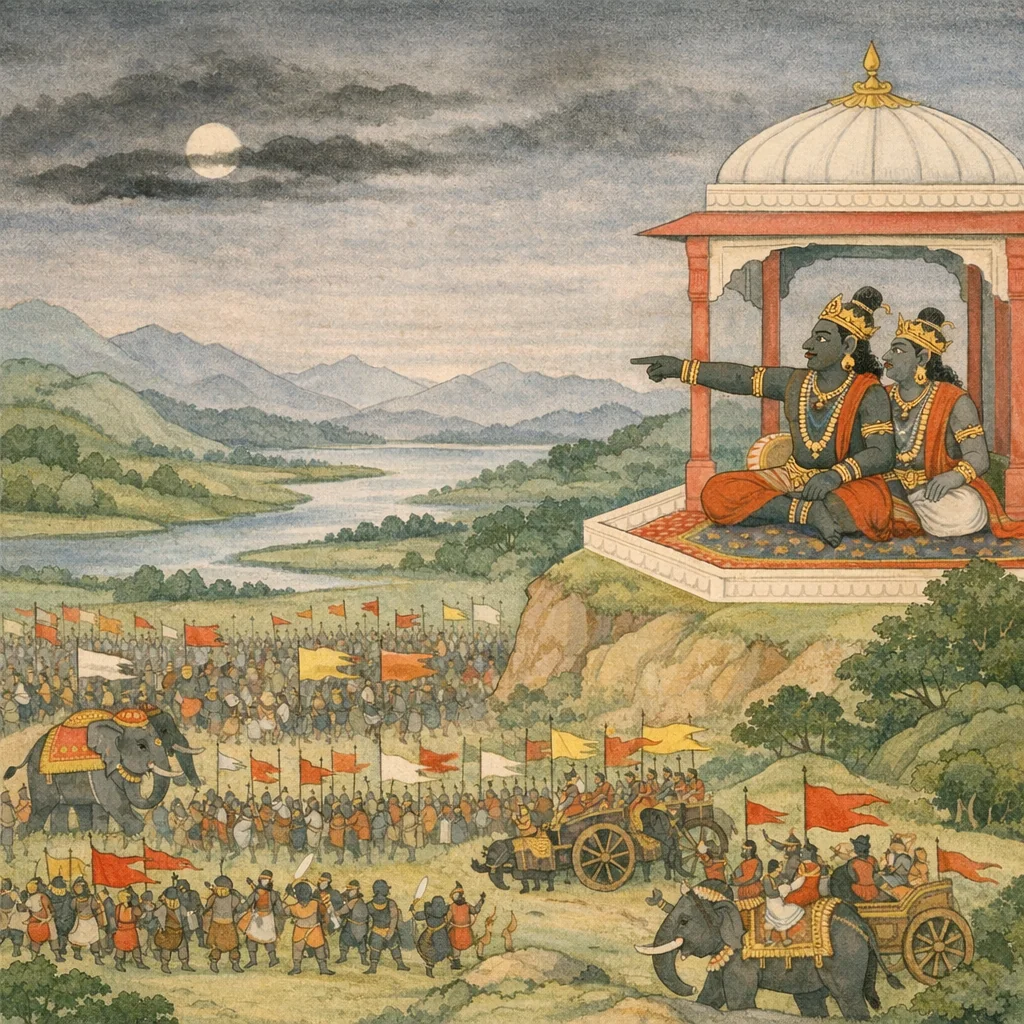
This adhyāya continues in a question-and-answer frame: the King asks the ṛṣi what Śumbha does after hearing that Devī has slain Dhūmrākṣa, Caṇḍa-Muṇḍa, and Raktabīja. The ṛṣi replies by shifting from news to mobilization: Śumbha, mighty and fearsome, commands the gathering of all allied and subordinate asura hosts, casting the coming clash as a total war of cosmic scale. The narrative then turns to a martial catalogue—elephant, horse, and chariot troops, with innumerable infantry—while the signs of battle fill the world: drums and war-instruments thunder, weapon-noise repeatedly shakes the devas, and darkness spreads until the sun’s chariot-disk is obscured. In its inner sense, the chapter portrays the ego’s escalation after defeat: adharma consolidates, amplifies sound and spectacle, and seeks to eclipse discernment (symbolized by the veiling of the sun). Thus it prepares for the next theological movement—Devī’s response—while preserving the Purāṇic art of embedding metaphysical instruction within sequential war-narrative.
Shlokas
Verse 1
राजोवाच । धूम्राक्षं चण्डमुण्डं च रक्तबीजासुरन्तथा । भगवन्निहतन्देव्या श्रुत्वा शुम्भः सुरार्दनः
The King said: “O Blessed One, having heard that the Goddess has slain Dhūmrākṣa, Caṇḍa and Muṇḍa, and also the demon Raktabīja, what did Śumbha—the tormentor of the gods—do then?”
Verse 2
किमकार्षीत्ततो ब्रह्मन्नेतन्मे ब्रूहि साम्प्रतम् । शुश्रूषवे जगद्योनेश्चरित्रं पापनाशनम्
“O Brahman, what did he do after that? Tell me this now. Eager to listen, I seek the sin-destroying sacred account of the Womb of the universe (the Supreme Lord).”
Verse 3
ऋषिरुवाच । हतानेमान्दैत्यवरान्महासुरो निशम्य राजन्महनीयविक्रमः । अजिज्ञपत्स्वीयगणान्दुरासदान्रणाभिधोच्चारणज्जातसंमदान्
The sage said: O King, hearing that these foremost Daityas had been slain, that mighty Asura—renowned for formidable valor—questioned his own hard-to-approach troops, who had grown exultant at the very utterance of the name of battle.
Verse 4
बलान्वितास्संमिलिता ममाज्ञया जयाशया कालकवंशसंभवाः । सकालकेयासुरमौर्य्यदौर्हृदास्तथा परेप्याशु प्रयाणयन्तु ते
Let those mighty ones—assembled by my command and hoping for victory, born of the lineage of Kālaka—together with the Kālakeya Asuras, the Mauryas, the Daurhṛdas, and the others as well, depart at once.
Verse 5
निशुंभशुंभौ दितिजान्निदेश्य तान्रथाधिरूढौ निरयां बभूवतुः । बलान्यनूखुर्बलिनोस्तयोर्धराद्विनाशवन्तः शलभा इवोत्थिताः
Having commanded the Diti-born Asuras, Niśumbha and Śumbha mounted their chariots and rushed toward the battlefield as though bound for hell. From the earth their armies surged up—doomed to destruction—like swarms of moths rising toward a flame.
Verse 6
प्रसादयामास मृदंगमर्दलं सभेरिकाडिण्डिमझर्झरानकम् । रणस्थले संजहृषू रणप्रिया असुप्रियाः संगरतः पराययुः
On the battlefield, drums and mṛdaṅgas, mardalas, kettledrums, ḍiṇḍimas, jharjharas, and ānakas were sounded in exultation. Those who delighted in war rejoiced, while those clinging to life and fearing death fled from the clash of arms.
Verse 7
भटाश्च ते युद्धपटावृतास्तदा रणस्थलीं मापुरपापविग्रहाः । गृहीतशस्त्रास्त्रचया जिगीषया परस्परं विग्रहयन्त उल्बणम्
Then those warriors—clad in their battle-gear, their bodies hardened by sin—entered the field of war. Grasping heaps of weapons and missiles, eager for victory, they assailed one another fiercely in a dreadful clash.
Verse 8
गजाधिरूढास्तुरगाधिरोहिणो रथाधिरूढाश्च तथापरेऽसुराः । अलक्षयन्तः स्वपराञ्जनान्मुदाऽसुरेशसंगे समरेऽभिरेभिरे
Some Asuras rode elephants, some rode horses, and others rode chariots. In the tumult, unable to tell their own from the foe, they rushed about in delight in the battle joined with the lord of the Asuras.
Verse 9
ध्वनिः शतघ्नी जनितो मुहुर्मुहुर्बभूव तेन त्रिदशाः समेजिताः । महान्धकारः समपद्यताम्बरे विलोक्यते नो रथमण्डलं रवेः
Again and again there arose a terrifying roar, like that produced by a śataghnī weapon; by it the Tridaśa gods were shaken. A great darkness spread across the sky, and the sun’s orb—his chariot-circle—could no longer be seen.
Verse 10
पदातयो निर्व वजुर्हि कोटिशः प्रभूतमाना विजयाभिलाषिणः । रथाश्वगा वारणगा अथापरेऽसुरा निरीयुः कति कोटिशो मुदा
In countless crores, the foot-soldiers surged forth—puffed up with pride and yearning for victory. Other Asuras too marched out in delighted multitudes: some mounted on chariots and horses, and some riding mighty elephants.
Verse 11
अशुक्ल शैला एव मत्तवारणा अतानिषुश्चीत्कृतिशब्दमाहवे । क्रमेलकाश्चापि गलद्गलध्वनिं वितन्वते क्षुद्रमहीधरोपमाः
Like dark mountains, the rut-maddened elephants in battle raised piercing cries; and the camels too, resembling small hills, spread all around their gurgling, clattering roar.
Verse 12
हयाश्च ह्रेषन्त उदग्रभूमिजा विशालकण्ठाभरणा गतेर्विदः । पदानि दन्तावलमूर्ध्नि बिभ्रतः सुडिड्यिरे व्योमपथा यथाऽवयः
The horses neighed aloud—spirited, high-stepping—adorned with broad neck-ornaments and skilled in swift motion. Bearing their hoof-marks upon the heads of the elephant-host, they darted along the sky-path like birds.
Verse 13
समीक्ष्य शत्रोर्बलमित्थमापतच्चकार सज्यं धनुरम्बिका तदा । ननाद घण्टां रिपुसाददायिनी जगर्ज सिंहोऽपि सटां विधूनयन्
Seeing the enemy’s might advancing in that manner, Ambikā at once strung her bow. She rang her bell, the bestower of the foes’ downfall; and her lion too, shaking his mane, roared.
Verse 14
ततो निशुंभस्तुहिनाचलस्थितां विलोक्य रम्याभरणायुधां शिवाम् । गिरं बभाषे रसनिर्भरां परां विलासनीभावविचक्षणो यथा
Then Niśumbha, beholding Śivā (the Goddess) stationed upon the Himālaya—adorned with delightful ornaments and bearing radiant weapons—addressed her with eloquent, emotion-laden, and refined speech, like one skilled in the arts of amorous persuasion.
Verse 15
भवादृशीनां रमणीयविग्रहे दुनोति कीर्णं खलु मालतीदलम् । कथं करालाहवमातनोष्यसे महेशि तेनैव मनोज्ञवर्ष्मणा
O Maheśī, upon a form as lovely as yours, even a scattered petal of malatī jasmine seems to bring pain. How, then, will you undertake a dreadful battle with that very enchanting body?
Verse 16
इतीरयित्वा वचनं महासुरो बभूव मौनी तमुवाच चंडिका । वृथा किमात्थासुर मूढ संगरं कुरुष्व नागालयमन्यथा व्रज
Having spoken thus, the mighty asura fell silent. Then Caṇḍikā said to him: “Deluded asura, why do you prattle in vain? Make ready for battle—or else depart to the abode of serpents (death).”
Verse 17
ततोतिरुष्टः समरे महारथश्चकार बाणावलिवृष्टिमद्भुताम् । घनाघनाः संववृषुर्यथोदकं रणस्थले प्रावृडिवागता तदा
Then, exceedingly enraged in the battle, that great chariot-warrior unleashed a wondrous shower of volleys of arrows. Upon the battlefield they rained down like water from dense clouds, just as when the monsoon season arrives.
Verse 18
शरैश्शितैश्शूलपरश्वधायुधैः सभिन्दिपालैः परिघैश्शरासनैः । भुशुण्डिकाप्रासक्षुरप्रसंज्ञकैर्महासिभिः संयुयुधे मदोद्धतैः
Maddened with pride, they fought with sharpened arrows, tridents, axes, and other weapons; with bhindipālas (javelins), iron clubs, and bows; and with bhuśuṇḍikās, spears, razor-like blades, and great swords, hurling themselves into battle with furious force.
Verse 19
विवभ्रमुस्तत्समरे महागजा विभिन्नकुंभाअसिताद्रिसन्निभाः । चलद्बलाकाधवला विकेतवो विसेतवः शुंभनिशुंभकेतवः
In that battle, mighty elephants reeled and staggered, their temples split open, looking like dark mountains. The standards, white as moving flocks of cranes, swayed and scattered—bearing the emblems of Śumbha and Niśumbha.
Verse 20
विभिन्नदेहा दितिजा झषोपमा विकन्धरा वाजिगणा भयंकराः । परासवः कालिकया कृता रणे मृगारिणा चाशिषतापरेऽसुरा
In that battle, the Diti-born demons—some with bodies torn apart, some like great fish, some headless, and some appearing as dreadful troops of horsemen—were deprived of life by Kālikā. Yet other asuras, seeking refuge, implored Mṛgāri (Śiva) for protection and blessing.
Verse 21
विसुस्रुवू रक्तवहास्तदन्तरे सरिच्च यास्तत्र विपुप्लुवे हतैः । कचा भटानां जलनीलिकोपमास्तदुत्तरीयं सितफेनसंनिभम्
In that very midst, streams of blood poured forth, and a river there became swollen, overflowing with the slain. The hair of the warriors looked like dark-blue water-plants, and their upper garments appeared like white foam.
Verse 22
तुरंगसादी तुरगाधिरोहिणं गजस्थितानभ्यपतन्गजारुहः । रथी रथेशं खलु पत्तिरङ्घ्रिगान्समप्रतिद्वन्द्विकलिर्महानभूत्
The horseman rushed upon the rider mounted on a horse; the elephant-rider charged at the one stationed upon an elephant. The charioteer indeed engaged the lord of chariots, and the foot-soldiers confronted the infantry. Thus a great and evenly matched clash of counterparts arose.
Verse 23
ततो निशुंभो हृदये व्यचिन्तयत्करालकालोयमुपागतोऽधुना । भवेद्दरिद्रोऽपि महाधनो महाधनो दरिद्रो विपरीतकालतः
Then Niśumbha reflected in his heart: “Now this dreadful turn of Time has arrived. By the reversal of destiny, even a poor man may become exceedingly wealthy, and an exceedingly wealthy man may fall into poverty.”
Verse 24
जडो भवेत्स्फीतमतिर्महामतिर्जडो नृशंसो बहुमन्तु संस्तुतः । पराजयं याति रणे महाबला जयंति संग्राममुखे च दुर्बलाः
A dull-witted man may seem to possess a flourishing intellect and be praised as “very wise”; even a cruel and insensitive man may be honored by many. Yet in battle the seemingly mighty can meet defeat, while the seemingly weak can win at the very front of war.
Verse 25
जयोऽजयो वा परमेश्वरेच्छया भवत्यनायासत एव देहिनाम् । न कालमुल्लंघ्य शशाक जीवितुं महेश्वरः पद्मजनी रमापतिः
Victory or defeat comes to embodied beings effortlessly, solely by the will of the Supreme Lord. None could overstep Time and continue living—not even Maheśvara, nor the Lotus-born Brahmā, nor Viṣṇu, the consort of Ramā (Lakṣmī).
Verse 26
उपेत्य संग्राममुखं पलायनं न साधुवीरा हृदयेऽनुमन्वते । परंतु युद्धे कथमेतया जयो विनाशितं मे सकलं बलं यथा
Having come to the very front of battle, noble heroes do not accept flight in their hearts. Yet how is it that, in this war, victory has gone to her—so that all my strength has been destroyed?
Verse 27
इयं हि नूनं सुरकर्म साधितुं समागता दैत्यबलं च बाधितुम् । पुराणमूर्तिः प्रकृतिः परा शिवा न लौकिकीयं वनिता कदापि वा
Surely she has come to accomplish the work of the gods and to restrain the power of the demons. She is the primordial embodiment—Prakṛti herself—the supreme Śivā (Divine Mother); she is never, at any time, a merely worldly woman.
Verse 28
वधोऽपि नारीविहितोऽयशस्करः प्रगीयते युद्धरसं लिलिक्षुभिः । तथाप्यकृत्वा समरं कथं मुखं प्रदर्शयामोऽसुरराजसन्निधौ
Even a killing done at a woman’s command is said to bring disgrace—so sing those who delight in the savor of battle. Yet if we do not fight at all, how shall we show our faces in the presence of the king of the asuras?
Verse 29
विचारयित्वेति महारथो रथं महान्तमध्यास्य नियन्तृचोदितम् । ययौ द्रुतं यत्र महेश्वरांगना सुरांगनाप्रार्थितयौवनोद्गमा
Having reflected thus, the great chariot-warrior mounted the mighty chariot, urged on by the charioteer, and swiftly went to the place where the Consort of Mahādeva—whose youthful radiance had been prayed for by the celestial maidens—was present.
Verse 30
अवोचदेनां स महेशि किं भवेदेभिर्हतैर्वेतनजीविभिर्भटैः । तवास्ति कांक्षा यदि योद्धुमावयोस्तदा रणः स्याद्धृतयुद्धसत्पटैः
He said to her: “O Maheśī, what is to be gained by slaying these hired soldiers who live for wages? If you truly wish to fight with us, then let there be battle between us—between steadfast warriors who have taken up the fight in earnest.”
Verse 31
उवाच कालीं प्रति कौशिकी तदा समीक्ष्यतामेष दुराग्रहोऽनयोः । करोति कालो विपदागमे मतिं विभिन्नवृत्तिं सदसत्प्रवर्तकः
Then Kauśikī said to Kālī: “Let this stubborn insistence of these two be examined with care. When adversity draws near, Time unsettles the mind, drives it into conflicting courses of action, and impels one toward both right and wrong.”
Verse 32
ततो निशुंभोऽभिजघान चण्डिकां शरैस्सहस्रैश्च तथैव कालिकाम् । बिभेद बाणानसुरप्रचोदितान्सहस्रखण्डं स्वशरोत्करैः शिवा
Then Niśumbha struck Caṇḍikā with thousands of arrows, and likewise Kālikā. But Śivā, the Divine Goddess, by volleys of her own arrows, shattered those demon-driven missiles into a thousand fragments.
Verse 33
ततः समुत्थाय कृपाणमुज्ज्वलं स चर्म्म कण्ठीरवमूर्ध्न्यताडयत् । बिभेद तं चापि महासिनाम्बिका यथा कुठारेण तरुं तरुश्छिदः
Then, rising up, he struck the lion-hide shield upon his head with a blazing sword. Yet Ambikā split him with her great sword, just as a cutter of trees fells a tree with an axe.
Verse 34
स भिन्नखड्गो निचखान मार्गणं पराम्बिका वक्षसि सोऽपि चिच्छिदे । पुनस्त्रिशूलं हृदयेऽक्षिपत्तदप्यचूर्ण यन्मुष्टिनिपातनेन सा
His sword shattered, he drove a missile toward the chest of the Supreme Mother; she split that as well. Then he hurled a trident at her heart, but with a single blow of her fist she crushed even that to powder.
Verse 35
ततोऽट्टहासं जगदम्बिका करोद्वितत्रसुस्तेन सुरारयोऽखिलाः । जयेति शब्दं जगदुस्तदा सुरा यदाम्बिकोवाच रणे स्थिरो भव
Then Jagadambikā, the Mother of the universe, burst into loud laughter; by it all the enemies of the gods trembled in fear. At that moment the gods cried, “Victory!” and Ambikā spoke in battle: “Stand firm.”
Verse 36
ततोम्बिका भीमभुजंगमोपमैस्सुरद्विषां शोणितचूषणोचितैः । निशुम्भमात्मीयशिलीमुखै श्शितैर्निहत्य भूमीमनयद्विषोक्षितैः
Then Ambikā, with her own keen arrows—terrible like fearsome serpents and fit to drink the blood of the gods’ foes—slew Niśumbha and cast him down upon the earth, drenched with the enemy’s blood.
Verse 37
निपातितेऽमानबलेऽसुरप्रभुः कनीयसि भ्रातरि रोषपूरितः । रथस्थितो बाहुभिरष्ट भिर्वृतो जगाम यत्र प्रमदा महेशितुः
When the younger brother, Māna-bala, had been struck down, the lord of the asuras was filled with wrath. Standing upon his chariot and surrounded by eight mighty arms (or armed attendants), he went to the place where the beloved consort of Maheśvara (Śiva) was.
Verse 38
अवादयच्छंखमरिन्दमं तदा धनुस्स्वनं चापि चकार दुःसहम् । ननाद सिंहोऽपि सटां विधूनयन्बभूव नादत्रयनादितन्नभः
Then the enemy-subduer blew the conch, and he also made the dreadful twang of the bow. A lion too roared, shaking its mane; and the sky became resounding with that threefold sound.
Verse 40
दैत्यराजो महतीं ज्वलच्छिखां मुमोच शक्तिं निहता च सोल्कया । बिभेद शुंभप्रहिताञ्छराच्छिवा शिवेरितान्सोपि सहस्रधा शरान्
The lord of the Daityas hurled a great spear blazing with flame, but it was struck down by her mace. Then Śivā shattered the arrows dispatched by Śumbha; and even those arrows impelled by Śiva, he too split into a thousand pieces.
Verse 41
त्रिशूलमुत्क्षिप्य जघान चण्डिका महासुरं तं स पपात मूर्च्छितः । विभिन्नपक्षो हरिणा यथा नगः प्रकंपयन् द्यां वसुधां स वारिधिम्
Raising her trident aloft, Caṇḍikā struck that great demon; and he fell down, senseless. Like a mountain whose wings have been shattered by Hari, he crashed down, shaking the heavens, the earth, and the ocean.
Verse 42
ततो मृषित्वा त्रिशिखोद्भवां व्यथां विधाय बाहूनयुतं महाबलः । स कालिकां सिंहयुतां महेश्वरीं जघान चक्रैरमरक्षयंकरैः
Then, enduring the torment that arose from the three-pointed weapon, that mighty one manifested a multitude of arms. Thereupon he struck Kālikā—the great Goddess, Mahēśvarī, mounted upon a lion—with discus-weapons that brought destruction even to the hosts of the immortals.
Verse 43
तदस्तचक्राणि विभिद्य लीलया त्रिशूलमुद्गूर्य्य जघान सासुरम् । शिवा जगत्पावनपाणिपङ्कजादुपात्तमृत्यू परमं पदं गतौ
Playfully piercing the missiles and discus-weapons hurled at her, Śivā raised her trident and struck down that asura. Those two—whose deaths were received from the lotus-hand of the world-purifying Goddess—attained the supreme state, the highest abode.
Verse 44
हते तस्मिन्महावीर्य्ये निशुंभे भीमविक्रमे । शुंभे च सकला दैत्या विविशुर्बलिसद्मनि
When that mighty and terribly valorous Niśumbha was slain, then all the Daityas, along with Śumbha, entered Bali’s abode, seeking refuge.
Verse 45
भक्षिता अपरे कालीसिंहाद्यैरमरद्विषः । पलायितास्तथान्ये च दशदिक्षु भयाकुलाः
Some of those enemies of the gods were devoured by Kāli and her lion-like attendants; others, seized by fear, fled in panic toward all the ten directions.
Verse 46
बभूवुर्मार्गवाहिन्यस्सरितः स्वच्छपाथसः । ववुर्वाताः सुखस्पर्शा निर्मलत्वं ययौ नभः
The rivers began to flow along their proper courses with clear streams; gentle winds blew with a pleasant touch, and the sky attained complete purity.
Verse 47
पुनर्यागः समारेभे देवैर्ब्रह्मर्षिभिस्तथा । सुखिनश्चाभवन्सर्वे महेन्द्राद्या दिवौकसः
Then the sacrifice was undertaken again by the gods and the Brahmarṣis. All the dwellers of heaven—beginning with great Indra—became joyful once more.
Verse 48
पवित्रं परमं पुण्यमुमायाश्चरितं प्रभो । दैत्यराजवधोपेतं श्रद्धया यः समभ्य सेत्
O Lord, whoever, with faith, diligently studies this supremely purifying and most meritorious account of Umā—together with the slaying of the king of the demons—attains sanctity and spiritual merit through that sacred recitation.
Verse 49
स भुक्त्वेहाखिलान्भोगांस्त्रिदशैरपि दुर्लभान् । परत्रोमालयं गच्छेन्महामायाप्रसादतः
Having enjoyed here all pleasures—such as are difficult to obtain even for the gods—he thereafter goes to the abode of Umā, by the grace of Mahāmāyā.
Verse 50
ऋषिरुवाच । एवन्देवी समुत्पन्ना शुंभासुरनिबर्हिणी । प्रोक्ता सरस्वती साक्षादुमांशाविर्भवा नृप
The sage said: “Thus that Goddess arose, the slayer of the demon Śumbha. She is proclaimed to be Sarasvatī herself in manifest form—an appearance born from a portion of Umā, O King.”
Frequently Asked Questions
It presents the immediate aftermath of Devī’s slaying of Dhūmrākṣa, Caṇḍa-Muṇḍa, and Raktabīja: Śumbha (with Niśumbha) responds by summoning and deploying massive asura forces, setting the stage for the next phase of the Devī–asura conflict.
The war-instruments and the spreading darkness function as symbolic diagnostics: adharma, when threatened, amplifies noise, speed, and scale, attempting to eclipse the ‘sun’ of clarity (viveka). The obscured solar chariot signifies a temporary dominance of tamas and confusion before divine reassertion of order.
The chapter foregrounds Devī (Gaurī/Umā) in her role as the victorious divine combatant—primarily through reported deeds rather than a new named form—while the narrative emphasis remains on the asuric mobilization provoked by her earlier manifestations and victories.