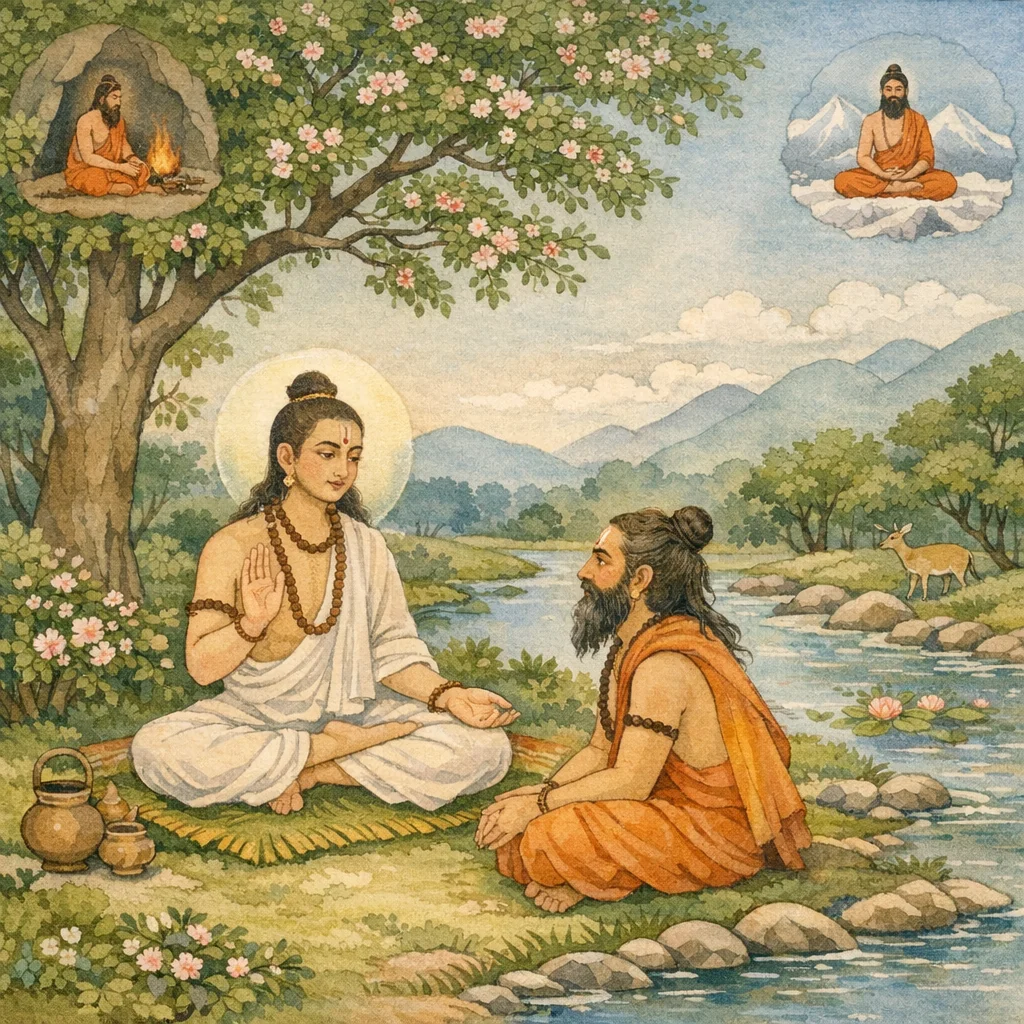
तपसो महिमा (The Greatness and Typology of Tapas)
Adhyāya 20 unfolds as a didactic dialogue between Vyāsa and Sanatkumāra. Vyāsa asks how one may attain the auspicious state reached by Śiva’s devotees—an irreversible, liberation-marked destination described as Śivaloka. Sanatkumāra answers by emphasizing vrata (sacred observance) and, above all, tapas (austerity) as the decisive cause (saddhetu) for receiving Śiva’s grace. The chapter teaches that what seems difficult, unendurable, or unattainable becomes achievable through tapas, and that the triumphs of gods and sages alike are powered by this hidden force of austerity. It then classifies tapas into three modes—sāttvika, rājasa, and tāmasa—each associated with characteristic performers (devas and ascetics; humans and daityas; rākṣasas and the cruel). The instruction is both theological and practical: the fruit of austerity depends on the inner disposition (bhāva) with which it is undertaken, and the moral quality of tapas determines its spiritual direction and results.
Shlokas
Verse 1
व्यास उवाच । सनत्कुमार सर्वज्ञ तत्प्राप्तिं वद सत्तम । यद्गत्वा न निवर्तंते शिवभक्तियुता नराः
Vyāsa said: “O Sanatkumāra, all-knowing one, best among the virtuous—tell me the means of attaining That, the supreme state; reaching it, men endowed with devotion to Śiva do not return again to worldly bondage.”
Verse 2
सनत्कुमार उवाच । पराशरसुत व्यास शृणु प्रीत्या शुभां गतिम् । व्रतं हि शुद्धभक्तानां तथा शुद्धं तपस्विनाम्
Sanatkumāra said: “O Vyāsa, son of Parāśara, listen with glad devotion to the auspicious path. This sacred observance (vrata) is indeed for pure devotees, and likewise it is pure for ascetics established in austerity (tapas).”}]}
Verse 3
ये शिवं शुद्धकर्माणस्सुशुद्धतपसान्विताः । समर्चयन्ति तं नित्यं वन्द्यास्ते सर्वथान्वहम्
Those who are pure in conduct and endowed with perfectly purified austerity, who worship Lord Śiva with due reverence each day—such people are worthy of veneration in every way, at all times.
Verse 4
नातप्ततपसो यांति शिवलोकमनामयम् । शिवानुग्रहसद्धेतुस्तप एव महामुने
Those who have not undertaken austerity do not attain Śivaloka, the sorrowless realm. For austerity alone, O great sage, is the true and sure cause of Śiva’s grace.
Verse 5
तपसा दिवि मोदन्ते प्रत्यक्षं देवतागणाः । ऋषयो मुनयश्चैव सत्यं जानीह मद्वचः
By austerity (tapas), the hosts of gods rejoice openly in heaven; and so too do the ṛṣis and munis. Know my words to be true.
Verse 6
सुदुर्द्धरं दुरासाध्यं सुधुरं दुरतिक्रमम् । तत्सर्वं तपसा साध्यं तपो हि दुरतिक्रमम्
Whatever is extremely hard to bear, difficult to accomplish, heavy to carry, and hard to surpass—everything of that kind is attainable through tapas (austerity); for tapas itself is a power that is hard to overcome.
Verse 7
सुस्थितस्तपसि ब्रह्मा नित्यं विष्णुर्हरस्तथा । देवा देव्योऽखिलाः प्राप्तास्तपसा दुर्लभं फलम्
Brahmā remains firmly established in austerity; Viṣṇu and Hara (Śiva) likewise abide ever in tapas. All the gods and goddesses have attained, through austerity, the rare fruit that is difficult to obtain.
Verse 8
येन येन हि भावेन स्थित्वा यत्क्रियते तपः । ततस्संप्राप्यतेऽसौ तैरिह लोके न संशयः
Whatever inner disposition (bhāva) a person abides in while performing tapas, that very result is attained by them here in this world—of this there is no doubt.
Verse 9
सात्त्विकं राजसं चैव तामसं त्रिविधं स्मृतम् । विज्ञेयं हि तपो व्यास सर्वसाधनसाधनम्
Tapas (spiritual austerity) is remembered as threefold—sāttvika, rājasa, and tāmasa. Therefore, O Vyāsa, tapas should be rightly understood, for it is the very instrument that empowers all other spiritual means.
Verse 10
सात्त्विकं दैवतानां हि यतीनामूर्द्ध्वरेतसाम् । राजसं दानवानां हि मनुष्याणां तथैव च । तामसं राक्षसानां हि नराणां क्रूरकर्मणाम्
The disposition of the Devas is chiefly sāttvika; so too is that of ascetics who, through continence, preserve their vital energy. The disposition of the Dānavas is chiefly rājasa, and likewise that of ordinary human beings. The disposition of the Rākṣasas is chiefly tāmasa, as is that of those engaged in cruel deeds.
Verse 11
त्रिविधं तत्फलं प्रोक्तं मुनिभिस्तत्त्वदर्शिभिः । जपो ध्यानं तु देवानामर्चनं भक्तितश्शुभम्
The seers who behold the truth have declared its fruit to be threefold: japa (repetition of the sacred mantra), dhyāna (meditative contemplation of the Divine), and auspicious worship (arcana) of the Deities performed with devotion.
Verse 12
सात्त्विकं तद्धि निर्दिष्टमशेषफलसाधकम् । इह लोके परे चैव मनोभिप्रेतसाधनम्
That is indeed declared to be sāttvika (pure and luminous), accomplishing every fruit. It fulfills what the mind seeks—both in this world and in the world beyond—under Śiva’s grace, leading the devotee toward auspicious attainments.
Verse 13
कामनाफलमुद्दिश्य राजसं तप उच्यते । निजदेहं सुसंपीड्य देहशोषकदुस्सहैः
Austerity performed with the aim of obtaining desired results is called rājasa (passion-driven) tapas. It is undertaken by harshly constraining one’s own body through unbearable practices that emaciate and exhaust it.
Verse 14
तपस्तामसमुद्दिष्टं मनोभिप्रेतसाधनम्
Austerity is declared to be tāmasika when it is undertaken merely to accomplish what the mind desires, for self-serving ends.
Verse 15
उत्तमं सात्त्विकं विद्याद्धर्मबुद्धिश्च निश्चला । स्नानं पूजा जपो होमः शुद्धशौचमहिंसनम्
Know that the highest way of life is sāttvika: steadfast discernment rooted in dharma—together with sacred bathing, worship, mantra-recitation (japa), fire-offering (homa), purity of conduct and cleanliness, and non-violence (ahiṃsā).
Verse 16
व्रतोपवासचर्या च मौनमिन्द्रियनिग्रहः । धीर्विद्या सत्यमक्रोधो दानं क्षांतिर्दमो दया
Vows and fasts, disciplined religious conduct, silence (mauna) and restraint of the senses; steadfast understanding, true knowledge (vidyā), truthfulness and freedom from anger; charity (dāna), forbearance, self-control (dama), and compassion (dayā)—these observances purify the bound soul (paśu) and turn it toward Lord Śiva, Pati, the liberating Lord.
Verse 17
वापीकूपतडागादेः प्रसादस्य च कल्पना । कृच्छ्रं चांद्रायणं यज्ञस्सुतीर्थान्याश्रमाः पुनः
One may also undertake the making of wells, step-wells, ponds and the like, and the construction of temples and sacred edifices; observe the Kṛcchra and Cāndrāyaṇa expiatory vows; perform sacrifices (yajña); and again resort to holy tīrthas and hermitages (āśramas)—all as purifying disciplines directed toward Śiva.
Verse 18
धर्मस्थानानि चैतानि सुखदानि मनीषिणाम् । सुधर्मः परमो व्यासः शिवभक्तेश्च कारणम्
These indeed are the abodes of dharma, bestowing happiness upon the wise. Right conduct (su-dharma) is supreme—O Vyāsa—and it becomes a direct cause for devotion to Lord Śiva.
Verse 19
संक्रातिविषुवद्योगो नादमुक्ते नियुज्यताम् । ध्यानं त्रिकालिकं ज्योतिरुन्मनीभावधारणा
Let the discipline connected with the sacred junctions of time—solstices/equinoxes and the solar transitions—be applied in the practice of release through inner sound (nāda). Let meditation be performed three times a day, sustaining the contemplation of the inner Light and the steady absorption called unmanī-bhāva.
Verse 20
रेचकः पूरकः कुम्भः प्राणायामस्त्रिधा स्मृतः । नाडीसंचारविज्ञानं प्रत्याहारनिरोधनम्
Prāṇāyāma is remembered as threefold—recaka (exhalation), pūraka (inhalation), and kumbhaka (retention). With it are the knowledge of guiding the flow through the nāḍīs, and the restraint of the senses by withdrawal (pratyāhāra) and control (nirodha).
Verse 21
तुरीयं तदधो बुद्धिरणिमाद्यष्टसंयुतम् । पूर्वोत्तमं समुद्दिष्टं परज्ञानप्रसाधनम्
Below that fourth state (turyā) is buddhi, the faculty of intellect, endowed with the eight powers beginning with aṇimā. It is declared the foremost among the earlier inner principles, and becomes a means for attaining supreme knowledge.
Verse 22
काष्ठावस्था मृतावस्था हरितावेति कीर्तिताः । नानोपलब्धयो ह्येतास्सर्वपापप्रणाशनाः
They are spoken of as the “woody state,” the “dead state,” and the “green state.” Truly, these states—attained in diverse ways—are all destroyers of every sin.
Verse 23
नारी शय्या तथा पानं वस्त्रधूपविलेपनम् । ताम्बूलभक्षणं पंच राजैश्वर्य्यविभूतयः
Womanly companionship, a bed, intoxicating drink, fine garments, incense and unguents, and the chewing of betel—these five are declared to be the enjoyments of royal prosperity and worldly magnificence.
Verse 24
हेमभारस्तथा ताम्रं गृहाश्च रत्नधेनवः । पांडित्यं वेदशास्त्राणां गीतनृत्यविभूषणम्
He granted loads of gold and also copper; houses and jewel-like, wish-fulfilling cows; mastery of the Vedas and śāstras, and the adornment of accomplishment in singing and dance.
Verse 25
शंखवीणामृदंगाश्च गजेन्द्रश्छत्रचामरे । भोगरूपाणि चैतानि एभिश्शक्तोऽनुरज्यते
Conches, lutes, and drums; the lordly elephant, along with the royal umbrella and yak-tail fans—these are all forms of enjoyment. By these, the bound soul becomes attached and is drawn into desire.
Verse 26
आदर्शवन्मुनेस्नेहैस्तिलवत्स निपीड्यते । अरं गच्छेति चाप्येनं कुरुते ज्ञानमोहितः
Deluded in understanding, he presses the calf close with affection—like one clinging to a mirror-image—and then tells it, “Enough; go away,” thus treating it with confused judgment.
Verse 27
जानन्नपीह संसारे भ्रमते घटियंत्रवत् । सर्वयोनिषु दुःखार्तस्स्थावरेषु चरेषु च
Even though he may possess understanding, in this worldly saṃsāra he still wanders like a water‑wheel mechanism, tormented by suffering in every womb—among the immovable as well as the moving beings.
Verse 28
एवं योनिषु सर्वासु प्रतिक्रम्य भ्रमेण त । कालांतरवशाद्याति मानुष्यमतिदुर्लभम्
Thus, after wandering in delusion through all kinds of wombs and repeatedly passing from one birth to another, a being—only after a long passage of time—attains the exceedingly rare human state.
Verse 29
व्युत्क्रमेणापि मानुष्यं प्राप्यते पुण्यगौरवात् । विचित्रा गतयः प्रोक्ताः कर्मणां गुरुलाघवात्
Even by an irregular course, one may attain a human birth because of the weight and dignity of merit. Thus the destinies of beings are declared to be manifold, according to the heaviness or lightness of their actions (karma).
Verse 30
मानुष्यं च समासाद्य स्वर्गमोक्षप्रसाधनम् । नाचरत्यात्मनः श्रेयस्स मृतश्शोचते चिरम्
Having attained human birth—the means for accomplishing heaven and liberation—one who does not practice what is truly beneficial for the Self (Ātman), after death, grieves for a long time.
Verse 31
देवासुराणां सर्वेषां मानुष्यं चाति दुर्लभं । तत्संप्राप्य तथा कुर्यान्न गच्छेन्नरकं यथा
For all beings—whether gods or asuras—human birth is exceedingly rare. Having attained it, one should live and act in such a way that one does not fall into hell.
Verse 32
स्वर्गापवर्गलाभाय यदि नास्ति समुद्यमः । दुर्लभं प्राप्य मानुष्यं वृथा तज्जन्म कीर्तितम्
If there is no earnest striving to attain heaven and, beyond it, liberation (mokṣa), then even after obtaining the rare gift of human birth, that life is declared to have been lived in vain.
Verse 33
सर्वस्य मूलं मानुष्यं चतुर्वर्गस्य कीर्तितम् । संप्राप्य धर्मतो व्यास तद्यत्तादनुपालयेत्
O Vyāsa, human birth is declared to be the very foundation of everything, for it is the basis of the four aims of life (dharma, artha, kāma, and mokṣa). Having attained it through dharma, one should carefully preserve it and live according to that righteous course.
Verse 34
धर्ममूलं हि मानुष्यं लब्ध्वा सर्वार्थसाधकम् । यदि लाभाय यत्नः स्यान्मूलं रक्षेत्स्वयं ततः
Having attained human life—which is rooted in dharma and capable of accomplishing every true aim—if one strives for gain, then one should first protect that very root (dharma) oneself.
Verse 35
मानुष्येऽपि च विप्रत्वं यः प्राप्य खलु दुर्लभम् । नाचरत्यात्मनः श्रेयः कोऽन्यस्तस्मादचेतनः
Even among human births, one who attains the truly rare state of being a brāhmaṇa—yet does not practise what brings the soul its highest good—who else could be more senseless than he?
Verse 36
द्वीपानामेव सर्वेषां कर्मभूमिरियमुच्यते । इतस्स्वर्गश्च मोक्षश्च प्राप्यते समुपार्जितः
Among all the continents (dvīpas), this alone is called the land of sacred action (karmabhūmi). From here, heaven is attained—and also liberation (mokṣa) is won, duly earned through meritorious effort.
Verse 37
देशेऽस्मिन्भारते वर्षे प्राप्य मानुष्यमध्रुवम् । न कुर्यादात्मनः श्रेयस्तेनात्मा खलु वंचितः
In this land of Bhārata, having gained the unsteady birth as a human, if one does not seek what is truly for the good of the Self (Ātman), then indeed one’s own soul is deceived, cheated of the highest good.
Verse 38
कर्मभूमिरियं विप्र फलभूमिरसौ स्मृता । इह यत्क्रियते कर्म स्वर्गे तदनुभुज्यते
O brāhmaṇa, this world is remembered as the field of action (karma), and that realm—heaven—as the field of results. Whatever karma is done here is experienced and enjoyed there in heaven as its fruit.
Verse 39
यावत्स्वास्थ्यं शरीरस्य तावद्धर्मं समाचरेत् । अस्वस्थश्चोदितोऽप्यन्यैर्न किंचित्कर्तुमुत्सहेत्
So long as the body remains healthy, one should diligently practice dharma. But when one is unwell, even if urged by others, one should not strain oneself to do anything at all.
Verse 40
अध्रुवेण शरीरेण ध्रुवं यो न प्रसाधयेत् । ध्रुवं तस्य परिभ्रष्टमध्रुवं नष्टमेव च
Whoever, using this impermanent body, does not strive to realize the Eternal—Śiva, the Everlasting—for him the Eternal is lost, and the impermanent too is destroyed all the same.
Verse 41
आयुषः खंडखंडानि निपतंति तदग्रतः । अहोरात्रोपदेशेन किमर्थं नावबुध्यते
Before one’s very eyes, the span of life falls away in fragments. Though day and night continually teach this truth, for what reason does a person still not awaken to it?
Verse 42
यदा न ज्ञायते मृत्युः कदा कस्य भविष्यति । आकस्मिके हि मरणे धृतिं विंदति कस्तथा
When it is not known when death will come, nor to whom it will come, who can truly maintain steadiness of mind when death strikes suddenly?
Verse 43
परित्यज्य यदा सर्वमेकाकी यास्यति ध्रुवम् । न ददाति कदा कस्मात्पाथेयार्थमिदं धनम्
When a person must certainly depart alone, leaving everything behind, to whom—and for what reason—does he not give this wealth, even as provisions for the journey?
Verse 44
गृहीतदानपाथेयः सुखं याति यमालयम् । अन्यथा क्लिश्यते जंतुः पाथेयरहिते पथि
One who has secured the “travel-provision” of charity goes in comfort to Yama’s abode; otherwise the embodied being suffers on the road, like a traveler who sets out without provisions.
Verse 45
येषां कालेय पुण्यानि परिपूर्णानि सर्वतः । गच्छतां स्वर्गदेशं हि तेषां लाभः पदेपदे
Those whose merits have, in due time, become complete and fully ripened—when they proceed to the heavenly realm, gain and auspicious reward attend them at every step.
Verse 46
इति ज्ञात्वा नरः पुण्यं कुर्यात्पापं विवर्जयेत् । पुण्येन याति देवत्वमपुण्यो नरकं व्रजेत्
Knowing this, a person should perform meritorious deeds and avoid sin. By merit one attains the state of the gods; one without merit goes to hell.
Verse 47
ये मनागपि देवेशं प्रपन्नाश्शरणं शिवम् । तेऽपि घोरं न पश्यंति यमं न नरकं तथा
Even those who, even slightly, have taken refuge in Śiva—the Lord of the gods—as their shelter do not behold the dreadful Yama, nor do they encounter hell.
Verse 48
किंतु पापैर्महामोहैः किंचित्काले शिवाज्ञया । वसंति तत्र मानुष्यास्ततो यांति शिवास्पदम्
Yet, due to their sins and great delusion, some human beings—by Śiva’s command—dwell there for a certain time; thereafter they go to Śiva’s own abode.
Verse 49
ये पुनस्सर्वभावेन प्रतिपन्ना महेश्वरम् । न ते लिम्पंति पापेन पद्मपत्रमिवाम्भसा
But those who, with their whole being, have taken refuge in Maheshvara—such persons are not stained by sin, just as a lotus leaf is not wetted by water.
Verse 50
उक्तं शिवेति यैर्नाम तथा हरहरेति च । न तेषां नरकाद्भीतिर्यमाद्धि मुनिसत्तम
O best of sages, those who utter the Name “Śiva,” and likewise “Hara-Hara,” have no fear of hell—indeed, they need not fear Yama.
Verse 51
परलोकस्य पाथेयं मोक्षोपायमनामयम् । पुण्यसंघैकनिलयं शिव इत्यक्षरद्वयम्
The two syllables “Śi-va” are the provision for the journey beyond this world, the flawless means to liberation, and the one abode in which all merits and holy virtues gather.
Verse 52
शिवनामैव संसारमहारोगेकशामकम् । नान्यत्संसाररोगस्य शामकं दृश्यते मया
Shiva’s Name alone is the sole remedy that pacifies the great disease of saṃsāra. I see no other pacifier for the disease of saṃsāra.
Verse 53
ब्रह्महत्यासहस्राणि पुरा कृत्वा तु पुल्कसः । शिवेति नाम विमलं श्रुत्वा मोक्षं गतः पुरा
In former times, a Pulkaśa—though he had committed thousands of sins of brahmahatyā—attained liberation simply by hearing the stainless Name “Śiva”.
Verse 54
तस्माद्विवर्द्धयेद्भक्तिमीश्वरे सततं बुधः । शिवभक्त्या महाप्राज्ञ भुक्तिं मुक्तिं च विंदति
Therefore, the wise should ever cultivate devotion to the Lord. O greatly discerning one, through devotion to Śiva one attains both worldly enjoyment (bhukti) and liberation (mukti).
Frequently Asked Questions
Sanatkumāra argues that access to Śivaloka and the non-returning state sought by Śiva-bhaktas is reliably grounded in tapas: austerity is presented as the principal causal condition for Śiva’s grace (śivānugrahasya saddhetuḥ).
The triguṇa classification functions as an interpretive key: austerity is not inherently liberative; its spiritual value depends on its guṇa-quality and motivating bhāva. Thus the same ‘tapas’ can elevate (sāttvika), empower worldly aims (rājasa), or intensify destructive tendencies (tāmasa).
No specific iconographic form of Śiva or Umā is foregrounded in the sampled portion; the chapter emphasizes Śiva as the granter of grace (anugraha) and the destination Śivaloka, focusing on soteriology and discipline rather than a named mūrti or avatāra.