Śiva–Arjuna Yuddha and the Subjugation of Pride (Śiva-parīkṣā)
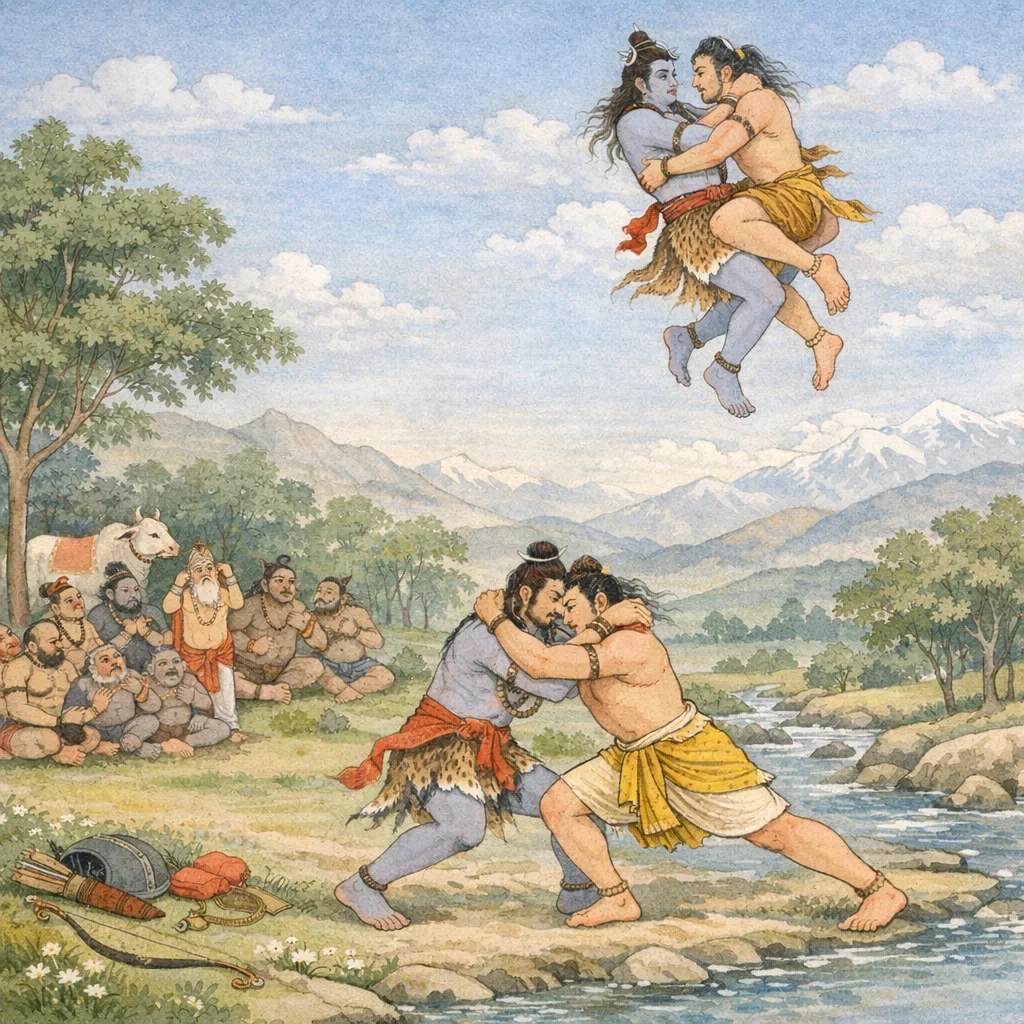
Adhyāya 41 portrays a Shaiva parīkṣā (divine test) through Arjuna’s confrontation with Śiva. After meditating on and remembering Śiva, Arjuna approaches and enters a fierce battle; Śiva’s gaṇas assail him with sharp weapons, and amid suffering Arjuna recalls his Lord all the more. Arjuna cuts through volleys of arrows and presses the fight until the gaṇas scatter, though their leaders restrain them. The conflict then rises to direct combat between Śiva and Arjuna with varied weapons, where Śiva’s inner compassion is hinted even as Arjuna strikes mightily. Śiva strips Arjuna of weapons and armor, leaving him exposed and teaching the limits of martial prowess and material supports. They shift to hand-to-hand wrestling of cosmic force that shakes the earth and troubles the gods. Finally Śiva takes to the sky and continues the contest, showing divine mastery beyond ordinary conditions of war. Esoterically, the episode turns heroic agency into recognition that remembrance of Śiva and humility before the divine will are the true grounds of victory and spiritual attainment.
Shlokas
Verse 1
तमागतन्ततो दृष्ट्वा ध्यानं कृत्वा शिवस्य सः । गत्वा तत्रार्जुनस्तेन युद्धं चक्रे सुदारुणम्
Seeing him arrive, Arjuna meditated upon Lord Śiva; then he went there and engaged him in a most fierce battle.
Verse 2
गणैश्च विविधैस्तीक्ष्णैरायुधैस्तं न्यपीडयत् । तैस्तदा पीडितः पार्थः सस्मार स्वामिनं शिवम्
Then the gaṇas, wielding many kinds of sharp weapons, pressed him hard. Tormented by them at that moment, Pārtha remembered his Lord—Śiva.
Verse 3
अर्जुनश्च तदा तेषां बाणावलिमथाच्छिनत् । यदायुद्धं च तैः क्षिप्तं ततः शर्वं परामृशत्
Then Arjuna cut down their volleys of arrows. And when the weapons hurled by them were thus checked, he next turned his attention toward Śarva (Lord Śiva), the all-destroying Lord.
Verse 4
पीडितास्ते गणास्तेन ययुश्चैव दिशो दश । गणेशा वारितास्ते च नाजग्मुस्स्वामिनम्प्रति
Afflicted by him, those gaṇas fled in all ten directions. Though restrained by Gaṇeśa, they still did not go back toward their Lord.
Verse 5
शिवश्चैवार्जुनश्चैव युयुधाते परस्परम् । नानाविधैश्चायुधैर्हि महाबलपराक्रमौ
Śiva and Arjuna fought one another, each answering the other in turn, evenly matched. With many kinds of weapons they battled—both mighty in strength and blazing in valor—revealing the Lord’s saguṇa līlā that tests and refines the devotee’s heroism and surrender.
Verse 6
शिवोऽपि मनसा नूनं दयां कृत्वार्जुनं ह्यगात् । अर्जुनश्च दृढं तत्र प्रहारं कृतवांस्तदा
Even Śiva, having conceived compassion in His mind, moved toward Arjuna. Then Arjuna, standing firm there, delivered a forceful blow.
Verse 7
आयुधानि शिवस्सो वै ह्यर्जुनस्याच्छिनत्तदा । कवचानि च सर्वाणि शरीरं केवलं स्थितम्
Then the Lord Śiva indeed severed Arjuna’s weapons, and all his armours as well; only the bare body remained standing.
Verse 8
तदार्जुनः शिवं स्मृत्वा मल्लयुद्धं चकार सः । वाहिनीपतिना तेन भयात्क्लिष्टोपि धैर्यवान्
Then Arjuna, remembering Lord Śiva, engaged in a wrestling combat (malla-yuddha). Though distressed by fear of that commander of the army, he remained steadfast and courageous.
Verse 9
तद्युद्धेन मही सर्वा चकंपे ससमुद्रका । देवा दुःखं समापन्नः किं भविष्यति वा पुनः
By that fierce battle, the entire earth—together with the oceans—trembled. The gods fell into distress, wondering again and again, “What will happen now?”
Verse 10
एतस्मित्रंतरे देवः शिवो गगनमास्थितः । युद्धं चकार तत्रस्थस्सोर्जुनश्च तथाऽकरोत्
Meanwhile, the Lord—Śiva—took His station in the sky and engaged in battle; and Arjuna too, standing there, fought in the same manner.
Verse 11
उड्डीयोड्डीय तौ युद्धं चक्रतुर्देवपार्थिवौ । देवाश्च विस्मयं प्रापू रणं दृष्ट्वा तदाद्भुतम्
Leaping up again and again, the divine and kingly warriors engaged in battle. Seeing that wondrous combat, the gods were filled with astonishment.
Verse 12
अथार्जुनोत्तरे ज्ञात्वा स्मृत्वा शिवपदांबुजम् । दधार पादयोस्तं वै तद्ध्यानादाप्तसद्बलः
Then Arjuna, understanding the situation, remembered the lotus-feet of Lord Śiva; and, strengthened by that very meditation, he firmly held Him at His feet.
Verse 13
धृत्वा पादौ तदा तस्य भ्रामयामास सोर्जुनः । विजहास महादेवो भक्तवत्सल ऊतिकृत्
Then Arjuna grasped His feet and began to whirl Him around. Mahādeva—ever tender to His devotees and the benefactor who brings their welfare—smiled and laughed.
Verse 14
दातुं स्वदासतां तस्मै भक्तवश्यतया मुने । शिवेनैव कृतं ह्येतच्चरितन्नान्यथा भवेत्
O sage, conquered by devotion, Śiva Himself performed this deed—to grant that devotee the state of being His own servant; it could not have happened otherwise.
Verse 15
पश्चाद्विहस्य तत्रैव शंकरो रूपम द्भुतम् । दर्शयामास सहसा भक्तवश्यतया शुभम्
Thereafter, right there, Śaṅkara smiled playfully and at once revealed an astonishing, auspicious form—because He was conquered by devotion.
Verse 16
यथोक्तं वेदशास्त्रेषु पुराणे पुरुषोत्तमम् । व्यासोपदिष्टं ध्यानाय तस्य यत्सर्वसिद्धिदम्
As declared in the Vedas, the śāstras, and the Purāṇas, that Supreme Person—taught by Vyāsa for the sake of meditation—bestows upon the meditator all attainments (siddhis).
Verse 17
तद्दृष्ट्वा सुंदरं रूपं ध्यानप्राप्तं शिवस्य तु । बभूव विस्मितोतीव ह्यर्जुनो लज्जितः स्वयम्
Beholding that supremely beautiful form of Lord Śiva—revealed through the power of meditation—Arjuna became utterly astonished, and, of his own accord, felt inwardly humbled and ashamed.
Verse 18
अहो शिवश्शिवस्सोय यो मे प्रभुतया वृतः । त्रिलोकेशः स्वयं साक्षाद्धा कृतं किं मयाऽधुना
Ah! This is Śiva—Śiva Himself—who, out of His sovereign grace, has accepted me. The Lord of the three worlds stands here directly before me; what more remains for me to do now?
Verse 19
प्रभोर्बलवती माया मायिनामपि मोहिनी । किं कृतं रूपमाच्छाद्य प्रभुणा छलितो ह्यहम्
The Lord’s māyā is exceedingly powerful—she bewilders even those who are themselves skilled in illusion. Veiling His true form with some assumed appearance, by what contrivance has the Lord deluded me?
Verse 20
धियेति संविचार्य्यैव साञ्जलिर्नतमस्तकः । प्रणनाम प्रभुं प्रीत्या तदोवाच स खिन्नधीः
Reflecting within himself—“(this is) by the power of intelligence and discernment”—he stood with joined palms and bowed head. With devotion he prostrated to the Lord, and then, his mind still troubled, he spoke.
Verse 21
अर्जुन उवाच देवदेव महादेव करुणाकर शंकर । ममापराधः सर्वेश क्षन्तव्यश्च त्वया पुनः
Arjuna said: O God of gods, O Mahādeva, O Śaṅkara, ocean of compassion—O Lord of all—whatever offense I have committed, may it indeed be forgiven by You, once again.
Verse 22
किं कृतं रूपमाच्छाद्य च्छलितोऽस्मि त्वयाधुना । धिङ् मां समरकर्तारं स्वामिना भवता प्रभो
“What have You done—veiling Your true form and deceiving me just now? Shame on me, the instigator of this battle, for I have been outwitted by You, my own Lord, O Prabhu.”
Verse 23
नन्दीश्वर उवाच । इत्येवं पाण्डवस्सोथ पश्चात्तापमवाप सः । पादयोर्निपपाताशु शंकरस्य महाप्रभोः
Nandīśvara said: “Thus that Pāṇḍava was filled with remorse, and quickly fell down at the feet of the great Lord Śaṅkara.”
Verse 24
अथेश्वरः प्रसन्नात्मा प्रत्युवाचार्जुनं च तम् । समाश्वास्येति बहुशो महेशो भक्तवत्सलः
Then the Lord, gracious and serene at heart, replied to that Arjuna. The great Maheśa—ever tender to His devotees—reassured him again and again.
Verse 25
शंकर उवाच । न खिद्य पार्थ भक्तोसि मम त्वं हि विशेषतः । परीक्षार्थं मया तेऽद्य कृतमेवं शुचञ्जहि
Śaṅkara said: “Do not grieve, O Pārtha. You are truly My devotee, especially dear to Me. Today I acted in this way only to test you. Therefore, abandon sorrow.”
Verse 26
नंदीश्वर उवाच । इत्युक्त्वा तं स्वहस्ताभ्यामुत्थाप्य प्रभुरर्जुनम् । विलज्जं कारयामास गणैश्च स्वामिनो गणैः
Nandīśvara said: Having spoken thus, the Lord lifted Arjuna up with His own hands, and through the Gaṇas—the attendants of his Master—He made him feel humbled and ashamed.
Verse 27
पुनश्शिवोऽर्जुनम्प्राह पाण्डवं वीरसम्मतम् । हर्षयन् सर्वथा प्रीत्या शंकरो भक्तवत्सलः
Again, Lord Śiva spoke to Arjuna—the Pāṇḍava praised among heroes. Śaṅkara, ever affectionate to His devotees, delighted him in every way with loving grace.
Verse 28
शिव उवाच । हे पार्थ पाण्डवश्रेष्ठ प्रसन्नोस्मि वरं वृणु । प्रहारैस्ताडनैस्तेऽद्य पूजनम्मानितम्मया
Śiva said: “O Pārtha, best of the Pāṇḍavas, I am pleased. Choose a boon. Today, by your blows and strikes, your worship has been accepted and honored by Me.”
Verse 29
इच्छया च कृतं मेऽद्य नापराधस्तवाधुना । नादेयं विद्यते तुभ्यं यदिच्छसि वृणीष्व तत्
What I have done today has been done by My own will; therefore, at present there is no offence against you. For you there is nothing that cannot be given—choose, as you desire, whatever you wish.
Verse 30
ते शत्रुषु यशोराज्यस्थापनाय शुभं कृतम् । एतद्दुःखं न कर्तव्यं वैक्लव्यं च त्यजाखिलम्
This auspicious deed has been done to subdue the enemies and to re-establish fame and rightful sovereignty. Therefore do not yield to this grief; cast away all dejection and every weakness of heart.
Verse 31
नन्दीश्वर उवाच । इत्युक्तस्त्वर्जुनस्तेन प्रभुणा शंकरेण सः । उवाच शंकरं भक्त्या सावधानतया स्थितः
Nandīśvara said: Thus addressed by the Lord Śaṅkara, Arjuna—standing attentive and composed—replied to Śaṅkara with devotion.
Verse 32
अर्जुन उवाच । भक्तप्रियस्य शम्भोस्ते सुप्रभो किं समीहितम् । वर्णनीयं मया देव कृपालुस्त्वं सदाशिव
Arjuna said: “O radiant Lord! What do You, Śambhu—so dear to Your devotees—desire? O God, tell me what I should describe or proclaim. You are compassionate, O Sadāśiva.”
Verse 33
इत्युक्त्वा संस्तुतिं तस्य शंकरस्य महाप्रभोः । चकार पाण्डवस्सोथ सद्भक्तिं वेदसंमताम्
Having thus uttered that hymn of praise to Śaṅkara, the Great Lord, the Pāṇḍava then practiced true devotion—devotion sanctioned by the Vedas—toward Him.
Verse 34
अर्जुन उवाच । नमस्ते देवदेवाय नमः कैलासवासिने । सदाशिव नमस्तुभ्यं पञ्चवक्त्राय ते नमः
Arjuna said: “Salutations to You, the God of gods; salutations to the One who dwells on Kailāsa. O Sadāśiva, salutations to You; salutations to Your five-faced (Pañcavaktra) form.”
Verse 35
कपर्दिने नमस्तुभ्यन्त्रिनेत्राय नमोऽस्तु ते । मनः प्रसन्नरूपाय सहस्रवदनाय च
Salutations to You, O Kapardin—wearer of matted locks; salutations to You, the Three-eyed Lord. Homage to You whose very form gladdens the mind, and to You who are the Thousand-faced One.
Verse 36
नीलकंठ नमस्तेस्तु सद्योजाताय वै नमः । वृषध्वज नमस्तेस्तु वामांगगिरिजाय च
Salutations to You, O Nīlakaṇṭha, the Blue-throated Lord; indeed, salutations to You as Sadyojāta. Salutations to You, O Vṛṣadhvaja, whose banner bears the bull; and salutations also to You, with Girijā (Pārvatī) abiding on Your left side.
Verse 37
दशदोष नमस्तुभ्यन्नमस्ते परमात्मने । डमरुकपालहस्ताय नमस्ते मुण्डमालिने
Salutations to You, O Remover of the ten faults; salutations to You, the Supreme Self. Salutations to You whose hands bear the ḍamaru drum and the skull-bowl; salutations to You who wears a garland of skulls.
Verse 38
शुद्धस्फटिकसंकाशशुद्धकर्पूरवर्ष्मणे । पिनाकपाणये तुभ्यन्त्रिशूलवरधारिणे
Salutations to You—whose body is pure and radiant like flawless crystal, whose form is immaculate like camphor; to You who hold the Pināka bow in Your hand, and who bear the excellent trident.
Verse 39
व्याघ्रचर्मोत्तरीयाय गजाम्बरविधारिणे । नागांगाय नमस्तुभ्यं गंगाधर नमोस्तु ते
Salutations to You who wear a tiger-skin as an upper garment and are clad in an elephant-hide; salutations to You whose very body is adorned with serpents. O Bearer of the Gaṅgā, to You I bow—again and again, salutations to You.
Verse 40
सुपादाय नमस्तेऽस्तु आरक्तचरणाय च । नन्द्यादिगणसेव्याय गणेशाय च ते नमः
Salutations to You, O Lord of beautiful feet; salutations to You whose feet glow with a reddish hue. Salutations to Gaṇeśa, attended and served by Nandin and the other gaṇas.
Verse 41
इत्यष्टाशीत्यवताराः । इति श्रीशिवमहापुराणे तृतीयायां शतरुद्रसंहितायां किरातेश्वरावतारवर्णनं नामैकचत्वारिंशोऽध्यायः
Thus are described the eighty-eight incarnations (manifest forms) of Lord Śiva. Here ends the forty-first chapter of the Śrī Śiva Mahāpurāṇa, in the third book, the Śatarudra Saṃhitā, entitled “The Description of the Kirāṭeśvara Incarnation.”
Verse 42
अगुणाय नमस्तेस्तु सगुणाय नमोनमः । अरूपाय सरूपाय सकलायाकलाय च
Salutations to You who are beyond all qualities (nirguṇa), and repeated salutations to You who are with qualities (saguṇa). Salutations to You who are formless, and to You who assume form; to You who are the manifest Whole, and to You who are the unmanifest, transcendent Reality.
Verse 43
नमः किरातरूपाय मदनुग्रहकारिणे । युद्धप्रियाय वीराणां नानालीलानुकारिणे
Salutations to the Lord who assumes the form of the Kirāta (the divine hunter), who bestows grace upon me; who delights in righteous battle; and who, for the sake of the valiant, enacts manifold divine plays.
Verse 44
यत्किंचिद्दृश्यते रूपन्तत्तेजस्तावकं स्मृतम् । चिद्रूपस्त्वं त्रिलोकेषु रमसेन्वयभेदतः
Whatever form is seen anywhere is understood to be Your very radiance. You are of the nature of pure Consciousness, and in the three worlds You manifest and delight in diverse modes of relation and lineage.
Verse 45
गुणानान्ते न संख्यास्ति यथा भूरजसामिह । आकाशे तारकाणां हि कणानां वृष्ट्यपामपि
There is no reckoning of the Lord’s qualities, for they are without end—just as the grains of dust upon the earth are beyond counting, as are the stars in the sky, and even the countless droplets in a rainfall.
Verse 46
न ते गुणास्तु संख्यातुं वेदा वै सम्भवन्ति हि । मन्दबुद्धिरहं नाथ वर्णयामि कथम्पुनः
Even the Vedas cannot count Your attributes. O Lord, my understanding is small—how then could I ever describe You?
Verse 47
सोसि योसि नमस्तेऽस्तु कृपां कर्तुमिहार्हसि । दासोहं ते महेशान स्वामी त्वं मे महेश्वर
You are That, and You are this as well—salutations to You. Be gracious here and now. O Maheśāna, I am Your servant; O Maheśvara, You alone are my Lord and Master.
Verse 48
नन्दीश्वर उवाच । इति श्रुत्वा वचस्तस्य पुनः प्रोवाच शंकर । सुप्रसन्नतरो भूत्वा विहसन्प्रभुरर्जुनम्
Nandīśvara said: Having heard his words, Śaṅkara spoke again. Becoming even more gracious, the Lord smiled and addressed Arjuna.
Verse 49
शंकर उवाच । वचसा किम्बहूक्तेन शृणुष्व वचनम्मम । शीघ्रं वृणु वरम्पुत्र सर्वन्तच्च ददामि ते
Śaṅkara said: “What need is there for many words? Hear My utterance. Dear son, quickly choose a boon; whatever you ask, I shall grant you in full.”
Verse 50
नन्दीश्वर उवाच । इत्युक्तश्चार्जुनस्तेन प्रणिपत्य सदाशिवम् । साञ्जलिर्नतकः प्रेम्णा प्रोवाच गद्गदाक्षरम्
Nandīśvara said: Thus addressed by him, Arjuna bowed down to Sadāśiva. With palms joined and head bent in reverence, he spoke with love, his words faltering with emotion.
Verse 51
अर्जुन उवाच । किं ब्रूयां त्वं च सर्वेषामन्तर्यामितया स्थितः । तथापि वर्णितं मेऽद्य श्रूयतां च त्वया विभो
Arjuna said: “What can I say, when You abide within all beings as their Inner Controller? Yet, O all-pervading Lord, I have spoken today as best as I can—may it still be heard and accepted by You.”
Verse 52
शत्रूणां संकटं यच्च तद्गतन्दर्शनात्तव । ऐहिकीं च परां सिद्धिम्प्राप्नुयां वै तथा कुरु
By merely beholding You, may whatever distress has befallen my enemies be removed; and may I indeed attain both worldly success and the supreme spiritual attainment. Please make it so.
Verse 53
नन्दीश्वर उवाच । इत्युक्त्वा तं नमस्कृत्य शंकरम्भक्तवत्सलम् । नतस्कन्धोऽर्जुनस्तत्र बद्धाञ्जलिरुपस्थितः
Nandīśvara said: Having spoken thus, Arjuna bowed to Śaṅkara, the One who is ever affectionate to His devotees. With shoulders bent in humility, he stood there with folded hands, reverently present before Him.
Verse 54
शिवोपि च तथाभूतञ्ज्ञात्वा पाण्डवमर्जुनम् । निजभक्तवरं स्वामी महातुष्टो बभूव ह
Śiva too, recognizing Arjuna of the Pāṇḍavas to be such a one, knew him as His own foremost devotee; and that Lord and Master became exceedingly pleased.
Verse 55
अस्त्रम्पाशुपतं स्वीयन्दुर्जयं सर्वदाखिलैः । ददौ तस्मै महेशानो वचनश्चेदमब्रवीत्
Then Maheśāna (Lord Śiva), bestowing upon him His own Pāśupata weapon—ever unconquerable by all beings—gave it to him, and spoke these words.
Verse 56
शिव उवाच । स्वं महास्त्रम्मया दत्तन्दुर्जयस्त्वम्भविष्यति । अनेन सर्वशत्रूणां जयकृत्यमवाप्नुहि
Śiva said: “I have bestowed upon you My own great celestial weapon. By it you shall become unconquerable. With this, accomplish the work of victory over all your enemies.”
Verse 57
कृष्णं च कथयिष्यामि साहाय्यन्ते करिष्यति । स वै ममात्मभूतश्च मद्भक्तः कार्य्यकारकः
“I shall also speak of Kṛṣṇa—he will render you assistance. Indeed, he is as My very self, a devotee of Mine, and a capable accomplisher of the task.”
Verse 58
मत्प्रभावान्भारत त्वं राज्यन्निकण्टकं कुरु । धर्म्यान्नानाविधान्भ्रात्रा कारय त्वं च सर्वदा
O Bhārata, by My divine power make your kingdom free of thorns—free from trouble and opposition. And through your brothers, have many kinds of righteous duties and works carried out at all times.
Verse 59
नन्दीश्वर उवाच । इत्युक्त्वा निजहस्तं च धृत्वा शिरसि तस्य सः । पूजितो ह्यर्जुनेनाशु शंकरोन्तरधीयत
Nandīśvara said: Having spoken thus, Śaṅkara placed His own hand upon Arjuna’s head. Then, duly worshipped by Arjuna, Lord Śaṅkara swiftly vanished from sight.
Verse 60
अथार्जुनः प्रसन्नात्मा प्राप्यास्त्रं च वरं प्रभोः । जगाम स्वाश्रमे मुख्यं स्मरन्भक्त्या गुरुं शिवम्
Then Arjuna, his heart made serene, having obtained from the Lord both the divine weapon and the boon, returned to his own chief hermitage—remembering with devotion Śiva, the Guru.
Verse 61
सर्व्वे ते भ्रातरः प्रीतास्तन्वः प्राणमिवागतम् । मिलित्वा तं सुखं प्रापुर्द्रौपदी चाति सुव्रता
All those brothers were filled with joy, as though their very life-breath had returned to the body. Meeting him again, they attained great happiness—and Draupadī too, the most virtuous and steadfast in her vows, rejoiced exceedingly.
Verse 62
शिवं परं च सन्तुष्टम्पाण्डवाः सर्व एव हि । नातृप्यन्सर्ववृत्तान्तं श्रुत्वा हर्षमुपागताः
Indeed, all the Pāṇḍavas were fully satisfied with the Supreme Śiva; yet, after hearing the entire account, they did not feel satiated—rather, they were filled with joy.
Verse 63
आश्रमे पुष्पवृष्टिश्च चन्दनेन समन्विता । पपात सुकरार्थं च तेषाञ्चैव महात्मनाम्
In the hermitage, a shower of flowers—mingled with fragrant sandal—fell down, bestowing auspicious ease and well-being upon those great-souled ones.
Verse 64
धन्यं च शंकरं चैव नमस्कृत्य शिवम्मुदा । अवधिं चागतं ज्ञात्वा जयश्चैव भविष्यति
Joyfully bowing to blessed Śaṅkara—Śiva Himself—and knowing that the destined limit of the ordeal has arrived, victory indeed shall come to pass.
Verse 65
एतस्मिन्नन्तरे कृष्णश्श्रुत्वार्जुनमथागतम् । मेलनाय समायातश्श्रुत्वा सुखमुपागतः
Meanwhile, Kṛṣṇa, hearing that Arjuna had arrived, came to meet him; and upon hearing the news, he was filled with happiness.
Verse 66
अतश्चैव मयाख्यातः शंकरः सर्वदुःखहा । स सेव्यते मया नित्यं भवद्भिरपि सेव्यताम्
Therefore I have declared Śaṅkara to be the remover of all sorrow. I worship Him every day; you too should worship Him.
Verse 67
इत्युक्तस्ते किराताह्वोवतारश्शंकस्य वै । तं श्रुत्वा श्रावयन्वापि सर्वान्कामानवाप्नुयात्
Thus has been spoken the incarnation of Śaṅkara known as the Kirāta. Whoever hears this account—or causes others to hear it as well—attains the fulfillment of all desired aims.
Frequently Asked Questions
It presents the Śiva–Arjuna confrontation as a structured divine ordeal: Arjuna’s prowess is met by gaṇas and then by Śiva directly, culminating in the stripping of weapons/armor and a cosmic-scale duel, arguing that devotion and humility before Śiva’s will outrank heroic self-reliance.
Weapons and armor represent contingent supports (upādhis) and ego-backed agency; their removal dramatizes spiritual nakedness before the Absolute. The gaṇas signify the Lord’s operative powers guarding sacred order, while the earth shaking and aerial combat encode the cosmic scope of Śiva’s sovereignty beyond terrestrial limits.
Śiva is highlighted as both the formidable Rudra-like warrior and the compassionate lord acting 'manasā dayāṃ kṛtvā'—a synthesis of terrifying power and inward grace (anugraha), revealing the divine capacity to test, restrain, and uplift the devotee simultaneously.