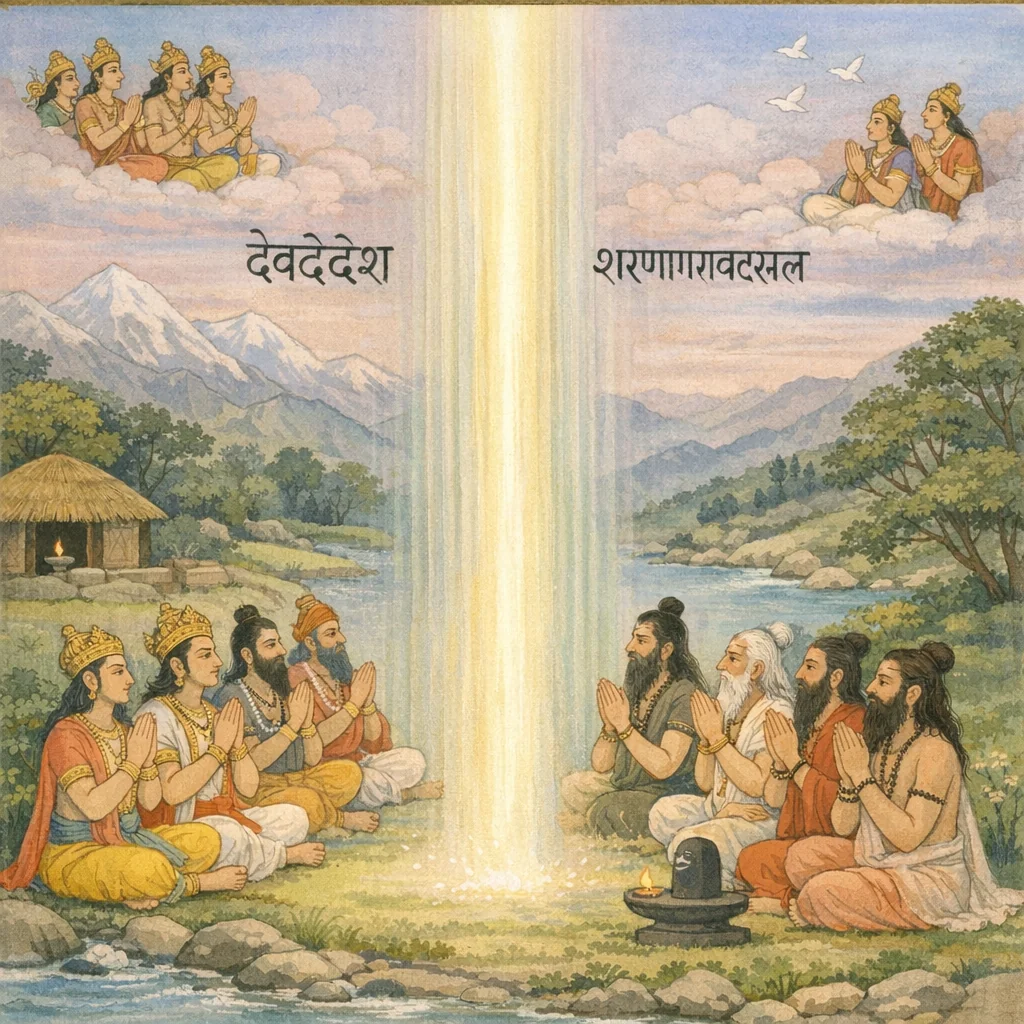
देवस्तुतिः — Hymn of Praise by the Devas (Devastuti)
Adhyāya 25 begins with Sanatkumāra describing how Brahmā, together with the assembled devas and sages, bows in reverence and offers a formal hymn to Śiva as Devadeveśa. The hymn highlights Śiva’s tender protection of those who seek refuge (śaraṇāgata-vatsala) and his continual removal of devotees’ suffering. The devas voice a theology of paradox: Śiva is wondrous in līlā, approachable through bhakti yet hard to reach for the impure; even the Veda cannot fully comprehend him, while exalted beings ceaselessly sing his hidden greatness. It affirms that Śiva’s grace can overturn ordinary expectations of spiritual capacity and emphasizes his omnipresence and unchanging nature, which manifests to true devotion. Exemplars are introduced—Yadupati and his wife Kalāvatī, and King Mitrasaha with Madayantī—who attain supreme accomplishment and kaivalya through devotion. Overall, the chapter functions as a doctrinal stotra within narrative, mapping devotion → divine manifestation → liberation.
Shlokas
Verse 1
सनत्कुमार उवाच । अथ ब्रह्मादयो देवा मुनयश्चाखिलास्तथा । तुष्टुवुर्देवदेवेशं वाग्भिरिष्टाभिरानताः
Sanatkumāra said: Then Brahmā and the other gods, and all the sages as well, bowing down, praised Devadeveśa—the Lord of the gods—through their cherished and fitting words of hymns.
Verse 2
देवा ऊचुः । देवदेव महादेव शरणागतवत्सल । साधुसौख्यप्रदस्त्वं हि सर्वदा भक्तदुःखहा
The Devas said: “O God of gods, O Mahādeva—tender toward those who take refuge in You—You indeed are the giver of happiness to the righteous, and forever the remover of Your devotees’ sorrow.”
Verse 3
त्वं महाद्भुतसल्लीलो भक्तिगम्यो दुरासदः । दुराराध्योऽसतां नाथ प्रसन्नस्सर्वदा भव
You are the Lord of wondrous and auspicious divine play—approachable through devotion, yet unassailable. O Master, for the untrue and impure you are difficult to propitiate; therefore, be ever gracious and pleased with us.
Verse 4
वेदोऽपि महिमानं ते न जानाति हि तत्त्वतः । यथामति महात्मानस्सर्वे गायंति सद्यशः
Even the Veda does not truly know Your glory in its full reality. According to their own capacity, all great souls sing of it—each in their own way, as best they can.
Verse 5
माहात्म्यमतिगूढं ते सहस्रवदनादयः । सदा गायंति सुप्रीत्या पुनंति स्वगिरं हि ते
Your glory is exceedingly profound. The thousand-faced one and other divine beings continually sing it with great delight, and through their own utterances they indeed purify their speech.
Verse 6
कृपया तव देवेश ब्रह्मज्ञानी भवेज्जडः । भक्तिगम्यस्सदा त्वं वा इति वेदा ब्रुवंति हि
O Lord of the gods, by Your grace even a knower of Brahman may become as one inert; but You are always attainable through devotion alone—thus indeed do the Vedas declare.
Verse 7
त्वं वै दीनदयालुश्च सर्वत्र व्यापकस्सदा । आविर्भवसि सद्भक्त्या निर्विकारस्सतां गतिः
You are truly compassionate to the distressed and ever all-pervading everywhere. By sincere devotion You manifest in a gracious, knowable form; though changeless, You are the supreme refuge and final goal of the righteous.
Verse 8
भक्त्यैव ते महेशान बहवस्सिद्धिमागताः । इह सर्वसुखं भुक्त्वा दुःखिता निर्विकारतः
O Maheśāna, by devotion alone many have attained consummate perfection. Having enjoyed every happiness here, they remain untouched by suffering—steadfast and unmodified by pleasure or pain.
Verse 9
पुरा यदुपतिर्भक्तो दाशार्हस्सिद्धिमागतः । कलावती च तत्पत्नी भक्त्यैव परमां प्रभो
O Lord, in former times the devoted king of the Yadus, Dāśārha, attained spiritual perfection; and his wife Kalāvatī too—by devotion alone—reached the supreme state.
Verse 10
तथा मित्रसहो राजा मदयंती च तत्प्रिया । भक्त्यैव तव देवेश कैवल्यं परमं ययौ
So too, King Mitrasaha and his beloved Madayantī—by devotion to You alone, O Lord of the gods—attained the supreme state of Kaivalya (liberating aloneness).
Verse 11
सौमिनी नाम तनया कैकेयाग्रभुवस्तथा । तव भक्त्या सुखं प्राप परं सद्योगिदुर्लभम्
Likewise, the daughter named Sauminī—born in the foremost line of the Kaikeyas—attained the supreme bliss through devotion to you, a fulfillment that is ever difficult to obtain even for accomplished yogins.
Verse 12
विमर्षणो नृपवरस्सप्तजन्मावधि प्रभो । भुक्त्वा भोगांश्च विविधांस्त्वद्भक्त्या प्राप सद्गतिम्
O Lord, the excellent king Vimarṣaṇa, for the span of seven births, experienced many kinds of enjoyments; yet through devotion to You he attained the true, auspicious goal—liberation in Shiva’s grace.
Verse 13
चन्द्रसेनो नृपवरस्त्वद्भक्त्या सर्वभोगभुक् । दुःखमुक्तः सुखं प्राप परमत्र परत्र च
O Lord, by devotion to You, the excellent king Candrasena enjoyed every worthy blessing; freed from sorrow, he attained supreme happiness—both here in this world and hereafter.
Verse 14
गोपीपुत्रः श्रीकरस्ते भक्त्या भुक्त्वेह सद्गतिम् । परं सुखं महावीरशिष्यः प्राप परत्र वै
By devotion, Śrīkara—the son of a gopī and disciple of the great hero—having enjoyed here a noble course of life, indeed attained in the world beyond the supreme bliss.
Verse 15
त्वं सत्यरथभूजानेर्दुःखहर्ता गतिप्रदः । धर्मगुप्तं राजपुत्रमतार्षीस्सुखिनं त्विह
You are the remover of Satyaratha Bhūjāna’s sorrow and the bestower of true refuge. Here You have carried Prince Dharmagupta—protector of dharma—across, and made him joyful.
Verse 16
तथा शुचिव्रतं विप्रमदरिद्रं महाप्रभो । त्वद्भक्तिवर्तिनं मात्रा ज्ञानिनं कृपयाऽकरोः
Likewise, O Great Lord, out of compassion You freed that Brahmin of pure vows from poverty; and by Your grace You made him steadfast in devotion to You and endowed him with true knowledge.
Verse 17
चित्रवर्मा नृपवरस्त्वद्भक्त्या प्राप सद्गतिम् । इह लोके सदा भुक्त्वा भोगानमरदुर्लभान्
Through devotion to You, O Lord, the excellent king Citravarmā attained sadgati—the true and auspicious end. Having first enjoyed in this very world pleasures difficult even for the immortals to obtain, he ultimately reached that blessed state through Śiva-bhakti.
Verse 18
चन्द्रांगदो राजपुत्रस्सीमंतिन्या स्त्रिया सह । विहाय सकलं दुःखं सुखी प्राप महागतिम्
Prince Candrāṅgada, together with his faithful wife, cast off all sorrow; becoming blissful, he attained the supreme, exalted state—by the grace that follows devotion to Lord Śiva.
Verse 19
द्विजो मंदरनामापि वेश्यागामी खलोऽधमः । त्वद्भक्तः शिव संपूज्य तया सह गतिं गतः
O Śiva, even a twice-born man named Mandara—though fallen, base, and one who frequented a courtesan—became Your devotee; having duly worshipped You, he attained the supreme state together with her.
Verse 20
भद्रायुस्ते नृपसुतस्सुखमाप गतव्यथः । त्वद्भक्तकृपया मात्रा गतिं च परमां प्रभो
O Lord, the prince Bhadrāyu attained happiness and became free from suffering; by the compassion of his mother—who was Your devotee—he also reached the supreme state (final liberation).
Verse 21
सर्वस्त्रीभोगनिरतो दुर्जनस्तव सेवया । विमुक्तोऽभूदपि सदा भक्ष्यभोजी महेश्वर
O Maheśvara, even a wicked man—absorbed in indulging with all women—through service to You becomes liberated; yet, due to lingering tendencies, he may still remain one who eats only what is fit to be eaten.
Verse 22
शंबरश्शंकरे भक्तश्चिताभस्मधरस्सदा । नियमाद्भस्मनश्शंभो स्वस्त्रिया ते पुरं गतः
Śambara was a devotee of Śaṅkara and always wore the ash of the funeral-pyre. O Śambhu, by the power of his disciplined observance with sacred ash (bhasma), he went to your city together with his own wife.
Verse 23
भद्रसेनस्य तनयस्तथा मंत्रिसुतः प्रभो । सुधर्मशुभकर्माणौ सदा रुद्राक्षधारिणौ
O Lord, (there was) Bhadrasena’s son and also the minister’s son—Sudharma and Śubhakarman—who always wore rudrākṣa beads.
Verse 24
त्वत्कृपातश्च तौ मुक्तावास्तां भुक्तेह सत्सुखम् । पूर्वजन्मनि यौ कीशकुक्कुटौ रुद्रभूषणौ
By your grace, those two have been liberated, and even here they abide enjoying true and noble happiness. In a former birth they were a monkey and a rooster—both adorned with Rudra’s insignia and favoured by him.
Verse 25
इति श्रीशिवमहापुराणे द्वितीयायां रुद्रसंहितायां पञ्चमे युद्धखण्डे जलंधरवधोपाख्याने देवस्तुतिवर्णनं नाम पंचविंशोऽध्यायः
Thus ends the twenty-fifth chapter, called “The Description of the Devas’ Hymn,” in the Jalandhara-Slaying episode, within the fifth section, the Yuddha-khaṇḍa, of the second compilation (Rudra-saṃhitā) of the Śrī Śiva Mahāpurāṇa.
Verse 26
शारदा विप्रतनया बालवैधव्यमागता । तव भक्तेः प्रभावात्तु पुत्रसौभा ग्यवत्यभूत्
Śāradā, the daughter of a brāhmaṇa, became a widow while still young; yet through the power of your devotion to Lord Śiva, she was blessed with the good fortune of a son.
Verse 27
बिन्दुगो द्विजमात्रो हि वेश्याभोगी च तत्प्रिया । वंचुका त्वद्यशः श्रुत्वा परमां गतिमाययौ
Binduga—though a brāhmaṇa only by birth—was addicted to a courtesan’s pleasures, and she was dear to him; yet Vaṃcukā, on hearing the fame of your divine glory, attained the supreme state.
Verse 28
इत्यादि बहवस्सिद्धिं गता जीवास्तव प्रभो । भक्तिभावान्महेशान दीनबन्धो कृपालय
Thus, O Lord, many souls have attained perfection through devotion to You. O Maheśāna—friend of the helpless, abode of compassion—grant Your grace.
Verse 29
त्वं परः प्रकृतेर्ब्रह्म पुरुषात्परमेश्वर । निर्गुणस्त्रिगुणाधारो ब्रह्मविष्णुहरात्मकः
You are the Supreme Brahman, transcending Prakṛti; O Parameśvara, You are beyond even Puruṣa. Though Yourself nirguṇa (beyond qualities), You are the support of the three guṇas, and You manifest as the very essence within Brahmā, Viṣṇu, and Hara.
Verse 30
नानाकर्मकरो नित्यं निर्विकारोऽखिलेश्वरः । वयं ब्रह्मादयस्सर्वे तव दासा महेश्वर
O Maheśvara, Lord of all—though You ever engage in manifold cosmic acts, You remain eternally changeless. We all, beginning with Brahmā, are truly Your servants.
Verse 31
प्रसन्नो भव देवेश रक्षास्मान्सर्वदा शिव । त्वत्प्रजाश्च वयं नाथ सदा त्वच्छरणं गताः
Be gracious, O Lord of the gods—protect us always, O Śiva. O Master, we are Your own creatures, and we have ever taken refuge at Your feet.
Verse 32
सनत्कुमार उवाच । इति स्तुत्वा च ते देवा ब्रह्माद्यास्समुनीश्वराः । तूष्णीं बभूवुर्हि तदा शिवांघ्रिद्वन्द्वचेतसः
Sanatkumāra said: Thus having praised Śiva, those gods—led by Brahmā, the lords among sages—then became silent, their minds absorbed in the pair of Śiva’s feet.
Verse 33
अथ शंभुर्महेशानः श्रुत्वा देवस्तुतिं शुभाम् । दत्त्वा वरान्वरान्सद्यस्तत्रैवांतर्दधे प्रभुः
Then Śambhu, the Great Lord Maheśāna, having heard the auspicious hymn of praise sung by the gods, immediately granted them excellent boons; and the Supreme Lord vanished from that very place.
Verse 34
देवास्सर्वेऽपि मुदिता ब्रह्माद्या हतशत्रवः । स्वं स्वं धाम ययुः प्रीता गायंतः शिवसद्यशः
All the gods were filled with joy; Brahmā and the others, their enemies slain, departed gladly to their respective abodes, singing at once the glory of Śiva.
Verse 35
इदं परममाख्यानं जलंधरविमर्दनम् । महेशचरितं पुण्यं महाघौघविनाशनम्
This is the supreme sacred narrative of the crushing of Jalandhara—an auspicious account of Maheśa’s deeds, holy in itself, and a destroyer of vast torrents of sin.
Verse 36
देवस्तुतिरियं पुण्या सर्वपापप्रणाशिनी । सर्वसौख्यप्रदा नित्यं महेशानंददायिनी
This sacred hymn of praise to the Lord is meritorious and destroys all sins. It bestows every kind of happiness always, and grants the bliss of Maheśa (Śiva).
Verse 37
यः पठेत्पाठयेद्वापि समाख्यानमिदं द्वयम् । भुक्त्वेह परं सौख्यं गाणपत्यमवाप्नुयात्
Whoever recites—or causes to be recited—this twofold sacred account, after enjoying supreme happiness here in this world, attains the blessed state under Gaṇapati’s grace (gāṇapatya).
Frequently Asked Questions
A collective stuti: Brahmā, devas, and sages bow and hymn Śiva, establishing him as the supreme refuge and the decisive agent in the unfolding cosmic crisis.
It marks Śiva as ultimately transcendent (anirvacanīya/atītārtha), while positioning bhakti and grace as the lived means by which the transcendent becomes experientially present.
Śiva is praised as Devadeveśa, śaraṇāgata-vatsala, sarvatra vyāpaka (all-pervading), nirvikāra (unchanging), and as one who manifests in response to true devotion.