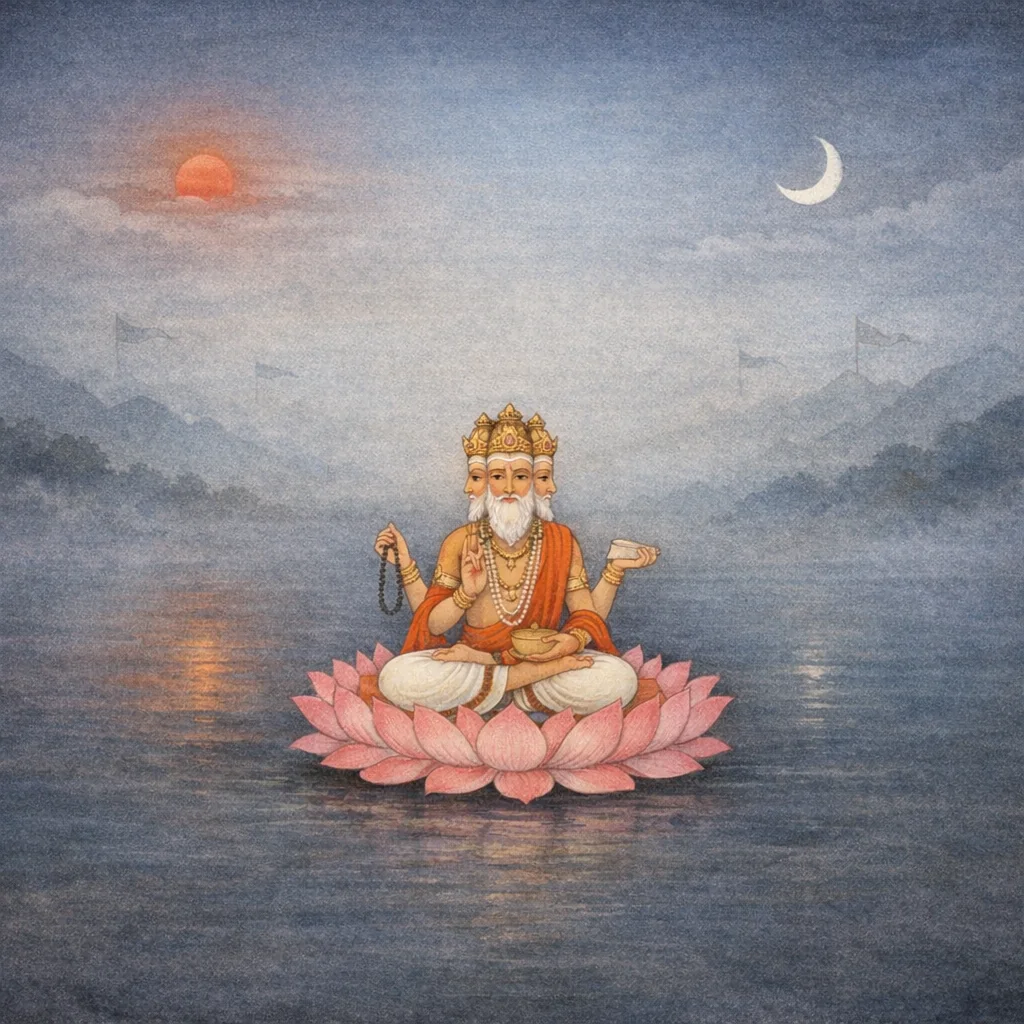
विष्णूत्पत्तिवर्णनम् (Description of the Origin/Manifestation of Viṣṇu)
Adhyāya 6 is cast as Brahmā’s instructive reply to a virtuous question asked for the welfare of the worlds (lokopakāra). Brahmā declares that hearing this teaching brings universal destruction of sin and promises to expound the “faultless,” unailing Śiva-tattva (śivatattvam anāmayam). The chapter then portrays the pralaya condition: when the moving and unmoving universe is dissolved, all becomes darkness-like (tamomaya), without sun or moon, without day–night cycles, and without fire, wind, earth, or water—an apophatic, undifferentiated state. The discourse intensifies the via negativa, denying ordinary sensory predicates: no visible qualities, no sound or touch; smell and form unmanifest, no taste, no directional orientation. Brahmā admits that the ultimate nature of Śiva-tattva is not fully knowable even to Brahmā and Viṣṇu “as it truly is” (yathārthataḥ), highlighting transcendence beyond divine cognition. The Supreme is beyond mind and speech (amanogocara, avācya), without name, form, or color, neither gross nor subtle, and is ‘seen’ by yogins in the inner sky (antarhitākāśa). As the colophon states, the purport is the account of Viṣṇu’s manifestation, placing his emergence upon the ineffable Śiva-ground and within the transition from undifferentiated pralaya to ordered cosmogenesis.
Shlokas
Verse 1
ब्रह्मोवाच । भो ब्रह्मन्साधु पृष्टोऽहं त्वया विबुधसत्तम । लोकोपकारिणा नित्यं लोकानां हितकाम्यया
Brahmā said: “O noble Brahmin, best among the wise, you have questioned me well—ever intent on the welfare of the worlds and desiring the good of all beings.”
Verse 2
अचन्द्रमनहोरात्रमनग्न्यनिलभूजलम् । अप्रधानं वियच्छून्यमन्यतेजोविवर्जितम्
There was no moon, no day or night, no fire, no wind, no earth, and no water. Not even Pradhāna, the primordial matter, existed; only an empty expanse of space remained, devoid of any other light or brilliance, before the Lord manifested for creation.
Verse 3
शिवतत्त्वं मया नैव विष्णुनापि यथार्थतः । ज्ञातश्च परमं रूपमद्भुतं च परेण न
“The true principle of Śiva has not been known in reality—neither by me nor even by Viṣṇu. Nor has that supreme, wondrous form been fully comprehended by any other being.”
Verse 4
महाप्रलयकाले च नष्टे स्थावरजंगमे । आसीत्तमोमयं सर्वमनर्कग्रहतारकम्
At the time of the great dissolution (mahāpralaya), when all stationary and moving beings had perished, everything became a mass of darkness—without the sun, without planets, and without stars.
Verse 6
अदृष्टत्वादिरहितं शब्दस्पर्शसमुज्झितम् । अव्यक्तगंधरूपं च रसत्यक्तमदिङ्मुखम्
It was devoid of visibility and the like, and was free from sound and touch; its smell and form were unmanifest, it was without taste, and it had no directions or faces—being the undifferentiated, unmanifest condition prior to manifestation.
Verse 7
इत्थं सत्यंधतमसे सूचीभेद्यं निरंतरे । तत्सद्ब्रह्मेति यच्छ्रुत्वा सदेकं प्रतिपद्यते
Thus, in the midst of dense darkness, when the continuous veil is pierced as though by the tip of a needle, and one hears (realizes) “That is Sat—Brahman,” one comes to abide in the One Existent Reality.
Verse 8
इतीदृशं यदा नासीद्यत्तत्सदसदात्मकम् । योगिनोंतर्हिताकाशे यत्पश्यंति निरंतरम्
When such a state had not yet arisen, That Reality existed as the essence of both the manifest and the unmanifest. It is the ever-present principle that yogins continually behold in the hidden inner space—within the subtle sky of consciousness.
Verse 9
अमनोगोचरम्वाचां विषयन्न कदाचन । अनामरूपवर्णं च न च स्थूलं न यत्कृशम्
He is beyond the reach of the mind and is never an object of speech. Without name, form, or color—neither gross nor subtle—thus is the Supreme Lord (Śiva), the transcendent Pati, to be understood.
Verse 10
अह्रस्वदीर्घमलघुगुरुत्वपरिवर्जितम् । न यत्रोपचयः कश्चित्तथा नापचयोऽपि च
That Reality is free from shortness and length, untouched by lightness or heaviness. In It there is no increase whatsoever, and likewise no decrease at all.
Verse 11
अभिधत्ते स चकितं यदस्तीति श्रुतिः पुनः । सत्यं ज्ञानमनंतं च परानंदम्परम्महः
The Śruti again declares—astonishingly yet decisively—that “He truly exists.” That Supreme Splendour is Truth, Conscious Knowledge, and Infinite; it is the highest Bliss and the Transcendent Great Light.
Verse 12
अप्रमेयमनाधारमविकारमनाकृति । निर्गुणं योगिगम्यञ्च सर्वव्याप्येककारकम्
He is immeasurable and without any support; changeless and without form. He is Nirguṇa (beyond the guṇas), attainable to yogins, all-pervading, and the single supreme Cause behind all that comes to be.
Verse 13
निर्विकल्पं निरारंभं निर्मायं निरुपद्रवम् । अद्वितीयमनाद्यन्तमविकाशं चिदात्मकम्
He is free from all conceptual distinctions, without any initiating impulse, without artifice or māyā, and untouched by disturbance. He is non-dual, without beginning or end, beyond all modification or expansion, and of the very nature of pure Consciousness.
Verse 14
यस्येत्थं संविकल्पंते संज्ञासंज्ञोक्तितः स्म वै । कियता चैव कालेन द्वितीयेच्छाऽभवत्किल
Thus, in Him, through the functioning of designation and expression (name and named), such determinations indeed arose. Then, after some measure of time, it is said that a second impulse of Will manifested.
Verse 15
अमूर्तेन स्वमूर्तिश्च तेनाकल्पि स्वलीलया । सर्वैश्वर्यगुणोपेता सर्वज्ञानमयी शुभा
From the Formless Lord, that very divine Form was manifested by His own playful will (līlā). Auspicious by nature, She was endowed with all sovereign powers and filled with perfect knowledge of all things.
Verse 16
सर्वगा सर्वरूपा च सर्वदृक्सर्वकारिणी । सर्वेकवंद्या सर्वाद्या सर्वदा सर्वसंस्कृतिः
She pervades all; She assumes all forms; She is the all-seeing and the doer of all. She alone is worthy of universal reverence; She is the primordial source, ever-present, and the very sacred refinement and ordering of all existence.
Verse 17
परिकल्येति तां मूर्तिमैश्वरीं शुद्धरूपिणीम् । अद्वितीयमनाद्यंतं सर्वाभासं चिदात्मकम् । अंतर्दधे पराख्यं यद्ब्रह्म सर्वगमव्ययम्
Having thus brought forth that divine form—Īśvarī, of perfectly pure nature—thereupon the Supreme Brahman, called Parā, withdrew into concealment: the non-dual Reality, without beginning or end, the ground in which all appearances shine, of the very essence of Consciousness, all-pervading and imperishable.
Verse 18
अमूर्ते यत्पराख्यं वै तस्य मूर्तिस्सदाशिवः । अर्वाचीनाः पराचीना ईश्वरं तं जगुर्बुधाः
That which, in the formless state, is called Parā, the Supreme—its manifest form is Sadāśiva. The wise, whether oriented to the outer (worldly) or the inner (transcendent), proclaim Him as Īśvara, the Lord.
Verse 19
शक्तिस्तदैकलेनापि स्वैरं विहरता तनुः । स्वविग्रहात्स्वयं सृष्टा स्वशरीरानपायिनी
That Śakti—though appearing as a single body—moved about freely. Self-manifest from her own form, she never departs from her essential nature, and thus remains inseparable from the Lord.
Verse 20
प्रधानं प्रकृति तां च मायां गुणवतीं पराम् । बुद्धितत्त्वस्य जननीमाहुर्विकृतिवर्जिताम्
They call Her Pradhāna, Prakṛti, and also Māyā—the supreme power endowed with the guṇas. She is the mother of the principle of Buddhi (cosmic intellect), yet she herself is free from modification.
Verse 21
सा शक्तिरम्बिका प्रोक्ता प्रकृतिस्सकलेश्वरी । त्रिदेवजननी नित्या मूलकारणमित्युत
She is declared to be Śakti, Ambikā; she is Prakṛti, the sovereign Lady of all. She is the eternal mother of the three gods (Brahmā, Viṣṇu, and Rudra) and is spoken of as the root cause of manifested creation.
Verse 22
अस्या अष्टौ भुजाश्चासन्विचित्रवदना शुभा । राकाचन्द्रसहस्रस्य वदने भाश्च नित्यशः
She had eight arms, and her countenance was wondrous and auspicious. Upon her face there ever shone a radiance like that of a thousand full moons.
Verse 23
नानाभरणसंयुक्ता नानागतिसमन्विता । नानायुधधरा देवी फुल्लपंकजलोचना
Adorned with many kinds of ornaments, endowed with many graceful movements, the Goddess bore diverse weapons; her eyes were like fully blossomed lotuses.
Verse 24
अचिंत्यतेजसा युक्ता सर्वयोनिस्समुद्यता । एकाकिनी यदा माया संयोगाच्चाप्यनेकिका
Endowed with inconceivable splendor, Māyā—the womb of all origins—arises. Though in herself she is one and solitary, by association with the Lord’s power she becomes manifold.
Verse 25
परः पुमानीश्वरस्स शिवश्शंभुरनीश्वरः । शीर्षे मन्दाकिनीधारी भालचन्द्रस्त्रिलोचनः
He is the Supreme Person, the Lord—Śiva, Śambhu, the Independent One, ruled by none. Upon His head He bears Mandākinī, the celestial Gaṅgā; upon His brow rests the moon; and He is the Three-Eyed One.
Verse 26
पंचवक्त्रः प्रसन्नात्मा दशबाहुस्त्रिशूलधृक् । कर्पूरगौरसुसितो भस्मोद्धूलितविग्रहः
He appeared as the auspicious Lord—five-faced, serene in essence, ten-armed and bearing the trident; radiant and white like camphor, His divine form was dusted over with sacred ash (bhasma).
Verse 27
युगपच्च तया शक्त्या साकं कालस्वरूपिणा । शिवलोकाभिधं क्षेत्रं निर्मितं तेन ब्रह्मणा
Then, simultaneously—together with that Power (Śakti) and with Time in its very form—Brahmā created the sacred realm known as Śivaloka.
Verse 28
तदेव काशिकेत्येतत्प्रोच्यते क्षेत्रमुत्तमम् । परं निर्वाणसंख्यानं सर्वोपरि विराजितम्
That very sacred region is called “Kāśikā” (Kāśī), the highest of all holy fields. It is proclaimed as the supreme abode of liberation, shining above all and surpassing every other place.
Verse 29
ताभ्यां च रममाणाभ्यां च तस्मिन्क्षेत्रे मनोरमे । परमानंदरूपाभ्यां परमानन्दरूपिणी
In that enchanting sacred field, Those Two—abiding as the very form of supreme bliss—sported together; and She (Śakti), whose nature is supreme bliss, remained united with Him in divine delight.
Verse 30
मुने प्रलयकालेपि न तत्क्षेत्रं कदाचन । विमुक्तं हि शिवाभ्यां यदविमुक्तं ततो विदुः
O sage, even at the time of cosmic dissolution, that sacred region is never, at any time, abandoned. Since it is never relinquished by Śiva and His Śivā, the wise know it as Avimukta—the holy place “Never Forsaken”.
Verse 31
अस्यानन्दवनं नाम पुराकारि पिनाकिना । क्षेत्रस्यानंदहेतुत्वादविमुक्तमनंतरम्
This sacred grove was formerly fashioned by Pinākī—Lord Śiva, bearer of the bow Pināka—and therefore is called Ānandavana. And because this holy field becomes the very cause of spiritual bliss, from time without beginning it is also known as Avimukta, “never abandoned (by Śiva)”.
Verse 32
अथानन्दवने तस्मिञ्च्छिवयो रममाणयोः । इच्छेत्यभूत्सुरर्षे हि सृज्यः कोप्यपरः किल
Then, O sage among the gods, while Śiva and His Śakti were delighting in that Ānandavana, there arose the divine Will—indeed, it is said that some other being, destined to be created, came into manifestation.
Verse 33
यस्मिन्यस्य महाभारमावां स्वस्वैरचारिणौ । निर्वाणधारणं कुर्वः केवलं काशिशायिनौ
In that condition, we—moving freely according to our own will—were bearing the great burden of existence; yet we maintained the state that upholds nirvāṇa, abiding solely as dwellers in Kāśī.
Verse 34
स एव सर्वं कुरुतां स एव परिपातु च । स एव संवृणोत्वं ते मदनुग्रहतस्सदा
May He alone accomplish everything; may He alone protect you as well. By His grace alone, may He ever fully cover you—enfolding you in His safeguarding presence.
Verse 35
चेतस्समुद्रमाकुंच्य चिंताकल्लोललोलितम् । सत्त्वरत्नं तमोग्राहं रजोविद्रुमवल्लितम्
Contracting the ocean of the mind—tossed about by the billows of anxiety—(one should discern it as) bearing the jewel of sattva, haunted by the crocodile of tamas, and hemmed in by the corals of rajas.
Verse 36
यस्य प्रसादात्तिष्ठावस्सुखमानंदकानने । परिक्षिप्तमनोवृत्तौ बहिश्चिंतातुरे सुखम्
By the grace of that Lord one abides happily in the grove of bliss; even when the mind’s movements are scattered and, outwardly, anxieties afflict, happiness is still found through His favor.
Verse 37
संप्रधार्य्येति स विभुस्तया शक्त्या परेश्वरः । सव्ये व्यापारयांचक्रे दशमेंऽगेसुधासवम्
Having thus resolved, that all-pervading Supreme Lord, together with that Śakti, set into motion the nectar-like essence; and on His left side He caused it to operate in the tenth limb (stage) of the creative process.
Verse 38
ततः पुमानाविरासीदेकस्त्रैलोक्यसुंदरः । शांतस्सत्त्वगुणोद्रिक्तो गांभीर्य्यामितसागरः
Then there manifested a single Divine Person, beautiful to all the three worlds—peaceful in nature, abounding in the quality of sattva, and profound like an immeasurable ocean.
Verse 39
तथा च क्षमया युक्तो मुनेऽलब्धोपमो ऽभवत् । इन्द्रनीलद्युतिः श्रीमान्पुण्डरीकोत्तमेक्षणः
Thus, O sage, being endowed with forbearance, he became incomparable—radiant like a sapphire, glorious in splendor, and possessing eyes like the finest lotus.
Verse 40
सुवर्णकृतिभृच्छ्रेष्ठ दुकूलयुगलावृतः । लसत्प्रचंडदोर्दण्डयुगलोह्यपराजितः
He appeared as the foremost bearer of golden adornments, clad in a pair of fine garments; with two radiant, exceedingly mighty arms, he stood unconquered.
Verse 41
ततस्स पुरुषश्शंभुं प्रणम्य परमेश्वरम् । नामानि कुरु मे स्वामिन्वद कर्मं जगाविति
Then that person bowed to Śambhu, the Supreme Lord, and said: “O Master, assign names to me, and declare to me my ordained duty.”
Verse 42
तच्छ्रुत्वा वचनम्प्राह शंकरः प्रहसन्प्रभुः । पुरुषं तं महेशानो वाचा मेघगभीरया
Hearing those words, the Lord Śaṅkara—smiling—spoke. That MahāĪśāna addressed the man in a voice deep as thunderclouds.
Verse 43
शिव उवाच । विष्ण्वितिव्यापकत्वात्ते नाम ख्यातं भविष्यति । बहून्यन्यानि नामानि भक्तसौख्यकराणि ह
Śiva said: “Because you are all-pervading, your name will become renowned as ‘Viṣṇu’. And you shall have many other names as well—names that bring happiness and spiritual ease to devotees.”
Verse 44
तपः कुरु दृढो भूत्वा परमं कार्यसाधनम् । इत्युक्त्वा श्वासमार्गेण ददौ च निगमं ततः
“Perform austerity, becoming steadfast—this is the supreme means for accomplishing the intended purpose.” Having said this, He then bestowed the Nigama (Vedic revelation) through the path of the breath.
Verse 46
दिव्यं द्वादश साहस्रं वर्षं तप्त्वापि चाच्युतः । न प्राप स्वाभिलषितं सर्वदं शंभुदर्शनम्
Even after performing austerities for twelve thousand divine years, Acyuta (Viṣṇu) did not obtain the longed-for vision of Śambhu—the all-bestowing Lord—for Śiva’s revelation is not compelled by effort alone, but is granted by His grace.
Verse 47
तत्तत्संशयमापन्नश्चिंतितं हृदि सादरम् । मयाद्य किं प्रकर्तव्यमिति विष्णुश्शिवं स्मरन्
Thus, having fallen into repeated doubt, he pondered earnestly within his heart: “What indeed should be done by me now?”—and Viṣṇu, remembering Lord Śiva, reflected in this way.
Verse 48
एतस्मिन्नंतरे वाणी समुत्पन्ना शिवाच्छुभा । तपः पुनः प्रकर्त्तव्यं संशयस्यापनुत्तये
Just then, an auspicious voice arose from Śiva: “Perform austerity once again, so that your doubt may be dispelled.”
Verse 49
ततस्तेन च तच्छ्रुत्वा तपस्तप्तं सुदारुणम् । बहुकालं तदा ब्रह्मध्यानमार्गपरेण हि
Then, having heard that instruction, he undertook extremely severe austerity for a long time—being wholly devoted to the path of contemplative absorption on Brahman (the Supreme), in accordance with the discipline of divine meditation.
Verse 50
ततस्स पुरुषो विष्णुः प्रबुद्धो ध्यानमार्गतः । सुप्रीतो विस्मयं प्राप्तः किं यत्तव महा इति
Then that Person—Viṣṇu—awoke from the path of meditation. Pleased and filled with wonder, he said: “What indeed is this—so great—belonging to You?”
Verse 51
परिश्रमवतस्तस्य विष्णोः स्वाङ्गेभ्य एव च । जलधारा हि संयाता विविधाश्शिवमायया
As Viṣṇu exerted himself in that task, streams of water indeed issued forth from his own limbs—arising in diverse ways through Śiva’s Māyā.
Verse 52
अभिव्याप्तं च सकलं शून्यं यत्तन्महामुने । ब्रह्मरूपं जलमभूत्स्पर्शनात्पापनाशनम्
O great sage, when all this was pervaded by that all-encompassing Void, the waters arose as the very form of Brahman; by their touch, sins are destroyed.
Verse 53
तदा श्रांतश्च पुरुषो विष्णुस्तस्मिञ्जले स्वयम् । सुष्वाप परम प्रीतो बहुकालं विमोहितः
Then that Person—Viṣṇu himself—became weary in those waters; and, feeling a strange contentment, he fell asleep, remaining deluded for a long time.
Verse 54
नारायणेति नामापि तस्यसीच्छ्रुतिसंमतम् । नान्यत्किंचित्तदा ह्यासीत्प्राकृतं पुरुषं विना
Even the name “Nārāyaṇa” for that Supreme Principle was accepted as valid by the Vedas. For at that time, apart from the primordial Cosmic Person (the Prākṛta Puruṣa), nothing else whatsoever existed.
Verse 55
एतस्मिन्नन्तरे काले तत्त्वान्यासन्महात्मनः । तत्प्रकारं शृणु प्राज्ञ गदतो मे महामते
In the meantime, O noble one, the great-souled Lord brought forth the principles (tattvas). O wise and high-minded one, listen to their manner of manifestation as I describe it.
Verse 56
प्रकृतेश्च महानासीन्महतश्च गुणास्त्रयः । अहंकारस्ततो जातस्त्रिविधो गुणभेदतः
From Prakṛti arose Mahān (Mahat-tattva); and from Mahat the three guṇas became manifest. Thereafter Ahaṃkāra was born, threefold according to the differentiation of the guṇas.
Verse 58
तत्त्वानामिति संख्यानमुक्तं ते ऋषिसत्तम । जडात्मकञ्च तत्सर्वं प्रकृतेः पुरुषं विना
Thus, O best of sages, I have declared to you the enumeration of the tattvas. And all of that is of the nature of inert matter; apart from Prakṛti, there is no Puruṣa there as its conscious principle.
Verse 59
तत्तदैकीकृतं तत्त्वं चतुर्विंशतिसंख्यकम् । शिवेच्छया गृहीत्वा स सुष्वाप ब्रह्मरूपके
Having thus unified the principles—the twenty-four tattvas—he, by Śiva’s will, gathered them into himself and then entered sleep in the state of Brahmā, the creator-form.
Frequently Asked Questions
The chapter’s declared topic is Viṣṇu’s manifestation (viṣṇūtpatti-varṇana), presented within a broader teaching on pralaya and the prior, transcendent Śiva-tattva.
Pralaya is used as a pedagogical model for non-differentiation: by removing time, elements, sensory qualities, and direction, the text points to an ultimate reality that cannot be captured by ordinary predicates.
Primarily negative attributes: beyond mind and speech, without name/form/color, neither gross nor subtle, and inaccessible even to Brahmā and Viṣṇu—yet intuited by yogins in the inner contemplative space.