Sarga 2
द्वितीयः सर्गः (Sarga 2): Sugriva’s Alarm and Hanuman’s Commission
किष्किन्धाकाण्ड
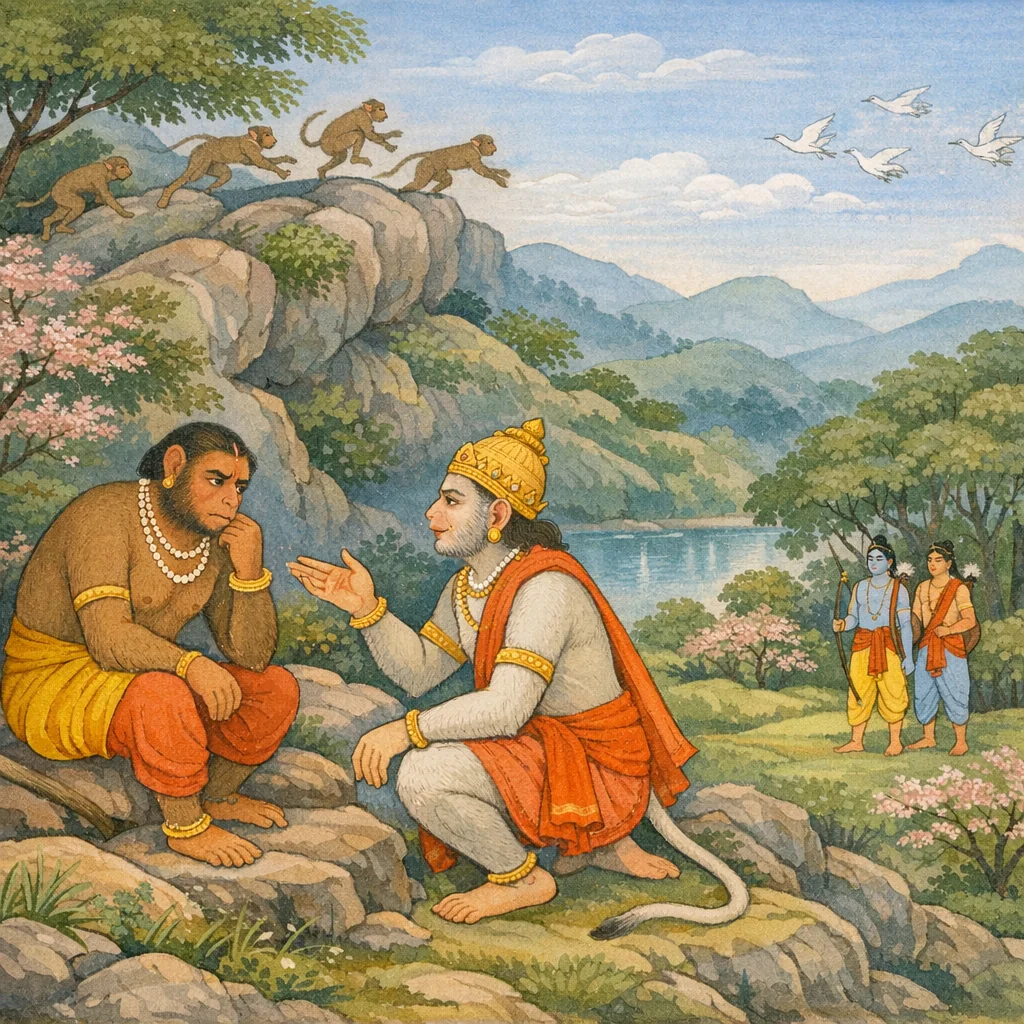
On Mount Ṛśyamūka, Sugrīva—scarred by his conflict with Vālī—spots Rāma and Lakṣmaṇa, armed and formidable, and suspects they may be Vālī’s agents in disguise. His fear shows as restless vigilance, while his ministers swiftly regroup across the peaks; their leaps shake flowering trees and startle the forest creatures, revealing the vānaras’ martial mobility. Hanumān, praised as vākya-kovida (skilled in speech), counsels Sugrīva to regain composure, noting that the Malaya-range refuge removes immediate danger from Vālī. He then lays out a protocol of reconnaissance: approach in an ordinary form, read gestures (iṅgita), traits, appearance, and conversation to infer intent; if their demeanor is agreeable, build trust through measured praise and then ask why they have entered the forest. Sugrīva authorizes Hanumān to carry out this diplomatic inquiry. Hanumān accepts, salutes with reverence, and proceeds toward Rāma and Lakṣmaṇa—establishing speech as the instrument that turns suspicion into the path of alliance.
Shlokas
Verse 1
तौ तु दृष्ट्वा महात्मानौ भ्रातरौ रामलक्ष्मणौ।वरायुधधरौ वीरौ सुग्रीवश्शङ्कितोऽभवत्।।
Seeing the two great-souled brothers, Rāma and Lakṣmaṇa—heroes bearing excellent weapons—Sugrīva grew anxious and suspicious.
Verse 2
उद्विग्नहृदयस्सर्वा दिशस्समवलोकयन्।न व्यतिष्ठत कस्मिंश्चिद्देशे वानरपुङ्गवः। ।।
With a heart shaken by anxiety, the foremost of monkeys kept scanning all directions and could not remain steady in any one place.
Verse 3
नैव चक्रे मनः स्थातुं वीक्षमाणो महाबलौ।कपेः परमभीतस्य चित्तं व्यवससाद ह।।
Seeing the two mighty heroes, the monkey (Sugrīva) could not steady his mind; overwhelmed by fear, his heart sank.
Verse 4
चिन्तयित्वा स धर्मात्मा विमृश्य गुरुलाघवम्।सुग्रीवः परमोद्विग्नस्सर्वैरनुचरैस्सह।।
That righteous Sugrīva, deeply agitated, reflected and weighed the gravity and lightness of the consequences together with all his attendants.
Verse 5
ततस्स सचिवेभ्यस्तु सुग्रीवः प्लवगाधिपः।शशंस परमोद्विग्नः पश्यंस्तौ रामलक्ष्मणौ।।
Then Sugrīva, lord of the monkeys, greatly distressed as he watched Rāma and Lakṣmaṇa, spoke to his ministers.
Verse 6
एतौ वनमिदं दुर्गं वालिप्रणिहितौ ध्रुवम्।छद्मना चीरवसनौ प्रचरन्ताविहागतौ4.2.6।।
Surely these two have come here into this difficult forest, sent by Vāli—moving about in disguise, wearing bark garments.
Verse 7
ततस्सुग्रीवसचिवा दृष्ट्वा परमधन्विनौ।जग्मुर्गिरितटात्तस्मादन्यच्छिखरमुत्तमम्।।
Then Sugrīva’s ministers, seeing the two supreme archers, departed from that mountainside and went to another excellent peak.
Verse 8
ते क्षिप्रमधिगम्याथ यूथपा यूथपर्षभम्।हरयो वानरश्रेष्ठं परिवार्योपतस्थिरे।।
Then the leaders of the monkey troops quickly reached Sugrīva—the foremost among the lords of monkeys—and stood around him in attendance.
Verse 9
एकमेकायनगताः प्लवमाना गिरेर्गिरिम्।प्रकम्पयन्तो वेगेन गिरीणां शिखराण्यपि।।
Leaping swiftly from mountain to mountain, they gathered in one place, their speed so great that even the peaks of the hills trembled.
Verse 10
ततश्शाखामृगास्सर्वे प्लवमाना महाबलाः।बभञ्जुश्च नगांस्तत्र पुष्पितान्दुर्गसंश्रितान्।।
Then all those powerful branch-dwelling monkeys, leaping about, broke the flowering trees there that grew along the rugged heights.
Verse 11
आप्लवन्तो हरिवरास्सर्वतस्तं महागिरिम्।मृगमार्जारशार्दूलांस्त्रासयन्तो ययुस्तदा।।
At that time the best of monkeys leapt all over that great mountain, frightening deer, wildcats, and tigers as they moved about.
Verse 12
ततस्सुग्रीवसचिवाः पर्वतेन्द्रं समाश्रिताः।सङ्गम्य कपिमुख्येन सर्वे प्राञ्जलय स्थिताः।।।।
Then Sugrīva’s ministers, having taken shelter on the lord of mountains, assembled with their monkey-chief and stood with folded hands.
Verse 13
ततस्तं भयसंविग्नं वालिकिल्बिषशङ्कितम्।उवाच हनुमान्वाक्यं सुग्रीवं वाक्यकोविदः।।
Then Hanumān, skilled in speech, spoke to Sugrīva, who was shaken with fear and suspected some wrongdoing or plot from Vāli.
Verse 14
सम्भ्रमस्त्यज्यतामेष सर्वैर्वालिकृते महान्।मलयोऽयं गिरिवरो भयं नेहास्ति वालिनः।।
Let this great agitation, born of Vāli, be given up by all. This is the noble Malaya mountain-range; here there is no fear from Vāli.
Verse 15
यस्मादुद्विग्नचेतास्त्वं प्रद्रुतो हरिपुङ्गव।तं क्रूरदर्शनं क्रूरं नेह पश्यामि वालिनम्।।
O bull among monkeys! The cruel Vāli—of dreadful appearance—because of whom your heart is alarmed and you have fled, I do not see him here.
Verse 16
यस्मात्तव भयं सौम्य पूर्वजात्पापकर्मणः।स नेह वाली दुष्टात्मा न ते पश्याम्यहं भयम्।।
O gentle one, since your fear is of your elder brother—sinful in deeds and evil in intent—yet that Vālī is not here; therefore I do not see any cause for you to be afraid at this moment.
Verse 17
अहो शाखामृगत्वं ते व्यक्तमेव प्लवङ्गम।लघुचित्ततयाऽत्मानं न स्थापयसि यो मतौ।।
Ah, O monkey—your ‘tree-dwelling’ nature is indeed plain to see: with a fickle mind, you cannot keep yourself steady in resolve.
Verse 18
बुद्धिविज्ञानसम्पन्न इङ्गितैस्सर्वमाचर।न ह्यबुद्धिं गतो राजा सर्वभूतानि शास्ति हि4.2.18।।
Be endowed with intelligence and discernment, and in every matter act while carefully reading signs and gestures; for a king who has fallen into folly cannot truly rule and restrain all beings.
Verse 19
सुग्रीवस्तु शुभं वाक्यं श्रुत्वा सर्वं हनूमतः।ततश्शुभतरं वाक्यं हनूमन्तमुवाच ह।।
Having heard all the auspicious and wise words of Hanumān, Sugrīva then spoke to Hanumān with words even more gracious.
Verse 20
दीर्घबाहू विशालाक्षौ शरचापासिधारिणौ।कस्य न स्याद्भयं दृष्ट्वा ह्येतौ सुरसुतोपमौ।।
Long-armed and large-eyed, bearing arrows, bow, and sword—who would not feel fear on seeing these two, comparable to the sons of gods?
Verse 21
वालिप्रणिहितावेतौ शङ्केऽहं पुरुषोत्तमौ।राजानो बहुमित्राश्च विश्वासो नात्र हि क्षमः।।
I suspect these two excellent men may have been sent by Vālī. Kings have many allies; therefore, here it is not proper to place trust too quickly.
Verse 22
अरयश्च मनुष्येण विज्ञेयाश्छद्मचारिणः।विश्वस्तानामविश्वस्तारन्ध्रेषु प्रहरन्ति हि।।
A man must recognize enemies who move about in disguise; the untrustworthy strike those who trust them, attacking at moments of vulnerability.
Verse 23
कृत्येषु वाली मेधावी राजानो बहुदर्शिनः।भवन्ति परहन्तारस्ते ज्ञेयाः प्राकृतैर्नरैः।।
Vālī is intelligent in his undertakings, and kings are far-seeing; they become destroyers of foes through stratagems—such designs must be recognized even by ordinary men.
Verse 24
तौ त्वया प्राकृतेनैव गत्वा ज्ञेयौ प्लवङ्गम।इङ्गितानां प्रकारैश्च रूपव्याभाषणेन च।।
O monkey, go to those two in an ordinary guise and find them out—by the patterns of their gestures, by their appearance, and by their manner of speech.
Verse 25
लक्षयस्व तयोर्भावं प्रहृष्टमनसौ यदि।विश्वासयन्प्रशंसाभिरिङ्गितैश्च पुनः पुनः।।ममैवाभिमुखं स्थित्वा पृच्छ त्वं हरिपुङ्गव ।प्रयोजनं प्रवेशस्य वनस्यास्य धनुर्धरौ।।
Observe the intention of those two; if their minds appear pleased and open, then—again and again—win their trust by praise and by reading their gestures.
Verse 26
लक्षयस्व तयोर्भावं प्रहृष्टमनसौ यदि।विश्वासयन्प्रशंसाभिरिङ्गितैश्च पुनः पुनः4.2.25।।ममैवाभिमुखं स्थित्वा पृच्छ त्वं हरिपुङ्गव ।प्रयोजनं प्रवेशस्य वनस्यास्य धनुर्धरौ4.2.26।।
Standing with me as your support, O best of monkeys, ask those two bowmen the purpose of their entering this forest.
Verse 27
शुद्धात्मानौ यदि त्वेतौ जानीहि त्वं प्लवङ्गम।व्याभाषितैर्वा विज्ञेया स्याद्दुष्टाऽदुष्टता तयोः।।
If these two are pure in spirit, understand that, O monkey; by conversation, their evil or non-evil intent can be discerned.
Verse 28
इत्येवं कपिराजेन सन्दिष्टो मारुतात्मजः।चकार गमने बुद्धिं यत्र तौ रामलक्ष्मणौ।।
Thus instructed by the king of the monkeys, the son of the Wind-god, Hanumān, set his mind on going to where Rāma and Lakṣmaṇa were.
Verse 29
तथेति सम्पूज्य वचस्तु तस्यतत्कपेस्सुभीमस्य दुरासदस्य च।महानुभावो हनुमान्ययौ तदास यत्र रामोऽतिबलश्च लक्ष्मणः।।
Saying, “So be it,” Hanumān reverently honored the words of that mighty and unassailable lord of monkeys, and then went to where Rāma and the exceedingly powerful Lakṣmaṇa were.
Frequently Asked Questions
The dilemma is whether to trust unknown armed arrivals who could be hostile agents. Sugrīva chooses an ethically cautious action: verify intent through nonviolent reconnaissance—Hanumān approaches in an ordinary form and evaluates their conduct via gestures, demeanor, and dialogue before extending trust.
Fear must be governed by buddhi (intelligence) and vāk (disciplined speech). Hanumān’s counsel models how composure, evidence-based judgment, and respectful communication transform panic into right action, showing that leadership requires both discernment and rhetorical responsibility.
Ṛśyamūka is presented as a protective mountain refuge where Vālī’s threat is mitigated, and the Malaya range is named to anchor the setting. The chapter also highlights vānaras’ mountain-to-mountain mobility and the forest ecology (blossoming trees, startled wildlife) as part of the narrative landscape.