Sarga 53
स्वयम्प्रभा-विमोचनम् — Svayamprabha Leads the Vanaras Out (Time-Limit Crisis and Counsel)
किष्किन्धाकाण्ड
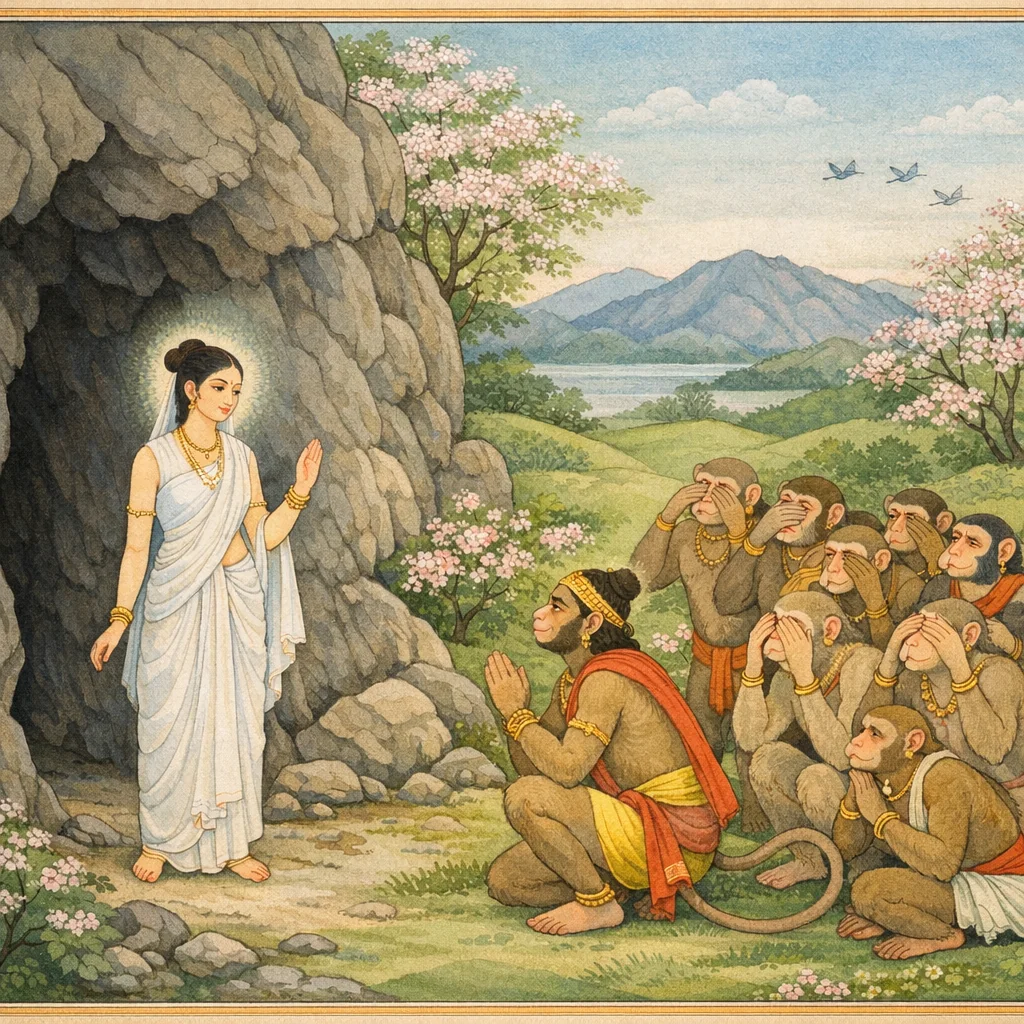
Sarga 53 turns from confinement to a moral crisis. Hanumān respectfully answers the hermitess Svayaṃprabhā’s auspicious, dharma-aligned words, and the vānaras take refuge in her, confessing that Sugrīva’s one-month deadline has been exceeded while they wandered within the magical cave-complex attributed to Māyā. By the power of her tapas and niyama, Svayaṃprabhā promises deliverance, yet prescribes a ritual-like protocol: the vānaras must close and cover their eyes to depart safely. In an instant she brings them outside, then points out their bearings—Vindhya, Prasravaṇa hill, and the great ocean—blesses them, and re-enters the cave. Outside, the vānaras see spring in the flowering trees and realize how much time has passed; anxiety swells into despair. After deliberation, Aṅgada speaks to the elders and forest-dwellers, sets forth their accountability, and proposes prāyopaveśana (fasting unto death) to avoid punishment upon return. Others agree that returning without any trace of Sītā may invite execution to satisfy Rāma. Tārā offers another course: remain within the inaccessible, well-provisioned magical cave, beyond fear even of Indra, Rāma, or Sugrīva. The company thus seeks a strategy that averts penalty while preserving collective survival and duty.
Shlokas
Verse 1
एवमुक्तश्शुभं वाक्यं तापस्या धर्मसंहितम्।उवाच हनुमान्वाक्यं तामनिन्दितचेष्टिताम्।।।।
Thus addressed with auspicious words, imbued with dharma, by the ascetic woman of blameless conduct, Hanumān spoke to her in reply.
Verse 2
शरणं त्वां प्रपन्ना स्म सर्वे वै धर्मचारिणीं।यः कृतस्समयोऽस्माकं सुग्रीवेण महात्मना।।।।स च कालो ह्यतिक्रान्तो बिले च परिवर्तताम्।
O righteous lady, we have all taken refuge in you. Yet the time-limit set for us by the great Sugriva has been exceeded, as we have been wandering within this cave.
Verse 3
सा त्वमस्माद्बिलाद्घोरादुत्तारयितुमर्हसि।।4.53.3।।तस्मात्सुग्रीववचनादतिक्रान्तान्गतायुषः।
O lady, you should help us out of this dreadful cave; for, by overstepping Sugrīva’s command, we are as good as dead.
Verse 4
त्रातुमर्हसि नस्सर्वान्सुग्रीवभयकर्शितान्।।।।महच्चकार्यमस्माभिः कर्तव्यं धर्मचारिणि।तच्चापि न कृतं कार्यमस्माभिरिह वासिभिः।।।।
“Save all of us who are tormented by fear of Sugrīva. A great duty still remains for us to accomplish, O woman devoted to dharma; yet that task has not been done by us while we have been dwelling here.”
Verse 5
त्रातुमर्हसि नस्सर्वान्सुग्रीवभयकर्शितान्।।4.53.4।।महच्चकार्यमस्माभिः कर्तव्यं धर्मचारिणि।तच्चापि न कृतं कार्यमस्माभिरिह वासिभिः।।4.53.5।।
Save us all, distressed by fear of Sugrīva. A great duty remains for us to fulfill, O righteous lady, and we who have dwelt here have not yet accomplished it.
Verse 6
एवमुक्ता हनुमता तापसी वाक्यमब्रवीत्।जीवता दुष्करं मन्ये प्रविष्टेन निवर्तितुम्।।।।
Thus addressed by Hanumān, the ascetic woman replied: “I think it is difficult for one who has entered this place to return alive.”
Verse 7
तपसस्तु प्रभावेन नियमोपार्जितेन च।सर्वानेव बिलादस्मादुद्धरिष्यामि वानरान्।।।।
“By the power of my austerities—won through disciplined observances—I shall lift all the monkeys out of this cave.”
Verse 8
निमीलयत चक्षूंषि सर्वे वानरपुङ्गवाः।न हि निष्क्रमितुं शक्यमनिमीलितलोचनैः।।4.53.8।।
“Close your eyes, all you foremost among monkeys; for it is not possible to come out with eyes left open.”
Verse 9
ततस्सम्मीलितास्सर्वे सुकुमाराङ्गुलैः करैः।सहसाऽपिदधुर्दृष्टिं हृष्टा गमनकाङ्क्षया।।।।
Then all of them—delighted with the desire to depart—shut their eyes at once and even covered their sight with their hands, using their soft fingers.
Verse 10
वानरास्तु महात्मानो हस्तरुद्धमुखास्तदा।निमेषान्तरमात्रेण बिलादुत्तारितास्तया।।।।
Then the noble vānaras, covering their faces with their hands, were brought out of the cave by her within the span of a single blink.
Verse 11
ततस्तान्वानरान्सर्वांस्तापसी धर्मचारिणी।निस्सृतान्विषमात्तस्मात्समाश्वास्येदमब्रवीत्।।।।
Then the ascetic woman, steadfast in dharma, consoled all the vānaras who had escaped that peril and spoke these words.
Verse 12
एष विन्ध्यो गिरिश्श्रीमान्नानाद्रुमलताकुलः।एष प्रस्रवणश्शैलस्सागरोऽयं महोदधिः।।।।स्वस्ति वोऽस्तु गमिष्यामि भवनं वानरर्षभाः।इत्युक्त्वा तद्बिलं श्रीमत्प्रविवेश स्वयम्प्रभा।।।।
“Here is the splendid Vindhya mountain, dense with many kinds of trees and creepers. Here is the Prasravaṇa hill; and here is the sea, the great ocean. May well-being be yours, O best of vānaras; I shall now go to my dwelling.” Having spoken thus, Svayamprabhā entered that splendid cave once more.
Verse 13
एष विन्ध्यो गिरिश्श्रीमान्नानाद्रुमलताकुलः।एष प्रस्रवणश्शैलस्सागरोऽयं महोदधिः।।4.53.12।।स्वस्ति वोऽस्तु गमिष्यामि भवनं वानरर्षभाः।इत्युक्त्वा तद्बिलं श्रीमत्प्रविवेश स्वयम्प्रभा।।4.53.13।।
“May auspiciousness be upon you; I shall go to my dwelling,” said Svayamprabhā to the foremost of the vānaras; having pointed out Vindhya, Mount Prasravaṇa, and the great ocean, she re-entered the splendid cave.
Verse 14
ततस्ते ददृशुर्घोरं सागरं वरुणालयम्।अपारमभिगर्जन्तं घोरैरूर्मिभिरावृतम्।।।।
Then they beheld the dreadful sea—the abode of Varuṇa—boundless, roaring, and covered with terrifying waves.
Verse 15
मयस्य मायाविहितं गिरिदुर्गं विचिन्वताम्।तेषां मासो व्यतिक्रान्तो यो राज्ञा समयः कृतः।।।।
While they searched the mountain-fastness fashioned by Maya’s illusory art, the one-month deadline fixed by the king had elapsed for them.
Verse 16
विन्ध्यस्य तु गिरेः पादे सम्प्रपुष्पितपादपे।उपविश्य महाभागाश्चिन्तामापेदिरे तदा।।।।
Then those fortunate vānaras sat down at the foot of Vindhya, where the trees were in full bloom, and fell into anxious reflection.
Verse 17
ततः पुष्पातिभाराग्रान् लताशतसमावृतान्।द्रुमान्वासन्तिकान्दृष्टवा बभूवुर्भयशङ्किताः।।।।
Then, seeing springtime trees whose tops drooped under the weight of abundant blossoms, wrapped in hundreds of creepers, they became fearful and apprehensive.
Verse 18
ते वसन्तमनुप्राप्तं प्रतिबुद्ध्वा परस्परम्।नष्टसन्देशकालार्था निपेतुर्धरणीतले।।।।
Realizing among themselves that spring had arrived and that the appointed time for reporting had been lost, they fell prostrate upon the earth.
Verse 19
ततस्तान्कपिवृद्धांस्तु शिष्टांश्चैव वनौकसः।वाचा मधुरयाऽभाष्य यथावदनुमान्य च।।।।स तु सिंहवृषस्कन्धः पीनायतभुजः कपिः।युवराजो महाप्राज्ञः अङ्गदो वाक्यमब्रवीत्।।।।
Then Angada—the wise heir-apparent among the vānaras, broad-shouldered like a lion or bull and strong-armed—having duly considered and shown proper respect, addressed the elder and honored forest-dwellers in a gentle, sweet voice.
Verse 20
ततस्तान्कपिवृद्धांस्तु शिष्टांश्चैव वनौकसः।वाचा मधुरयाऽभाष्य यथावदनुमान्य च।।4.53.19।।स तु सिंहवृषस्कन्धः पीनायतभुजः कपिः।युवराजो महाप्राज्ञः अङ्गदो वाक्यमब्रवीत्।।4.53.20।।
Then Angada—the wise heir-apparent among the monkeys, broad-shouldered like a lion or bull and strong-armed—spoke these words.
Verse 21
शासनात्कपिराजस्य वयं सर्वे विनिर्गताः।मासः पूर्णो बिलस्थानां हरयः किं न बुद्ध्यते।।।।
By the command of the monkey-king we all set out; and for those haris who have been in this cave, a full month has been completed—do you not understand?
Verse 22
वयमाश्वयुजे मासि कालसङ्ख्याव्यवस्थिताः।प्रस्थितास्सोऽपि चातीतः किमतः कार्यमुत्तरम्।।।।
We set out in the month of Āśvayuja, with the time fixed by reckoning; even that term has now passed. What, then, should be done next?
Verse 23
भवन्तः प्रत्ययं प्राप्ताः नीतिमार्गविशारदाः।हितेष्वभिरता भर्तुर्निसृष्टास्सर्वकर्मसु।।4.53.23।।
All of you are trusted men, skilled in the paths of righteous policy, devoted to your lord’s welfare, and dispatched for every necessary task.
Verse 24
कर्मस्वप्रतिमास्सर्वे दिक्षु विश्रुतपौरुषाः।मां पुरस्कृत्य निर्याताः पिङ्गाक्षप्रतिचोदिताः।।।।
All of you are unmatched in action, renowned for valor in every direction; urged on by the tawny-eyed Sugriva, you set out with me placed at the fore.
Verse 25
इदानीमकृतार्थानां मर्तव्यं नात्र संशयः।हरिराजस्य सन्देशमकृत्वा कस्सुखी भवेत्।।।।
Now, since we have not accomplished the purpose, we must die—there is no doubt. Who could live happily after failing to carry out the monkey-king’s command?
Verse 26
तस्मिन्नतीते काले तु सुग्रीवेण कृते स्वयम्।प्रायोपवेशनं युक्तं सर्वेषां च वनौकसाम्।।।।
Since the time fixed by Sugriva has passed, it is proper for all of us forest-dwellers to undertake prāyopaveśana—fasting unto death.
Verse 27
तीक्ष्णः प्रकृत्या सुग्रीवस्स्वामिभावे व्यवस्थितः।न क्षमिष्यति नस्सर्वानपराधकृतो गतान्।।।।
Sugrīva is harsh by nature and now firmly established as king; if we return as offenders, he will forgive none of us.
Verse 28
अप्रवृत्तौ च सीतायाः पापमेव करिष्यति।तस्मात् क्षममिहाद्यैव गन्तुं प्रायोपवेशनम् हि नः।।4.53.28।।त्यक्त्वा पुत्रांश्च दारांश्च धनानि च गृहाणि च।
And if there is no progress regarding Sītā, he will only incur sin (by punishing us unjustly). Therefore it is fitting that here, today itself, we go to prāyopaveśana—renouncing sons, wives, wealth, and homes.
Verse 29
धृवं नो हिंसिता राजा सर्वान्प्रतिगतानितः।।।।वधेनाप्रतिरूपेण श्रेयान्मृत्युरिहैव नः।
Surely, when we return from here, the king will torment all of us, sentencing us to death in a dreadful and exceptional way; better for us is death here itself.
Verse 30
न चाहं यौवराज्येन सुग्रीवेणाभिषेचितः।।।।नरेन्द्रेणाभिषिक्तोऽस्मि रामेणाक्लिष्टकर्मणा।
I was not installed as heir-apparent by Sugrīva; I was consecrated by Rāma—the king among men—whose deeds are free from cruelty.
Verse 31
स पूर्वं बद्धवैरो मां राजा दृष्ट्वा व्यतिक्रमम्।।।।घातयिष्यति दण्डेन तीक्ष्णेन कृतनिश्चयः।
That king—who has long borne enmity toward me—seeing this transgression, will resolutely punish me with a harsh penalty, having firmly decided so.
Verse 32
किं मे सुहृदभिर्व्यसनं पश्यद्भिर्जीवितान्तरे।।।।इहैव प्रायमासिष्ये पुण्ये सागररोधसि।
What use is it that my friends should witness my calamity at the end of my life? Here itself, upon this sacred seashore, I will sit fasting unto death.
Verse 33
एतच्छ्रुत्वा कुमारेण युवराजेन भाषितम्।।।।सर्वे ते वानरश्रेष्ठाः करुणं वाक्यमब्रुवन्।
Hearing these words spoken by the young prince, all the foremost of the vānaras replied with compassionate speech.
Verse 34
तीक्ष्णः प्रकृत्या सुग्रीवः प्रियासक्तश्च राघवः।।।।अदृष्टायां तु वैदेह्यां दृष्ट्वाऽस्मांश्त समागतान्।राघवप्रियकामार्थं घातयिष्यत्यसंशयम्।।।।
Sugrīva is harsh by nature, and Rāghava is devoted to his beloved. Therefore, if Vaidehī is not found and he sees us returned, he will—without doubt—have us killed to please Rāghava.
Verse 35
तीक्ष्णः प्रकृत्या सुग्रीवः प्रियासक्तश्च राघवः।।4.53.34।।अदृष्टायां तु वैदेह्यां दृष्ट्वाऽस्मांश्त समागतान्।राघवप्रियकामार्थं घातयिष्यत्यसंशयम्।।4.53.35।।
Sugrīva is harsh by nature, and Rāghava is devoted to his beloved. Thus, if Vaidehī is not found and he sees us returned, he will—without doubt—have us killed to please Rāghava.
Verse 36
न क्षमं चापराद्धानां गमनं स्वामिपार्श्वतः।इहैव सीतामन्विष्य प्रवृत्तिमुपलभ्य वा।।।।नो चेद्गच्छाम तं वीरं गमिष्यामो यमक्षयम्।
It is not fitting for offenders to go into the lord’s presence. Here itself we shall seek Sītā and, having learned her whereabouts, approach that hero; otherwise we shall go to Yama’s abode, to the inescapable end.
Verse 37
प्लवङ्गमानां तु भयार्दितानांश्रुत्वा वचस्तार इदं बभाषे।अलं विषादेन बिलं प्रविश्यवसाम सर्वे यदि रोचते वः।।।।
Hearing the words of the vānaras shaken by fear, Tārā spoke: “Enough of despair. If it pleases you, let us all enter the cave and live there.”
Verse 38
इदं हि मायाविहितं सुदुर्गमंप्रभूतवृक्षोदकभोज्यपेयकम्।इहास्ति नो नैव भयं पुरन्दरान्न राघवाद्वानरराजतोऽपि वा।।।।
This place, fashioned by magic, is exceedingly hard to access, and it is supplied with abundant trees, water, food, and drink. If we remain here, there will be no fear for us—not even from Indra the fortress-breaker, nor from Rāghava (Rāma), nor even from the king of monkeys.
Verse 39
श्रुत्वाऽङ्गदस्यापि वचोऽनुकूलमूचुश्च सर्वे हरयः प्रतीताः।यथा न हिंस्येम तथा विधानमसक्तमद्यैव विधीयतां नः।।।।
Having heard Angada’s agreeable words, all the monkeys assented and said: “Let a plan be devised at once so that we are not harmed; let our course be arranged without being bound by the king’s strict conditions.”
Frequently Asked Questions
The dilemma is mission failure under a fixed royal deadline: the vānaras exceed Sugrīva’s one-month samaya while trapped in Maya’s magical mountain-cave, and must decide whether to return as offenders or adopt an extreme penance. Aṅgada frames prāyopaveśana (fasting unto death) as a response to breached obligation and anticipated royal punishment.
The chapter contrasts dharma-protected refuge with fear-driven despair: Svayaṃprabhā’s tapas enables liberation when approached respectfully, yet liberation immediately reopens the moral burden of accountability. The upadeśa emphasizes that ethical agency requires counsel (deliberation), truthful assessment of time and duty, and choosing strategies that preserve both collective welfare and fidelity to rightful purpose.
Svayaṃprabhā identifies key wayfinding markers for the search mission: Vindhya mountain, Prasravaṇa hill, and the great ocean (Varuṇālaya/Mahodadhi). The vānaras also infer seasonal change—spring—through flowering trees and creepers, using ecological signs as a narrative signal that time has elapsed.