Sarga 66
हनूमद्बलप्रबोधनम् / Jāmbavān Rekindles Hanūmān’s Power
किष्किन्धाकाण्ड
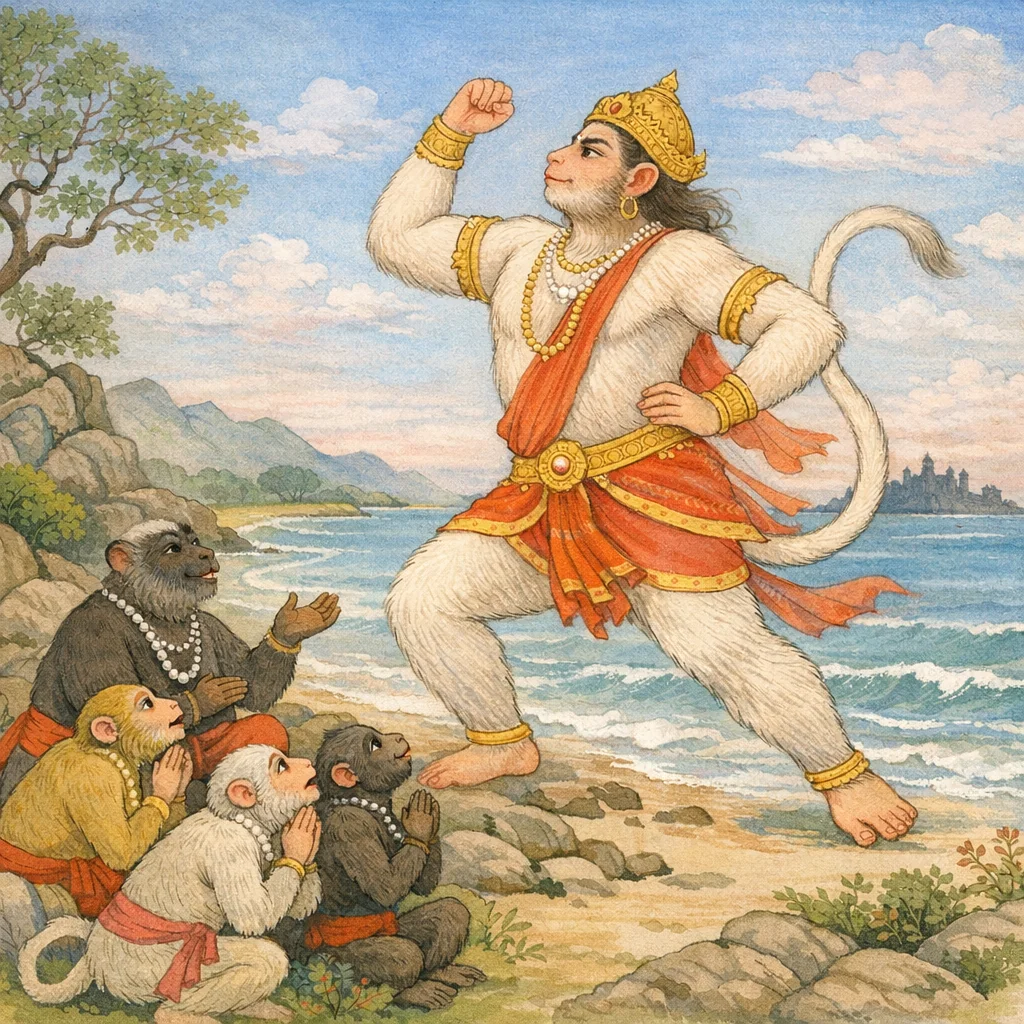
In Sarga 66, Jāmbavān rouses the dejected vānaravāhinī by awakening Hanūmān’s self-knowledge. He questions Hanūmān’s silence and withdrawal, and, invoking Garuḍa (Vainateya) as a measure, declares that Hanūmān’s shoulder-strength, speed, and valor are in no way inferior. Jāmbavān then recounts Hanūmān’s origin: Añjanā—once the apsaras Puñjikāsthalā, changed by a curse—assumes human form. The Wind-god Māruta/Pavana approaches her mentally rather than physically, promising a son endowed with wisdom, courage, and extraordinary leaping power. As a child Hanūmān flies toward the rising sun; Indra strikes him with the thunderbolt, breaking his left jaw, hence the name “Hanūmān.” Vāyu protests by ceasing to blow, unsettling the cosmos, until the gods appease him with boons: Brahmā grants invulnerability to weapons, and Indra grants that death shall come only by Hanūmān’s own choosing. At last Jāmbavān exhorts him to cross the great ocean. Stirred by this upadeśa, Hanūmān enlarges his body, restores the host’s morale, and all stand ready for the leap toward Laṅkā.
Shlokas
Verse 1
अनेकशतसाहस्रीं विषण्णां हरिवाहिनीम्।जाम्बवान्समुदीक्ष्यैवं हनूमन्तमथाब्रवीत्।।।।
Seeing the monkey host—hundreds of thousands—sunk in dejection, Jāmbavān then spoke to Hanumān in this manner.
Verse 2
वीर वानरलोकस्य सर्वशास्त्रविदां वर।तूष्णीमेकान्तमाश्रित्य हनूमन्किं न जल्पसि।।।।
“O hero Hanumān—best in the Vānara world, foremost among those who know all the śāstras—why do you sit silent, withdrawn in solitude, and not speak?”
Verse 3
हनूमन्हरिराजस्य सुग्रीवस्य समो ह्यसि।रामलक्ष्मणयोश्चापि तेजसा च बलेन च।।।।
Hanumān, you are indeed equal to Sugrīva, the monkey-king—and also to Rāma and Lakṣmaṇa—in brilliance and in strength.
Verse 4
अरिष्टनेमिनः पुत्रो वैनतेयो महाबलः।गरुत्मानिति विख्यात उत्तमस्सर्वपक्षिणाम्।।।।
You belong to the mighty lineage of Ariṣṭanemi and Vinatā; and Garuḍa—renowned as Garutmān, the greatest of all birds—is famed for his extraordinary power.
Verse 5
बहुशो हि मया दृष्टः सागरे स महाबलः।भुजङ्गानुद्धरन्पक्षी महावेगो महायशाः।।।।
Many times I have seen that glorious bird in the ocean—mighty in strength and swift in speed—snatching up serpents; so great are his power and fame.
Verse 6
पक्षयोर्यद्बलं तस्य तावद्भुजबलं तव।विक्रमश्चापि वेगश्च न ते तेनावहीयते।।।।
The strength he bears in his wings, you bear in your arms and shoulders; and in valor and speed you are not inferior to him at all.
Verse 7
बलं बुद्धिश्च तेजश्च सत्त्वं च हरिपुङ्गव।विशिष्टं सर्वभूतेषु किमात्मानं न बुध्यसे।।।।
O foremost of monkeys, in strength, intelligence, radiance, and courage you surpass all beings; why do you not recognize your own true capacity?
Verse 8
अप्सराप्सरसां श्रेष्ठा विख्याता पुञ्जिकस्थला।अञ्जनेति परिख्याता पत्नी केसरिणो हरेः।।4.66.8।।
Among the apsarases, the renowned Puñjikasthalā was foremost; she became celebrated by the name Añjanā, the wife of the monkey Kesarin.
Verse 9
विख्याता त्रिषु लोकेषु रूपेणाप्रतिमा भुवि।अभिशापादभूत्तात वानरी कामरूपिणी।।।।
Dear one, famed in the three worlds and peerless in beauty on earth, she became a she-monkey—able to assume forms at will—because of a curse.
Verse 10
दुहिता वानरेन्द्रस्य कुञ्जरस्य महात्मनः।मानुषं विग्रहं कृत्वा रूपयौवनशालिनी।।।।विचित्रमाल्याभरणा महार्हक्षौमवासिनी।अचरत्पर्वतस्याग्रे प्रावृडम्बुदसन्निभे।।।।
She was the daughter of the great monkey-king Kuñjara; endowed with beauty and youth, she assumed a human form.
Verse 11
दुहिता वानरेन्द्रस्य कुञ्जरस्य महात्मनः।मानुषं विग्रहं कृत्वा रूपयौवनशालिनी।।4.66.10।।विचित्रमाल्याभरणा महार्हक्षौमवासिनी।अचरत्पर्वतस्याग्रे प्रावृडम्बुदसन्निभे।।4.66.11।।
Adorned with wondrous garlands and ornaments, clad in costly silk, she wandered upon the mountain’s summit, which looked like a monsoon cloud.
Verse 12
तस्या वस्त्रं विशालाक्ष्याः पीतं रक्तदशं शुभम्।स्थितायाः पर्वतस्याग्रे मारुतोऽपहरच्छनैः।।।।
As the large-eyed maiden stood upon the mountain’s summit, the Wind gently bore away her auspicious yellow garment with its red border.
Verse 13
स ददर्श ततस्तस्या वृत्तावूरू सुसंहतौ।स्तनौ च पीनौ सहितौ सुजातं चारु चाननम्।।।।
Then he beheld her rounded, well-knit thighs, her full breasts, and her lovely face, beautifully shaped.
Verse 14
तां विशालायतश्रोणीं तनुमध्यां यशस्विनीम्।दृष्टवैव शुभसर्वाङ्गीं पवनः काममोहितः।।।।
Seeing that renowned lady—broad-hipped, slender-waisted, and beautiful in every limb—Pavana, the Wind-god, became infatuated with desire.
Verse 15
स तां भुजाभ्यां दीर्घाभ्यां पर्यष्वजत मारुतः।मन्मथाविष्टसर्वाङ्गो गतात्मा तामनिन्दिताम्।।।।
Then Maruta embraced that blameless woman with his long arms; his whole being seized by love, he lost his self-control.
Verse 16
सा तु तत्रैव सम्भ्रान्ता सुव्रता वाक्यमब्रवीत्।एकपत्नीव्रतमिदं को नाशयितुमिच्छति।।।।
Bewildered on the spot, that chaste woman, steadfast in her vows, spoke: “Who is it that seeks to destroy this vow of fidelity to one husband?”
Verse 17
अञ्जनाया वच्शुत्वा मारुतः प्रत्यभाषत।न त्वां हिंसामि सुश्रोणि मा भूत्ते सुभगे भयम्।।।।
Hearing Anjanā’s words, Maruta replied: “O fair-hipped, auspicious lady, I do not harm you—let there be no fear within you.”
Verse 18
मनसाऽस्मि गतो यत्त्वां परिष्वज्य यशस्विनीम्।वीर्यवान्बुद्धिसम्पन्न: पुत्रस्तव भविष्यति।।।।
“O renowned lady, I united with you only in mind, as though embracing you; a son will be born to you—courageous and endowed with wisdom.”
Verse 19
महासत्त्वो महातेजा महाबलपराक्रमः।लङ्घने प्लवने चैव भविष्यति हि मत्समः।।।।
“He will be of mighty spirit and great radiance, possessing immense strength and prowess; in leaping and bounding he will indeed be equal to me.”
Verse 20
एवमुक्ता ततस्तुष्टा जननी ते महाकपे।गुहायां त्वां महाबाहो प्रजज्ञे प्लवगर्षभम्।।।।
Thus assured, your mother was pleased, O great monkey; O strong-armed one, in a cave she gave birth to you—the bull among the leapers.
Verse 21
अभ्युत्थितं ततस्सूर्यं बालो दृष्ट्वा महावने।फलं चेति जिघृक्षुस्त्वमुत्प्लुत्याभ्युद्गतो दिवम्।।।।
Then, as a child in the vast forest, seeing the rising Sun and taking it for a fruit, you leapt up and soared into the heavens to seize it.
Verse 22
शतानि त्रीणि गत्वाऽथ योजनानां महाकपे।तेजसा तस्य निर्धूतो न विषादं ततोगतः।।।।
O great monkey, after traversing three hundred yojanas, you were driven back by the Sun’s radiance—yet even then you did not sink into dejection.
Verse 23
तावदापपत स्तूर्णमन्तरिक्षं महाकपे।क्षिप्तमिन्द्रेण ते वज्रं कोपाविष्टेन धीमता।।।।
O great monkey, as you were swiftly falling through the sky, the wise Indra—overcome by anger—hurled his thunderbolt, the vajra, at you.
Verse 24
तदा शैलाग्रशिखरे वामो हनुरभज्यत।ततो हि नामधेयं ते हनुमानिति कीर्त्यते।।।।
Then, upon the edge of a mountain peak, your left jaw was broken; therefore your name has become renowned as “Hanumān”.
Verse 25
तस्त्वावि निहतं दृष्ट्वा वायुर्गन्धवहस्स्वयम्।त्रैलोक्ये भृशसङ्कृद्धो न ववौ वै प्रभञ्जनः।।।।
Then, seeing you struck down, Vāyu himself—the bearer of fragrance, Prabhañjana who breaks trees—grew fiercely enraged and ceased to blow throughout the three worlds.
Verse 26
सम्भ्रान्ताश्च सूरास्सर्वे त्रैलोक्ये क्षुभिते सति।प्रसादयन्ति संक्रुद्धं मारुतं भुवनेश्वराः।।4.66.26।।
When the three worlds were thrown into turmoil, all the gods, alarmed, sought to pacify the enraged Māruta, the lord of the Wind.
Verse 27
प्रसादिते च पवने ब्रह्मा तुभ्यं वरं ददौ।अशस्त्रवध्यतां तात समरे सत्यविक्रम।।।।
When Pāvana (the Wind) was appeased, Brahmā granted you a boon: “Dear one, steadfast in true valor—may you be invulnerable to weapons in battle.”
Verse 28
वज्रस्य च निपातेन विरुजं त्वां समीक्ष्य च।सहस्रनेत्रः प्रीतात्मा ददौ ते वरमुत्तमम्।।।।स्वच्छन्दतश्च मरणं तेभूयादिति वै प्रभो।
O lord, seeing you uninjured even after the thunderbolt’s strike, Indra of the thousand eyes, pleased at heart, granted you an excellent boon: that death would come to you only by your own will.
Verse 29
स त्वं केसरिणः पुत्रः क्षेत्रजो भीमविक्रमः।।।।मारुतस्यौरसः पुत्रस्तेजसा चापि तत्समः।त्वं हि वायुसुतो वत्स प्लवने चापि तत्समः।।।।
You are Kesarin’s son, born with fearsome prowess, and also the true son of Māruta. In brilliance you are his equal; yes, dear one, as Vāyu’s son you are equal to him even in flight.
Verse 30
स त्वं केसरिणः पुत्रः क्षेत्रजो भीमविक्रमः।।4.66.29।।मारुतस्यौरसः पुत्रस्तेजसा चापि तत्समः।त्वं हि वायुसुतो वत्स प्लवने चापि तत्समः।।4.66.30।।
You are Kesarin’s son, born with formidable valor, and also the true son of Māruta; in brilliance you are his equal, and, dear one, as Vāyu’s son you match him in flight as well.
Verse 31
वयमद्य गतप्राणा भवान्नस्त्रातु साम्प्रतम्।दाक्ष्यविक्रमसम्पन्नः कपिराज इवापरः।।।।
We are now as if bereft of life; you must save us at once—endowed with skill and valor, like another king of monkeys.
Verse 32
त्रिविक्रमे मया तात सशैलवनकानना।त्रिस्सप्तकृत्वः पृथिवी परिक्रान्ता प्रदक्षिणम्।।।।
Dear one, in the age of Trivikrama I circumambulated the entire earth—mountains, forests, and groves included—twenty-one times, in reverent clockwise course.
Verse 33
तथा चौषधयोऽस्माभिस्सञ्चिता देवशासनात्।निष्पन्नममृतं याभिस्तदासीन्नो महद्बलम्।।।।
Likewise, by the command of the gods we gathered potent herbs; through them nectar (amṛta) was obtained, and from that we gained great strength.
Verse 34
स इदानीमहं वृद्धः परिहीनपराक्रमः।साम्प्रतं कालमस्माकं भवान्सर्वगुणान्वितः।।।।
Now I am aged, and my former prowess has waned; in this present hour, you—endowed with every needed excellence—are the one upon whom our task depends.
Verse 35
तद्विजृम्भस्व विक्रान्त: प्लवतामुत्तमो ह्यसि।त्वद्वीर्यं द्रष्टुकामा हि सर्वा वानरवाहिनी।।।।
Therefore, rouse yourself and expand into your strength, O valiant one; you are the foremost among leapers, and the entire monkey host longs to witness your prowess.
Verse 36
उत्तिष्ठ हरिशार्दूल लङ्घयस्व महार्णवम्।परा हि सर्वभूतानां हनुमन्या गतिस्तव।।।।
Rise, tiger among monkeys—leap across the great ocean. O Hanumān, your capacity is indeed supreme among all beings.
Verse 37
विषण्णा हरयस्सर्वे हनुमन्किमुपेक्षसे।विक्रमस्व महावेगो विष्णुस्त्रीन्विक्रमानिव।।।।
All the monkeys are downcast, O Hanumān—why do you hold back? O swift one, stride forth like Viṣṇu who measured the three worlds in three steps.
Verse 38
ततस्तु वै जाम्बवता प्रचोदितःप्रतीतवेगः पवनात्मजः कपिः।प्रहर्षयंस्तां हरिवीरवाहिनींचकार रूपं महदात्मनस्तदा।।।।
Then, urged on by Jāmbavān, Hanumān—the monkey, son of the Wind—recognized his true speed and power; and to delight the host of heroic monkeys, he expanded his own body into a vast form.
Frequently Asked Questions
The pivotal action is Jāmbavān’s intervention against paralysis by doubt: he reframes Hanūmān’s silence as a failure of self-recognition and urges decisive action to cross the ocean for the common mission, restoring collective responsibility.
Capability becomes effective only when remembered and directed by right counsel: the sarga teaches that latent power (bala/tejas) must be joined to purpose, humility, and service, so that personal gifts become instruments of dharma.
The mahārṇava (great ocean) functions as the central geographic threshold; other landmarks include the mountain peak where Hanūmān falls and the cave (guhā) of his birth, while cultural motifs include divine boons, the Trivikrama paradigm, and the vajra as a marked mythic object.