Sarga 67
हनूमद्विक्रम-प्रशंसा तथा महेन्द्रारोहणम् (Hanuman’s Self-Assertion of Power and Ascent of Mount Mahendra)
किष्किन्धाकाण्ड
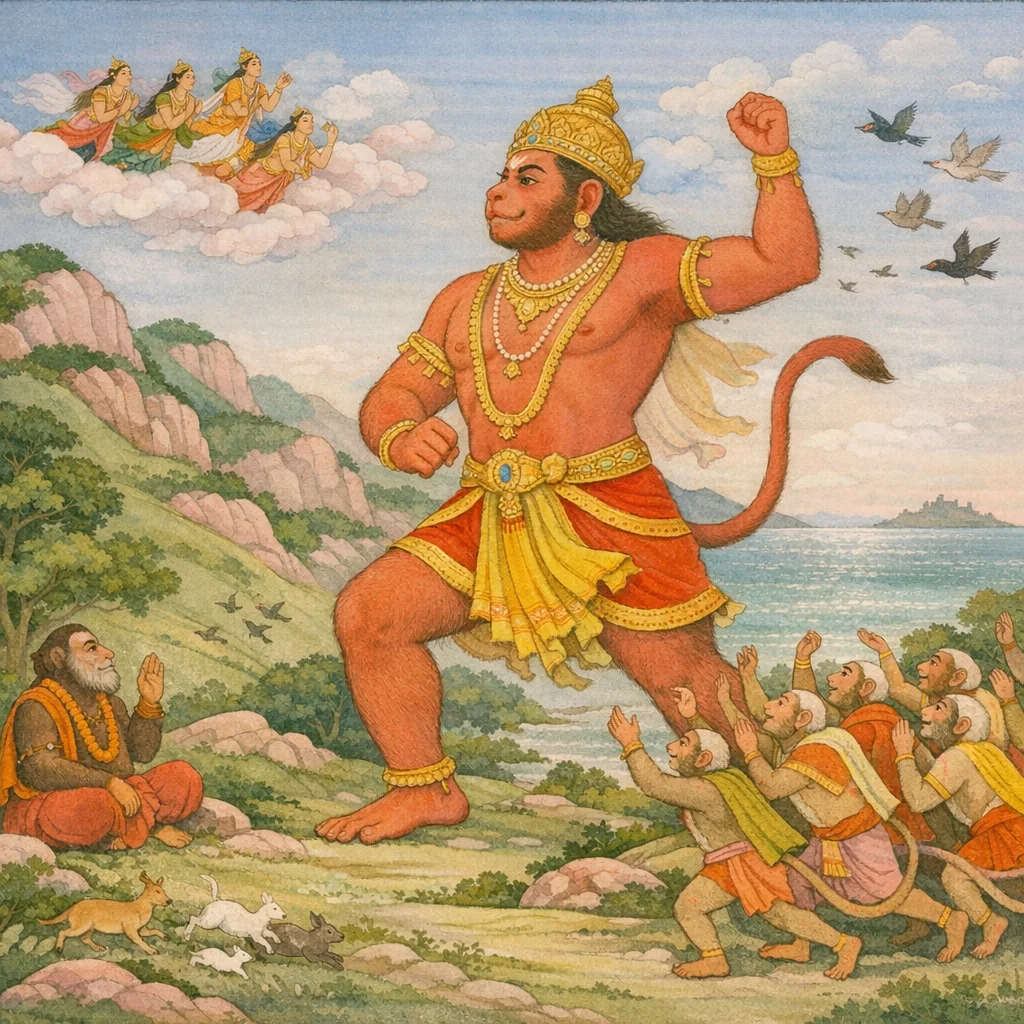
This sarga marks the decisive psychological and strategic turning point before the ocean-crossing to Lanka. Seeing Hanuman expand himself to attempt a hundred-yojanas leap, the vanaras cast off grief and praise him, the moment framed by a Vamana–Trivikrama comparison and vivid images of his swelling, radiant form. Hanuman rises in the assembly, salutes the elders, and sets forth a measured account of his powers: as Maruta’s lawful son he can circle Meru, stir or repel the sea, outpace aerial beings, and match Garuda and the Wind in speed. He even declares cosmic-scale feats—approaching the Sun and returning without touching earth, or seizing amrita from Indra’s hand—so as to steady the host and clarify the mission. Jambavan answers with solemn blessing and auspicious rites, affirming the support of sages and elders and the community’s shared reliance. Hanuman then chooses Mount Mahendra as his launch, saying the earth cannot bear the thrust of his leap; as he ascends and braces upon the firm peaks, a controlled “cosmic tremor” unfolds—rocks scatter, animals flee, gandharvas and vidyadharas depart, and serpents hide. The sarga ends with Hanuman fixing his mind on speed and reaching Lanka first in thought, showing disciplined intention (manas-samadhi) as the inner engine of heroic action.
Shlokas
Verse 1
तं दृष्ट्वा जृम्भमाणं ते क्रमितुं शतयोजनम्।वीर्येणापूर्यमाणं च सहसा वानरोत्तमम्।।4.67.1।।सहसा शोकमुत्सृज्य प्रहर्षेण समन्विताः।विनेदुस्तुष्टुवुश्चापि हनूमन्तं महाबलम्।।4.67.2।।
Seeing the foremost of monkeys suddenly expand to cross a hundred yojanas, filled with power, they at once cast off their grief; brimming with joy, they cried aloud and praised mighty Hanumān.
Verse 2
तं दृष्ट्वा जृम्भमाणं ते क्रमितुं शतयोजनम्।वीर्येणापूर्यमाणं च सहसा वानरोत्तमम्।।4.67.1।।सहसा शोकमुत्सृज्य प्रहर्षेण समन्विताः।विनेदुस्तुष्टुवुश्चापि हनूमन्तं महाबलम्।।4.67.2।।
Seeing Hanumān—the best of the monkeys—suddenly expand himself and fill with strength to cross a hundred yojanas, they at once cast off their grief. Filled with joy, they cried aloud and praised mighty Hanumān.
Verse 3
प्रहृष्टा विस्मिताश्चैव वीक्षन्ते स्म समन्ततः।त्रिविक्रमकृतोत्साहं नारायणमिव प्रजाः।।4.67.3।।
Joyful and astonished, they gazed from all sides—like beings who once beheld Nārāyaṇa filled with the ardor of Trivikrama.
Verse 4
संस्तूयमानो हनुमान्व्यवर्धत महाबलः।समाविध्य च लाङ्गूलं हर्षाद्बलमुपेयिवान्।।4.67.4।।
Praised by the vānaras, the mighty Hanumān grew in stature; whirling his tail, he joyfully gathered strength within himself.
Verse 5
तस्य संस्तूयमानस्य सर्वैर्वानरपुङ्गवैः।तेजसापूर्यमाणस्य रूपमासीदनुत्तमम्।।4.67.5।।
As he was praised by all the foremost monkey-leaders, Hanumān’s form, filling with radiant energy, became unsurpassed.
Verse 6
यथा विजृम्भते सिंहो विवृद्धो गिरिगह्वरे।मारुतस्यौरसः पुत्रस्तथा सम्प्रति जृम्भते।।4.67.6।।
Just as a lion, grown strong within a mountain cave, stretches itself, so too at that moment Māruta’s true-born son, Hanumān, stretched forth his limbs.
Verse 7
अशोभत मुखं तस्य जृम्भमाणस्य धीमतः।अम्बरीषमिवाऽदीप्तं विधूम इव पावकः।।4.67.7।।
As the wise Hanumān expanded himself, his face shone brilliantly—glowing like a blazing furnace and radiant like smokeless fire.
Verse 8
हरीणामुत्थितो मध्यात्सम्प्रहृष्टतनूरुहः।अभिवाद्य हरीन्वृद्धान्हनुमानिदमब्रवीत्।।4.67.8।।
Rising from the midst of the vānaras, his body-hair standing on end with exhilaration, Hanumān respectfully saluted the elders among the monkeys and then spoke these words.
Verse 9
अरुजत्सर्वताग्राणि हुताशनसखोऽनिलः।बलवानप्रमेयश्च वायुराकाशगोचरः।।4.67.9।।
The Wind—friend of Fire—ranges through the sky; immeasurable and mighty, he can even shatter the peaks of mountains.
Verse 10
तस्याहं शीघ्रवेगस्य शीघ्रगस्य महात्मनः।मारुतस्यौरसः पुत्रः प्लवनेनास्मि तत्समः।।4.67.10।।
I am the true-born son of Maruta, the great Wind swift in his course; in leaping I am his equal.
Verse 11
उत्सहेयं हि विस्तीर्णमालिखन्तमिवाम्बरम्।मेरुं गिरिमसङ्गेन परिगन्तुं सहस्रशः।।4.67.11।।
Indeed, without even touching it, I could circle Mount Meru a thousand times— that vast peak which seems to scrape the sky.
Verse 12
बाहुवेगप्रणुन्नेन सागरेणाहमुत्सहे।समाप्लावयितुं लोकं सपर्वतनदीह्रदम्।।4.67.12।।
With the ocean driven back by the force of my arms, I could flood the world—together with its mountains, rivers, and lakes.
Verse 13
ममोरुजङ्घावेगेन भविष्यति समुत्थितः।सम्मूर्च्छितमहाग्राहस्समुद्रो वरुणालयः।।4.67.13।।
With the force of my thighs and calves, the ocean—Varuṇa’s abode—would heave up, and its mighty sea-creatures would be stunned by the shock.
Verse 14
पन्नगाशनमाकाशे पतन्तं पक्षिसेविते।वैनतेयमहं शक्तः परिगन्तुं सहस्रशः।।4.67.14।।
I can circle Vainateya—Garuḍa, devourer of serpents—a thousand times as he flies through the bird-frequented sky.
Verse 15
उदयात्प्रस्थितं वापि ज्वलन्तं रश्मिमालिनम्।अनस्तमितमादित्यमभिगन्तुं समुत्सहे।।4.67.15।।ततो भूमिमसंस्पृश्य पुनरागन्तुमुत्सहे।प्रवेगेनैव महता भीमेन प्लवगर्षभाः।।4.67.16।।
O bull among monkeys, I can set out with the Sun—blazing, crowned with rays—from his rising and reach him again before he sets; then, without touching the earth, I can return once more with that same great and formidable speed.
Verse 16
उदयात्प्रस्थितं वापि ज्वलन्तं रश्मिमालिनम्।अनस्तमितमादित्यमभिगन्तुं समुत्सहे।।4.67.15।।ततो भूमिमसंस्पृश्य पुनरागन्तुमुत्सहे।प्रवेगेनैव महता भीमेन प्लवगर्षभाः।।4.67.16।।
Then, O bull among monkeys, I can return again without even touching the earth—by that same great and formidable speed.
Verse 17
उत्सहेयमतिक्रान्तुं सर्वानाकाशगोचरान्।सागरं क्षोभयिष्यामि दारयिष्यामि मेदिनीम्।।4.67.17।।
I could outstrip all beings that move through the sky; I could churn the ocean and even rend the earth.
Verse 18
पर्वतांश्चूर्णयिष्यामि प्लवमानः प्लवङ्गमाः।हरिष्याम्यूरुवेगेन प्लवमानो महार्णवम्।।4.67.18।।
O monkeys, as I leap I can crush mountains to powder; and leaping on, with the force of my thighs I can even drag along the great ocean.
Verse 19
लतानां विविधं पुष्पं पादपानां च सर्वशः।अनुयास्यन्ति मामद्य प्लवमानं विहायसा।।4.67.19।।
Today, as I leap through the sky, diverse flowers from creepers and trees everywhere will stream after me.
Verse 20
भविष्यति हि मे पन्थास्स्वातेः पन्था इवाम्बरे।चरन्तं घोरमाकाशमुत्पतिष्यन्तमेव वा।।4.67.20।।द्रक्ष्यन्ति निपतिष्यन्तं च सर्वभूतानि वानराः।
O monkeys, my course in the sky will be like the path of the constellation Svātī. As I move through the dreadful heavens—rising and also descending—all beings will behold me.
Verse 21
महामेरुप्रतीकाशं मां द्रक्ष्यथ वानराः।।4.67.21।।दिवमावृत्य गच्छन्तं ग्रसमानमिवाम्बरम्।
O monkeys, you will see me like mighty Mount Meru—going forth after covering the sky, as though I were swallowing the heavens themselves.
Verse 22
विधमिष्यामि जीमूतान्कम्पयिष्यामि पर्वतान्।।4.67.22।।सागरं शोषयिष्यामि प्लवमानस्समाहितः।
Composed in mind as I leap, I will scatter the clouds, shake the mountains, and dry up the ocean.
Verse 23
वैनतेयस्य या शक्तिर्मम सा मारुतस्य वा।।4.67.23।।ऋते सुपर्णराजानं मारुतं वा महाजवम्।न तद्भूतं प्रपश्यामि यन्मां प्लुतमनुव्रजेत्।।4.67.24।।
The power that belongs to Vainateya (Garuḍa) is mine—and so too is that of Māruta. Save for the king of birds and the swift Wind, I see no being that could follow me as I fly.
Verse 24
वैनतेयस्य या शक्तिर्मम सा मारुतस्य वा।।4.67.23।।ऋते सुपर्णराजानं मारुतं वा महाजवम्।न तद्भूतं प्रपश्यामि यन्मां प्लुतमनुव्रजेत्।।4.67.24।।
Such power of flight as belongs to Vainateya (Garuḍa)—or to the Wind (Māruta)—that alone is mine. Except for the king of birds and the swift Wind, I see no being that could keep pace with me as I leap through the air.
Verse 25
निमेषान्तरमात्रेण निरालम्बनमम्बरम्।सहसा निपतिष्यामि घनाद्विद्युदिवोत्थिता।।4.67.25।।
Like lightning sprung from a cloud, I shall descend at once through the unsupported sky—in less than the blink of an eye.
Verse 26
भविष्यति हि मे रूपं प्लवमानस्य सागरे।विष्णोर्विक्रममाणस्य पुरा त्रीन्विक्रमानिव।।4.67.26।।
As I leap across the ocean, my form will be like that of Viṣṇu of old when he strode forth with his three great strides.
Verse 27
बुद्ध्या चाहं प्रपश्यामि मनश्चेष्टा च मे तथा।अहं द्रक्ष्यामि वैदेहीं प्रमोदध्वं प्लवङ्गमाः।।4.67.27।।
By my understanding—and by the movement of my mind as well—I foresee it: I shall see Vaidehī. Rejoice, O vanaras!
Verse 28
मारुतस्य समो वेगे गरुडस्य समो जवे।अयुतं योजनानां तु गमिष्यामीति मे मतिः।।4.67.28।।
In speed I am the equal of the Wind-god, and in swiftness the equal of Garuḍa; I believe I can traverse ten thousand yojanas.
Verse 29
वासवस्य सवज्रस्य ब्रह्मणो वा स्वयम्भुवः।विक्रम्य सहसा हस्तादमृतं तदिहानये।।4.67.29।।लङ्कां वापि समुत्क्षिप्य गच्छेयमिति मे मतिः।
I believe I could even confront Vāsava, wielder of the thunderbolt, or even self-born Brahmā, and in a sudden stride snatch that amṛta from his hand and bring it here at once; I believe I could even uproot Laṅkā and carry it away.
Verse 30
तमेवं वानरश्रेष्ठं गर्जन्तममितौजसम्।।4.67.30।।प्रहृष्टा हरयस्तत्र समुदैक्षन्त विस्मिताः।
Thus they looked upon that best of vanaras—roaring, of immeasurable splendor—and there the monkeys, delighted, watched in amazement.
Verse 31
तस्य तद्वचनं श्रुत्वा ज्ञातीनां शोकनाशनम्।।4.67.31।।उवाच परिसंहृष्टो जाम्बवान्हरिसत्तमः।
Hearing his words—words that dispelled the sorrow of their kin—Jāmbavān, the best of monkeys, spoke in great delight.
Verse 32
वीर केसरिणः पुत्र हनुमान्मारुतात्मज।।4.67.32।।ज्ञातीनां विपुलश्शोकस्त्वया तात प्रणाशितः।
O hero—son of Keśarī, Hanumān, son of Māruta—dear one, by you the great sorrow of your kin has been destroyed.
Verse 33
तव कल्याणरुचयः कपिमुख्यास्समागताः।।4.67.33।।मङ्गलं कार्यसिद्ध्यर्थं करिष्यन्ति समाहिताः।
Your well-wishers—the chiefs among the monkeys—have assembled; composed in mind, they will perform auspicious rites for the success of your task.
Verse 34
ऋषीणां च प्रसादेन कपिवृद्धमतेन च।।4.67.34।।गुरूणां च प्रसादेन प्लवस्व त्वं महार्णवम्।
With the blessings of the sages, with the approving counsel of the elder monkeys, and with the grace of the venerable elders—may you cross the vast ocean.
Verse 35
स्थास्यामश्चैकपादेन यावदागमनं तव।।4.67.35।।त्वद्गतानि च सर्वेषां जीवनानि वनौकसाम्।
We shall stand waiting—on one foot—until you return; for the lives of all us forest-dwellers now depend upon you.
Verse 36
ततस्तु हरिशार्दूलस्तानुवाच वनौकसः।।4.67.36।।नेयं मम मही वेगं लङ्घने धारयिष्यति।
Then Hanuman, the tiger among monkeys, said to those forest-dwellers: “This earth will not be able to bear the force of my leap as I spring forth.”
Verse 37
एतानीह नगस्यास्य शिलासङ्कटशालिनः।।4.67.37।।शिखराणि महेन्द्रस्य स्थिराणि सुमहान्ति च।
Behold the peaks of Mount Mahendra, crowded with massive rock formations—steadfast, firm, and exceedingly great.
Verse 38
एषु वेगं करिष्यामि महेन्द्रशिखरेष्वहम्।।4.67.38।।नानाद्रुमविकीर्णेषु धातुनिष्यन्दशोभिषु।
Upon these peaks of Mahendra I shall gather my speed—amid slopes strewn with many kinds of trees and gleaming with streams of mineral ores.
Verse 39
एतानि मम निष्पेषं पादयोः प्लवतां वराः।।4.67.39।।प्लवतो धारयिष्यन्ति योजनानामितश्शतम्।
O best of leapers, these peaks will endure the crushing impact of my feet as I spring—over a hundred yojanas from here.
Verse 40
ततस्तं मारुतप्रख्यस्सहरिर्मारुतात्मजः।।4.67.40।।आरुरोह नगश्रेष्ठं महेन्द्रमरिमर्दनः।वृतं नानाविधैः वृक्षैर्मृगसेवितशाद्वलम्।।4.67.41।।लताकुसुमसम्बाधं नित्यपुष्पफलद्रुमम्।सिंहशार्दूलचरितं मत्तमातङ्गसेवितम्।।4.67.42।।मत्तद्विजगणोद्घुष्टं सलिलोत्पीडसङ्कुलम्।
Then that monkey, the son of the Wind-god—radiant like the Wind himself, a crusher of foes—ascended the foremost of mountains, Mahendra: clothed in many kinds of trees, with grassy tracts frequented by deer; thick with creepers and blossoms, and with trees ever bearing flowers and fruit; a range roamed by lions and tigers and inhabited by proud elephants; resounding with flocks of excited birds and crowded with cascading waterfalls.
Verse 41
ततस्तं मारुतप्रख्यस्सहरिर्मारुतात्मजः।।4.67.40।।आरुरोह नगश्रेष्ठं महेन्द्रमरिमर्दनः।वृतं नानाविधैः वृक्षैर्मृगसेवितशाद्वलम्।।4.67.41।।लताकुसुमसम्बाधं नित्यपुष्पफलद्रुमम्।सिंहशार्दूलचरितं मत्तमातङ्गसेवितम्।।4.67.42।।मत्तद्विजगणोद्घुष्टं सलिलोत्पीडसङ्कुलम्।
Hanumān, crusher of enemies, climbed the foremost of mountains—Mahendra—its slopes carpeted with grassy meadows frequented by deer and covered with many kinds of trees.
Verse 42
ततस्तं मारुतप्रख्यस्सहरिर्मारुतात्मजः।।4.67.40।।आरुरोह नगश्रेष्ठं महेन्द्रमरिमर्दनः।वृतं नानाविधैः वृक्षैर्मृगसेवितशाद्वलम्।।4.67.41।।लताकुसुमसम्बाधं नित्यपुष्पफलद्रुमम्।सिंहशार्दूलचरितं मत्तमातङ्गसेवितम्।।4.67.42।।मत्तद्विजगणोद्घुष्टं सलिलोत्पीडसङ्कुलम्।
That mountain was dense with creepers and blossoms, with trees ever bearing flowers and fruits; it was a range where lions and tigers roamed, frequented by rutting elephants—resounding with the cries of flocks of exhilarated birds, and crowded with the spray and rush of cascading waters.
Verse 43
महद्भिरुच्छ्रितं शृङ्गैर्महेन्द्रं स महाबलः।।4.67.43।।विचचार हरिश्रेष्ठो महेन्द्रसमविक्रमः।
That mighty best of monkeys, equal to Indra in prowess, strode upon Mount Mahendra, lofty with its great, towering peaks.
Verse 44
पादाभ्यां पीडितस्तेन महाशैलो महात्मना।।4.67.44।।रराज सिंहाभिहतो महान्मत्त इव द्विपः।
Pressed down by the feet of that great-souled one, the vast mountain shone forth, like a mighty rutting elephant struck by a lion.
Verse 45
मुमोच सलिलोत्पीडान्विप्रकीर्णशिलोच्चयः।।4.67.45।।वित्रस्तमृगमातङ्गः प्रकम्पितमहाद्रुमः।
The mountain, its rocky masses scattered, released surging jets of water; deer and elephants were terrified, and great trees trembled violently.
Verse 46
नानागन्धर्वमिथुनैः पानसंसर्गकर्कशैः।।4.67.46।।उत्पतद्भिश्च विहगैर्विद्याधरगणैरपि।त्यज्यमानमहासानुस्सन्निलीनमहोरगः।।4.67.47।।चलशृङ्गशिलोद्घातस्तदाऽभूत्स महागिरिः।
Then the great mountain became a tumult: various pairs of Gandharvas, roughened by drunken revel, abandoned its broad slopes; birds took flight, and hosts of Vidyādharas too departed; great serpents lay hidden, and rocks from the moving peaks were hurled down.
Verse 47
नानागन्धर्वमिथुनैः पानसंसर्गकर्कशैः।।4.67.46।।उत्पतद्भिश्च विहगैर्विद्याधरगणैरपि।त्यज्यमानमहासानुस्सन्निलीनमहोरगः।।4.67.47।।चलशृङ्गशिलोद्घातस्तदाऽभूत्स महागिरिः।
The mountain, its rocky masses scattered, released surging jets of water; deer and elephants were terrified, and great trees trembled violently.
Verse 48
निश्श्वसद्भिस्तदाऽर्तैस्तु भुजङ्गैरर्धनि:सृतैः।।4.67.48।।सपताक इवाभाति स तदा धरणीधरः।
Then that mountain—holder of the earth—appeared as though bannered with flags, for the distressed serpents, half-emerging from the clefts, hissed.
Verse 49
ऋषिभिस्त्राससम्भ्रान्तैस्त्यज्यमानः शिलोच्चयः।।4.67.49।।सीदन्महति कान्तारे सार्थहीन इवाध्वगः।
Abandoned by sages who had been alarmed and shaken, the mountain peak seemed like a traveler in a vast wilderness—sinking in distress, bereft of his caravan.
Verse 50
सवेगवान् वेगसमाहितात्माहरिप्रवीरः परवीरहन्ता।मनस्समाधाय महानुभावोजगाम लङ्कां मनसा मनस्वी।।4.67.50।।
Swift and intent on speed, that heroic monkey—slayer of enemy champions—composed his mind; the great-souled, resolute Hanumān set out for Laṅkā, first reaching it in thought.
Frequently Asked Questions
The pivotal action is the assumption of responsibility under collective crisis: Hanuman publicly commits to the hundred-yojanas crossing, converting the troop’s despair into coordinated resolve; the ethical axis is leadership-through-service, where capability is asserted not for pride but to secure a shared dharmic objective (Sita’s discovery).
Power becomes efficacious when joined to inner composure and right purpose: Hanuman’s catalogue of feats culminates in manas-samādhi—he ‘reaches’ Lanka mentally before physically—teaching that disciplined intention, supported by blessings and communal trust, is the catalyst that turns potential into successful action.
Mount Mahendra is highlighted as the practical launch-site whose peaks can bear Hanuman’s leap-force; the Ocean (Varuṇa’s abode) is the main barrier to be crossed; Lanka is the target; and cosmic reference points—Meru, the Sun’s course, and the Swāti constellation path—function as cultural-geographical markers for scale and navigation imagery.