Sarga 47
सप्तचत्वारिंशः सर्गः — वानरयूथपानां अन्वेषणवृत्तान्तनिवेदनम् (Search Reports of the Vanara Leaders)
किष्किन्धाकाण्ड
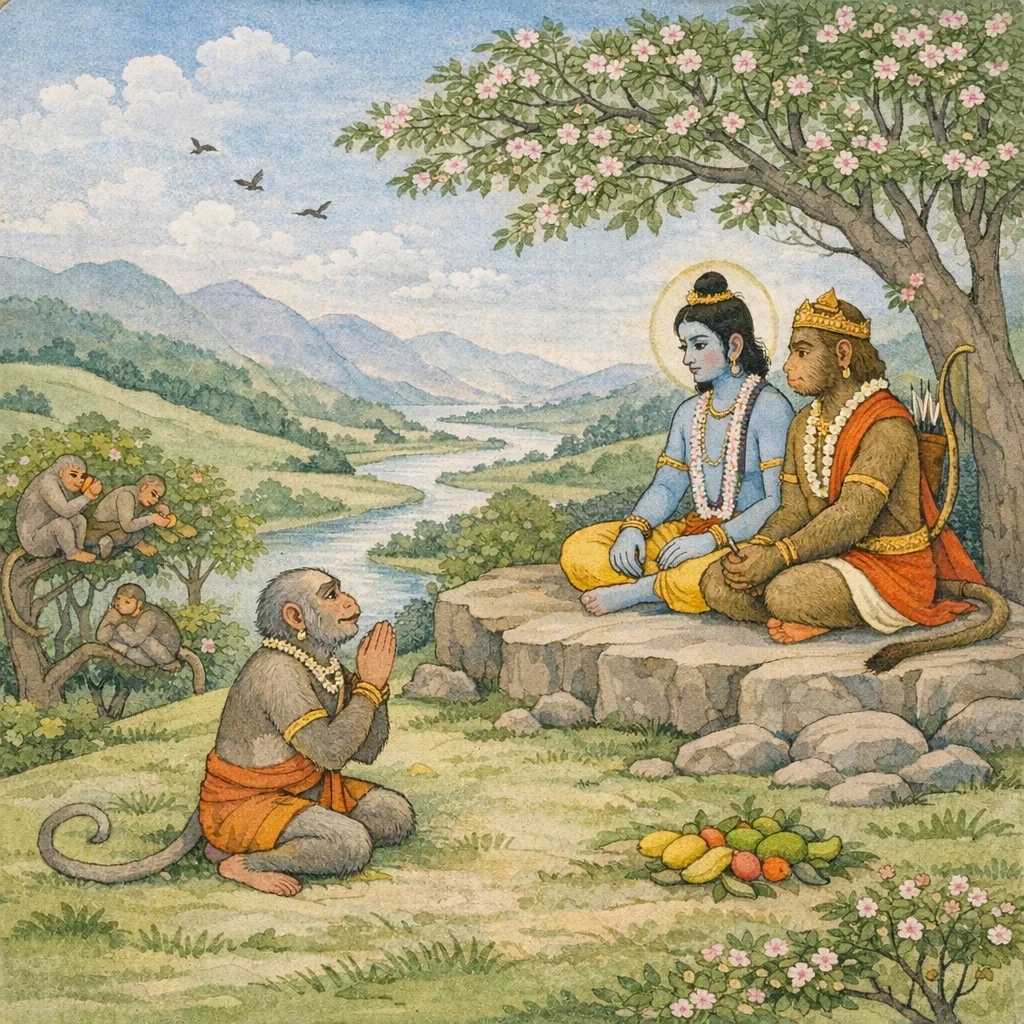
This sarga recounts the vānaras’ disciplined month-long search for Vaidehī (Sītā) and their reports thereafter. By the command of the kapirāja Sugrīva, the troop leaders swiftly disperse in every direction, scouring varied regions—tanks and riverbeds, towns and open skies, mountains, forests, caves, vine-choked thickets, and hard-to-reach interiors. Their perseverance is stressed: daytime reconnaissance, nightly regrouping, and makeshift rest upon fruit-bearing trees through changing seasons. When the allotted month ends, the leaders return disappointed: Vinata has found nothing in the east, Śatabalī in the north, and Suṣeṇa in the west. Suṣeṇa approaches Sugrīva, seated with Rāma on Mount Prasravaṇa, offers reverent salutations, and delivers a full account of exhaustive searches, including perilous encounters and the slaying of enormous beasts in hazardous lands. The chapter closes with a strategic hope and inference: Hanumān, the Vāyusuta, has gone in the very direction Sītā was taken and alone is uniquely able to find her and return, marking him as the pivotal agent for what follows.
Shlokas
Verse 1
दर्शनार्थं तु वैदेह्यास्सर्वतः कपियूधपाः।व्यादिष्टाः कपिराजेन यथोक्तं जग्मुरञ्जसा।।4.47.1।।
To seek Vaidehī, the leaders of the monkey hosts—commanded by the king of monkeys—swiftly set out in every direction, exactly as instructed.
Verse 2
सरांसि सरित काक्षानाकाशं नगराणि च।नदीदुर्गांस्तथा शैलान्विचिन्वन्ति समन्ततः।।4.47.2।।
They searched on every side—ponds, riverbanks and channels, even the sky and the towns; likewise they examined river-forts and mountains all around.
Verse 3
सुग्रीवेण समाख्यातास्सर्वे वानरयूथपाः।प्रदेशान्प्रविचिन्वन्ति सशैलवनकाननान्।।4.47.3।।
All the leaders of the monkey troops, instructed by Sugrīva, searched the regions—together with their mountains, forests, and wild groves.
Verse 4
विचित्य दिवसं सर्वे सीताधिगमने धृताः।समायान्ति स्म मेदिन्यां निशाकालेषु वानराः।।4.47.4।।
Resolved to find Sītā, they searched throughout the day; and at nightfall the monkeys would gather together at a fixed place upon the ground.
Verse 5
सर्वर्तुकमान् देशेषु वानारास्सफलद्रुमान्।आसाद्य रजनीं शय्यां चक्रुस्सर्वेष्वहस्सु ते।।4.47.5।।
Day after day the vanaras pressed on in their search; and at night, reaching fruit-laden trees in lands where such trees stand through every season, they made their resting-place and lay down.
Verse 6
तदहः प्रथमं कृत्वा मासे प्रश्रवणं गताः।कपिराजेन सङ्गम्य निराशाः कपियूधपाः।।4.47.6।।
When the first day had passed and thus a month went by, the leaders of the monkey-troops came to Prasravaṇa; meeting the monkey-king, they were bereft of hope, having found no sign of Sītā.
Verse 7
विचित्य तु दिशं पूर्वां यथोक्तां सचिवैस्सह।अदृष्ट्वा विनतस्सीतामाजगाम महाबलः।।4.47.7।।
Having searched the eastern quarter as instructed, Vinata—mighty in strength—returned with his counsellors, not having beheld Sītā.
Verse 8
उत्तरां च दिशं सर्वां विचित्य स महाकपिः।आगतस्सह सैन्येन वीरश्शतवलिस्तदा।।4.47.8।।
Then the heroic great monkey Śatabalī, having searched the entire northern direction, returned together with his troop.
Verse 9
सुषेणः पश्चिमा माशां विचित्य सह वानरैः।समेत्य मासे सम्पूर्णे सुग्रीवमुपचक्रमे।।4.47.9।।
Suṣeṇa, having searched the western quarter together with the monkeys, returned when the month was completed and reported to Sugrīva.
Verse 10
तं प्रस्रवणपृष्ठस्थं समासाद्याभिवाद्य च।आसीनं सह रामेण सुग्रीवमिदमब्रवीत्।।4.47.10।।
Approaching Sugrīva, who sat with Rāma on the slopes of Prasravaṇa, and paying him reverent homage, he spoke as follows.
Verse 11
विचिताः पर्वतास्सर्वे वनानि गहनानि च।निम्नगास्सागरान्ताश्च सर्वे जनपदाश्च ये।।4.47.11।।
All the mountains were searched, and the dense forests as well; the rivers that run down to the sea were examined, and every inhabited countryside too.
Verse 12
गुहाश्च विचितास्सर्वास्त्वया याः परिकीर्तिताः।विचिताश्च महागुल्मा लताविततसन्तताः।।4.47.12।।
All the caves you spoke of were searched, and so too the great thickets—wide stretches densely spread and interwoven with creepers.
Verse 13
गहनेषु च देशेषु दुर्गेषु विषमेषु च।सत्त्वान्यतिप्रमाणानि विचितानि हतानि च।।4.47.13।।ये चैव गहना देशा विचितास्ते पुनः पुनः।
In dense interiors, in hard-to-reach strongholds, and across uneven ground they searched; and enormous wild creatures were encountered—tracked down and even slain. Those difficult regions were examined again and again.
Verse 14
उदारसत्त्वाभिजनो महात्मास मैथिलीं द्रक्ष्यति वानरेन्द्रः।दिशं तु यामेव गता तु सीतातामास्थितोवायुसुतो हनूमान्।।4.47.14।।
O king of the monkeys, that great-souled one—noble in courage and lineage—will surely behold Maithilī. For Hanumān, the Wind-god’s son, has set out in precisely the direction in which Sītā was taken.
Frequently Asked Questions
The pivotal action is accountable leadership under a time-bound mandate: troop leaders must execute Sugrīva’s command to search everywhere, then return and report truthfully despite failure—modeling duty-performance without self-deception or blame-shifting.
The chapter teaches that righteous aims require organized effort and honest assessment; when exhaustive methods fail, wisdom turns to strategic delegation—recognizing the uniquely capable agent (Hanumān) and trusting competence aligned with dharma.
Prasravaṇa mountain functions as the command-and-report hub where Sugrīva sits with Rāma; the search-map spans caves, dense forests, mountains, rivers, sea-edges, towns, and river-forts—expanding the epic’s operational geography for the Sītā-anveṣaṇa.