Sarga 60
सम्पातिवृत्तान्तः — Sampāti’s Account and the Sage Niśākara
किष्किन्धाकाण्ड
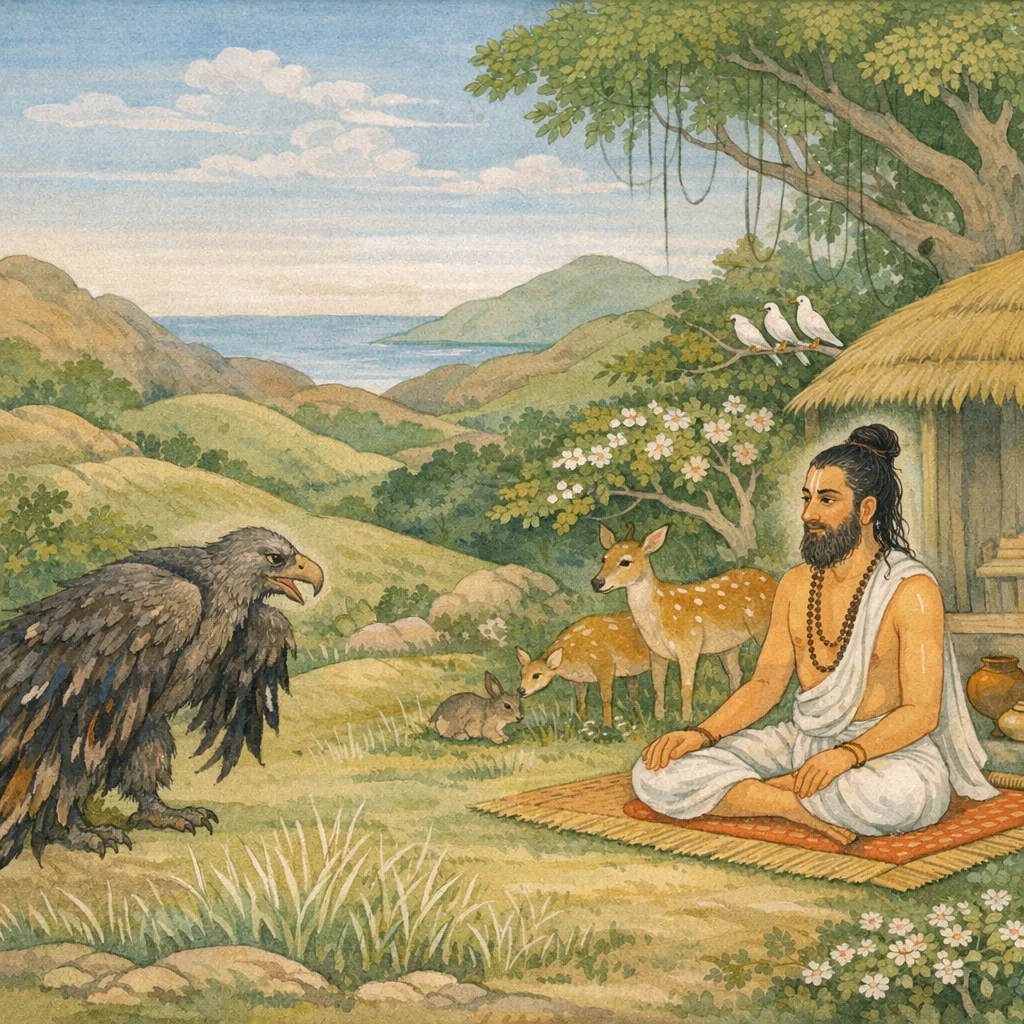
After performing the water-rites and libations for Jatāyu, the vānaras sit on a pleasant mountain around the vulture Sampāti. Seeing Aṅgada nearby, surrounded by the troop-leaders, Sampāti is reassured; he asks for attentive silence and begins a truthful account of how he knows Maithilī (Sītā). He recalls an earlier fall upon a Vindhya peak, scorched by the sun’s rays, and regaining consciousness only after six nights. As he surveyed seas, mountains, rivers, lakes, forests, and regions, his memory slowly returned. He identifies the place as the Vindhya range by the southern ocean and speaks of a sacred āśrama revered even by the gods, once belonging to the ascetic sage Niśākara; eight thousand years have passed since the sage’s departure, and Sampāti has dwelt there. With difficulty he descended to a plain bristling with sharp darbha grass and approached the hermitage seeking the sage. He beheld the radiant ascetic—facing north and freshly bathed—before whom wild creatures gathered and then withdrew. The sage greeted Sampāti with affection, discerned his burned wings and wounds, and recognized him and Jatāyu as wind-swift, shape-changing kings of vultures. When Sampāti asked to honor him as an elder, the sage inquired into the cause of Sampāti’s disability and punishment, preparing the discourse that follows.
Shlokas
Verse 1
ततः कृतोदकं स्नातं तं गृध्रं हरियूथपाः।उपविष्टा गिरौ रम्ये परिवार्य समन्ततः।।4.60.1।।
Then, having bathed and offered the water-oblation, the leaders of the monkeys sat upon the lovely mountain, surrounding that vulture on every side.
Verse 2
तमङ्गदमुपासीनं तैस्सर्वैर्हरिभिर्वृतम्।जनितप्रत्ययो हर्षात्सम्पातिः पुनरब्रवीत्।।4.60.2।।
Seeing Aṅgada seated and surrounded by all the monkeys, Sampāti—reassured and filled with joy—spoke to him once again.
Verse 3
कृत्वा निश्शब्दमेकाग्रा श्श्रुण्वन्तु हरयो मम।तत्वं सङ्कीर्तयिष्यामि यथा जानामि मैथिलीम्।।4.60.3।।
Remain silent and listen with single-pointed attention, O monkeys. I shall declare the truth—how I came to know about the princess of Mithilā.
Verse 4
अस्य विन्ध्यस्य शिखरे पतितोऽस्मि पुरावने।सूर्यतपपरीताङ्गो निर्दग्धस्सूर्यरश्मिभिः।।4.60.4।।
Long ago I fell upon the summit of this Vindhya mountain, my body enveloped by the Sun’s fierce heat and burned by its rays.
Verse 5
लब्धसंज्ञस्तु षड्रात्राद्विवशो विह्वलन्निव।वीक्षमाणो दिशस्सर्वा नाभिजानामि किञ्चन।।4.60.5।।
After six nights my consciousness returned; yet I was helpless, as though bewildered. Though I looked in every direction, I could recognize nothing at all.
Verse 6
ततस्तु सागरान् शैलान्नदीस्सर्वास्सरांसि च।वनानि च प्रदेशांश्च नीरीक्ष्य मतिरागता।।4.60.6।।
Then, after observing the seas, mountains, all rivers, lakes, forests, and the surrounding regions, my understanding returned.
Verse 7
हृष्टपक्षिगणाकीर्णः कन्दरान्तरकूटवान्।दक्षिणस्योदधेस्तीरे विन्ध्योऽयमिति निश्चितः।।4.60.7।।
Seeing it crowded with cheerful flocks of birds, rich with caves and peaks, I became certain: “This is the Vindhya, on the shore of the southern ocean.”
Verse 8
आसीच्चात्राश्रमं पुण्यं सुरैरपि सुपूजितम्।ऋषिर्निशाकरो नाम यस्मिन्नुग्रतपाभवत्।।4.60.8।।
Near this place there was a holy hermitage, revered even by the gods. In it lived a sage named Niśākara, engaged in rigorous austerities.
Verse 9
अष्टौ वर्षसहस्राणि तेनास्मिन्नृषिणा विना।वसतो मम धर्मज्ञा स्वर्गते तु निशाकरे।।4.60.9।।
O knowers of dharma, since the sage Niśākara went to heaven, eight thousand years have passed while I have dwelt here without him.
Verse 10
अवतीर्य तु विन्ध्याग्रात्कृच्छ्रेण विषमाच्छनैः।तीक्ष्णदर्भां वसुमतीं दुःखेन पुनरागतः।।4.60.10।।
Descending slowly from the rugged peak of Vindhya with great difficulty, I returned once more—painfully—to the earth thick with sharp darbha grass.
Verse 11
तमृषिं द्रष्टुकामोऽस्मि दुःखेनाभ्यागतो भृशम्।जटायुषा मया चैव बहुशोऽभिगतो हि सः।।4.60.11।।
Eager to behold that sage, I reached him only with extreme hardship; for Jatāyu and I had visited him many times before.
Verse 12
तस्याश्रमपदाभ्याशे ववुर्वातास्सुगन्धिनः।वृक्षो वापुष्पितः कश्चिदफलो वा न विद्यते।।4.60.12।।
Near that hermitage, fragrant breezes blew; no tree was to be found without blossoms, nor any tree without fruit.
Verse 13
उपेत्य चाश्रमं पुण्यं वृक्षमूलमुपाश्रितः।द्रष्टुकामः प्रतीक्षेऽहं भगवन्तं निशाकरम्।।4.60.13।।
Having reached the sacred hermitage, I stayed beneath the root of a tree, waiting—eager to behold the venerable sage Niśākara.
Verse 14
अथापश्यमदूरस्थमृषिं ज्वलिततेजसम्।कृताभिषेकं दुर्धर्षमुपावृत्तमुदङ्मुखम्।।4.60.14।।
Then I saw the sage nearby—radiant with ascetic splendor—fresh from his ritual bathing, unassailable, turned back and facing north.
Verse 15
तमृक्षास्सृमरा व्याघ्रास्सिंहा नागास्सरीसृपाः।परिवार्योपगच्छन्ति धातारं प्राणिनो यथा।।4.60.15।।
Bears, deer, tigers, lions, elephants, and creeping creatures gathered around him, as living beings gather about their Creator.
Verse 16
ततः प्राप्तमृषिं ज्ञात्वा तानि सत्त्वानि वै ययुः।प्रविष्टे राजनि यथा सर्वं सामात्यकं बलम्।।4.60.16।।
Then, knowing that the sage had arrived, those creatures withdrew—just as an entire army with its ministers falls back when the king enters.
Verse 17
ऋषिस्तु दृष्ट्वा मां प्रीतः प्रविष्टश्चाश्रमं पुनः।मुहूर्तमात्रान्निष्क्रम्य ततः कार्यमपृच्छत।।4.60.17।।
The sage, pleased on seeing me, entered the hermitage again; then, coming out after only a brief moment, he asked me my purpose.
Verse 18
सौम्य वैकल्यतां दृष्ट्वा रोम्णां ते नावगम्यते।अग्निदग्धाविमौ पक्षौ व्रणाश्चापि शरीरके।।4.60.18।।
Gentle one, seeing the loss of the hair on your body, it is evident: these two wings have been burned by fire, and there are wounds upon you as well.
Verse 19
गृध्रौ द्वौ दृष्टपूर्वौ मे मातरिश्वसमौ जवे।गृध्राणां चैव राजानौ भ्रातरौ कामरूपिणौ।।4.60.19।।
I have seen before two vultures—swift as the wind. You are indeed kings among vultures, brothers, able to assume forms at will.
Verse 20
ज्येष्ठो हि त्वं तु सम्पाते जटायुरनुजस्तव।मानुषं रूपमास्थाय गृह्णीतां चरणौ मम।।4.60.20।।
O Sampāti, you are indeed the elder, and Jatāyu is your younger brother. Assuming a human form, please accept (touch) my feet.
Verse 21
किं ते व्याधिसमुत्थानं पक्षयोः पतनं कथम्।दण्डोऽयंच कृतः केन सर्वमाख्याहि पृच्छतः।।4.60.21।।
What illness has come upon you? How did the falling of your wings occur? By whom was this punishment inflicted? Tell me everything, as I ask.
Frequently Asked Questions
The chapter foregrounds ethical action rather than a dilemma: the vānaras and Sampāti perform memorial water-rites for Jatāyu, emphasizing gratitude and ritual duty even amid urgent mission constraints, and Sampāti commits to truthful disclosure as actionable intelligence for the search.
Ascetic authority and truth operate as stabilizing forces: Niśākara’s tapas is depicted as ordering nature itself, while Sampāti’s willingness to narrate his suffering and history frames knowledge as a dharmic service—testimony offered for collective purpose.
Key landmarks include the Vindhya peak near the southern ocean, the sacred hermitage of the sage Niśākara, and the darbha-grass plain; culturally, the text highlights kṛtodaka (water-offerings) for the deceased and the protocol of elder-reverence (touching feet).