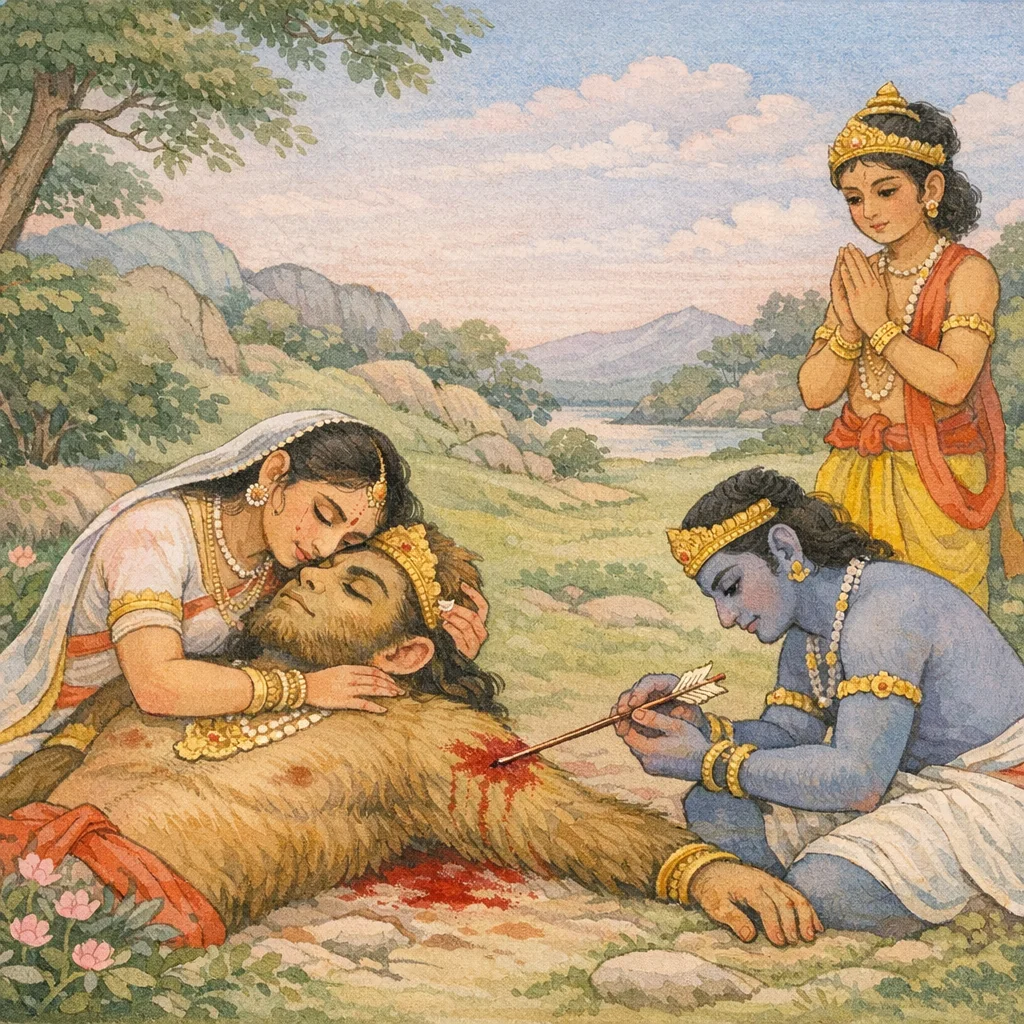
Sarga 23
ताराविलापः (Tārā’s Lament over Vāli)
किष्किन्धाकाण्ड
This sarga is a concentrated vilāpa (elegiac lament) set on the battlefield after Vāli’s death. Tārā comes to the fallen vānararāja, kisses and inhales the scent of his forehead, and pours out a sequence of grief-filled utterances that are both intimate address and moral reflection. She recalls his valor and their bond, mourns widowhood as a social and spiritual condition untouched by wealth or progeny, and depicts his body lying in dust and blood. She acknowledges the political consequence as well—Sugrīva’s fear dispelled by Rāma’s single arrow—while confessing her own inability to restrain Vāli from war. The lament turns toward ritual duty when Tārā instructs Aṅgada to salute his father departing for Yama’s abode; Aṅgada obeys, yet the dead king cannot bless him, deepening the pathos. Nīla then draws out the arrow embedded in Vāli’s heart; its blood-wet radiance is described with images of sun and mountain, followed by torrents of blood from the wounds. The chapter closes with Tārā’s final reckoning: with Vāli slain, her prosperity and stability collapse, marking the passage from personal loss to dynastic reordering.
Shlokas
Verse 1
ततस्समुपजिघ्रन्ती कपिराजस्य तन्मुखम्।पतिं लोकाच्च्युतं तारा मृतं वचनमब्रवीत्।।
Then Tārā, smelling and kissing the face of the monkey-king—her husband fallen away from this world—spoke these words to the dead.
Verse 2
शेषे त्वं विषमे दुःखमकृत्वा वचनं मम।उपलोपचिते वीर सुदुःखे वसुधातले।।
O hero, disregarding my counsel, you now lie in anguish on the hard ground, strewn with stones and painfully uneven.
Verse 3
मत्तः प्रियतरा नूनं वानरेन्द्र मही तव।शेषे हि तां परिष्वज्य मां च न प्रतिभाषसे।।
O lord of monkeys, surely the earth is dearer to you than I am—since in your last moments you embrace her, and you do not answer me.
Verse 4
सुग्रीवस्य वशं प्राप्तो विधिरेषभवत्यहो।सुग्रीव एव विक्रान्तो वीर साहसिकप्रिय।।
O hero, lover of daring deeds—alas, such is fate: you have come under Sugrīva’s control, as though Sugrīva alone were the valiant one.
Verse 5
ऋक्षवानरमुख्यास्त्वां बलिनः पर्युपासते।एषां विलपितं कृच्छ्रमङ्गदस्य च शोचतः।।मम चेमा गिरः श्रुत्वा किं त्वं न प्रतिबुध्यसे।
The powerful leaders of bears and monkeys stand close by you, lamenting in anguish; and Aṅgada too is weeping in grief. Hearing their cries—and these words of mine—why do you not rise, why do you not awaken?
Verse 6
इदं तच्छूरशयनं यत्र शेषे हतो युधि।शायिता निहता यत्र त्वयैव रिपवः पुरा।।
This is that hero’s bed where you now lie, slain in battle—where once, by your own hand, your enemies were struck down and made to lie.
Verse 7
विशुद्धसत्त्वाभिजन प्रिययुद्ध मम प्रिय।मामनाथां विहायैकां गतस्त्वमसि मानद।।
O my beloved—born of a pure and noble lineage, delighting in battle—O giver of honor, you have gone away, leaving me alone and without refuge.
Verse 8
शूराय न प्रदातव्या कन्या खलु विपश्चिता।शूरभार्यां हतां पश्य सद्यो मां विधवां कृताम्।।
The wise indeed say a maiden should not be given to a warrior; behold me—the wife of a warrior—now struck down by fate, made a widow at once.
Verse 9
अवभग्नश्च मे मानो भग्ना मे शाश्वती गतिः।।अगाधे च निमग्नाऽस्मि विपुले शोकसागरे।
My pride is crushed; my lasting refuge is shattered. I am plunged into a vast ocean of sorrow—deep and without a bottom.
Verse 10
अश्मसारमयं नूनमिदं मे हृदयं दृढम्।।भर्तारं निहतं दृष्ट्वा यन्नाद्य शतधा कृतम्।
Surely my heart is hard, made of stone; for even today, seeing my husband slain, it has not shattered into a hundred pieces.
Verse 11
सुहृच्चैव हि भर्ता च प्रकृत्या मम च प्रियः।आहवे च पराक्रान्तश्शूरः पञ्चत्वमागतः।।
He was my husband and also my friend, by nature dear to me; mighty in battle, that hero has now gone to death.
Verse 12
पतिहीना तु या नारी कामं भवतु पुत्रिणी।धनधान्यैस्सुपूर्णाऽपि विधवेत्युच्यते बुधैः।।
A woman without a husband—though she may have sons, and even if she is filled with wealth and grain—still, the wise call her a widow.
Verse 13
स्वगात्रप्रभवे वीर शेषे रुधिरमण्डले।क्रिमिरागपरिस्तोमे त्वमात्मशयने यथा।।
O hero, you lie in a pool of blood flowing from your own body—like one reclining upon a crimson bed as though it were your very couch.
Verse 14
रेणुशोणितसंवीतं गात्रं तव समन्ततः।परिरब्धुं न शक्नोमि भुजाभ्यां प्लवगर्षभ ।।
O bull among monkeys, your body is covered everywhere with dust and blood; I cannot clasp you in my arms.
Verse 15
कृतकृत्योऽद्य सुग्रीवो वैरेऽस्मिन्नतिदारुणे।यस्य रामविमुक्तेन हृतमेकेषुणा भयम्।।
Today Sugrīva has fulfilled his purpose in this most dreadful enmity: by a single arrow released by Rāma, his fear has been taken away.
Verse 16
शरेण हृदि लग्नेन गात्रसंस्पर्शने तव।वार्यामि त्वां निरीक्षन्ती त्वयि पञ्चत्वमागते।।
Because the arrow is lodged in your chest, I restrain myself from touching your limbs; I only look on, for once death has come upon you, there is no return.
Verse 17
उद्ववर्ह शरं नीलस्तस्य गात्रगतं तदा।गिरिगह्वरसंलीनं दीप्तमाशीविषं यथा।।
Then Nīla, with great effort, drew out the arrow lodged in his body—like pulling a blazing serpent hidden within a mountain cave.
Verse 18
तस्य निष्कृष्यमाणस्य बाणस्य च बभौ द्युतिः।अस्तमस्तकसंरुद्धो रश्मिर्दिनकरादिव।।
As that arrow was being pulled out, its radiance appeared like a sunbeam from the orb of the sun, checked by the crest of the western mountain.
Verse 19
पेतुः क्षतजधारास्तु व्रणेभ्यस्तस्य सर्वशः।ताम्रगैरिकसम्पृक्ता धारा इव धराधरात्।।
From all his wounds, streams of blood poured forth everywhere, tinged with coppery red ochre, like rivulets flowing down from a mountain.
Verse 20
अवकीर्णं विमार्जन्ती भर्तारं रणरेणुना।अस्रैर्नयनजैश्शूरं सिषेचास्त्रसमाहतम्।।
She wiped her husband, dust-covered from battle; and the heroic one, struck by a weapon, she bathed with the tears that flowed from her eyes.
Verse 21
रुधिरोक्षितसर्वाङ्गं दृष्ट्वा विनिहतं पतिम्।उवाच तारा पिङ्गाक्षं पुत्रमङ्गदमङ्गना।।
Seeing her husband slain, his whole body drenched in blood, Tārā—the lady—spoke to her tawny-eyed son Aṅgada.
Verse 22
अवस्थां पश्चिमां पश्य पितुः पुत्र सुदारुणाम्।सम्प्रसक्तस्य वैरस्य गतोऽन्तः पापकर्मणा।।
O son, behold the dreadful final state of your father: driven on by enmity, he reached this end through sinful action.
Verse 23
बालसूर्योदयतनुं प्रयान्तं यमसदनम्।अभिवादय राजानं पितरं पुत्र मानदम्।।
O son, salute your father—the king, worthy of honor—whose body is red like the rising sun, as he departs toward Yama’s abode.
Verse 24
एवमुक्तस्समुत्थाय जग्राह चरणौ पितुः।भुजाभ्यां पीनवृत्ताभ्यामङ्गदोऽहमिति ब्रुवन्।।
Thus instructed, Aṅgada rose up and clasped his father’s feet with his strong, rounded arms, saying, “I am Aṅgada.”
Verse 25
अभिवादयमानं त्वामङ्गदं त्वं यथा पुरा।दीर्घायुर्भव पुत्रेति किमर्थं नाभिभाषसे।।
As your son Aṅgada bows to you in reverence, why do you not speak to him as before, saying, “Be long-lived, my son”?
Verse 26
अहं पुत्रसहाया त्वामुपासे गतचेतसम्।सिंहेन निहतं सद्यो गौस्सवत्सेव गोवृषम्।।
I, together with your son, will remain by you though your consciousness is gone—like a cow with her calf standing by a mighty bull just struck down by a lion.
Verse 27
इष्ट्वा सङ्ग्रामयज्ञेन रामप्रहरणाम्भसि।अस्मिन्नवभृथे स्नातः कथं पत्न्या मया विना।।
Having ‘offered’ the war-sacrifice, and bathing in the waters of Rāma’s weapon as in the concluding avabhṛtha bath—how did you bathe without me, your wife?
Verse 28
या दत्ता देवराजेन तव तुष्टेन संयुगे।शातकुम्भमयीं मालां तां ते पश्यामि नेह किम्।।
Why do I not see here upon you that golden garland, given by the lord of the gods, pleased with you in battle?
Verse 29
राज्यश्रीर्न जहाति त्वां गतासुमपि मानद।सूर्यस्यावर्तमानस्य शैलराजमिव प्रभा।।
O venerable one, even though life has left you, royal splendor does not abandon you—just as the sun’s radiance does not leave the lordly mountain at sunset.
Verse 30
न मे वचः पथ्यमिदं त्वया कृतंन चास्मि शक्ता हि निवारणे तव।हता सपुत्राऽस्मि हतेन संयुगेसह त्वया श्रीर्विजहाति मामिह।।
You did not follow my wholesome counsel, nor was I able to restrain you. Now, since you are slain in battle, I too am as good as destroyed with my son; and prosperity itself is leaving me here along with you.
Frequently Asked Questions
The pivotal action is the confrontation with irreversible consequence: Tārā articulates that Vāli did not heed caution and she could not prevent his martial choice, while the political outcome (Sugrīva’s security via Rāma’s arrow) reframes personal tragedy within questions of power, legitimacy, and responsibility.
The sarga teaches anitya (the fragility of life and royal fortune) and the social-ethical weight of relational dharma: widowhood is portrayed as a condition defined by the loss of the पति rather than material abundance, and filial rites become the vehicle for continuity when speech and blessing are no longer possible.
Culturally, the sarga highlights death-ritual orientation through the reference to Yama’s abode and the formal act of a son saluting the father. Poetically, it uses landscape imagery—sun rays obstructed by a western mountain peak and ‘king of mountains’ metaphors—to map bodily aftermath into cosmic and geographic analogies.