Sarga 3
हनूमत्संवादः / Hanuman’s Diplomatic Approach to Rama and Lakshmana
किष्किन्धाकाण्ड
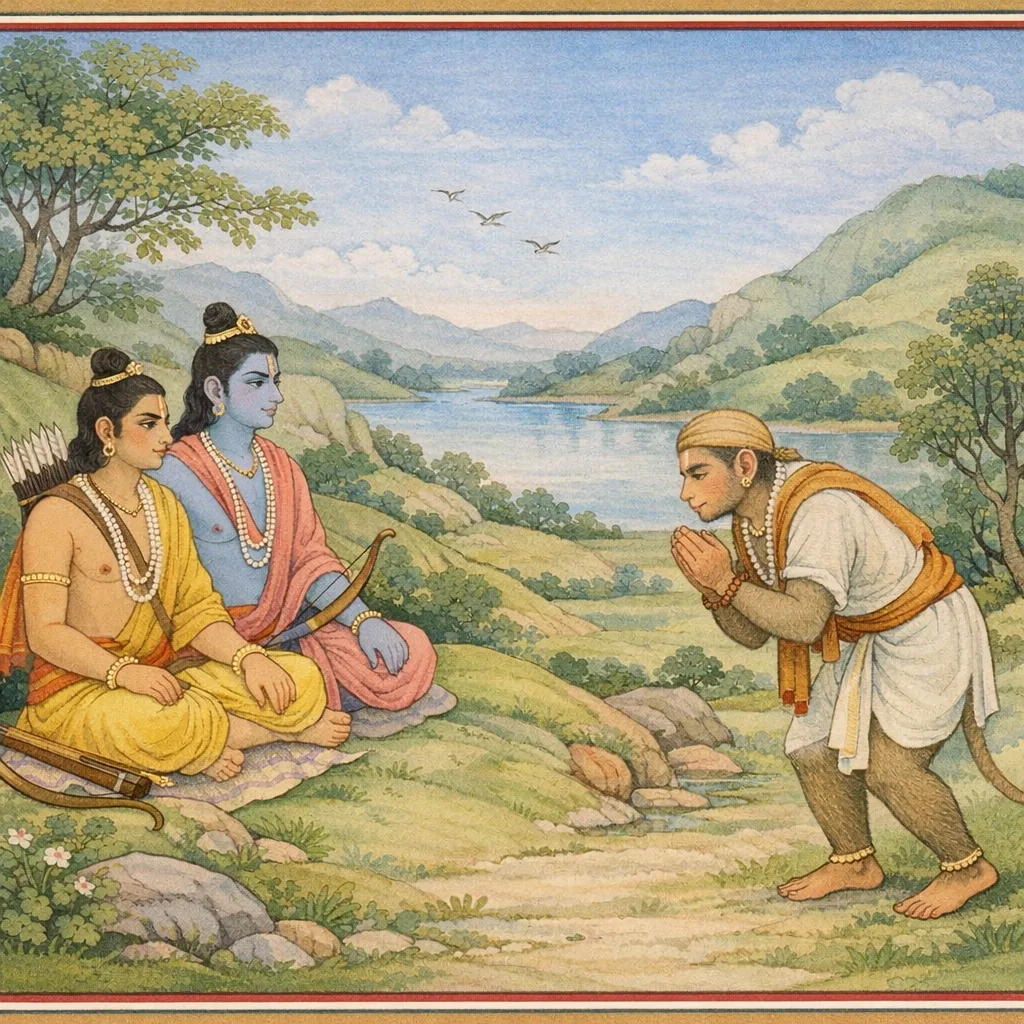
Sarga 3 presents the first formal contact between the Rāghavas and Sugrīva’s camp. On Sugrīva’s instruction, Hanumān leaps down from Ṛṣyamūka and, with diplomatic caution, sets aside his monkey-form to appear as a mendicant, signaling peace and enabling measured dialogue. Approaching with ritual reverence (praṇipāta), he offers an ornate appraisal of Rāma and Lakṣmaṇa—their lion-like gaze, divine radiance, lotus-petal eyes, broad chests—and depicts their weapons through vivid similes: bows like Indra’s rainbow, quivers like hissing serpents, and swords gleaming like snakes after shedding their skin. From praise he turns to inquiry: why such men, worthy of sovereignty, dwell in the forest. He then discloses Sugrīva’s plight—this righteous vānaraking has been wronged by his brother and seeks friendship—and identifies himself as Sugrīva’s minister, noting his power of shape-shifting and swift movement. Rāma asks Lakṣmaṇa to reply gently and commends Hanumān’s speech as exemplary, reflecting Vedic training, grammatical mastery, faultless pronunciation, and balanced vocal delivery, thus presenting eloquence as a mark of diplomatic competence. Lakṣmaṇa accepts the proposal to meet Sugrīva, and Hanumān, pleased, resolves to formalize the friendship, setting the alliance in motion.
Shlokas
Verse 1
वचो विज्ञाय हनुमान् सुग्रीवस्य महात्मनः।पर्वतादृश्यमूकात्तु पुप्लुवे यत्र राघवौ।।।।
Having understood the words of the great-souled Sugrīva, Hanumān leapt from Mount Ṛṣyamūka to the place where the two Rāghavas—Rāma and Lakṣmaṇa—were.
Verse 2
कपिरूपं परित्यज्य हनुमान्मारुतात्मजः।भिक्षुरूपं ततो भेजे शठबुद्धितया कपिः।।
Then Hanumān, the Wind-god’s son, setting aside his monkey-form, assumed the guise of a mendicant, employing keen and strategic intelligence.
Verse 3
ततस्स हनुमान्वाचा श्लक्ष्णया सुमनोज्ञया।विनीतवदुपागम्य राघवौ प्रणिपत्य च।।।।आबभाषे तदा वीरौ यथावत्प्रशशंस च।
Then Hanuman, drawing near with humility, approached the two Raghavas and bowed down in reverence; thereafter he addressed those two heroes with gentle, mind-pleasing words, praising them duly.
Verse 4
सम्पूज्य विधिवद्वीरौ हनुमान्मारुतात्मजः।उवाच कामतो वाक्यं मृदु सत्यपराक्रमौ।।
Hanuman, the Wind-god’s son, having duly honoured the two heroes, spoke gently to them as he deemed fit—those whose prowess was grounded in truth.
Verse 5
राजर्षिदेवप्रतिमौ तापसौ संशितव्रतौ।देशं कथमिमं प्राप्तौ भवन्तौ वरवर्णिनौ।।त्रासयन्तौ मृगगणानन्यांश्च वनचारिणः।।
You two, fair in appearance, resembling royal sages and gods—ascetics steadfast in vows—how have you come to this region, as though causing fear to the herds of deer and other forest-dwellers?
Verse 6
राजर्षिदेवप्रतिमौ तापसौ संशितव्रतौ।देशं कथमिमं प्राप्तौ भवन्तौ वरवर्णिनौ4.3.5।।त्रासयन्तौ मृगगणानन्यांश्च वनचारिणः4.3.6।।
O you two, like royal sages and akin to the gods, steadfast in your vows and of noble beauty—how have you come to this land? Your very presence seems to alarm the herds of deer and the other forest-roaming creatures.
Verse 7
पम्पातीररुहान्वृक्षान् वीक्षमाणौ समन्ततः।इमां नदीं शुभजलां शोभयन्तौ तपस्विनौ।।धैर्यवन्तौ सुवर्णाभौ कौ युवां चीरवाससौ।निःश्वसन्तौ वरभुजौ पीडयन्ताविमाः प्रजा:।।
As you look all around at the trees rising on Pampa’s bank, you two ascetics seem to adorn this river of auspicious waters. Who are you—young yet steadfast, golden-hued, clad in garments of bark—broad-shouldered, breathing deep sighs, and yet unsettling the beings here?
Verse 8
पम्पातीररुहान्वृक्षान् वीक्षमाणौ समन्ततः।इमां नदीं शुभजलां शोभयन्तौ तपस्विनौ4.3.7।।धैर्यवन्तौ सुवर्णाभौ कौ युवां चीरवाससौ।निःश्वसन्तौ वरभुजौ पीडयन्ताविमाः प्रजा:4.3.8।।
Who are you two—steadfast and golden-hued—though young, wearing garments of bark? With noble arms you breathe deep sighs, and your very presence seems to make these creatures tremble.
Verse 9
सिंहविप्रेक्षितौ वीरौ महाबलविक्रमौ।शक्रचापनिभे चापे गृहीत्वा शत्रुसूदनौ।।श्रीमन्तौ रूपसम्पन्नौ वृषभश्रेष्ठविक्रमौ।हस्तिहस्तोपमभुजौ द्युतिमन्तौ नरर्षभौ।।
With a lion-like gaze, the two heroes display immense strength and prowess. Holding bows like Śakra’s (Indra’s) rainbow, they appear as slayers of enemies—splendid and handsome, endowed with the valor of the finest bulls; their arms are like elephant trunks, radiant, the best of men.
Verse 10
सिंहविप्रेक्षितौ वीरौ महाबलविक्रमौ।शक्रचापनिभे चापे गृहीत्वा शत्रुसूदनौ4.3.9।।श्रीमन्तौ रूपसम्पन्नौ वृषभश्रेष्ठविक्रमौ।हस्तिहस्तोपमभुजौ द्युतिमन्तौ नरर्षभौ4.3.10।।
“You both are splendid and fair to behold, endowed with the valor of the finest bull; your arms are like elephant-trunks, radiant and mighty—truly the foremost among men.”
Verse 11
प्रभया पर्वतेन्द्रोऽयं युवयोरवभासितः।राज्यार्हावमरप्रख्यौ कथं देशमिहागतौ।।
“This lord of mountains shines with your radiance. You both look like gods and are fit to rule—how then have you come to this wilderness?”
Verse 12
पद्मपत्रेक्षणौ वीरौ जटामण्डलधारिणौ।अन्योन्यसदृशौ वीरौ देवलोकादिवागतौ।।यदृच्छयेव सम्प्राप्तौ चन्द्रसूर्यौ वसुन्धराम्।विशालवक्षसौ वीरौ मानुषौ देवरूपिणौ।।सिंहस्कन्धौ महोत्साहौ समदाविव गोवृषौ।
“You two heroes have lotus-petal eyes and wear matted locks; alike in appearance, you seem to have come down from the world of the gods. As if by chance the sun and moon had reached the earth, you stand broad-chested—human in form, yet godlike in presence.”
Verse 13
पद्मपत्रेक्षणौ वीरौ जटामण्डलधारिणौ।अन्योन्यसदृशौ वीरौ देवलोकादिवागतौ4.3.12।।यदृच्छयेव सम्प्राप्तौ चन्द्रसूर्यौ वसुन्धराम्।विशालवक्षसौ वीरौ मानुषौ देवरूपिणौ4.3.13।।सिंहस्कन्धौ महोत्साहौ समदाविव गोवृषौ।
“As though by chance the sun and moon had come upon the earth, you two broad-chested heroes appear—human, yet bearing a divine form.”
Verse 14
आयताश्च सुवृत्ताश्च बाहवः परिघोपमाः।सर्वभूषणभूषार्हाः किमर्थं न विभूषिताः।।
Your arms are long and well-formed, like iron bars; worthy of every ornament—why then are they left unadorned?
Verse 15
उभौ योग्यावहं मन्ये रक्षितुं पृथिवीमिमाम्।ससागरवनां कृत्स्नां विन्ध्यमेरुविभूषिताम्।।
I consider you both fit to protect this entire earth—with its seas and forests—adorned by mountains like Vindhya and Meru.
Verse 16
इमे च धनुषी चित्रे श्लष्णे चित्रानुलेपने।प्रकाशेते यथेन्द्रस्य वज्रे हेमविभूषिते।।
And these two bows—wonderfully wrought, smooth to the touch, and anointed with exquisite unguents—shine forth like Indra’s thunderbolt adorned with gold.
Verse 17
सम्पूर्णा निशितैर्बाणै स्तूणाश्च शुभदर्शनाः।।जीवितान्तकरैर्घोरै श्श्वसद्भिरिव पन्नगैः।।
And your quivers too appear beautiful—yet they are filled to the brim with sharp arrows, terrible and life-ending, like hissing serpents.
Verse 18
महाप्रमाणौ विस्तीर्णौ तप्तहाटकभूषितौ।।खडगावेतौ विराजेते निर्मुक्ताविवपन्नगौ।।
These two swords—vast in measure, broad and long, adorned with gleaming refined gold—shine like serpents newly freed of their slough.
Verse 19
एवं मां परिभाषन्तं कस्माद्वै नाभिभाषथः।।सुग्रीवो नाम धर्मात्मा कश्चिद्वानरयूथपः।वीरो विनिकृतो भ्रात्रा जगद्भ्रमति दुःखितः।।
Why do you not reply, even as I speak in this manner? There is a righteous hero named Sugrīva, leader of the monkey-troops—wronged by his brother—who now wanders the world in sorrow.
Verse 20
एवं मां परिभाषन्तं कस्माद्वै नाभिभाषथः4.3.19।।सुग्रीवो नाम धर्मात्मा कश्चिद्वानरयूथपः।वीरो विनिकृतो भ्रात्रा जगद्भ्रमति दुःखितः4.3.20।।
Why do you not reply as I speak? There is a righteous hero named Sugrīva, leader of the monkey-troops, wronged by his brother, who wanders about in grief.
Verse 21
प्राप्तोऽहं प्रेषितस्तेन सुग्रीवेण महात्मना।राज्ञा वानरमुख्यानां हनुमान्नाम वानरः।।
I have come here, sent by that great-souled Sugrīva, king among the foremost of monkeys. I am the monkey named Hanumān.
Verse 22
युवाभ्यां सह धर्मात्मा सुग्रीवस्सख्यमिच्छति।तस्य मां सचिवं वित्तं वानरं पवनात्मजम्।।भिक्षुरूपप्रतिच्छन्नं सुग्रीवप्रियकाम्यया।ऋष्यमूकादिह प्राप्तं कामगं कामरूपिणम्।।
That righteous Sugrīva seeks friendship with you both. Know me as his minister—Hanumān, a monkey, the son of the Wind-god. For Sugrīva’s welfare I have come here from Ṛṣyamūka, concealed in a mendicant’s guise—able to go as I wish and to assume forms at will.
Verse 23
युवाभ्यां सह धर्मात्मा सुग्रीवस्सख्यमिच्छति।तस्य मां सचिवं वित्तं वानरं पवनात्मजम्4.3.22।।भिक्षुरूपप्रतिच्छन्नं सुग्रीवप्रियकाम्यया।ऋष्यमूकादिह प्राप्तं कामगं कामरूपिणम्4.3.23।।
Sugrīva, righteous by nature, seeks friendship with you both. Know me as his minister, a vānara, son of the Wind-god; I have come here from Ṛṣyamūka, concealed in a mendicant’s guise for Sugrīva’s good—free to roam and to change form at will.
Verse 24
एवमुक्त्वा तु हनुमांस्तौ वीरौ रामलक्ष्मणौ।वाक्यज्ञौ वाक्यकुशलः पुनर्नोवाच किञ्चन।।
Having spoken thus to the two heroes, Rāma and Lakṣmaṇa—both discerning in speech—the eloquent Hanumān said nothing further.
Verse 25
एतच्छ्रुत्वा वचन्तस्य रामो लक्ष्मणमब्रवीत्।प्रहृष्टवदनश्श्रीमान्भ्रातरं पार्श्वतः स्थितम्।।
Hearing those words as they were spoken, the illustrious Rāma—his face bright with delight—addressed his brother Lakṣmaṇa, who stood close by.
Verse 26
सचिवोऽयं कपीन्द्रस्य सुग्रीवस्य महात्मनः।तमेव काङ्क्षमाणस्य ममान्तिकमुपागतः।।
“This is the minister of Sugrīva, the great-souled lord of the vānara hosts; and it is that very Sugrīva whom I seek—his envoy has come near to me.”
Verse 27
तमभ्यभाष सौमित्रे सुग्रीवसचिवं कपिम्।वाक्यज्ञं मधुरैर्वाक्यैस्स्नेहयुक्तमरिन्दम।।।।
“O Saumitri, conqueror of foes—this vānara is Sugrīva’s minister, skilled in speech and speaking with friendliness. Answer him with words that are gentle and sweet.”
Verse 28
नानृग्वेदविनीतस्य नायजुर्वेद्धारिणः।नासामवेदविदुषश्शक्यमेवं विभाषितुम्।।
One who is not trained in the Rigveda, not grounded in the Yajurveda, and not learned in the Samaveda cannot speak in such a manner.
Verse 29
नूनं व्याकरणं कृत्स्नमनेन बहुधा श्रुतम्।बहु व्याहरताऽनेन न किञ्चिदपशब्दितम्।।
Surely he has studied the whole of grammar in many ways; though he spoke at length, not even the slightest faulty word or mispronunciation was heard from him.
Verse 30
न मुखे नेत्रयोर्वापि ललाटे च भ्रुवोस्तथा।अन्येष्वपि च गात्रेषु दोषस्संविदितः क्वचित्।।
No fault is seen—whether in his face, or in his eyes, or on his forehead, or between his brows; nor indeed is any defect noticed anywhere else in his limbs.
Verse 31
अविस्तरमसन्दिग्धमविलम्बितमद्रुतम्।उरस्थं कण्ठगं वाक्यं वर्तते मध्यमे स्वरे।।
His speech is not overlong, not unclear, neither dragging nor hurried; his words arise from the chest and the throat, and proceed in a moderate tone.
Verse 32
संस्कारक्रमसम्पन्नामद्रुतामविलम्बिताम्।उच्चारयति कल्याणीं वाचं हृदयहारिणीम्।।
He utters auspicious speech—refined and well-ordered—neither too fast nor too slow; his words are heart-captivating.
Verse 33
अनया चित्रया वाचा त्रिस्थानव्यञ्जनस्थया।कस्य नाराध्यते चित्तमुद्यतासेररेरपि।।
With such wonderful speech—articulated from the three stations—whose mind would not be won over, even that of an enemy with sword raised?
Verse 34
एवं विधो यस्य दूतो न भवेत्पार्थिवस्य तु।सिद्ध्यन्ति हि कथं तस्य कार्याणां गतियोऽनघ।।
O sinless one, if a king does not have an envoy of this calibre, how could the courses and outcomes of his affairs ever reach accomplishment?
Verse 35
एवं गुणगणैर्युक्ता यस्य स्युः कार्यसाधकाः।तस्य सिध्यन्ति सर्वाऽर्था दूतवाक्यप्रचोदिताः।।
For the one whose agents are endowed with such a wealth of virtues and are able to accomplish tasks, all objectives are fulfilled—set in motion by the envoy’s effective speech.
Verse 36
एवमुक्तस्तु सौमित्रिस्सुग्रीवसचिवं कपिम्।अभ्यभाषत वाक्यज्ञो वाक्यज्ञं पवनात्मजम्।।
Thus addressed, Saumitri—skilled in speech—replied to Sugriva’s minister, the monkey Hanuman, the Wind-god’s son, who was himself adept with words.
Verse 37
विदितौ नौ गुणा विद्वंत्सुग्रीवस्य महात्मनः।तमेव चाऽवां मार्गावस्सुग्रीवं प्लवगेश्वरम्।।
O learned one, the virtues of the great-souled Sugriva are known to us; it is Sugriva alone—the lord of the monkeys—whom we seek.
Verse 38
यथा ब्रवीषि हनुमान्सुग्रीववचनादिह।तत्तथा हि करिष्यावो वचनात्तव सत्तम।।
O best among the good, Hanuman, as you speak here on Sugriva’s word, so indeed shall we act, guided by your statement.
Verse 39
तत्तस्य वाक्यं निपुणं निशम्यप्रहृष्टरूपः पवनात्मजः कपिः।मनस्समाधाय जयोपपत्तौसख्यं तदा कर्तुमियेष ताभ्याम्।।
Hearing his skilful words, Hanuman—the Wind-god’s son—grew radiant with joy; fixing his mind upon the prospect of success, he then desired to forge friendship with the two of them.
Frequently Asked Questions
The pivotal action is Hanuman’s controlled, non-threatening approach: he changes form into a mendicant and speaks with humility and precision, balancing caution (security for Sugriva) with dharma (truthful disclosure and respectful engagement).
The sarga teaches that righteous outcomes depend on refined communication: truthful intent must be carried by disciplined speech, etiquette, and clarity—so diplomacy becomes a moral instrument rather than mere strategy.
Ṛṣyamūka and the Pampā region frame the encounter as a liminal political space (refuge and negotiation zone), while references to the three Vedas and vyākaraṇa foreground a cultural ideal: authoritative speech grounded in sacred learning and correct pronunciation.