Sarga 51
स्वयंप्रभा-प्रश्नोत्तरम् / Svayamprabha Explains the Golden Forest and Questions the Vanaras
किष्किन्धाकाण्ड
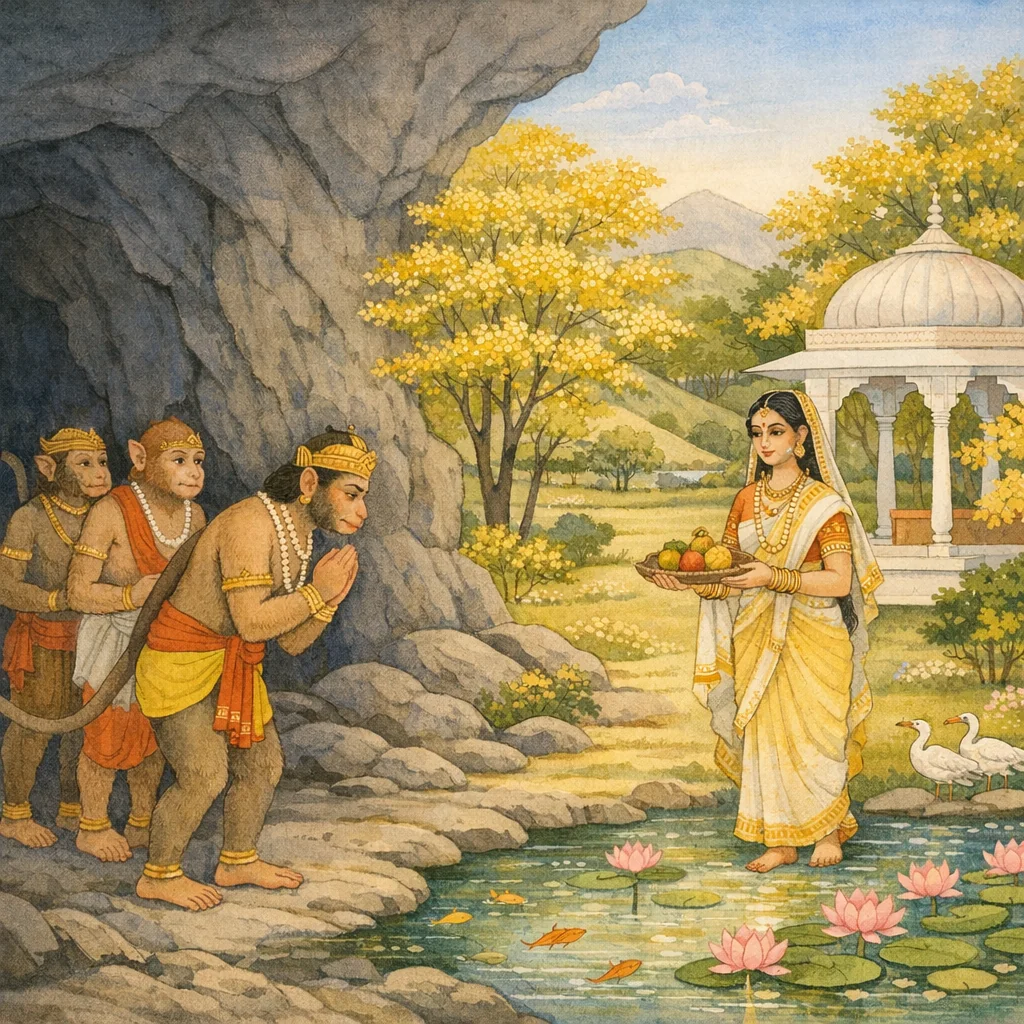
Sarga 51 unfolds as a measured exchange of questions and answers within a dark cave that suddenly opens into a dazzling, seemingly impossible “golden forest” (kāñcana vana), filled with gem-latticed mansions and wondrous plants and creatures. The Vanaras, worn down by hunger and thirst, admit their sudden entry and, astonished by golden trees, lotuses, fish, and tortoises, ask whose ascetic power (tapas) or agency has produced such marvels. Hanumān serves as the chief interlocutor, requesting clear attribution and explanation. The resident ascetic woman, Svayaṃprabhā—portrayed as righteous and devoted to the welfare of all—answers with an origin narrative: the golden forest and mansion were fashioned through māyā by a powerful, deceitful being named Maya, whose craft is linked among the dānava chiefs to the lineage of Viśvakarmā. By long penance to Brahmā, Maya gained boons and enjoyed this place until Indra struck him with the thunderbolt (vajra) when he became infatuated with the apsaras Hemā. Thereafter Brahmā granted the forest and golden house permanently to Hemā, and appointed Svayaṃprabhā, daughter of Meru Sāvarṇi, as its guardian—boon-protected and invested with authority. The chapter closes with her hospitable offer of roots, fruits, and water, and with her direct questions about the Vanaras’ mission and how they found this inaccessible forest, making the wonder-filled episode a threshold to the disclosure of their quest.
Shlokas
Verse 1
इत्युक्त्वा हनुमांस्तत्र पुनः कृष्णाजिनाम्बराम्।अब्रवीत्तां महाभागां तापसीं धर्मचारिणीम्।।4.51.1।।
Having spoken thus, Hanumān there again addressed that fortunate ascetic woman, robed in black antelope-skin, devoted to righteous conduct in accordance with dharma.
Verse 2
इदं प्रविष्टास्सहसा बिलं तिमिरसंवृतम्।क्षुत्पिपासापरिश्रान्ताः परिखिन्नाश्च सर्वशः।।4.51.2।।
Worn out by hunger and thirst, and utterly fatigued, we suddenly entered this cave that is shrouded in darkness.
Verse 3
महद्धरण्या विवरं प्रविष्टाः स्म पिपासिताः।इमां स्त्वेवंविधान्भावान्विविधानद्भुतोपमान्।।4.51.3।।दृष्ट्वा वयं प्रव्यथितास्सम्भ्रान्ता नष्टचेतसः।
Parched with thirst, we entered this vast opening in the earth; and seeing these many extraordinary marvels, we became shaken, bewildered, and almost lost our senses.
Verse 4
कस्यैते काञ्चना वृक्षास्तरुणादित्यसन्निभाः।।4.51.4।।शुचीन्यभ्यवहार्याणि मूलानि च फलानि च।काञ्चनानि विमानानि राजतानि गृहाणि च।।4.51.5।।तपनीयगवाक्षाणि मणिजालावृतानि च।
Whose are these golden trees, radiant like the rising sun? And for whom are these pure, delectable roots and fruits?
Verse 5
कस्यैते काञ्चना वृक्षास्तरुणादित्यसन्निभाः।।4.51.4।।शुचीन्यभ्यवहार्याणि मूलानि च फलानि च।काञ्चनानि विमानानि राजतानि गृहाणि च।।4.51.5।।तपनीयगवाक्षाणि मणिजालावृतानि च।
Whose are these golden vimānas and these silver dwellings, with radiant golden windows, veiled by lattices of gems?
Verse 6
पुष्पिताः फलवन्तश्च पुण्यास्सुरभिगन्धिनः।।4.51.6।।इमे जाम्बूनदमयाः पादपाः कस्य तेजसा।काञ्चनानि च पद्मानि जातानि विमले जले।।4.51.7।।कथं मत्स्याश्च सौवर्णा दृश्यन्ते सह कच्छपैः।आत्मानमनुभावं च कस्य चैतत्तपोबलम्।।4.51.8।।अजानतां न स्सर्वेषां सर्वमाख्यातुमर्हसि।
These trees are in bloom and heavy with fruit—holy and fragrant; by whose radiance have these trees become of Jāmbūnada-gold?
Verse 7
पुष्पिताः फलवन्तश्च पुण्यास्सुरभिगन्धिनः।।4.51.6।।इमे जाम्बूनदमयाः पादपाः कस्य तेजसा।काञ्चनानि च पद्मानि जातानि विमले जले।।4.51.7।।कथं मत्स्याश्च सौवर्णा दृश्यन्ते सह कच्छपैः।आत्मानमनुभावं च कस्य चैतत्तपोबलम्।।4.51.8।।अजानतां न स्सर्वेषां सर्वमाख्यातुमर्हसि।
And how have golden lotuses come to be born in this pure water?
Verse 8
पुष्पिताः फलवन्तश्च पुण्यास्सुरभिगन्धिनः।।4.51.6।।इमे जाम्बूनदमयाः पादपाः कस्य तेजसा।काञ्चनानि च पद्मानि जातानि विमले जले।।4.51.7।।कथं मत्स्याश्च सौवर्णा दृश्यन्ते सह कच्छपैः।आत्मानमनुभावं च कस्य चैतत्तपोबलम्।।4.51.8।।अजानतां न स्सर्वेषां सर्वमाख्यातुमर्हसि।
How do golden fish appear here, along with tortoises? Who holds the power behind all this—whose might, born of tapas, is it? Since none of us knows, you should explain everything to us.
Verse 9
एवमुक्ता हनुमता तापसी धर्मचारिणी।।4.51.9।।प्रत्युवाच हनूमन्तं सर्वभूतहिते रता।
Thus addressed by Hanuman, the female ascetic—steadfast in dharma and devoted to the welfare of all beings—replied to him.
Verse 10
मयो नाम महातेजा मायावी वानरर्षभः।।4.51.10।।तेनेदं निर्मितं सर्वं मायया काञ्चनं वनम्।
“O bull among monkeys, a brilliant being named Maya, skilled in illusion, created this entire golden forest by his māyā (mystic power).”
Verse 11
पुरा दानवमुख्यानां विश्वकर्मा बभूव ह।।4.51.11।।येनेदं काञ्चनं दिव्यं निर्मितं भवनोत्तमम्।
In former times, among the chiefs of the dānavas, there was indeed a Viśvakarmā—by whom this divine, golden, best of mansions was built.
Verse 12
स तु वर्षसहस्राणि तपस्तप्त्वा महावने।।4.51.12।।पितामहाद्वरं लेभे सर्वमौशनसं धनम्।
He performed austerities for thousands of years in a great forest, and from Pitāmaha (Brahmā) obtained a boon—namely, the entire wealth associated with Auśanasa (Śukra).
Verse 13
वनं विधाय बलवान्सर्वकामेश्वरस्तदा।।4.51.13।।उवास सुखितः कालं कञ्चिदस्मिन्महावने।
Then that powerful one, a master of wish-fulfilment, fashioned this forest and dwelt here happily for some time in this great woodland.
Verse 14
तमप्सरसि हेमायां सक्तं दानवपुङ्गवम्।।4.51.14।।विक्रम्यैवाशनिं गृह्य जघानेत्रः पुरन्दरः।
When that foremost of dānavas became infatuated with the apsaras Hēmā, Purandara (Indra), taking up his thunderbolt and exerting his might, struck him down.
Verse 15
इदं च ब्रह्मणा दत्तं हेमायै वनमुत्तमम्।।4.51.15।।शाश्वता: कामभोगश्च गृहं चेदं हिरण्मयम्।
And this excellent forest was granted by Brahmā to Hēmā—together with enduring enjoyments and this golden dwelling.
Verse 16
दुहिता मेरुसावर्णेरहं तस्यास्स्वयंप्रभा।।4.51.16।।इदं रक्षामि भवनं हेमाया वानरोत्तम।
O best of monkeys, I am Svayaṃprabhā, daughter of Merusāvarṇi. I guard this mansion that belongs to Hēmā.
Verse 17
मम प्रियसखी हेमा नृत्तगीतविशारदा।।4.51.17।।तया दत्तवरा चास्मि रक्षामि भवनोत्तमम्।
Hēmā—skilled in dance and song—is my dear friend. By her I have been granted a boon; therefore I guard this excellent mansion.
Verse 18
किं कार्यं कस्य वा हेतोः कान्ताराणि प्रपश्यथ।।4.51.18।।कथं चेदं वनं दुर्गं युष्माभिरुपलक्षितम्।
What is your task, and for what purpose do you search these wilderness tracts? And how did you discover this inaccessible, difficult forest?
Verse 19
इमान्यभ्यवहार्याणि मूलानि च फलानि च।।4.51.19।।भुक्त्वा पीत्वा च पानीयं सर्वं मे वक्तुमर्हथ।
Eat these edible roots and fruits, and drink this water; then you should tell me everything.
Frequently Asked Questions
The Vanaras’ urgent action—entering an unknown, dark cave without permission due to hunger and thirst—raises a practical dharma question about necessity versus propriety; the episode resolves it through truthful confession, respectful inquiry, and the host’s compassionate hospitality.
Marvels can arise from māyā, tapas, and divine grants; therefore, disciplined questioning and ethical conduct are required to interpret extraordinary experiences without losing discernment or mission-focus.
An inaccessible cave region opening into a ‘kāñcana vana’ with hiraṇmaya dwellings, gem-lattice windows, and golden aquatic life—presented as a liminal, otherworldly landmark that functions as a narrative checkpoint before the search party’s mission is disclosed.