Sarga 39
वानरसेनामिलनम् / The Mustering of the Vanara Hosts
किष्किन्धाकाण्ड
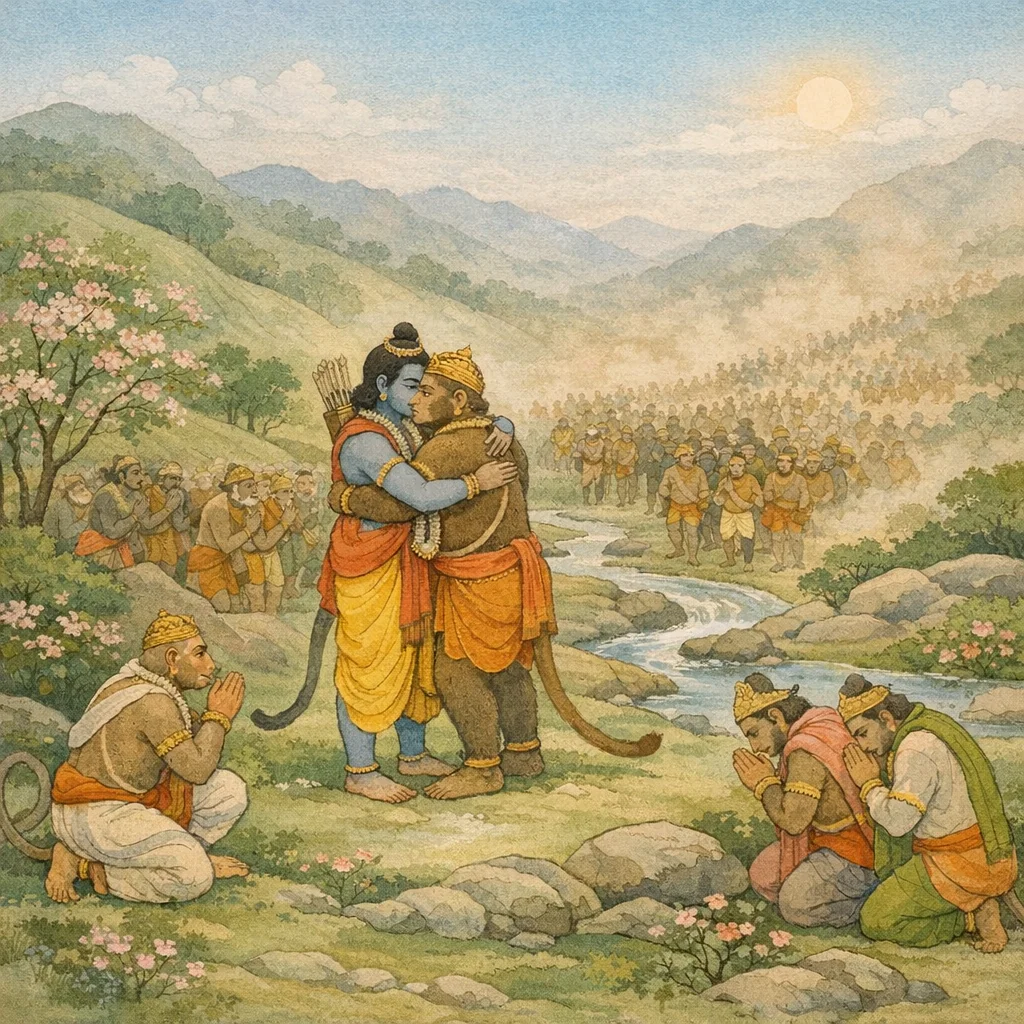
This sarga seals friendship in formal terms and turns at once to swift mobilization. Rama, hailed as foremost among upholders of dharma, embraces Sugriva and assures him that repaying a friend’s aid is as natural as cosmic order—rain bestowed by Indra, and light from Sun and Moon. Rama declares Ravana’s abduction of Vaidehi (Sita) to be self-ruin and vows speedy retribution with keen arrows, invoking the exemplar of Indra and Poulomi to cast the coming war in an epic moral frame. The narrative then becomes a spectacle of logistics: dust clouds dim the sun, directions blur, and the earth seems to tremble as countless vanaras and bears arrive. A roll of leaders and their hosts follows—Satavali; Tara’s father; Ruma’s father (Sugriva’s father-in-law); Kesari (Hanuman’s father); Gavaksha, Dhumra, Panasa, Nila, Gavaya, Darimukha; Mainda and Dvivida; Gaja, Jambavan, Rumanvan, Gandhamadana; Angada, Tara, Indrajanu, Rambha, Durmukha; Hanuman, Nala, Dadhimukha; and others such as Sarabha, Kumuda, Vahni, and Ramha. The assembled forces roar and bow, reporting to Sugriva. Sugriva presents the gathered chiefs to Rama and orders the army to encamp comfortably by mountain streams, forests, and hills, and to determine exact numbers—an explicit epic moment of administration, reconnaissance, and disciplined command.
Shlokas
Verse 1
इति ब्रुवाणं सुग्रीवं रामो धर्मभृतां वरः।बाहुभ्यां सम्परिष्वज्य प्रत्युवाच कृताञ्जलिम्।।4.39.1।।
Hearing his command, the swift-acting monkeys promptly brought forward a palanquin that was pleasing to behold.
Verse 2
यदिन्द्रो वर्षते वर्षं न तच्चित्रं भवेत्क्वचित्।आदित्यो वा सहस्रांशुः कुर्याद्वितिमिरं नभः।।4.39.2।।चन्द्रमा रश्मिभिः कुर्यात्पृथिवीं सौम्य निर्मलाम्।त्वद्विधो वाऽपि मित्राणां प्रतिकुर्यात्परन्तप ।।4.39.3।।
O gentle Sugrīva, scorcher of foes—there is nothing strange if Indra sends rain, if the thousand-rayed Sun drives darkness from the sky, and if the Moon with his beams makes the earth serene, bright, and cool; likewise it is only fitting that one like you should repay the kindness of friends.
Verse 3
यदिन्द्रो वर्षते वर्षं न तच्चित्रं भवेत्क्वचित्।आदित्यो वा सहस्रांशुः कुर्याद्वितिमिरं नभः।।4.39.2।।चन्द्रमा रश्मिभिः कुर्यात्पृथिवीं सौम्य निर्मलाम्।त्वद्विधो वाऽपि मित्राणां प्रतिकुर्यात्परन्तप ।।4.39.3।।
O gentle Sugrīva, scorcher of foes—there is nothing strange if Indra sends rain, if the thousand-rayed Sun drives darkness from the sky, and if the Moon with his beams makes the earth serene, bright, and cool; likewise it is only fitting that one like you should repay the kindness of friends.
Verse 4
एवं त्वयि न तच्चित्रं भवेद्यत्सौम्य शोभनम्।जानाम्यहं त्वां सुग्रीव सततं प्रियवादिनम्।।4.39.4।।
So, O gentle Sugrīva, it is no wonder that you act with such noble grace; I know you always to be gracious, pleasing, and sweet of speech.
Verse 5
त्वत्सनाथ: सखे सङ्ख्ये जेताऽस्मि सकलानरीन्।त्वमेव मे सुहृतन्मित्रं साहाय्यं कर्तुमर्हसि।।4.39.5।।
O friend, with you as my support in battle, I shall conquer all foes. You alone are my true well-wisher and friend—therefore it is right that you grant me your aid.
Verse 6
जहारात्मविनाशाय वैदेहीं राक्षसाधमः।वञ्चयित्वा तु पौलोमीमनुह्लादो यथा शचीम्।।4.39.6।।
That vile rākṣasa carried off Vaidehī for his own destruction—just as Anuhlāda, by deceit, abducted Paulomī (Śacī).
Verse 7
न चिरात्तं हनिष्यामि रावणं निशितैश्शरैः।पौलोम्याः पितरं दृप्तं शतक्रतुरिवाऽहवे।।4.39.7।।
Before long I shall slay that Rāvaṇa with keen arrows—just as Śatakratu (Indra) in battle struck down the arrogant father of Paulomī.
Verse 8
एतस्मिन्नन्तरे चैव रजस्समभिवर्तत।उष्णां तीव्रां सहस्रांशोश्छादयद्गगने प्रभाम्।।4.39.8।।
Just then dust billowed up and spread everywhere, veiling in the sky the blazing heat and radiance of the thousand-rayed Sun.
Verse 9
दिशः पर्याकुलाश्चासन्रजसा तेन मूर्छता।चचाल च मही सर्वा सशैलवनकानना।।4.39.9।।
With that dust thickening and spreading, the directions became confused and indistinct; the whole earth too trembled—mountains, forests, and groves along with it.
Verse 10
ततो नगेन्द्रसङ्काशैस्तीक्ष्णदंष्ट्रैर्महाबलैः।कृत्स्ना सञ्छादिता भूमिरसङ्ख्येयैः प्लवङ्गमैः।।4.39.10।।निमेषान्तरमात्रेण ततस्तैर्हरियूथपैः।कोटीशतपरीवारैः कामरूपिभिरावृता।।4.39.11।।नादेयैः पार्वतीयैश्च सामुद्रैश्च महाबलैः।हरिभिर्मेघनिर्ह्रादैरन्यैश्च वनचारिभिः।।4.39.12।।तरुणादित्यवर्णैश्च शशिगौरैश्च वानरैः।पद्मकेसरवर्णैश्च श्वेतैर्मेरुकृतालयैः।।4.39.13।।
Then the entire land was completely covered by innumerable monkeys—mighty, sharp-fanged, and huge like mountain-lords.
Verse 11
ततो नगेन्द्रसङ्काशैस्तीक्ष्णदंष्ट्रैर्महाबलैः।कृत्स्ना सञ्छादिता भूमिरसङ्ख्येयैः प्लवङ्गमैः।।4.39.10।।निमेषान्तरमात्रेण ततस्तैर्हरियूथपैः।कोटीशतपरीवारैः कामरूपिभिरावृता।।4.39.11।।नादेयैः पार्वतीयैश्च सामुद्रैश्च महाबलैः।हरिभिर्मेघनिर्ह्रादैरन्यैश्च वनचारिभिः।।4.39.12।।तरुणादित्यवर्णैश्च शशिगौरैश्च वानरैः।पद्मकेसरवर्णैश्च श्वेतैर्मेरुकृतालयैः।।4.39.13।।
In scarcely the span between two blinks, it was filled by those leaders of monkey-troops, surrounded by hundreds of crores of followers—beings able to assume forms at will.
Verse 12
ततो नगेन्द्रसङ्काशैस्तीक्ष्णदंष्ट्रैर्महाबलैः।कृत्स्ना सञ्छादिता भूमिरसङ्ख्येयैः प्लवङ्गमैः।।4.39.10।।निमेषान्तरमात्रेण ततस्तैर्हरियूथपैः।कोटीशतपरीवारैः कामरूपिभिरावृता।।4.39.11।।नादेयैः पार्वतीयैश्च सामुद्रैश्च महाबलैः।हरिभिर्मेघनिर्ह्रादैरन्यैश्च वनचारिभिः।।4.39.12।।तरुणादित्यवर्णैश्च शशिगौरैश्च वानरैः।पद्मकेसरवर्णैश्च श्वेतैर्मेरुकृतालयैः।।4.39.13।।
There were mighty monkeys from river-regions, from the mountains, and from the seas—others too, forest-ranging vānaras whose roaring thundered like clouds.
Verse 13
ततो नगेन्द्रसङ्काशैस्तीक्ष्णदंष्ट्रैर्महाबलैः।कृत्स्ना सञ्छादिता भूमिरसङ्ख्येयैः प्लवङ्गमैः।।4.39.10।।निमेषान्तरमात्रेण ततस्तैर्हरियूथपैः।कोटीशतपरीवारैः कामरूपिभिरावृता।।4.39.11।।नादेयैः पार्वतीयैश्च सामुद्रैश्च महाबलैः।हरिभिर्मेघनिर्ह्रादैरन्यैश्च वनचारिभिः।।4.39.12।।तरुणादित्यवर्णैश्च शशिगौरैश्च वानरैः।पद्मकेसरवर्णैश्च श्वेतैर्मेरुकृतालयैः।।4.39.13।।
Monkeys came in many hues—some like the young sun, some pale as the moon, some the color of lotus filaments; and some were white, said to dwell upon Mount Meru.
Verse 14
कोटीसहस्रैर्दशभिः श्रीमान्परिवृतस्तदा।वीरश्शतवलिर्नाम वानरः प्रत्यदृश्यत।।4.39.14।।
Then the illustrious warrior-monkey named Śatavalī appeared, surrounded by ten thousand crores of monkeys.
Verse 15
ततः काञ्चनशैलाभस्ताराया वीर्यवान्पिता।अनेकैर्दशसाहस्रैः कोटिभिः प्रत्यदृश्यत।।4.39.15।।
Then Tārā’s valiant father appeared, radiant like a golden mountain, attended by many tens of thousands of crores of monkeys.
Verse 16
तथाऽपरेण कोटीनां सहस्रेण समन्वितः।पिता रुमाया सम्प्राप्तस्सुग्रीवश्वशुरो विभुः।।4.39.16।।
Likewise, Rुमā’s father—the mighty one, and Sugrīva’s father-in-law—arrived, accompanied by another thousand crores of monkeys.
Verse 17
पद्मकेसरसङ्काशस्तरुणार्कनिभाननः।बुद्धिमान्वानरश्रेष्ठस्सर्ववानरसत्तमः।।4.39.17।।अनेकैर्बहुसाहस्रैर्वानराणां समन्वितः।पिता हनुमतश्रशीमान्केसरी प्रत्यदृश्यत।।4.39.18।।
His hue was like lotus filaments, his face like the young sun—wise, the foremost of monkeys, the best among all vānaras.
Verse 18
पद्मकेसरसङ्काशस्तरुणार्कनिभाननः।बुद्धिमान्वानरश्रेष्ठस्सर्ववानरसत्तमः।।4.39.17।।अनेकैर्बहुसाहस्रैर्वानराणां समन्वितः।पिता हनुमतश्रशीमान्केसरी प्रत्यदृश्यत।।4.39.18।।
Then the illustrious Keśarī—Hanumān’s father—appeared, accompanied by many thousands of vānara.
Verse 19
गोलाङ्गूलमहाराजो गवाक्षो भीमविक्रमः।वृतः कोटिसहस्रेण वानराणामदृश्यत।।4.39.19।।
Gavākṣa, the great king of the Golāṅgūlas, of terrible valor, was seen surrounded by a thousand koṭis of vānara.
Verse 20
ऋक्षाणां भीमवेगानां धूम्रश्शत्रुनिबर्हणः।वृतः कोटिसहस्राभ्यां द्वाभ्यां समभिवर्तत।।4.39.20।।
Next came Dhūmra, destroyer of enemies, surrounded by two koṭi-sahasras of bears (ṛkṣa) of terrifying speed.
Verse 21
महाचलनिभैर्घोरै: पनसो नाम यूथपः।आजगाम महावीर्यस्तिसृभिः कोटिभिर्वृतः।।4.39.21।।
Then the troop-leader named Panasa, a warrior of great prowess, arrived—surrounded by three koṭis of dreadful fighters, like mighty mountains in form.
Verse 22
नीलाञ्जनचयाकारो नीलो नामाऽथ यूथपः।अदृश्यत महाकायः कोटिभिर्दशभिर्वृतः।।4.39.22।।
Then appeared the troop-leader named Nīla, huge of body and dark like a mass of collyrium, surrounded by ten crores of vānaras.
Verse 23
ततः काञ्चनशैलाभो गवयो नाम यूथपः।आजगाम महावीर्यः पञ्चभि: कोटिभिर्वृतः।।4.39.23।।
After that came the troop-leader named Gavaya, a mighty hero, shining like a golden mountain, surrounded by five crores of vānaras.
Verse 24
दरीमुखश्च बलवान्यूथपोऽभ्याययौ तदा।वृतः कोटिसहस्रेण सुग्रीवं समुपस्थितः।।4.39.24।।
Then the strong troop-leader Darīmukha came forward, attended by a koṭi-sahasra host, and presented himself before Sugrīva.
Verse 25
मैन्दश्च द्विविदश्चोभावश्विपुत्रौ महाबलौ।कोटिकोटिसहस्रेण वानराणामदृश्यताम्।।4.39.25।।
Mainda and Dvivida—both immensely powerful, sons of the Aśvins—were seen, accompanied by an enormous multitude of vānaras, described as koṭi-koṭi-sahasra.
Verse 26
गजश्च बलवान् वीर: कोटिभिस्तिसृभिर्वृतः।आजगाम महातेजा सुग्रीवस्य समीपतः।।4.39.26।।
Gaja too—strong, heroic, and brilliant—came into Sugrīva’s presence, surrounded by three crores of vānaras.
Verse 27
ऋक्षराजो महातेजा जाम्बवान्नाम नामतः।कोटिभिर्दशभिः प्राप्तः सुग्रीवस्य वशे स्थितः।।4.39.27।।
Jāmbavān by name—the radiant king of bears—arrived with ten crores and stood under Sugrīva’s command.
Verse 28
रुमण्वान्नाम विक्रान्तो वानरो वानरेश्वरम्।आययौ बलवांस्तूर्णं कोटीशतसमावृतः।।4.39.28।।
The powerful and valorous vānara named Rumaṇvān swiftly came to the lord of vānaras, Sugrīva, surrounded by a hundred crores.
Verse 29
ततः कोटिसहस्राणां सहस्रेण शतेन च।पृष्ठतोऽनुगतः प्राप्तो हरिभिर्गन्धमादनः।।4.39.29।।
Then Gandhamādana arrived, followed from behind by an immense host of vānara warriors—counted in thousands of crores, and further by thousands and hundreds.
Verse 30
ततः पद्मसहस्रेण वृतश्शङ्कुशतेन च।युवराजोऽङ्गदः प्राप्तः पितृतुल्यपराक्रमः।।4.39.30।।
Then the heir-apparent Aṅgada arrived—mighty as his father—surrounded by hosts numbered in thousands of padmas and hundreds of śaṅkus.
Verse 31
ततस्ताराद्युतिस्तारो हरिर्भीमपराक्रमः।पञ्चभिर्हरिकोटीभिर्दूरतः प्रत्यदृश्यत।।4.39.31।।
Then, from afar, Tāra—radiant like a star and terrible in prowess—came into view, attended by five crores of vānara warriors.
Verse 32
इन्द्रजानुः कपिर्वीरो यूथपः प्रत्यदृश्यत।एकादशानां कोटीनामीश्वरस्तैस्समावृतः।।4.39.32।।
Indrajānu, the heroic vānara troop-leader, appeared—lord over eleven crores—surrounded by those forces.
Verse 33
ततो रम्भस्त्वनुप्राप्तस्तरुणादित्यसन्निभः।अयुतेनावृतश्चैव सहस्रेण शतेन च।।4.39.33।।
Thereafter Rambha arrived, glowing like the rising sun, surrounded by an ayuta, and also by thousands and hundreds of vānara troops.
Verse 34
ततो यूथपतिर्वीरो दुर्मुखो नाम वानरः।प्रत्यदृश्यत कोटीभ्यां द्वाभ्यां परिवृतो बली।।4.39.34।।
Then the strong and heroic troop-leader, the vānara named Durmukha, appeared, surrounded by two crores of warriors.
Verse 35
कैलासशिखराकारैर्वानरैर्भीमविक्रमैः।वृतः कोटिसहस्रेण हनुमान्प्रत्यदृश्यत।।4.39.35।।
Hanumān appeared, surrounded by a thousand crores of vānara warriors of dreadful valor, towering like the peaks of Kailāsa.
Verse 36
नलश्चापि महावीर्यस्संवृतो द्रुमवासिभिः।कोटीशतेन सम्प्राप्तस्सहस्रेण शतेन च।।4.39.36।।
Nala too—of mighty prowess—arrived, surrounded by the vānara hosts who dwell among the trees, with a hundred crores, and also with thousands and hundreds.
Verse 37
ततो दधिमुखश्रीमान्कोटिभिर्दशभिर्वृतः।सम्प्राप्तोऽभिमतस्तस्य सुग्रीवस्य महात्मनः।।4.39.37।।
Then the illustrious Dadhimukha arrived, surrounded by ten crores, a trusted favorite of the great-souled Sugrīva.
Verse 38
शरभः कुमुदो वह्निर्वानरो रंह एव च।एते चान्ये च बहवो वानराः कामरूपिणः।।4.39.38।।आवृत्य पृथिवीं सर्वां पर्वतांश्च वनानि च।यूथपा स्समनुप्राप्ता स्तेषां संख्या न विद्यते।।4.39.39।।आगताश्च विशिष्टाश्च पृथिव्यां सर्ववानराः।
Śarabha, Kumuda, Vahni, and Raṃha arrived, along with many other vanaras who could assume forms at will, each with their troops.
Verse 39
शरभः कुमुदो वह्निर्वानरो रंह एव च।एते चान्ये च बहवो वानराः कामरूपिणः।।4.39.38।।आवृत्य पृथिवीं सर्वां पर्वतांश्च वनानि च।यूथपा स्समनुप्राप्ता स्तेषां संख्या न विद्यते।।4.39.39।।आगताश्च विशिष्टाश्च पृथिव्यां सर्ववानराः।
Covering the whole earth—its mountains and forests—the troop-leaders advanced; their number could not be reckoned.
Verse 40
आप्लवन्तः प्लवन्तश्च गर्जन्तश्च प्लवङ्गमाः।अभ्यवर्तन्त सुग्रीवं सूर्यमभ्रगणा इव।।4.39.40।।
Leaping, bounding, and roaring, the monkeys pressed around Sugrīva—like masses of clouds around the sun.
Verse 41
कुर्वाणा बहुशब्दांश्च प्रहृष्टा बाहुशालिनः।शिरोभिर्वानरेन्द्राय सुग्रीवाय न्यवेदयन्।।4.39.41।।
Exultant and broad-shouldered, they raised many cries and, bowing their heads, reported themselves to Sugrīva, lord of the vanaras.
Verse 42
अपरे वानरश्रेष्ठास्सङ्गम्य च यथोचितम्।सुग्रीवेण समागम्य स्थिताः प्राञ्जलय स्तदा।।4.39.42।।
Others—foremost among the vanaras—approached in proper form, and after meeting Sugrīva, stood there with folded hands.
Verse 43
सुग्रीवस्त्वरितो रामे सर्वांस्तां वानररर्षभान्।निवेदयित्वा धर्मज्ञः स्थितः प्राञ्जलिरब्रवीत्।।4.39.43।।
Sugrīva, swift to act and versed in dharma, presented to Rāma all those foremost of the vanaras; then, standing with folded hands, he spoke.
Verse 44
यथासुखं पर्वतनिझरेषुवनेषु सर्वेषु च वानरेन्द्राः।निवेशयित्वा विधिवद्बलानिबलं बलज्ञः प्रतिपत्तुमीष्टे।।4.39.44।।
Having duly quartered the forces in comfort—by mountain streams and throughout the forests—the leader, who knew true strength, resolved to ascertain the army’s full might.
Frequently Asked Questions
The pivotal action is the public ratification of sakhya (allied friendship): Rama embraces Sugriva and frames reciprocal assistance as dharmically natural, converting personal obligation into legitimate collective mobilization against Ravana’s wrongdoing.
Dharma is shown as both moral and administrative: virtue includes gratitude and truthful alliance, but also disciplined organization—leaders must report, armies must be housed properly, and strength must be assessed before action.
The sarga uses epic geography and landscape logistics: Mount Meru (as an origin/residence motif), Kailasa (as an imagery benchmark), and practical encampment sites—mountain streams, forests, and hills—marking a cultural ideal of orderly mustering in wilderness terrain.