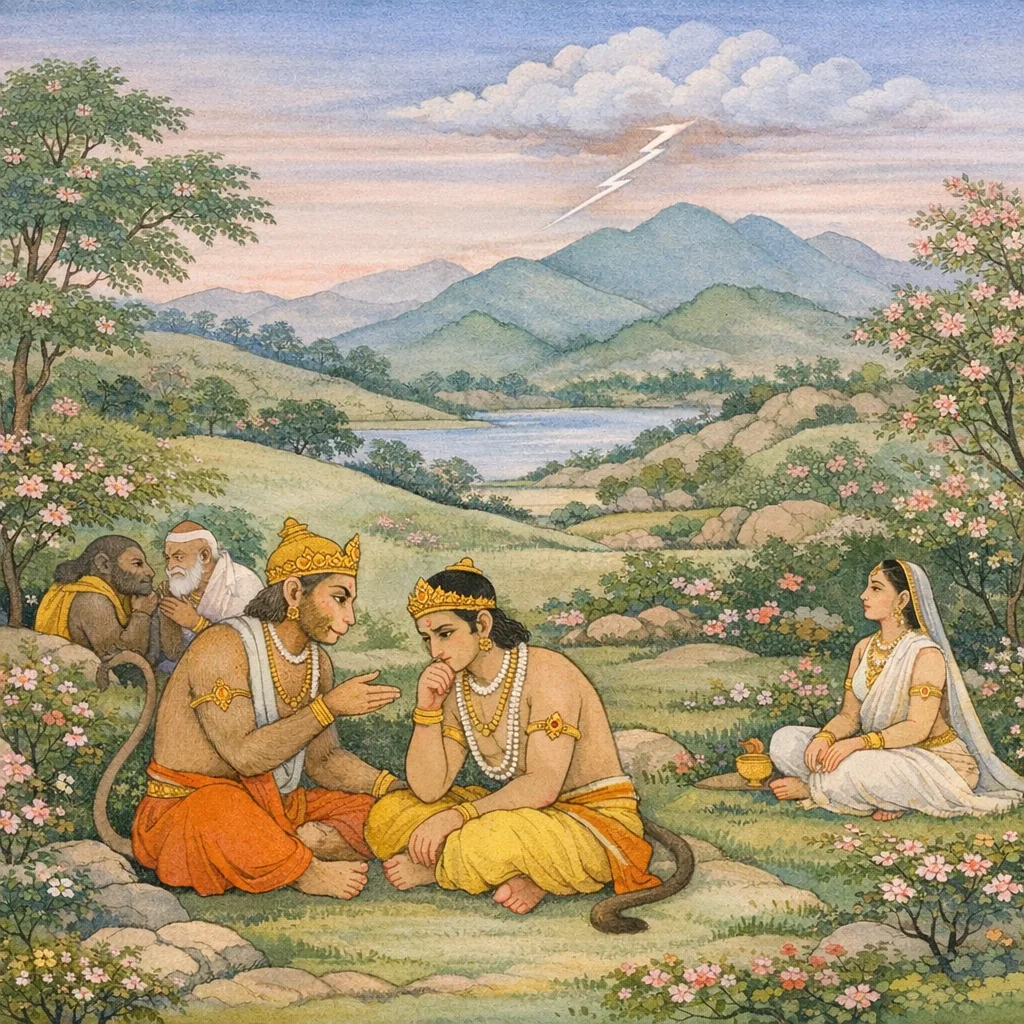
Sarga 54
अङ्गद-उपदेशः — Hanuman’s Counsel to Angada on Succession and Strategy
किष्किन्धाकाण्ड
In Sarga 54, after hearing Tārā—radiant like the moon—Hanuman weighs the political danger that Aṅgada might seek to seize the kingdom. Yet he also affirms Aṅgada’s royal fitness, citing his intellect, “eight-limbed” competence, fourfold strength, and the fourteen qualities of a king. To quell factional turmoil among the vānaras, Hanuman applies classical nīti and explicitly uses bheda, the third of the four upāyas (sāma, dāna, bheda, daṇḍa), to separate opinions and turn Aṅgada from a doomed stance of withdrawal through pragmatic, fear-awakening reasoning. He warns that elders such as Jāmbavān, Nīla, and Suhotra will not follow Aṅgada against Sugriva, and that neither persuasion nor force can detach the host from the established king. Hanuman further stresses the decisive power imbalance because of Lakshmana: a cave is no refuge, for Lakshmana’s thunderbolt-like arrows can shatter even mountains, and a fleeing foe cannot evade them. The counsel ends in a constructive remedy—approach Sugriva humbly; by lawful succession (ānupūrvyā) Sugriva will install Aṅgada as heir, for Sugriva is virtuous, true to his word, without other offspring, and devoted to pleasing Tārā. The lesson is crisis governance through calibrated speech, legitimate succession, and avoidance of unwinnable conflict.
Shlokas
Verse 1
तथा ब्रुवति तारे तु ताराधिपतिवर्चसि।अथ मेने हृतं राज्यं हनूमानङ्गदेन तत्।।।।
As Tārā, radiant like the lord of stars—the Moon—spoke thus, Hanumān then suspected that Aṅgada might seize the kingdom.
Verse 2
बुद्ध्या ह्यष्टाङ्गया युक्तं चतुर्बलसमन्वितम्।चतुर्दशगुणं मेने हनूमान्वालिनस्सुतम्।।।।
Hanūmān judged Vāli’s son to be endowed with discerning intellect, furnished with the eightfold constituents, supported by the four strengths, and marked by fourteen royal qualities.
Verse 3
आपूर्यमाणं शश्वच्च तेजोबलपराक्रमैः।शशिनं शुक्लपक्षादौ वर्धमानमिव श्रिया।।।।बृहस्पतिसमं बुद्ध्या विक्रमे सदृशं पितुः।शुश्रूषमाणं तारस्य शक्रस्येव पुरन्दरम्।।।।भर्तुरर्थे परिश्रान्तं सर्वशास्त्रविदांवरम्।अभिसन्धातुमारेभे हनूमानङ्गदं ततः।।।।
Then Hanumān deliberately set about drawing Aṅgada into counsel—Aṅgada who was ever filled with brilliance, strength, and valor, growing in splendor like the moon at the start of the bright fortnight; whose intellect matched Bṛhaspati’s and whose prowess resembled his father’s; who attended upon Tārā as Indra, breaker of fortresses, listens to his preceptor; and who, though weary for his lord’s cause, was foremost among those versed in the śāstras.
Verse 4
आपूर्यमाणं शश्वच्च तेजोबलपराक्रमैः।शशिनं शुक्लपक्षादौ वर्धमानमिव श्रिया।।4.54.3।।बृहस्पतिसमं बुद्ध्या विक्रमे सदृशं पितुः।शुश्रूषमाणं तारस्य शक्रस्येव पुरन्दरम्।।4.54.4।।भर्तुरर्थे परिश्रान्तं सर्वशास्त्रविदांवरम्।अभिसन्धातुमारेभे हनूमानङ्गदं ततः।।4.54.5।।
Describing the third of the four means, he used the wealth of his speech to sow division among all those vānaras.
Verse 5
आपूर्यमाणं शश्वच्च तेजोबलपराक्रमैः।शशिनं शुक्लपक्षादौ वर्धमानमिव श्रिया।।4.54.3।।बृहस्पतिसमं बुद्ध्या विक्रमे सदृशं पितुः।शुश्रूषमाणं तारस्य शक्रस्येव पुरन्दरम्।।4.54.4।।भर्तुरर्थे परिश्रान्तं सर्वशास्त्रविदांवरम्।अभिसन्धातुमारेभे हनूमानङ्गदं ततः।।4.54.5।।
When all of them had become divided, he then frightened Aṅgada with many terrifying words, fashioned as a tactic that combined sternness with expediency.
Verse 6
स चतुर्णामुपायानां तृतीयमुपवर्णयन्।भेदयामास तान्सर्वान् वानरान्वाक्यसम्पदा।।।।
Describing the third of the four means, he used the wealth of his speech to sow division among all those vānaras.
Verse 7
तेषु सर्वेषु भिन्नेषु ततोऽभीषयदङ्गदम्।भीषणैर्भहुभिर्वाक्यै: कोपोपायसमन्वितैः।।।।
When all of them had become divided, he then frightened Aṅgada with many terrifying words, fashioned as a tactic that combined sternness with expediency.
Verse 8
त्वं समर्थतरः पित्रा युद्धे तारेय वै धुरम्।दृढं धारयितुं शक्तः कपिराज्यं यथा पिता।।।।
O son of Tārā, in battle you are even more capable than your father; you can firmly bear the yoke of the vānaras’ kingdom, just as your father once did.
Verse 9
नित्यमस्थिरचित्ता हि कपयो हरिपुङ्गव।नाज्ञाप्यं विषहिष्यन्ति पुत्रदारान्विना त्वया।।।।
O best of monkey-leaders, the vānaras are by nature always unsteady in mind. Separated from their sons and wives, they will not long endure strict command, nor remain here under discipline without you.
Verse 10
त्वां नैतेह्यनुयुञ्जेयु: प्रत्यक्षं प्रवदामि ते।यथायं जाम्बवान्नीलस्सुहोत्रश्च महाकपिः।।।।न ह्यहं ते इमे सर्वे सामदानादिभिर्गुणैः।दण्डेन वा त्वया शक्यास्सुग्रीवादपकर्षितम्।।।।
“I tell you plainly, to your face: these leaders will not follow you in this course—Jāmbavān, Nīla, the great monkey Suhotra, and even I. You cannot detach us from Sugrīva—whether by conciliation and gifts and the like, or even by coercion.”
Verse 11
त्वां नैतेह्यनुयुञ्जेयु: प्रत्यक्षं प्रवदामि ते।यथायं जाम्बवान्नीलस्सुहोत्रश्च महाकपिः।।4.54.10।।न ह्यहं ते इमे सर्वे सामदानादिभिर्गुणैः।दण्डेन वा त्वया शक्यास्सुग्रीवादपकर्षितम्।।4.54.11।।
“I tell you plainly, to your face: these leaders will not follow you in this course—Jāmbavān, Nīla, the great monkey Suhotra, and even I. You cannot detach us from Sugrīva—whether by conciliation and gifts and the like, or even by coercion.”
Verse 12
विगृह्यासनमप्याहुर्दुर्बलेन बलीयसः।आत्मरक्षाकरस्तस्मान्न विगृह्णीत दुर्बलः।।।।
They say that even ‘āsana’—remaining watchful and still—counts as a kind of contest for a weak man facing a stronger one; therefore the weak should not take up open conflict, but act for self-preservation.
Verse 13
यां चेमां मन्यसे धात्रीमेतद्बिलमिति श्रुतम्।एतल्लक्ष्मणबाणानामीषत्कार्यं विदारणे।।।।
And this earth-cleft that you take to be a ‘cave’—so it is said—would be only a trifling task for Lakṣmaṇa’s arrows to split apart.
Verse 14
स्वल्पं हि कृतमिन्द्रेण क्षिपता ह्यशनिं पुरा।लक्ष्मणो निशितैर्बाणैर्भिन्ध्यात्पत्रपुटं यथा।।।।
Formerly Indra, hurling his thunderbolt, wrought only slight harm; but Lakṣmaṇa, with keen arrows, would shatter it as easily as one splits a cup made of leaves.
Verse 15
लक्ष्मणस्य च नाराचा बहवस्सन्ति तद्विधाः।वज्राशनिसमस्पर्शा गिरीणामपि दारणाः।।।।
And Lakṣmaṇa has many such arrows with iron shafts; their touch is like the vajra-thunderbolt, able to split even mountains.
Verse 16
अवस्थाने यदैव त्वमासिष्यसि परन्तप।तदैव हरयस्सर्वे त्यक्ष्यन्ति कृतनिश्चयाः।।।
O scorcher of foes, the very moment you decide to remain here, all the vānaras—steadfast in their resolve—will abandon you.
Verse 17
स्मरन्तः पुत्रदाराणां नित्योद्विग्ना बुभुक्षिताः।खेदिता दुःखशय्याभिस्त्वां करिष्यन्ति पृष्ठतः।।।।
Remembering their children and wives, ever anxious, hungry, and worn down by painful resting-places, they will leave you behind.
Verse 18
स त्वं हीनस्सुहृद्भिश्च हितकामैश्च बन्धुभिः।तृणादपि भृशोद्विग्नस्स्पन्दमानाद्भविष्यसि।।।।
Then you, bereft of friends and well-wishing kinsmen, will become exceedingly fearful—startled even by the quiver of a blade of grass.
Verse 19
न च जातु न हिंस्युस्त्वां घोरा लक्ष्मणसायकाः ।अपवृत्तं जिघांसन्तो महावेगा दुरासदाः ।। ।।
Lakṣmaṇa’s dreadful arrows—swift and irresistible—would never miss you if you turned away, for they seek to slay the deserter who retreats.
Verse 20
न च जातु न हिंस्युस्त्वा घोरा लक्ष्मणसायकाः।अपावृत्तं जिघांसन्तो महावेगा दुरासदाः।।।।
Lakṣmaṇa’s dreadful arrows—swift and hard to withstand—would not spare you; intent on killing a fleeing foe, they would surely strike and torment you.
Verse 21
अस्माभिस्तु गतं सार्धं विनीतवदुपस्थितम्।आनुपूर्व्यात्तु सुग्रीवो राज्ये त्वां स्थापयिष्यति।।।।
But if you go with us and approach (Sugrīva) in humility, then—following the proper order of succession—Sugrīva will establish you in the kingdom as the rightful heir.
Verse 22
धर्मकामः पितृव्यस्ते प्रीतिकामो दृढव्रतः।शुचिस्सत्यप्रतिज्ञश्च न त्वां जातु जिघांसति।।।।
Your paternal uncle is devoted to dharma, seeks goodwill, is steadfast in his vows, pure in conduct, and true to his promises—he will never seek to kill you.
Verse 23
प्रियकामश्च ते मातुस्तदर्थं चास्य जीवितम्।तस्यापत्यं च नास्त्यन्यत्तस्मादङ्गद गम्यताम्।।।।
He seeks to please your mother, and his very life is bound to her; he has no child other than you—therefore, O Aṅgada, return.
Frequently Asked Questions
Aṅgada faces a governance-and-survival dilemma: whether to hold a separatist position (including the notion of remaining in a “cave” refuge) versus returning to Kishkindha’s lawful order. Hanuman urges avoidance of an unwinnable conflict with Sugriva and Lakshmana and advocates a dharmic, succession-based reconciliation.
Power must be met with proportionate strategy: a weaker party should not choose direct confrontation with a stronger force, and political stability is best preserved through legitimate succession, truthful counsel, and disciplined rhetoric rather than pride-driven isolation.
The prominent “landmark” is the bilam (earth-opening/cave) proposed as a refuge, treated as strategically ineffective due to Lakshmana’s weaponry. Culturally, the chapter foregrounds classical Indian statecraft (the four upāyas) as a normative framework for conflict management.