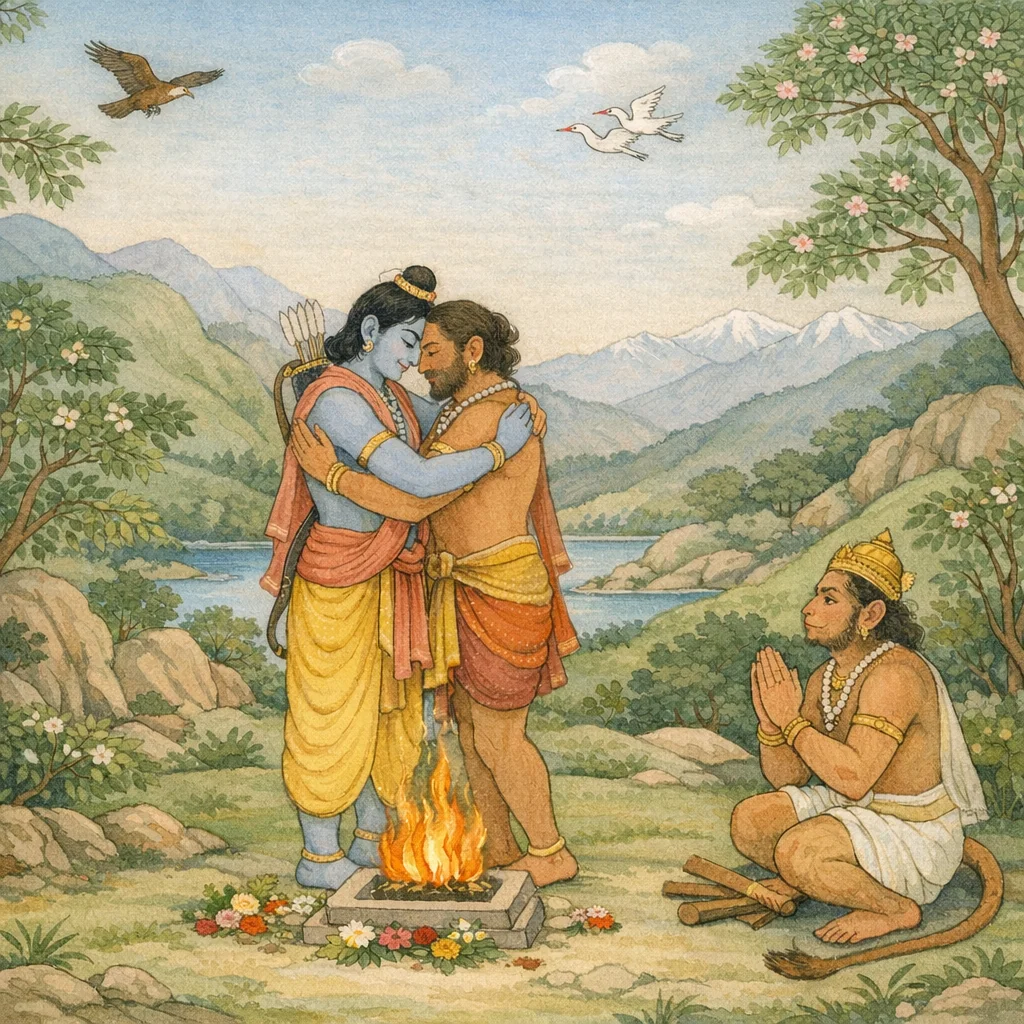
Sarga 5
मैत्रीप्रतिष्ठा (Rama–Sugriva Alliance and Fire-Rite of Friendship)
किष्किन्धाकाण्ड
In this sarga, Hanuman goes from Rishyamuka to Mount Malaya and informs the monkey-king Sugriva of the arrival of the two Raghavas. He also proclaims Rama’s lineage and virtues—born of the Ikshvaku line, faithful to his father’s command, steadfast in truth and heroic in valor. Sugriva’s fear is dispelled; taking human form, he speaks sweetly to Rama and proposes friendship: “Let the arm be extended, let hand clasp hand, and let an unshakable bond be set.” Rama, pleased, grips his hand and embraces him. Hanuman then casts off the mendicant guise; in his own form he kindles fire by churning wood, honors it with flower-offerings, and places the sacred flame between them. Rama and Sugriva circumambulate the fire, making it witness, and thus establish their formal alliance. Sugriva tells the cause of his sorrow—Vali’s deceit, the abduction of his wife, and his fearful forest exile. Rama, devoted to dharma, vows to slay Vali, swiftly bringing him down with unfailing arrows radiant as the sun. In closing, Sugriva longs, by Rama’s grace, to regain both kingdom and wife; and a subtle omen is noted—the twitching of the left eye in Sita, Vali, and Ravana—hinting, by the differing portents for woman and man, at the tale’s coming turns.
Shlokas
Verse 1
ऋश्यमूकात्तु हनुमान्गत्वा तु मलयं गिरिम्।आचचक्षे तदा वीरौ कपिराजाय राघवौ4.5.1।।
Then Hanumān, departing from Ṛśyamūka, went to Mount Malaya and informed the lord of the monkeys about the two heroic Rāghavas.
Verse 2
अयं रामो महाप्राज्ञ स्सम्प्राप्तो दृढविक्रमः।लक्ष्मणेन सह भ्रात्रा रामोऽयं सत्यविक्रमः4.5.2।।
This is Rāma—highly wise and unwavering in valor—who has arrived here along with his brother Lakṣmaṇa; this Rāma is steadfast in truth and true in his heroic power.
Verse 3
इक्ष्वाकूणां कुले जातो रामो दशरथात्मजः।धर्मे निगदितश्चैव पितुर्निर्देशपारगः4.5.3।।
Rāma, Daśaratha’s son, born in the Ikṣvāku line, is renowned for righteousness; and he carries his father’s command through to its full completion.
Verse 4
तस्यास्य वसतोऽरण्ये नियतस्य महात्मनः।रावणेन हृता भार्या स त्वां शरणमागतः4.5.4।।
While that great-souled man lived self-controlled in the forest, Rāvaṇa abducted his wife; therefore he has come to you, seeking refuge.
Verse 5
राजसूयाश्वमेधैश्च वह्निर्येनाभितर्पितः।दक्षिणाश्च तथोत्सृष्टा गावश्शतसहस्रशः4.5.5।।तपसा सत्यवाक्येन वसुधा येन पालिता।स्त्री हेतोस्तस्य पुत्रोऽयं रामस्त्वां शरणं गतः4.5.6।।
He whose sacrificial fires were gratified through the Rājasūya and Aśvamedha rites, who bestowed gifts—cows by the hundreds of thousands—who protected the earth through austerity and truthfulness: that king’s son, this Rāma, has come to you seeking refuge, for the sake of a woman.
Verse 6
राजसूयाश्वमेधैश्च वह्निर्येनाभितर्पितः।दक्षिणाश्च तथोत्सृष्टा गावश्शतसहस्रशः4.5.5।।तपसा सत्यवाक्येन वसुधा येन पालिता।स्त्री हेतोस्तस्य पुत्रोऽयं रामस्त्वां शरणं गतः4.5.6।।
He whose sacrificial fires were gratified through the Rājasūya and Aśvamedha rites, who bestowed gifts—cows by the hundreds of thousands—who protected the earth through austerity and truthfulness: that king’s son, this Rāma, has come to you seeking refuge, for the sake of a woman.
Verse 7
भवता सख्यकामौ तौ भ्रातरौ रामलक्ष्मणौ।प्रतिगृह्यार्चयस्वैतौ पूजनीयतमावुभौ4.5.7।।
Those two brothers, Rāma and Lakṣmaṇa, seek friendship with you; receive them and honor them, for both are supremely worthy of reverence.
Verse 8
श्रुत्वा हनुमतो वाक्यं सुग्रीवो हृष्टमानसः।भयं चराघवाद्घोरं प्रजहौ विगतज्वरः।।4.5.8।।सकृत्वा मानुषं रूपं सुग्रीवः प्लवगर्षभः।दर्शनीयतमो भूत्वा प्रीत्या प्रोवाच राघवम्4.5.9।।
Hearing Hanumān’s words, Sugrīva’s heart grew glad; his dreadful fear of Rāghava left him and his agitation subsided. Then Sugrīva—bull among monkeys—assumed a human form, became most pleasing to behold, and affectionately addressed Rāghava.
Verse 9
श्रुत्वा हनुमतो वाक्यं सुग्रीवो हृष्टमानसः।भयं चराघवाद्घोरं प्रजहौ विगतज्वरः।।4.5.8।।सकृत्वा मानुषं रूपं सुग्रीवः प्लवगर्षभः।दर्शनीयतमो भूत्वा प्रीत्या प्रोवाच राघवम्4.5.9।।
Hearing Hanumān’s words, Sugrīva’s heart grew glad; his dreadful fear of Rāghava left him and his agitation subsided. Then Sugrīva—bull among monkeys—assumed a human form, became most pleasing to behold, and affectionately addressed Rāghava.
Verse 10
भवान्धर्मविनीतश्च विक्रान्तस्सर्ववत्सलः।आख्याता वायुपुत्रेण तत्त्वतो मे भवद्गुणाः4.5.10।।
You are disciplined in dharma, valiant, and affectionate to all. The Wind-god’s son has truthfully described your virtues to me.
Verse 11
तन्ममैवैष सत्कारो लाभश्चैवोत्तमः प्रभो।यत्त्वमिच्छसि सौहार्दं वानरेण मया सह4.5.11।।
O Lord, this is for me the highest honor and the greatest gain—that you desire friendship with me, a mere monkey.
Verse 12
रोचते यदि वा सख्यं बाहुरेष प्रसारितः।गृह्यतां पाणिना पाणिर्मर्यादा बध्यतां ध्रुवा4.5.12।।
If this friendship pleases you, here is my arm extended—take my hand in yours, and let a firm bond of proper conduct be established between us.
Verse 13
एतत्तु वचनं श्रुत्वा सुग्रीवेण सुभाषितम्।सम्प्रहृष्टमना हस्तं पीडयामास पाणिना4.5.13।।हृद्यं सौहृदमालम्ब्यपर्यष्वजत पीडितम्।
Hearing Sugrīva’s well-spoken words, Rāma, his heart brimming with joy, clasped Sugrīva’s hand in his own; cherishing that heartfelt goodwill, he drew near and embraced him firmly.
Verse 14
ततो हनूमान्सन्त्यज्य भिक्षुरूपमरिन्दमः।।4.5.14।।काष्ठयोस्स्वेन रूपेण जनयामास पावकम्।दीप्यमानं ततो वह्निं ह्निं पुष्पैरभ्यर्च्य सत्कृतम्4.5.15।।तयोर्मध्येऽथ सुप्रीतो निदधे सुसमाहितः।
Then Hanumān, vanquisher of foes, casting off his mendicant guise, assumed his own form and kindled fire by rubbing two pieces of wood.
Verse 15
ततो हनूमान्सन्त्यज्य भिक्षुरूपमरिन्दमः।।4.5.14।।काष्ठयोस्स्वेन रूपेण जनयामास पावकम्।दीप्यमानं ततो वह्निं ह्निं पुष्पैरभ्यर्च्य सत्कृतम्4.5.15।।तयोर्मध्येऽथ सुप्रीतो निदधे सुसमाहितः।
Then, worshipping the blazing fire with flowers and honoring it duly, he—well pleased and fully attentive—placed it between the two.
Verse 16
ततोऽग्निं दीप्यमानं तौ चक्रतुश्च प्रदक्षिणम्।।4.5.16।।सुग्रीवो राघवश्चैव वयस्यत्वमुपागतौ।
Then the two of them circumambulated the blazing fire, and Sugrīva and Rāghava entered into the bond of sworn friendship.
Verse 17
ततस्सुप्रीतमनसौ तावुभौ हरिराघवौ4.5.17।।अन्योन्यमभिवीक्षन्तौ न तृप्तिमुपजग्मतुः।
Thereafter, both of them—Sugrīva and Rāghava—delighted at heart, kept gazing at one another and still were not satisfied.
Verse 18
त्वं वयस्योऽसि मे हृद्यो ह्येकं दुःखं सुखं च नौ4.5.18।।सुग्रीवो राघवं वाक्यमित्युवाच प्रहृष्टवत्।
“You are my dear friend; for us both, sorrow and joy are one and the same.” Thus Sugrīva spoke to Rāghava, exultant with happiness.
Verse 19
ततस्सुपर्णबहुलां छित्वा शाखां सुपुष्पिताम्4.5.19।।सालस्यास्तीर्य सुग्रीवो निषसाद सराघवः।
Then Sugrīva cut a well-flowering branch of a śāla tree, rich with leaves, spread it out, and sat down together with Rāghava.
Verse 20
लक्ष्मणायाथ संहृष्टो हनूमान् प्लवगर्षभः4.5.20।।शाखां चन्दनवृक्षस्य ददौ परमपुष्पिताम्।
Then Hanumān—foremost among the monkeys—delighted at heart, offered Lakṣmaṇa a richly blossoming branch of a sandalwood tree.
Verse 21
ततः प्रहृष्टस्सुग्रीवः श्लक्ष्णं मधुरया गिरा4.5.21।।प्रत्युवाच तदा रामं हर्षव्याकुललोचनः।
Then Sugrīva, his eyes shining with joy, replied to Rāma in gentle and sweet words.
Verse 22
अहं विनिकृतो राम चरामीह भयार्दितः4.5.22।।हृतभार्यो वने त्रस्तो दुर्गमेतदुपाश्रितः।
‘O Rāma, I have been grievously wronged; driven by fear I wander here—my wife taken from me—frightened in the forest, having sought refuge in this hard-to-reach place.’
Verse 23
सोऽहं त्रस्तो वने भीतो वसाम्युद्भ्रान्तचेतनः4.5.23।।वालिना निकृतो भ्रात्रा कृतवैरश्च राघव।
So I dwell in the forest, terrified, my mind unsteady—wronged by my brother Vālin—and driven into enmity, O Rāghava.
Verse 24
वालिनो मे महाभाग भयार्तस्याभयं कुरु4.5.24।।कर्तुमर्हसि काकुत्स्थ भयं मे न भवेद्यथा।
O noble one, grant me safety, for I am tormented by fear of Vālin. O Kakutstha, act so that fear may no longer remain in me.
Verse 25
एवमुक्तस्तु तेजस्वी धर्मज्ञो धर्मवत्सलः4.5.25।।प्रत्यभाषत काकुत्स्थ: सुग्रीवं प्रहसन्निव।
Thus addressed, Kakutstha—radiant, discerning of dharma and devoted to dharma—replied to Sugrīva with a gentle, reassuring smile.
Verse 26
उपकारफलं मित्रं विदितं मे महाकपे4.5.26।।वालिनं तं वधिष्यामि तव भार्यापहारिणम्।
O great monkey, I know that true friendship bears fruit through mutual help. I will slay that Vālin who has taken your wife.
Verse 27
अमोघास्सूर्यसङ्काशा ममैते निशिताश्शराः4.5.27।।तस्मिन्वालिनि दुर्वृत्ते निपतिष्यन्ति वेगिताः।कङ्कपत्रप्रतिच्छन्ना महेन्द्राशनिसन्निभाः4.5.28।।तीक्ष्णाग्रा ऋजुपर्वाणस्सरोषा भुजगा इव।
These my sharp arrows are unfailing, radiant like the sun; swift, they will strike that wicked Vālin. Clad with kanka-feathers, like Indra’s thunderbolt, keen-tipped and straight-jointed, they are like enraged serpents.
Verse 28
अमोघास्सूर्यसङ्काशा ममैते निशिताश्शराः4.5.27।।तस्मिन्वालिनि दुर्वृत्ते निपतिष्यन्ति वेगिताः।कङ्कपत्रप्रतिच्छन्ना महेन्द्राशनिसन्निभाः4.5.28।।तीक्ष्णाग्रा ऋजुपर्वाणस्सरोषा भुजगा इव।
These my sharp arrows are unfailing, radiant like the sun; swift, they will strike that wicked Vālin. Clad with kanka-feathers, like Indra’s thunderbolt, keen-tipped and straight-jointed, they are like enraged serpents.
Verse 29
तमद्य वालिनं पश्य तीक्ष्णैराशीविषोपमैः4.5.29।।शरैर्विनिहतं भूमौ विकीर्णमिव पर्वतम्।
See Vālin today—felled by sharp arrows like venomous serpents—lying upon the earth, shattered like a mountain.
Verse 30
स तु तद्वचनं श्रुत्वा राघवस्यात्मनो हितम्4.5.30।।सुग्रीवः परमप्रीतस्सुमहद्वाक्यमब्रवीत्।
Hearing those words—beneficial both to Rāghava and to himself—Sugrīva, greatly delighted, spoke in lofty terms.
Verse 31
तव प्रसादेन नृसिंह राघवप्रियां च राज्यं च समाप्नुयामहम्। तथा कुरु त्वं नरदेव वैरिणंयथा निहंस्यद्य रिपुंममाग्रजम्4.5.31।।
By your favor, O lion among men, O Rāghava, I shall regain both my beloved and my kingdom. Therefore act, O king, so that I may now destroy my enemy—my elder brother.
Verse 32
सीता कपीन्द्रक्षणदाचराणांराजीवहेमज्वलनोपमानि।सुग्रीवरामप्रणयप्रसङ्गेवामानि नेत्राणि समं स्फुरन्ति4.5.32।।
At the moment when Sugrīva and Rāma entered into friendship, the left eyes—of Sītā, of the lord of monkeys, and of the night-roaming one—trembled together, like a lotus, like gold, and like blazing fire.
Frequently Asked Questions
The pivotal action is the formalization of Rama–Sugriva alliance through a fire-centered rite and pledged reciprocity; it ethically frames Rama’s later intervention against Vali as protective duty toward an ally seeking refuge and justice.
Friendship is treated as a dharmic contract: it is grounded in truthfulness, mutual benefit, and firm maryada; once accepted (hand-clasp, embrace, fire-circumambulation), obligations become binding and must be upheld without ambiguity.
Rishyamuka and Malaya mountain anchor the geography of refuge and alliance; culturally, the agni-pradakshina and flower-offering function as a ritual technology for legitimizing political friendship within an epic ethical framework.