Sarga 65
पञ्चषष्टितमः सर्गः — वानराणां प्लवन-पराक्रम-निरूपणम् (Assessment of the Vanaras’ Leaping Capacity; Jambavan Motivates Hanuman)
किष्किन्धाकाण्ड
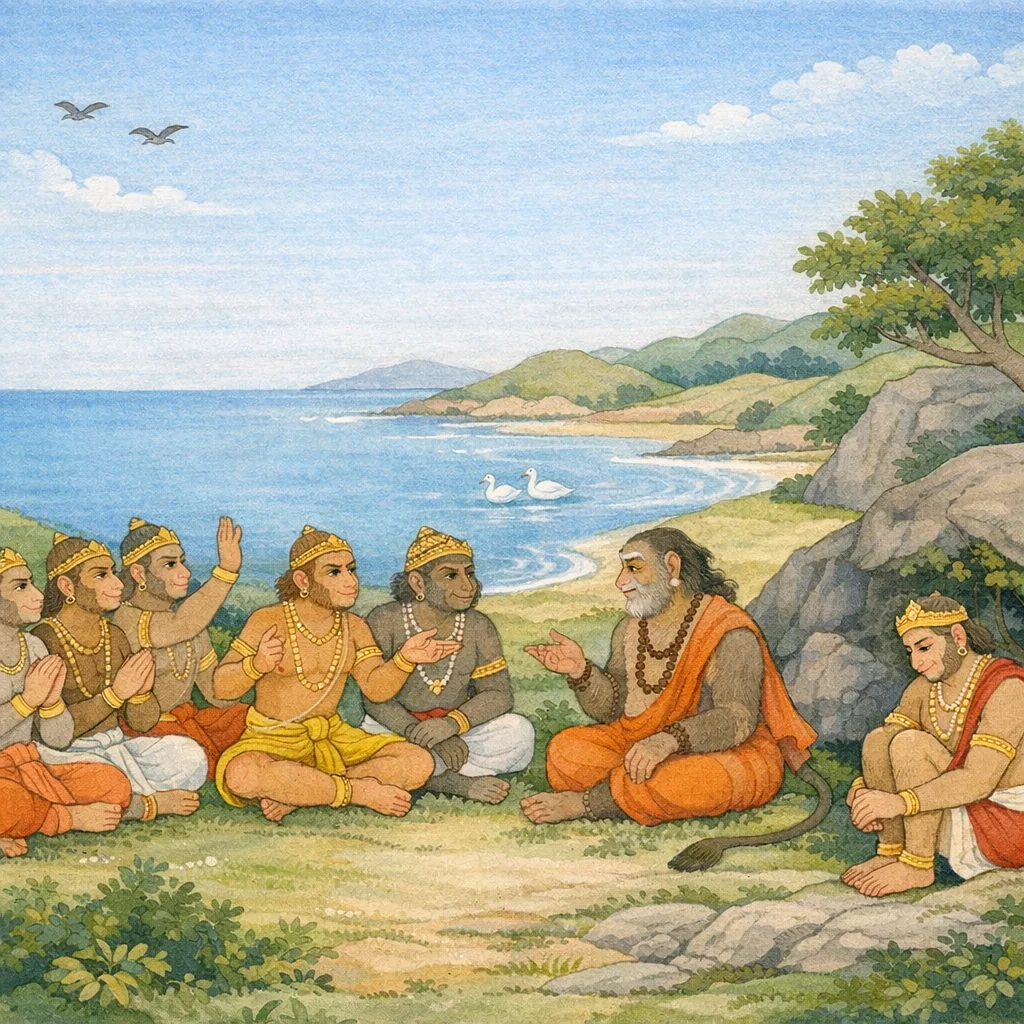
In this sarga, after hearing Angada, the foremost Vanara heroes declare their leaping capacity in turn: Gaja (10), Gavaksha (20), Gavaya (30), Sharabha (40), Gandhamadana (50), Mainda (more than 60), Dvivida (70), and Sushena (80) yojanas. Then Jambavan, the eldest, assesses their strength and speaks of his own old age. Recalling the might of his youth—when, at a great yajña, he circumambulated Trivikrama-Vishnu—he says that now he can go only ninety yojanas, and teaches that this is still insufficient for the mission. Angada declares he can reach a hundred yojanas, yet his power to return is uncertain. Jambavan insists Angada should not be sent, for he is the army’s commander and the “root” of the enterprise, to be protected by the principle of safeguarding the foundation. Angada, still urgent in duty, makes a dreadful vow: if none will go, he will again undertake fasting unto death. At last Jambavan resolves to rouse the truly capable one: he approaches Hanuman, seated apart and famed as the greatest of leapers, to kindle his confidence and zeal. Thus this sarga plants the seed of Hanuman’s appointment to the great crossing.
Shlokas
Verse 1
अथाङ्गदवचश्श्रुत्वा ते सर्वे वानरर्षभाः।स्वं स्वं गतौ समुत्साहमूचुस्तत्र यथाक्रमम्।।।।गजो गवाक्षो गवयश्शरभो गन्धमादनः।मैन्दश्च द्विविदश्चैव सुषेणो जाम्बवां स्तथा।।।।
After hearing Angada’s words, all the foremost monkeys—Gaja, Gavākṣa, Gavaya, Śarabha, Gandhamādana, Mainda, Dvivida, Suṣeṇa, and Jāmbavān—each in turn declared their own confidence and ability for the leap.
Verse 2
अथाङ्गदवचश्श्रुत्वा ते सर्वे वानरर्षभाः।स्वं स्वं गतौ समुत्साहमूचुस्तत्र यथाक्रमम्।।4.65.1।।गजो गवाक्षो गवयश्शरभो गन्धमादनः।मैन्दश्च द्विविदश्चैव सुषेणो जाम्बवां स्तथा।।4.65.2।।
Then, having heard Angada’s words, all those bull-like leaders among the vānaras—Gaja, Gavākṣa, Gavaya, Śarabha, Gandhamādana, Mainda, Dvivida, Suṣeṇa, and also Jāmbavān—declared, each in turn, the extent of his own ability for the journey.
Verse 3
आबभाषे गजस्तत्र प्लवेयं दशयोजनम्।गवाक्षो योजननान्याह गमिष्यामीति विंशतिम्।।।।
Then Gaja declared that he could leap ten yojanas, and Gavākṣa said that he could go as far as twenty.
Verse 4
गवयो वानरस्तत्र वानरां स्तानुवाच ह।त्रिंशतं तु गमिष्यामि योजनानां प्लवङ्गमाः।।।।शरभस्तानुवाचाथ वानरान् वानरर्षभः।चत्वारिंशद्गमिष्यामि योजनानां प्लवङ्गमाः।।।।वानरस्तु महातेजा अब्रवीद्गन्धमादनः।योजनानां गमिष्यामि पञ्चाशत्तु न संशयः।।।।मैन्दस्तु वानरस्तत्र वानरांस्तानुवाच ह।योजनानां परं षष्टिमहं प्लवितुमुत्सहे।।।।ततस्तत्र महातेजा द्विविदः प्रत्यभाषत।गमिष्यामि न सन्देहस्सप्ततिं योजनान्यहम्।।।।सुषेणस्तु महातेजा:प्रोक्तवान्हरिसत्तमान्।अशीतिं योजनानां तु प्लवेयं प्लवगेश्वराः।।।।
There Gavaya addressed the monkeys: “O leaping ones, I can go thirty yojanas.” Then Śarabha, the bull among monkeys, said: “I can go forty yojanas.” The radiant Gandhamādana declared: “I can go fifty yojanas—without doubt.” Mainda told them: “I am eager to leap beyond sixty yojanas.” Then the mighty Dvivida replied: “Without doubt, I can go seventy yojanas.” And the brilliant Suṣeṇa proclaimed before the best of monkeys: “O lords of leapers, I can leap eighty yojanas.”
Verse 5
गवयो वानरस्तत्र वानरां स्तानुवाच ह।त्रिंशतं तु गमिष्यामि योजनानां प्लवङ्गमाः।।4.65.4।।शरभस्तानुवाचाथ वानरान् वानरर्षभः।चत्वारिंशद्गमिष्यामि योजनानां प्लवङ्गमाः।।4.65.5।।वानरस्तु महातेजा अब्रवीद्गन्धमादनः।योजनानां गमिष्यामि पञ्चाशत्तु न संशयः।।4.65.6।।मैन्दस्तु वानरस्तत्र वानरांस्तानुवाच ह।योजनानां परं षष्टिमहं प्लवितुमुत्सहे।।4.65.7।।ततस्तत्र महातेजा द्विविदः प्रत्यभाषत।गमिष्यामि न सन्देहस्सप्ततिं योजनान्यहम्।।4.65.8।।सुषेणस्तु महातेजा:प्रोक्तवान्हरिसत्तमान्।अशीतिं योजनानां तु प्लवेयं प्लवगेश्वराः।।4.65.9।।
There Gavaya addressed the monkeys: “O leaping ones, I can go thirty yojanas.” Then Śarabha, the bull among monkeys, said: “I can go forty yojanas.” The radiant Gandhamādana declared: “I can go fifty yojanas—without doubt.” Mainda told them: “I am eager to leap beyond sixty yojanas.” Then the mighty Dvivida replied: “Without doubt, I can go seventy yojanas.” And the brilliant Suṣeṇa proclaimed before the best of monkeys: “O lords of leapers, I can leap eighty yojanas.”
Verse 6
गवयो वानरस्तत्र वानरां स्तानुवाच ह।त्रिंशतं तु गमिष्यामि योजनानां प्लवङ्गमाः।।4.65.4।।शरभस्तानुवाचाथ वानरान् वानरर्षभः।चत्वारिंशद्गमिष्यामि योजनानां प्लवङ्गमाः।।4.65.5।।वानरस्तु महातेजा अब्रवीद्गन्धमादनः।योजनानां गमिष्यामि पञ्चाशत्तु न संशयः।।4.65.6।।मैन्दस्तु वानरस्तत्र वानरांस्तानुवाच ह।योजनानां परं षष्टिमहं प्लवितुमुत्सहे।।4.65.7।।ततस्तत्र महातेजा द्विविदः प्रत्यभाषत।गमिष्यामि न सन्देहस्सप्ततिं योजनान्यहम्।।4.65.8।।सुषेणस्तु महातेजा:प्रोक्तवान्हरिसत्तमान्।अशीतिं योजनानां तु प्लवेयं प्लवगेश्वराः।।4.65.9।।
There Gavaya addressed the monkeys: “O leaping ones, I can go thirty yojanas.” Then Śarabha, the bull among monkeys, said: “I can go forty yojanas.” The radiant Gandhamādana declared: “I can go fifty yojanas—without doubt.” Mainda told them: “I am eager to leap beyond sixty yojanas.” Then the mighty Dvivida replied: “Without doubt, I can go seventy yojanas.” And the brilliant Suṣeṇa proclaimed before the best of monkeys: “O lords of leapers, I can leap eighty yojanas.”
Verse 7
गवयो वानरस्तत्र वानरां स्तानुवाच ह।त्रिंशतं तु गमिष्यामि योजनानां प्लवङ्गमाः।।4.65.4।।शरभस्तानुवाचाथ वानरान् वानरर्षभः।चत्वारिंशद्गमिष्यामि योजनानां प्लवङ्गमाः।।4.65.5।।वानरस्तु महातेजा अब्रवीद्गन्धमादनः।योजनानां गमिष्यामि पञ्चाशत्तु न संशयः।।4.65.6।।मैन्दस्तु वानरस्तत्र वानरांस्तानुवाच ह।योजनानां परं षष्टिमहं प्लवितुमुत्सहे।।4.65.7।।ततस्तत्र महातेजा द्विविदः प्रत्यभाषत।गमिष्यामि न सन्देहस्सप्ततिं योजनान्यहम्।।4.65.8।।सुषेणस्तु महातेजा:प्रोक्तवान्हरिसत्तमान्।अशीतिं योजनानां तु प्लवेयं प्लवगेश्वराः।।4.65.9।।
There Gavaya addressed the monkeys: “O leaping ones, I can go thirty yojanas.” Then Śarabha, the bull among monkeys, said: “I can go forty yojanas.” The radiant Gandhamādana declared: “I can go fifty yojanas—without doubt.” Mainda told them: “I am eager to leap beyond sixty yojanas.” Then the mighty Dvivida replied: “Without doubt, I can go seventy yojanas.” And the brilliant Suṣeṇa proclaimed before the best of monkeys: “O lords of leapers, I can leap eighty yojanas.”
Verse 8
गवयो वानरस्तत्र वानरां स्तानुवाच ह।त्रिंशतं तु गमिष्यामि योजनानां प्लवङ्गमाः।।4.65.4।।शरभस्तानुवाचाथ वानरान् वानरर्षभः।चत्वारिंशद्गमिष्यामि योजनानां प्लवङ्गमाः।।4.65.5।।वानरस्तु महातेजा अब्रवीद्गन्धमादनः।योजनानां गमिष्यामि पञ्चाशत्तु न संशयः।।4.65.6।।मैन्दस्तु वानरस्तत्र वानरांस्तानुवाच ह।योजनानां परं षष्टिमहं प्लवितुमुत्सहे।।4.65.7।।ततस्तत्र महातेजा द्विविदः प्रत्यभाषत।गमिष्यामि न सन्देहस्सप्ततिं योजनान्यहम्।।4.65.8।।सुषेणस्तु महातेजा:प्रोक्तवान्हरिसत्तमान्।अशीतिं योजनानां तु प्लवेयं प्लवगेश्वराः।।4.65.9।।
There Gavaya addressed the monkeys: “O leaping ones, I can go thirty yojanas.” Then Śarabha, the bull among monkeys, said: “I can go forty yojanas.” The radiant Gandhamādana declared: “I can go fifty yojanas—without doubt.” Mainda told them: “I am eager to leap beyond sixty yojanas.” Then the mighty Dvivida replied: “Without doubt, I can go seventy yojanas.” And the brilliant Suṣeṇa proclaimed before the best of monkeys: “O lords of leapers, I can leap eighty yojanas.”
Verse 9
गवयो वानरस्तत्र वानरां स्तानुवाच ह।त्रिंशतं तु गमिष्यामि योजनानां प्लवङ्गमाः।।4.65.4।।शरभस्तानुवाचाथ वानरान् वानरर्षभः।चत्वारिंशद्गमिष्यामि योजनानां प्लवङ्गमाः।।4.65.5।।वानरस्तु महातेजा अब्रवीद्गन्धमादनः।योजनानां गमिष्यामि पञ्चाशत्तु न संशयः।।4.65.6।।मैन्दस्तु वानरस्तत्र वानरांस्तानुवाच ह।योजनानां परं षष्टिमहं प्लवितुमुत्सहे।।4.65.7।।ततस्तत्र महातेजा द्विविदः प्रत्यभाषत।गमिष्यामि न सन्देहस्सप्ततिं योजनान्यहम्।।4.65.8।।सुषेणस्तु महातेजा:प्रोक्तवान्हरिसत्तमान्।अशीतिं योजनानां तु प्लवेयं प्लवगेश्वराः।।4.65.9।।
There Gavaya addressed the monkeys: “O leaping ones, I can go thirty yojanas.” Then Śarabha, the bull among monkeys, said: “I can go forty yojanas.” The radiant Gandhamādana declared: “I can go fifty yojanas—without doubt.” Mainda told them: “I am eager to leap beyond sixty yojanas.” Then the mighty Dvivida replied: “Without doubt, I can go seventy yojanas.” And the brilliant Suṣeṇa proclaimed before the best of monkeys: “O lords of leapers, I can leap eighty yojanas.”
Verse 10
तेषां कथयतां तत्र सर्वांस्ताननुमान्य च।ततो वृद्धतमस्तेषां जाम्बवान्प्रत्यभाषत।।।।
As they spoke there, Jāmbavān—the eldest among them—considered the strength of them all and then replied.
Verse 11
पूर्वमस्माकमप्यासीत्कश्चिद्गतिपराक्रमः।ते वयं वयसः पारमनुप्राप्तास्स्म साम्प्रतम्।।।।
“In earlier days, I too had a measure of heroic power of movement; but now I have reached the far end of age.”
Verse 12
किन्तु नैवं गते शक्यमिदं कार्यमुपेक्षितुम्।यदर्थं कपिराजश्च रामश्च कृतनिश्चयौ।।।।
Yet even so, this task cannot be neglected, for the Monkey-king and Rāma stand firmly resolved for this very purpose.
Verse 13
साम्प्रतं कालभेदेन या गतिस्तां निबोधत।नवतिं योजनानां तु गमिष्यामि न संशयः।।4.65.13।।
Now, altered by the passage of time, understand the measure of my movement: I can go ninety yojanas—without doubt.
Verse 14
तांश्च सर्वान्हरिश्रेष्ठाञ्जाम्बवान्पुनरब्रवीत्।न खल्वेतावदेवासीद्गमने मे पराक्रमः।।।।
Jāmbavān again addressed all those best of monkeys: “Truly, in former days my leaping prowess was not limited to only this extent.”
Verse 15
मया महाबलेश्चैव यज्ञे विष्णुस्सनातनः।प्रदक्षिणीकृतः पूर्वं क्रममाणस्त्रिविक्रमम्।।।।
Formerly, at Mahābali’s sacrifice, I reverently circumambulated the eternal Viṣṇu as he advanced in his three great strides—Trivikrama.
Verse 16
स इदानीमहं वृद्धः प्लवने मन्दविक्रमः।यौवने च तदाऽसीन्मे बलमप्रतिमं परैः।।।।
But now I am old, and my leaping strength is diminished; in my youth, my power then was unequalled by others.
Verse 17
सम्प्रत्येतावतीं शक्तिं गमने तर्कयाम्यहम्।नैतावता हि संसिद्धिः कार्यस्यास्य भविष्यति।।।।
At present, I judge my strength for the journey to be only this much; with only this, the success of this undertaking will not be attained.
Verse 18
अथोत्तरमुदारार्थमब्रवीदङ्गदस्तदा।अनुमान्य तथा प्राज्ञो जाम्बवन्तं महाकपिम्।।।।
Then the wise Angada, respectfully considering the great monkey Jāmbavān, replied in a gentle and gracious manner.
Verse 19
अहमेतद्गमिष्यामि योजनानां शतं महत्।निवर्तने तु मे शक्तिस्स्यान्न वेति न निश्चितम्।।।।
I can go as far as a great hundred yojanas; but as for returning, it is not certain whether I will still have the strength—or not.
Verse 20
तमुवाच हरिश्रेष्ठं जाम्बवान्वाक्यकोविदः।ज्ञायते गमने शक्तिस्तव हर्यृक्षसत्तम।।।।
Jāmbavān, skilled in speech, said to that best of vānaras: “O foremost among monkeys and bears, your strength for going is well known.”
Verse 21
कामं शतं सहस्रं वा न ह्येष विधिरुच्यते।योजनानां भवान् शक्तो गन्तुं प्रतिनिवर्तितुम्।।।।
Even if it were a hundred—or a thousand—yojanas, you are able both to go and to return; yet it is not the proper course to appoint you for this mission.
Verse 22
न हि प्रेषयिता तात स्वामी प्रेष्यः कथञ्चन।भवताऽयं जनस्सर्वः प्रेष्यः प्लवगसत्तम।।4.65.22।।
For the one who commands—the lord—should never, dear one, be the one sent on errands. Rather, O best of leapers, it is this entire company that should be dispatched by you.
Verse 23
भवान्कळत्रमस्माकं स्वामिभावे व्यवस्थितः।स्वामी कळत्रं सैन्यस्य गतिरेषा परन्तप।।।।
You are established in the role of our lord; to us you are like a protected spouse. The lord is the ‘spouse’ of the army—this is the proper order, O subduer of foes.
Verse 24
अपि चैतस्य कार्यस्य भवान्मूलमरिन्दम।तस्मात्कळत्रवत्तात प्रतिपाल्यस्सदा भवान्।।।।
And moreover, O subduer of enemies, you are the very root of this undertaking. Therefore, dear one, you must always be protected—like a spouse.
Verse 25
मूलमर्थस्य संरक्ष्यमेष कार्यविदां नयः।मूले सति हि सिद्ध्यन्ति गुणा फलो पुष्पोदयाः।।।।
The root of the objective must be protected—this is the policy of those who understand how tasks are accomplished. For when the root remains secure, qualities come to fruition, and flowers and fruits arise.
Verse 26
तद्भवानस्य कार्यस्य साधने सत्यविक्रम।बुद्धिविक्रमसम्पन्नो हेतुरत्र परन्तप।।।।
Therefore, O truly valiant one, in accomplishing this task, you—endowed with both intelligence and prowess—are the decisive cause here, O chastiser of foes.
Verse 27
गुरुश्च गुरुपुत्रश्च त्वं हि नः कपिसत्तम।भवन्तमाश्रित्य वयं समर्था ह्यर्थसाधने।।।।
For us, O best of monkeys, you are both a revered guide and the son of our revered guide; relying on you, we are truly capable of accomplishing our purpose.
Verse 28
उक्तवाक्यं महाप्राज्ञं जाम्बवन्तं महाकपिः।प्रत्युवाचोत्तरं वाक्यं वालिसूनुरथाङ्गदः।।।।
When the very wise Jāmbavān had spoken, the great monkey Aṅgada—Vāli’s son—answered him in reply.
Verse 29
यदि नाहं गमिष्यामि नान्यो वानरपुङ्गवः।पुनः खल्विदमस्माभिः कार्यं प्रायोपवेशनम्।।।।
If I do not go—and if no other monkey-chief goes—then indeed we must again resort to prāyopaveśana, the sacred fast unto death.
Verse 30
न ह्यकृत्वा हरिपतेस्सन्देशं तस्य धीमतः।तत्रापि गत्वा प्राणानां पश्यामि परिरक्षणम्।।।।
For if we do not accomplish the command of that wise lord of monkeys, I see no safeguarding of our lives—even if we return there, to Kiṣkindhā.
Verse 31
स हि प्रसादे चात्यर्थं कोपे च हरिरीश्वरः।अतीत्य तस्य सन्देशं विनाशो गमने भवेत्।।।।
For that lord among monkeys is exceedingly powerful—both in granting favor and in anger. If we depart having overstepped his command, destruction would follow.
Verse 32
तद्यथा ह्यस्य कार्यस्य न भवत्यन्यथा गतिः।तद्भवानेव दृष्टार्थस्सञ्चिन्तयितु मर्हति।।।।
Since there is no other course for accomplishing this task, you alone—who see the matter clearly—ought to consider the means carefully.
Verse 33
सोऽङ्गदेन तदा वीरः प्रत्युक्तः प्लवगर्षभः।जाम्बवानुत्तरं वाक्यं प्रोवाचेदं ततोऽङ्गदम्।।।।
Thus addressed by the hero Aṅgada, Jāmbavān—the bull among the leapers—then spoke these answering words to Aṅgada.
Verse 34
अस्य ते वीर कार्यस्य न किञ्चित्परिहीयते।एष सञ्चोदयाम्येनं यः कार्यं साधयिष्यति।।।।
O hero, nothing in this undertaking shall be lost. I shall rouse the one who will accomplish the task.
Verse 35
ततःप्रतीतं प्लवतांवरिष्ठम्एकान्तमाश्रित्य सुसुखेपविष्ठम्सञ्चोदयामास हरिप्रवीरोहरिप्रवीरं हनुमन्तमेव।।।।
Then the foremost of the monkey-heroes approached Hanumān alone—renowned, the best among leapers—seated at ease apart, and stirred Hanumān himself to action.
Frequently Asked Questions
The dilemma is whether Angada, as heir-apparent and commander, should be sent on a high-risk envoy mission. Jambavan argues it violates role-ethics (svāmī vs. preṣya) and strategic prudence, insisting the ‘root’ of the mission must be protected even if Angada is personally capable.
Competence alone is not sufficient; right deployment is dharma and nīti. The sarga teaches ‘mūlam arthasya saṅrakṣyam’—protect the essential enabling cause (leadership/strategic center), and use wise motivation to awaken the uniquely suited agent (Hanuman) for task completion.
Rather than a physical geography, the sarga foregrounds cultural-religious memory: Mahabali’s yajña and Vishnu’s Trivikrama episode, used by Jambavan as a benchmark for past strength; it also uses the yojana as the operative metric for mission-distance planning.