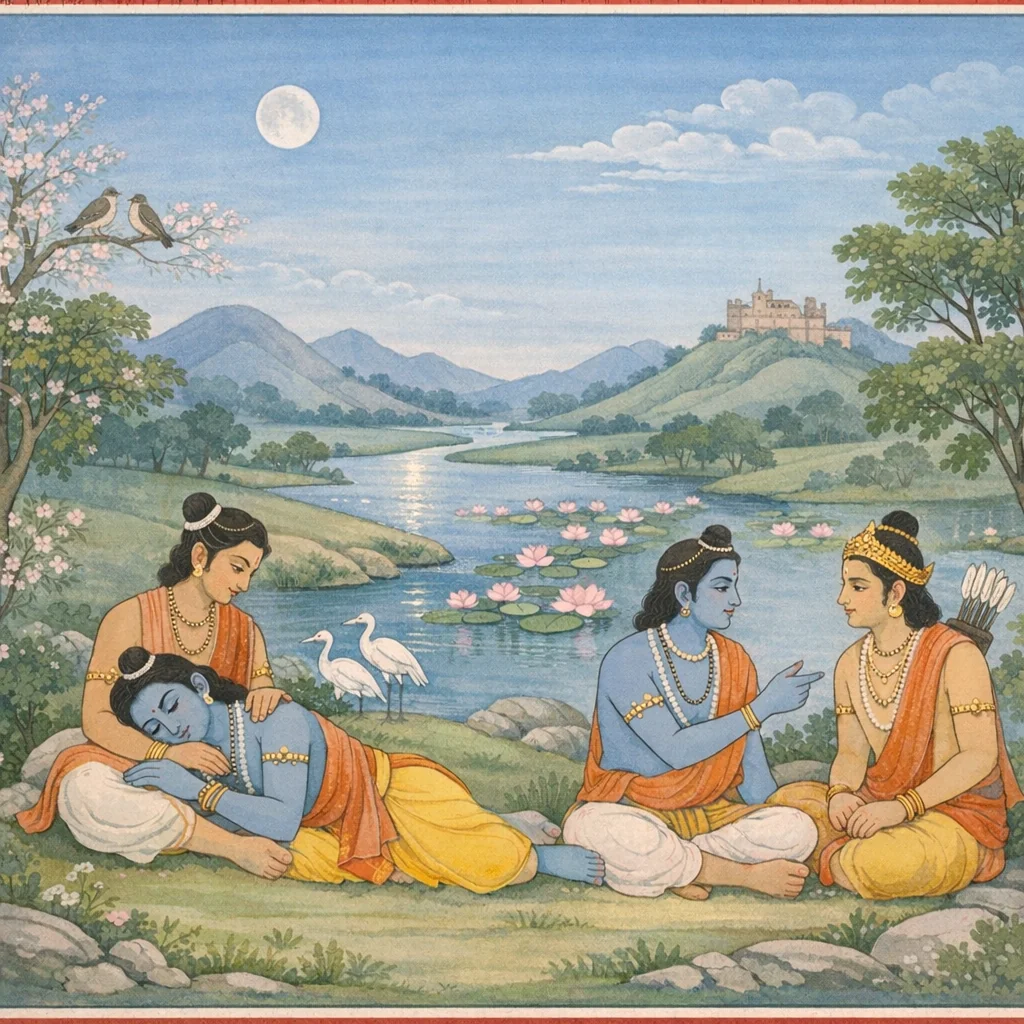
Sarga 30
शरत्प्रवेशे रामविलापः तथा सुग्रीवप्रमादे लक्ष्मणप्रेषणम् (Autumn’s Onset: Rama’s Lament and Lakshmana Sent to Sugriva)
किष्किन्धाकाण्ड
In Sarga 30, when the rains have ended and the sky is clear, Rāma gazes upon the autumn moon. Tormented by kāma and śoka in separation from Sītā, he realizes that the promised time has passed while Sugrīva remains absorbed in pleasure, and he collapses into a swoon. Reviving, Rāma laments Sītā through reflections bound to nature—birds, rivers, lotuses, winds, and moonlight—using the season’s imagery to voice viraha and to mark the turning from varṣā to śarat. Lakṣmaṇa returns, finds Rāma senseless, and urges him toward kriyābhiyoga: renewed effort, calm resolve, and strategic follow-through, affirming that Janakī cannot be easily held when Rāma is her protector. Rāma accepts the counsel yet insists that the pledge and timeline have been violated. He commands Lakṣmaṇa to enter Kiṣkindhā and admonish Sugrīva, warning that failure to honor the vow will bring consequences like Vāli’s fate. Thus the chapter binds poetic ṛtu-varṇana to an ethic of rule: promises, alliances, and timely action are indispensable for dharma and the mission’s success.
Shlokas
Verse 1
गुहं प्रविष्टे सुग्रीवे विमुक्ते गगने घनैः।वर्षरात्रोषितो रामः कामशोकाभिपीडितः।।पाण्डुरं गगनं दृष्ट्वा विमलं चन्द्रमण्डलम्।शारदीं रजनीं चैव दृष्ट्वा ज्योत्स्नानुलेपनाम्।।कामवृत्तं च सुग्रीवं नष्टां च जनकात्मजाम्।बुद्ध्वा कालमतीतं च मुमोह परमातुरः।।
When Sugrīva had entered his cave and the sky was freed from heavy clouds, Rāma—who had endured the nights of the rainy season—remained oppressed by longing and grief.
Verse 2
गुहं प्रविष्टे सुग्रीवे विमुक्ते गगने घनैः।वर्षरात्रोषितो रामः कामशोकाभिपीडितः4.30.1।।पाण्डुरं गगनं दृष्ट्वा विमलं चन्द्रमण्डलम्।शारदीं रजनीं चैव दृष्ट्वा ज्योत्स्नानुलेपनाम्4.30.2।।कामवृत्तं च सुग्रीवं नष्टां च जनकात्मजाम्।बुद्ध्वा कालमतीतं च मुमोह परमातुरः4.30.3।।
Seeing the sky grow pale and clear, and beholding the spotless orb of the moon—seeing too the autumn night as though anointed with moonlight—Rāma’s sorrow grew keener as the season changed and the promised time slipped away.
Verse 3
गुहं प्रविष्टे सुग्रीवे विमुक्ते गगने घनैः।वर्षरात्रोषितो रामः कामशोकाभिपीडितः4.30.1।।पाण्डुरं गगनं दृष्ट्वा विमलं चन्द्रमण्डलम्।शारदीं रजनीं चैव दृष्ट्वा ज्योत्स्नानुलेपनाम्4.30.2।।कामवृत्तं च सुग्रीवं नष्टां च जनकात्मजाम्।बुद्ध्वा कालमतीतं च मुमोह परमातुरः4.30.3।।
When Sugrīva withdrew into his residence and the sky was freed of clouds, Rāma—who had spent the rainy nights tormented by longing and grief—beheld the pale heavens and the spotless circle of the autumn moon, the night as though anointed with moonlight. Realizing that Sugrīva was absorbed in pleasure, that Janaka’s daughter was still lost, and that the appointed time had been exceeded, the deeply distressed Rāma fainted.
Verse 4
स तु संज्ञामुपागम्य मुहूर्तान्मतिमान्पुनः।मनस्स्थामपि वैदेहीं चिन्तयामास राघवः।।
But after a short while, regaining consciousness, the wise Rāghava again began to think of Vaidehī, ever abiding within his mind.
Verse 5
आसीनः पर्वतस्याग्रे हेमधातुविभूषिते।शारदं गगनं दृष्ट्वा जगाम मनसा प्रियाम्।।
Seated on a mountain peak adorned with gold and minerals, Rama, seeing the clear autumn sky, went in his mind to his beloved.
Verse 6
दृष्ट्वा च विमलं व्योम गतविद्युद्वलाहकम्।सारसारावसङ्घुष्ठं विललापार्तया गिरा।।
Seeing the sky clear—freed of clouds and lightning—and echoing with the cries of sārasa cranes, Rāma lamented in a sorrow-stricken voice.
Verse 7
सारसारावसन्नादैस्सारसारवनादिनी।याऽऽश्रमे रमते बाला साऽद्य मे रमते कथम्।।
How can that young woman—whose voice was like the call of the sārasas, who once delighted in the hermitage amid their sweet sounds—find any delight now?
Verse 8
पुष्पितांश्चासनान् दृष्ट्वा काञ्चनानिव निर्मलान्।कथं सा रमते बाला पश्यन्ती मामपश्यती।।
Seeing the aśana trees in bloom—pure, as though golden—how can that young woman find any joy, seeing everything yet not seeing me?
Verse 9
या पुरा कलहंसानां स्वरेण कलभाषिणी।बुध्यते चारुसर्वाङ्गी साऽद्य मे बुद्ध्यते कथम्।।
She who once—sweet-voiced and lovely in every limb—would awaken to the calls of swans: how will that Sītā of mine awaken now?
Verse 10
निस्वनं चक्रवाकानां निशम्य नहचारिणाम्।पुण्डरीकविशालाक्षी कथमेषा भविष्यति।।
Hearing the calls of the cakravāka birds moving through the sky, I wonder: how will she fare—she of wide eyes like the pale lotus—now that such companions are no longer near her?
Verse 11
सरांसि सरितो वापीः काननानि वनानि च।तां विना मृगशाबाक्षीं चरन्नाद्य सुखं लभे।।
Though I wander among lakes, rivers, wells, groves, and forests, I find no happiness now without her—the fawn-eyed lady.
Verse 12
अपि तां मद्वियोगाच्छ सौकुमार्याच्च भामिनीम्।सुदूरं पीडयेत्कामश्शरद्गुणनिरन्तरः।।
That lovely lady—so delicate, and separated from me—must be tormented severely; even the ceaseless charm of autumn, awakening desire, would only deepen her pain so far away.
Verse 13
एवमादि नरश्रेष्ठो विललाप नृपात्मजः।विहङ्ग इव सारङ्गस्सलिलं त्रिदशेश्वरात्।।
Thus the prince, best among men, lamented in many such ways—like the sāraṅga bird crying out for water to Indra, lord of the gods.
Verse 14
ततश्चञ्चूर्य रम्येषु फलार्थी गिरिसानुषु।ददर्श पर्युपावृत्तो लक्ष्मीवान्लक्ष्मणोऽग्रजम्।।
Then Lakṣmaṇa, graceful and radiant, having searched the lovely mountain slopes for fruits and turned back, saw his elder brother.
Verse 15
तं चिन्तया दुस्सहया परीतंविसंज्ञमेकं विजने मनस्वी।भ्रातुर्विषादात्परितापदीनःसमीक्ष्य सौमित्रिरुवाच रामम्।।
Seeing Rāma alone in that lonely wilderness—beset by unbearable thoughts and fallen unconscious—the noble Saumitrī, pained by his brother’s grief and suffering, addressed him.
Verse 16
किमार्य कामस्य वशंगतेनकिमात्मपौरुष्यपराभवेन।अयं सदा संह्रियते समाधिःकिमत्र योगेन निवर्तितेन।।
O noble brother, why submit to desire, and why let your own courage be overcome? Your steady composure is slipping away—why forsake self-discipline and inner steadiness at such a time?
Verse 17
क्रियाभियोगं मनसः प्रसादंसमाधियोगानुगतं च कालम्।सहायसामर्थ्यमदीनसत्त्वःस्वकर्म हेतुं च कुरुष्व हेतुम्।।
O undaunted one, commit yourself to decisive action; through disciplined contemplation regain clarity and serenity of mind, and act at the proper time. Let the strength of your own effort and the support you can gather become the very cause of success.
Verse 18
न जानकी मानव वंशनाथत्वया सनाथा सुलभा परेण।न चाग्निचूडां ज्वलितामुपेत्यन दह्यते वीर वरार्ह कच्छित्।।
O lord of the human lineage, since Janakī has you as her protector, she cannot be easily held by another. Just as none can approach a towering, blazing fire without being burned, so none can safely keep her when you rise to reclaim her.
Verse 19
सलक्षणं लक्ष्मणमप्रधृष्यंस्वभावजं वाक्यमुवाच रामः।हितं च पथ्यं च नयप्रसक्तंससाम धर्मार्थसमाहितं च।।
Then Rāma spoke to Lakṣmaṇa—auspicious in marks and unassailable—words true to his own nature: beneficial and wholesome, aligned with sound policy, conciliatory in approach, and firmly grounded in dharma and artha.
Verse 20
निस्संशयं कार्यमवेक्षितव्यंक्रियाविशेषोऽह्यनुवर्तितव्यः।ननु प्रवृत्तस्य दुरासदस्यकुमार कार्यस्य फलं च चिन्त्यम्।।
Beloved, without doubt the task must be reviewed and pursued with special care. And once such a formidable undertaking is set in motion, its outcome too must be thoughtfully considered.
Verse 21
अथ पद्मपलाशाक्षीं मैथिलीमनुचिन्तयन्।उवाच लक्ष्मणं रामो मुखेन परिशुष्यता।।
Then Rāma, ever thinking of Maithilī whose eyes were like lotus petals, spoke to Lakṣmaṇa, his mouth and lips dried by anguish.
Verse 22
तर्पयित्वा सहस्राक्षस्सलिलेन वसुन्धराम्।निर्वर्तयित्वा सस्यानि कृतकर्मा व्यवस्थितः।।
Having satisfied the earth with waters and brought the crops to fruition, Sahasrākṣa (Indra), his duty accomplished, now stands at rest.
Verse 23
स्निग्धगम्भीरनिर्घोषाश्शैलद्रुमपुरोगमाः।विसृज्य सलिलं मेघाः परिश्रान्ता नृपात्मज।।
O prince, the clouds—sounding deep and pleasing as they move before mountains and trees—have poured out their waters and are now spent with exertion.
Verse 24
नीलोत्पलदलश्यामाश्श्यामीकृत्वा दिशो दश।विमदा इव मातङ्गाश्शान्तवेगाः पयोधराः।।
The rain-clouds, dark as blue-lotus petals and once blackening all ten directions, have now grown calm in their force—like elephants whose intoxication has passed.
Verse 25
जलगर्भा महामेघा कुटजार्जुनगन्धिनः।चरित्वा विरतास्सौम्य वृष्टिवातास्समुद्यताः।।
O gentle one, the great clouds—laden with water—have moved on and ceased; and the rain-laden winds no longer blow as before, now carrying the fragrance of kuṭaja and arjuna blossoms.
Verse 26
घनानां वारणानां च मयूराणां च लक्ष्मण।नादः प्रस्रवणानां च प्रशान्तस्सहसाऽनघ।।
O sinless Lakṣmaṇa, the rumbling of the heavy clouds, the trumpeting of elephants, the cries of peacocks, and even the roar of waterfalls have suddenly fallen silent.
Verse 27
अभिवृष्टा महामेघैर्निर्मलाश्चित्रसानवः।अनुलिप्ता इवाऽभान्ति गिरयश्चित्रदीप्तिभिः।।
Washed on all sides by great rain-clouds, the many-hued mountain-slopes stand cleansed; the mountains shine as though smeared with variegated radiance.
Verse 28
शाखासु सप्तच्छदपादपानांप्रभासु तारार्कनिशाकराणाम्।लीलासु चैवोत्तम वारणानांश्रियं विभज्याद्य शरत्प्रवृत्ता।।
Now autumn has begun, distributing its beauty—upon the branches of the saptacchada trees, in the radiance of stars, sun, and moon, and in the playful movements of noble elephants.
Verse 29
सम्प्रत्यनेकाश्रय चित्रशोभालक्ष्मीश्शरत्कालगुणोपनीता।सूर्याग्रहस्तप्रतिबोधितेषुपद्माकरेष्वभ्यधिकं विभाति।।
Now the many-formed, variegated beauty brought by autumn—like Lakṣmī herself—shines all the more upon lotus-lakes awakened by the sun’s first rays.
Verse 30
सप्तच्छदानां कुसुमोपगन्धीषट्पादबृन्दैरनुगीयमानः।मत्तद्विपानां पवनोऽनुसारीदर्पं विनेष्यन्नधिकं करोति।।।।
The wind, bearing the fragrance of saptacchada blossoms and accompanied by the humming of swarms of bees, follows the rutting elephants and, as it were, makes their pride rise still higher.
Verse 31
अभ्यागतैश्चारुविशालपक्षैस्सरःप्रियैः पद्मरजोवकीर्णैः।महानदीनां पुलिनोपयातैःक्रीडन्ति हंसास्सह चक्रवाकैः।।
Swans—lovers of the lakes—newly arrived with lovely broad wings dusted with lotus pollen, sport together with cakravāka birds along the sandy banks of great rivers.
Verse 32
मदप्रगल्भेषु च वारणेषुगवां समूहेषु च दर्पितेषु।प्रसन्नतोयासु च निम्नगासुविभाति लक्ष्मीर्बहुधा विभक्ता।।
Beauty—like Lakṣmī herself, divided into many manifestations—shines in proud rutting elephants, in spirited herds of cattle, and in streams whose waters have become clear.
Verse 33
नभस्समीक्ष्याम्बुधरैर्विमुक्तंविमुक्तबर्हाभरणा वनेषु।प्रियास्वसक्ता विनिवृत्तशोभागतोत्सवा ध्यानपरा मयूराः।।
Seeing the sky released from clouds, the peacocks in the forests have cast off their plume-ornaments; no longer clinging to their beloveds, their splendour withdrawn and their revelry gone, they are absorbed only in yearning contemplation.
Verse 34
मनोज्ञगन्धैः प्रियकैरनल्पैःपुष्पातिभारावनताग्रशाखैः।सुवर्णगौरैर्नयनाभिरामैरुद्योतितानीव वनान्तराणि।।
The forest tracts seem as though illumined—by countless priyaka trees, sweetly and richly fragrant, their branch-tips bowed beneath the heavy burden of blossoms, golden-hued and delightful to the eyes.
Verse 35
प्रियान्वितानां नलिनीप्रियाणांवने रतानां कुसुमोद्धतानाम्।मदोत्कटानां मदलालसानांगजोत्तमानां गतयोऽद्य मन्दाः।।
Today the movements of the lordly elephants are slow—accompanied by their beloved mates, fond of lotus-ponds, delighting in the forest, exhilarated by the fragrance of blossoms, and stirred by rut and longing.
Verse 36
व्यभ्रं नभश्शस्त्रविधौतवर्णंकृशप्रवाहानि नदीजलानि।कह्लारशीताः पवनाः प्रवान्तितमोविमुक्ताश्च दिशः प्रकाशाः।।
The cloudless sky gleams like a weapon newly polished; the rivers run with a slender current; winds cooled by white lotuses blow; and the quarters, released from darkness, shine clear.
Verse 37
सूर्यातपक्रामणनष्टपङ्काभूमिश्चिरोदधाटितसान्द्ररेणुः।अन्योन्यवैरेणसमायुतानामुद्योगकालोऽद्य नराधिपानाम्4.30.37।।
With the sun’s heat the mud has dried away, and after long the thick dust rises again—today is the season fit for campaigns by kings who are bound together in mutual enmity.
Verse 38
शरद्गुणाप्यायितरूपशोभाःप्रहर्षिताः पांशुसमुत्क्षिताङ्गाः।मदोत्कटास्सम्प्रति युद्धलुब्धावृषा गवां मध्यगता नदन्ति।।
Amid the herd of cows, the bulls bellow now—exultant, their limbs dust-coated, their forms made splendid by the virtues of autumn; driven by rut, they are eager for battle.
Verse 39
समन्मथं तीव्रगतानुरागाःकुलान्विता मन्दगतिं करिण्यः।मदान्वितं सम्परिवार्य यान्तंवनेषु भर्तारमनुप्रयान्ति।।
Female elephants of noble breed, their love running deep and swift, encircle and follow their lord maddened by rut as he moves slowly through the forests.
Verse 40
त्यक्त्वा वराण्यात्मविभूषणानिबर्हाणि तीरोपगता नदीनाम्।निर्भर्त्स्यमाना इव सारसौघैःप्रयान्ति दीना विमदा मयूराः।।
Having cast off their splendid ornaments—their plumes—the peacocks wander along the riverbanks, spiritless and forlorn, as though reproached by flocks of sārasas.
Verse 41
वित्रास्य कारण्डवचक्रवाकान्महारवैर्भिन्नकटा गजेन्द्राः।सरस्सु बद्धाम्बुजभूषणेषुविक्षोभ्य विक्षोभ्य जलं पिबन्ति।।
Great elephants in rut, with loud trumpeting, terrify the ducks and cakravāka birds; in lotus-adorned lakes they churn the water again and again and then drink.
Verse 42
व्यपेतपङ्कासु सवालुकासुप्रसन्नतोयासु सगोकुलासु।ससारसारावनिनादितासुनदीषु हृष्टा निपतन्ति हंसाः।।
Joyful swans alight upon the rivers—where the mud has cleared, sandy banks appear, the waters run pure, cattle gather, and the calls of the sārasas resound.
Verse 43
नदीघनप्रस्रवणोदकानामतिप्रवृद्धानिलबर्हिणानाम्।प्लवङ्गमानां च गतोत्सवानांद्रुतं रवास्सम्प्रति सम्प्रणष्टाः।।
Now the clamorous sounds quickly vanish—the roar of rivers, clouds, and waterfalls; the peacocks, once thrilled by strong winds, lose their festive excitement, and the frogs too fall silent.
Verse 44
अनेकवर्णास्सुविनष्टकायानवोदितेष्वम्बुधरेषु नष्टाः।क्षुधार्दिता घोरविषा बिलेभ्यश्चिरोषिता विप्रसरन्ति सर्पाः।।
When no fresh rain-clouds appear, serpents of many colours—long confined in their holes, their bodies wasted away—emerge, fierce with hunger and terrible with venom.
Verse 45
चञ्चच्चन्द्रकरस्पर्शहर्षोन्मीलिततारका।अहो रागवती सन्ध्या जहाति स्वयमम्बरम्।।
As the stars open out in delight at the playful touch of the moonbeams—ah—this crimson twilight, of her own accord, leaves the sky.
Verse 46
रात्रिश्शशाङ्कोदितसौम्यवक्त्रातारागणोन्मीलितचारुनेत्रा।ज्योत्स्नांशुकप्रावरणा विभातिनारीव शुक्लांशुकसंवृताङ्गी।।
Night shines like a woman: her gentle face made fair by the risen moon, her lovely eyes opened by the host of stars, her body wrapped in a garment of white moonlight.
Verse 47
विपक्वशालिप्रसवानि भुक्त्वाप्रहर्षिता सारसचारुपङ्क्तिः।नभस्समाक्रामति शीघ्रवेगाःवातावधूता ग्रथितेव माला।।
After feeding on the ripe ears of rice, the lovely lines of sārasas, delighted and swift, sweep across the sky—wind-driven, like a garland strung and flung aloft.
Verse 48
सुप्तैकहंसं कुमुदैरुपेतंमहाह्रदस्थं सलिलं विभाति।घनैर्विमुक्तं निशि पूर्णचन्द्रंतारागणाकीर्णमिवान्तरिक्षम्।।
The water of the great lake—adorned with night-lotuses and holding a single swan asleep—shines like the night sky, freed of clouds, with the full moon and strewn with stars.
Verse 49
प्रकीर्णहंसाकुलमेखलानांप्रबुद्धपद्मोत्पलमालिनीनाम्।वाप्युत्तमानामधिकाऽद्य लक्ष्मीर्वराङ्गनानामिव भूषितानाम्।।
Today the beauty of the finest ponds is heightened—swans scattered like girdles, and awakened lotuses and lilies like garlands—as though they were noble women adorned.
Verse 50
वेणुस्वनव्यञ्जिततूर्यमिश्रःप्रत्यूषकालानिलसम्प्रवृद्धः।सम्मूर्छितो गर्गरगोवृषाणामन्योन्यमापूरयतीव शब्दः।।
At dawn, the sound—mingling with music shaped by bamboo-notes and strengthened by the wind—swells and resonates, as if the cavern-bellowings of bulls were filling and answering one another.
Verse 51
नवैर्नदीनां कुसुमप्रभासैर्व्याधूयमानैर्मृदुमारुतेन।धौतामलक्षौमपटप्रकाशैःकूलानि काशैरुपशोभितानि।।
The riverbanks are adorned with fresh kāśa reeds—white as newly blossomed flowers—gently swaying in a soft breeze, shining like spotless, washed silk cloth.
Verse 52
वनप्रचण्डा मधुपानशौण्डाःप्रियान्विताष्षट्चरणाः प्रह्रृष्टाः।वनेषु मत्ताः पवनानुयात्रांकुर्वन्ति पद्मासनरेणुगौराः।।
In the forests, the bees—bold in their woodland roaming, skilled in drinking honey—move about in delight with their mates, intoxicated, following the wind, their bodies pale with the pollen-dust from lotus-cups.
Verse 53
जलं प्रसन्नं कुमुदं प्रभासंक्रौञ्चस्वनश्शालिवनं विपक्वम्।मृदुश्च वायुर्विमलश्च चन्द्रश्शंसन्ति वर्षव्यपनीतकालम्।।
Clear waters, night-lotuses in full bloom, the calls of krauñca birds, ripened paddy-fields, a gentle breeze, and the bright moon all proclaim that the season of rains has passed and autumn has arrived.
Verse 54
मीनोपसन्दर्शितमेखलानांनदीवधूनां गतयोऽद्य मन्दाः।कान्तोपभुक्तालसगामिनीनांप्रभातकालेष्विव कामिनीनाम्।।
Today the river-brides, showing fish as though they were girdles at their waists, flow gently—like lovers in the early morning, moving languidly after being enjoyed by their beloved.
Verse 55
सचक्रवाकानि सशैवलानिकाशैर्दुकूलैरिव संवृतानि।सपत्रलेखानि सरोचनानिवधूमुखानीव नदीमुखानि।।
The river-mouths, filled with cakravāka birds and green moss, and veiled with kāśa reeds as if with silken cloth, appear like a bride’s face—adorned with leaf-designs and bright rocanā marks.
Verse 56
प्रफुल्लबाणासनचित्रितेषुप्रहृष्टषट्पादनिकूजितेषु।गृहीतचापोद्यतचण्डदण्डःप्रचण्डचारोऽद्य वनेषु कामः।।
Now, in forests patterned with blooming bāṇa and āsana flowers and resonant with the joyful humming of bees, Kāma moves fiercely—bow in hand, his harsh rod raised—punishing those separated from their beloveds.
Verse 57
लोकं सुवृष्ट्या परितोषयित्वानदीस्तटाकानि च पूरयित्वा।निष्पन्नसस्यां वसुधां च कृत्वात्यक्त्वा नभस्तोयधराः प्रणष्टाः।।
After satisfying the world with good rains, filling rivers and tanks, and making the earth rich with mature crops, the cloud-bearers have left the sky and vanished.
Verse 58
दर्शयन्ति शरन्नद्यः पुलिनानि शनैः शनैः।नवसङ्गमसव्रीडा जघनानीव योषितः।।
In autumn the rivers slowly reveal their sandbanks—like young brides, shy at a first union, who gradually disclose their hips.
Verse 59
प्रसन्नसलिलास्सौम्य कुररीभिर्विनादिताः।चक्रवाकगणाकीर्णा विभान्ति सलिलाशयाः।।
O gentle one, the reservoirs shine with clear water, resonant with the calls of female kurarī birds, and crowded with flocks of cakravākas.
Verse 60
असनास्सप्तपर्णाश्च कोविदाराश्च पुष्पिताः।दृश्यन्ते बन्धुजीवाश्च श्यामाश्च गिरिसानुषु।।
On the mountain slopes, āsana trees, saptaparṇas, and kovidāras are in bloom; bandhujīva plants and śyāmā creepers too are seen flowering.
Verse 61
हंससारसचक्राह्वैः कुररैश्च समन्ततः।पुलिनान्यवकीर्णानि नदीनां पश्य लक्ष्मण।।
Look, Lakshmana: the sandbanks of the rivers are strewn all around with swans, sārasa cranes, cakravākas, and kurara birds.
Verse 62
अन्योन्यबद्धवैराणां जिगीषूणां नृपात्मज।उद्योगसमयस्सौम्य पार्थिवानामुपस्थितः।।
O prince, dear one: for kings who are bound in mutual enmity and seek victory, the season for setting out on campaigns has now arrived.
Verse 63
इयं सा प्रथमा यात्रा पार्थिवानां नृपात्मजन च पश्यामि सुग्रीवमुद्योगं वा तथाविधम्।।
O prince, this is that first campaigning season of kings; yet I do not see Sugrīva making effort in the manner required.
Verse 64
चत्वारो वार्षिका मासा गता वर्षशतोपमाः।मम शोकाभिभूतस्य सौम्य सीतामपश्यतः।।
Dear one, four months of the rains have passed—each like a hundred years to me—while I, overwhelmed by grief, have not seen Sītā.
Verse 65
चक्रवाकीव भर्तारं पृष्ठतोऽनुगता वनम्।विषमं दण्डकारण्यमुद्यानमिव याऽगता।।
Like a cakravākī following her mate, she followed her husband into the forest—entering the rugged Daṇḍaka wilderness as though it were a pleasure-garden.
Verse 66
प्रियाविहीने दुःखार्ते हृतराज्ये विवासिते।कृपां न कुरुते राजा सुग्रीवो मयि लक्ष्मण।।
Lakṣmaṇa, though I am deprived of my beloved, afflicted with sorrow, stripped of kingdom, and living in exile, King Sugrīva shows me no compassion.
Verse 67
अनाथो हृतराज्योऽयं रावणेन च धर्षितः।दीनो दूरगृहः कामी मां चैव शरणं गतः।।इत्येतैः कारणैस्सौम्य सुग्रीवस्य दुरात्मनः।अहं वानरराजस्य परिभूतः परन्तप।।
“He is helpless, deprived of kingdom, violated by Rāvaṇa, miserable, far from home, love-stricken, and has come to me for refuge”—for such reasons, dear one, that evil-minded Sugrīva, the monkey-king, treats me with contempt, O scorcher of foes.
Verse 68
अनाथो हृतराज्योऽयं रावणेन च धर्षितः।दीनो दूरगृहः कामी मां चैव शरणं गतः4.30.67।।इत्येतैः कारणैस्सौम्य सुग्रीवस्य दुरात्मनः।अहं वानरराजस्य परिभूतः परन्तप4.30.68।।
That evil-minded one, having reckoned the time for searching for Sītā and achieved his own ends, does not understand that the time fixed by his promise has arrived and now presses with urgency.
Verse 69
स कालं परिसङ्ख्याय सीतायाः परिमार्गणे।कृतार्थस्समयं कृत्वा दुर्मतिर्नावबुध्यते।।
That evil-minded one, having reckoned the time for searching for Sītā and achieved his own ends, does not understand that the time fixed by his promise has arrived and now presses with urgency.
Verse 70
त्वं च किष्किन्धां प्रविश्य ब्रूहि वानरपुङ्गवम्।मूर्खं ग्राम्यसुखे सक्तं सुग्रीवं वचनान्मम।।
Enter Kiṣkindhā and, in my name, speak to Sugrīva, chief of the vānaras—foolishly absorbed in coarse, worldly pleasures.
Verse 71
अर्थिनामुपपन्नानां पूर्वं चाप्युपकारिणाम्।आशां संश्रुत्य यो हन्ति स लोके पुरुषाधमः।।
He who, after giving hope by a pledged assurance to one who seeks help—especially to a former benefactor—then destroys that hope, is the lowest of men in this world.
Verse 72
शुभं वा यदि वा पापं यो हि वाक्यमुदीरितम्।सत्येन प्रतिगृह्णाति स वीरः पुरुषोत्तमः।।
But he who takes up the word he has spoken—whether it brings good or hardship—and upholds it in truth, is a hero, the best of men.
Verse 73
कृतार्था ह्यकृतार्थानां मित्राणां न भवन्ति ये।तान्मृतानपि क्रव्यादाः कृतघ्नान्नोपभुञ्जते।।
Those who, having achieved their own ends, do not stand by friends still in need—such ungrateful men are so vile that even flesh-eating beasts would not consume them, even in death.
Verse 74
नूनं काञ्चनपृष्ठस्य विकृष्टस्य मया रणे।द्रष्टुमिच्छति चापस्य रूपं विद्युद्गणोपमम्।।
Surely he longs to behold the form of my bow, gold-backed, when I draw it in battle—flashing like a mass of lightning.
Verse 75
घोरं ज्यातलनिर्घोषं क्रुद्धस्य मम संयुगे।निर्घोषमिव वज्रस्य पुनस्संश्रोतुमिच्छसि।।
Perhaps you wish to hear again, in combat, the dreadful twang of my bowstring when I am enraged—like the crash of Indra’s thunderbolt.
Verse 76
काममेवंगतेऽप्यस्य परिज्ञाते पराक्रमे।त्वत्सहायस्य मे वीर न चिन्ता स्यान्नृपात्मज।।
Even if he behaves thus, though fully aware of my prowess, O heroic prince—since you stand as my ally, son of a king—I have no cause for anxiety.
Verse 77
यदर्थमयमारम्भः कृतः परपुरञ्जयः।समयं नाभिजानाति कृतार्थः प्लवगेश्वरः।।
O conqueror of enemy strongholds, the lord of monkeys—having attained his own end—no longer recognizes the agreement for the sake of which this effort was begun.
Verse 78
वर्षासमयकालं तु प्रतिज्ञाय हरीश्वरः।व्यतीतांश्चतुरो मासान्विहरन्नावबुध्यते।।
Though the lord of monkeys had vowed to act after the rainy season, he does not even notice that four months have passed while he has been sporting in pleasure.
Verse 79
सामात्यपरिषत्क्रीडन्पानमेवोपसेवते।शोकदीनेषु नास्मासु सुग्रीवः कुरुते दयाम्।।
Surrounded by his ministers and court, Sugriva sports and clings only to drink; toward us—worn down by grief—he shows no compassion.
Verse 80
उच्यतां गच्छ सुग्रीवस्त्वया वत्स महाबल।मम रोषस्य यद्रूपं ब्रूयाश्चैवमिदं वचः।।
O mighty one, dear child—go to Sugrīva. Make him understand the true force of my anger, and convey to him these words in exactly this manner.
Verse 81
न च सङ्कुचितः पन्था येन वाली हतो गतः।समये तिष्ठ सुग्रीव मा वालिपथमन्वगाः।।
The path by which Vālī went—slain—has not been closed. Keep to the agreement, O Sugrīva; do not follow the path of Vālī.
Verse 82
एक एव रणे वाली शरेण निहतो मया।त्वां तु सत्यादतिक्रान्तं हनिष्यामि सबान्धवम्।।
Vālī was struck down by me in battle with a single arrow. But you—if you have crossed beyond truth—I will destroy along with your kinsmen.
Verse 83
तदेवं विहिते कार्ये यद्धितं पुरुषर्षभ।तत्तद्भ्रूहि नरश्रेष्ठत्वर कालव्यतिक्रमः।।
Since the task must be carried out in this way, tell him what is truly for his good, O best of men. Make haste—time is slipping away.
Verse 84
कुरुष्व सत्यं मयि वानरेश्वरप्रतिश्रुतं धर्ममवेक्ष्य शाश्वतम्।मा वालिनं प्रेत्य गतो यमक्षयंत्वमद्य पश्येर्मम चोदितैश्शरैः।।
Fulfil your truth to me, O lord of the Vānaras; honour your promise, regarding it as eternal dharma. Do not, struck down today by arrows loosed by me, go to Yama’s realm and behold Vālī there.
Verse 85
स पूर्वजं तीव्रविवृद्धकोपंलालप्यमानं प्रसमीक्ष्य दीनम्।चकार तीव्रां मतिमुग्रतेजाहरीश्वरे मानववंशनाथः।।
Seeing his elder brother—wretched, lamenting, and with anger fiercely intensified—the fierce and radiant Lakṣmaṇa, protector of the human line, steeled his resolve against the lord of the Vānaras (Sugrīva).
Frequently Asked Questions
The dilemma is alliance ethics under delay: Sugrīva has benefited from Rāma’s aid yet neglects the promised, time-bound search for Sītā. The pivotal action is Rāma’s directive to Lakṣmaṇa to confront Sugrīva and enforce accountability, including a warning framed by Vāli’s precedent.
The dialogue teaches that grief must be transmuted into disciplined effort (kriyābhiyoga) without abandoning composure; and that satya (keeping one’s word) is a binding dharma in friendship and governance—failure of gratitude and promise-keeping is portrayed as a profound moral fall.
Kiṣkindhā is foregrounded as the political center whose inaction threatens the mission; Prasravaṇa and mountain slopes frame Rāma’s vigil; rivers, lakes, lotus-ponds, and autumnal nightscapes serve as cultural-poetic landmarks of ṛtu-varṇana, while the ‘Vāli-path’ becomes a symbolic landmark of punitive consequence.