Sarga 9
वालि–मायावी–बिलप्रवेशः (Vali’s Pursuit of Mayavi and the Cave Episode)
किष्किन्धाकाण्ड
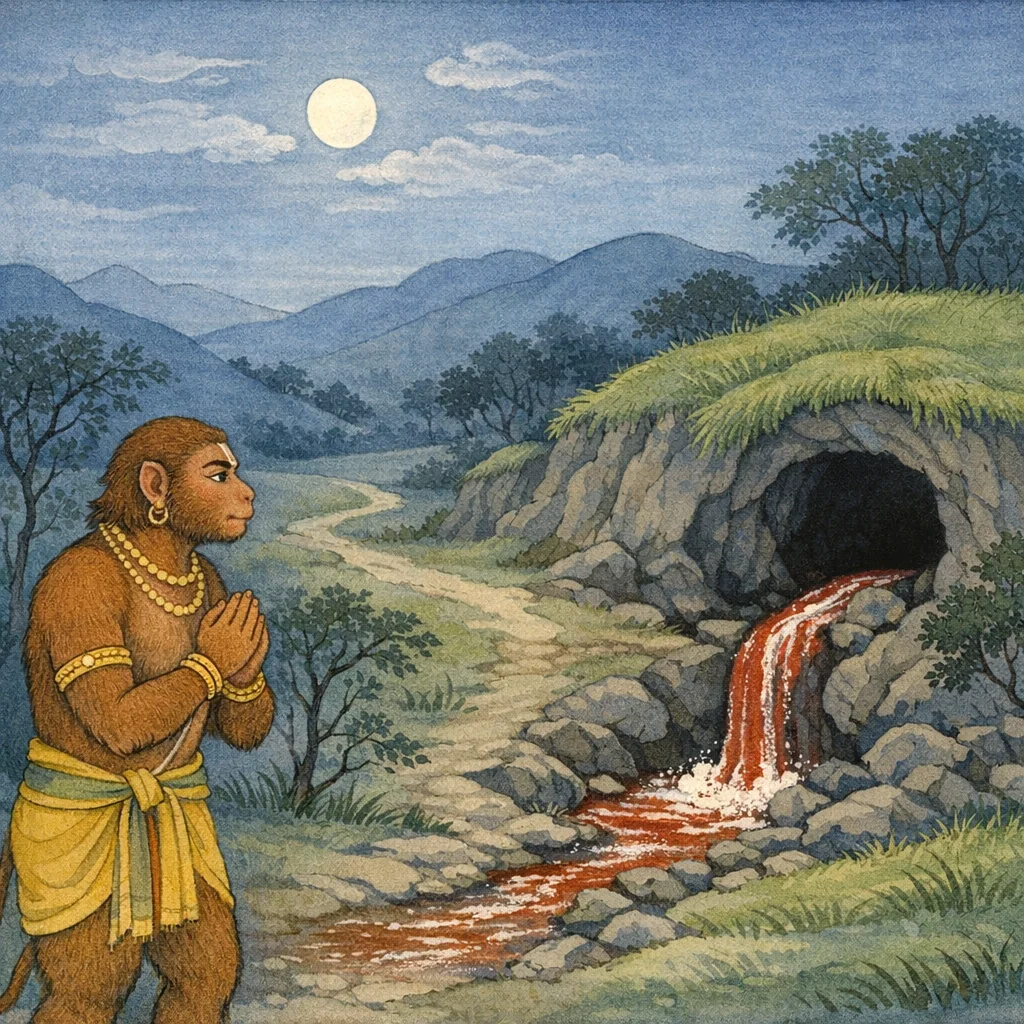
In this sarga, Sugriva tells Rama how his rupture with Vali arose from a chain of politically weighty misunderstandings. He portrays Vali as the elder brother, a slayer of foes, honored by their father and revered by Sugriva himself. At night the demon Mayavi, son of Dundubhi, comes to Kishkindha’s gate and challenges Vali; Vali, enraged, rushes out despite the women’s and Sugriva’s attempts to restrain him. Sugriva follows out of brotherly affection. Seeing them, Mayavi flees, and the moonlit chase ends at a grass-covered, hard-to-reach cave. Vali commands Sugriva to keep watch at the cave mouth while he enters to kill the enemy, making him swear obedience. A long time passes—more than a year—as Sugriva waits, hearing demonic roars but not Vali’s voice; then blood and foam flow out. Concluding Vali has died, Sugriva seals the entrance with a mountain-like rock, performs funerary water-offerings, and returns to Kishkindha. The ministers, seeking continuity of rule, consecrate Sugriva as king. Later Vali returns alive after killing Mayavi; seeing Sugriva enthroned, he imprisons Sugriva’s ministers and speaks harshly. Sugriva says he could have resisted but refrained out of reverence; he offers complete submission—touching Vali’s feet with his crown—yet Vali remains unappeased. Thus the chapter raises a dharma-question: governance amid uncertainty, the ethics of inference from signs, and the fragility of legitimacy when communication collapses.
Shlokas
Verse 1
वाली नाम मम भ्राता ज्येष्ठश्शत्रुनिषूदनः।पितुर्बहुमतो नित्यं ममापि च तथा पुरा4.9.1।।
My elder brother, named Vālī—an annihilator of enemies—was always held in high esteem by our father, and formerly by me as well.
Verse 2
पितर्युपरतेऽस्माकं ज्येष्ठोऽयमिति मन्त्रिभिः।कपीनामीश्वरो राज्ये कृतः परमसम्मतः4.9.2।।
When our father had passed away, the ministers—agreeing, “this one is the elder”—appointed him lord of the monkeys in the kingdom, with the full assent of all.
Verse 3
राज्यं प्रशासतस्तस्य पितृपैतामहं महत्।अहं सर्वेषु कालेषु प्रणतः प्रेष्यवत् स्थितः4.9.3।।
While he governed the great kingdom inherited from our forefathers, I remained at all times bowed and obedient, standing by him like a servant.
Verse 4
मायावी नाम तेजस्वी पूर्वजो दुन्दुभेः सुतः।तेन तस्य महद्वैरं स्त्रीकृतं विश्श्रुतं पुरा4.9.4।।
There was a mighty one named Māyāvī, the elder son of Dundubhi; long ago a great enmity—famed and bitter—arose between him and Vālī, born of a quarrel over a woman.
Verse 5
स तु सुप्तजने रात्रौ किष्किन्धाद्वारमागतः।नर्दति स्म सुसंरब्धो वालिनं चाह्वयद्रणे4.9.5।।
One night, when the people were asleep, he came to the gate of Kiṣkindhā; raging, he roared aloud and challenged Vālī to battle.
Verse 6
प्रसुप्तस्तु मम भ्राता नर्दितं भैरवस्वनम्।श्रुत्वा न ममृषे वाली निष्पपात जवात्तदा4.9.6।।
Though asleep, my brother Vālī, hearing that dreadful roar, could not endure it and at once sprang out in haste.
Verse 7
स तु वै निस्सृतः क्रोधात्तं हन्तुमसुरोत्तमम्।वार्यमाणस्तत स्त्रीभिर्मया च प्रणतात्मना4.9.7।।
In anger he came out to slay that foremost demon, even as the women and I—submissive in spirit—tried to restrain him.
Verse 8
स तु निर्धूय ताः सर्वा निर्जगाम महाबलः।ततोऽहमपि सौहार्दान्निस्सृतो वालिना सह4.9.8।।
That mighty one brushed aside all of them and went out; then I too, out of brotherly affection, came out along with Vālī.
Verse 9
स तु मे भ्रातरं दृष्ट्वा मां च दूरादवस्थितम्।असुरो जातसन्त्रासः प्रदुद्राव ततो भृशम्4.9.9।।
But when the demon saw my brother—and me standing at a distance—he was seized by fear and fled swiftly away.
Verse 10
तस्मिन् द्रवति सन्त्रस्ते ह्यावां द्रुततरं गतौ।प्रकाशश्च कृतो मार्गश्चन्द्रेणोद्गच्छता तदा4.9.10।।
When he fled in fear, we too ran after him even faster; and then, as the moon rose, the path became illuminated.
Verse 11
स तृणैरावृतं दुर्गं धरण्या विवरं महत्।प्रविवेशासुरो वेगादावामासाद्य विष्ठितौ4.9.11।।
That asura, in haste, entered a great opening in the earth—hard to access and covered with grass; we reached the spot and stood our ground there.
Verse 12
तं प्रविष्टं रिपुं दृष्ट्वा बिलं रोषवशं गतः।मामुवाच तदा वाली वचनं क्षुभितेन्द्रियः4.9.12।।
Seeing that enemy enter the cave, Vālī fell under the power of anger; his senses in turmoil, he then spoke these words to me.
Verse 13
इह त्वं तिष्ठ सुग्रीव बिलद्वारि समाहितः।यावत्तत्र प्रविश्याहं निहन्मि सहसा रिपुम्4.9.13।।
“Stay here, Sugrīva, at the mouth of the cave, composed and fully alert, until I enter within and swiftly slay the enemy.”
Verse 14
मया त्वेतद्वचश्श्रुत्वा याचितस्स परन्तपः।शापयित्वा तु मां पद्भ्यां प्रविवेश बिलं महत्4.9.14।।
Hearing my words, I pleaded with him; but that scorcher of foes made me swear at his feet, and then he entered the great cave.
Verse 15
तस्य प्रविष्टस्य बिलं साग्रस्संवत्सरो गतः।स्थितस्य मम बिलद्वारि स कालो व्यत्यवर्तत4.9.15।।
After he entered the cave, more than a full year passed; as I stood waiting at the cave’s entrance, that entire span of time went by.
Verse 16
अहं तु नष्टं ज्ञात्वा तं स्नेहादागतसम्भ्रमः।भ्रातरं न च पश्यामि पापाशङ्कि च मे मनः4.9.16।।
But when I thought him lost, out of affection I was shaken with grief; and since I did not see my brother, my mind became filled with fearful suspicions.
Verse 17
अथ दीर्घस्य कालस्य बिलात्तस्माद्विनिस्सृतम्।सफेनं रुधिरं रक्तमहं दृष्ट्वा सुदुःखितः।।4.9.17।।
Then, after a long time, I saw foaming, crimson blood flowing out from that cave, and I was overwhelmed with sorrow.
Verse 18
नर्दतामसुराणां च ध्वनिर्मे श्रोत्रमागतः।निरस्तस्य च सङ्ग्रामे क्रोशतोनिस्स्वनो गुरोः4.9.18।।
To my ears came only the roar of the asuras; I heard neither a cry nor any voice of my elder brother as he fought in battle.
Verse 19
अहं त्ववगतो बुद्ध्या चिह्नैस्तैर्भ्रातरं हतम्।पिधाय च बिलद्वारं शिलया गिरिमात्रया4.9.19।।शोकार्तश्चोदकं कृत्वा किष्किन्धामागतस्सखे।गूहमानस्य मे तत्त्वं यत्नतो मन्त्रिभिश्श्रुतम्4.9.20।।
O friend, by those signs I understood that my brother had been slain. I sealed the cave’s mouth with a rock as vast as a mountain; then, stricken with grief, I performed the water-offering for the departed and returned to Kiṣkindhā. Though I sought to conceal the truth, the ministers learned it through careful effort.
Verse 20
अहं त्ववगतो बुद्ध्या चिह्नैस्तैर्भ्रातरं हतम्।पिधाय च बिलद्वारं शिलया गिरिमात्रया4.9.19।।शोकार्तश्चोदकं कृत्वा किष्किन्धामागतस्सखे।गूहमानस्य मे तत्त्वं यत्नतो मन्त्रिभिश्श्रुतम्4.9.20।।
O friend, by those signs I understood that my brother had been slain. I sealed the cave’s mouth with a rock as vast as a mountain; then, stricken with grief, I performed the water-offering for the departed and returned to Kiṣkindhā. Though I sought to conceal the truth, the ministers learned it through careful effort.
Verse 21
ततोऽहं तैस्समागम्य सम्मतैरभिषेचितः।राज्यं प्रशासतस्तस्य न्यायतो मम राघव4.9.21।।आजगाम रिपुं हत्वा वाली तमसुरोत्तमम्।।
Then, when those ministers had assembled, they consecrated me by common consent. While I governed the kingdom in accordance with dharma, O Rāghava, Vāli returned after slaying that enemy, the foremost of the asuras.
Verse 22
अभिषिक्तं तु मां दृष्ट्वा वाली संरक्तलोचनः।मदीयान्मन्त्रिणो बद्ध्वा परुषं वाक्यमब्रवीत्4.9.22।।
But when Vāli saw me consecrated, his eyes reddened with rage; he bound my ministers and spoke harsh words to me.
Verse 23
निग्रहेऽपि समर्थस्य तं पापं प्रति राघव।न प्रावर्तत मे बुद्धिर्भ्रातुर्गौरवयन्त्रिता4.9.23।।
O Rāghava, though I was able to restrain that sinner, my judgment did not turn against him, held back by reverence for my brother.
Verse 24
हत्वा शत्रुं स मे भ्राता प्रविवेश पुरं तदा4.9.24।।मानयंस्तं महात्मानं यथावच्चाभ्यवादयम्।उक्ताश्च नाशिषस्तेन सन्तुष्टेनान्तरात्मना4.9.25।।
After killing the enemy, my brother then entered the city.
Verse 25
हत्वा शत्रुं स मे भ्राता प्रविवेश पुरं तदा4.9.24।।मानयंस्तं महात्मानं यथावच्चाभ्यवादयम्।उक्ताश्च नाशिषस्तेन सन्तुष्टेनान्तरात्मना4.9.25।।
Honouring that great-souled one, I greeted him with due reverence as was proper; yet he spoke no blessing to me, for in his inmost heart he was not truly pleased.
Verse 26
नत्वा पादावहं तस्य मकुटेनास्पृशं प्रभोअपि वाली मम क्रोधान्न प्रसादं चकार सः4.9.26।।
O lord, bowing down, I touched his feet with my crown; even so, Vālī, in anger toward me, showed me no favour.
Frequently Asked Questions
Sugriva must act under uncertainty: after waiting at the cave for a long period and seeing blood flow out, he infers Vali’s death, seals the cave, performs rites, and returns—actions later interpreted as betrayal when Vali reappears.
The narrative highlights how dharma can hinge on evidence and intention: decisions based on signs (blood, silence, time) may be reasonable yet politically catastrophic, and restraint born of reverence can fail to prevent injustice when power is driven by anger.
Key landmarks include Kishkindha and its gate, the grass-covered cave (bilam) and its entrance (biladvāra), and the sealing rock; culturally, it notes coronation by ministers and the funerary water-offering (udaka) as a response to presumed death.