Sarga 41
दक्षिणदिशि सीतान्वेषण-आदेशः (Commissioning the Southern Search for Sītā)
किष्किन्धाकाण्ड
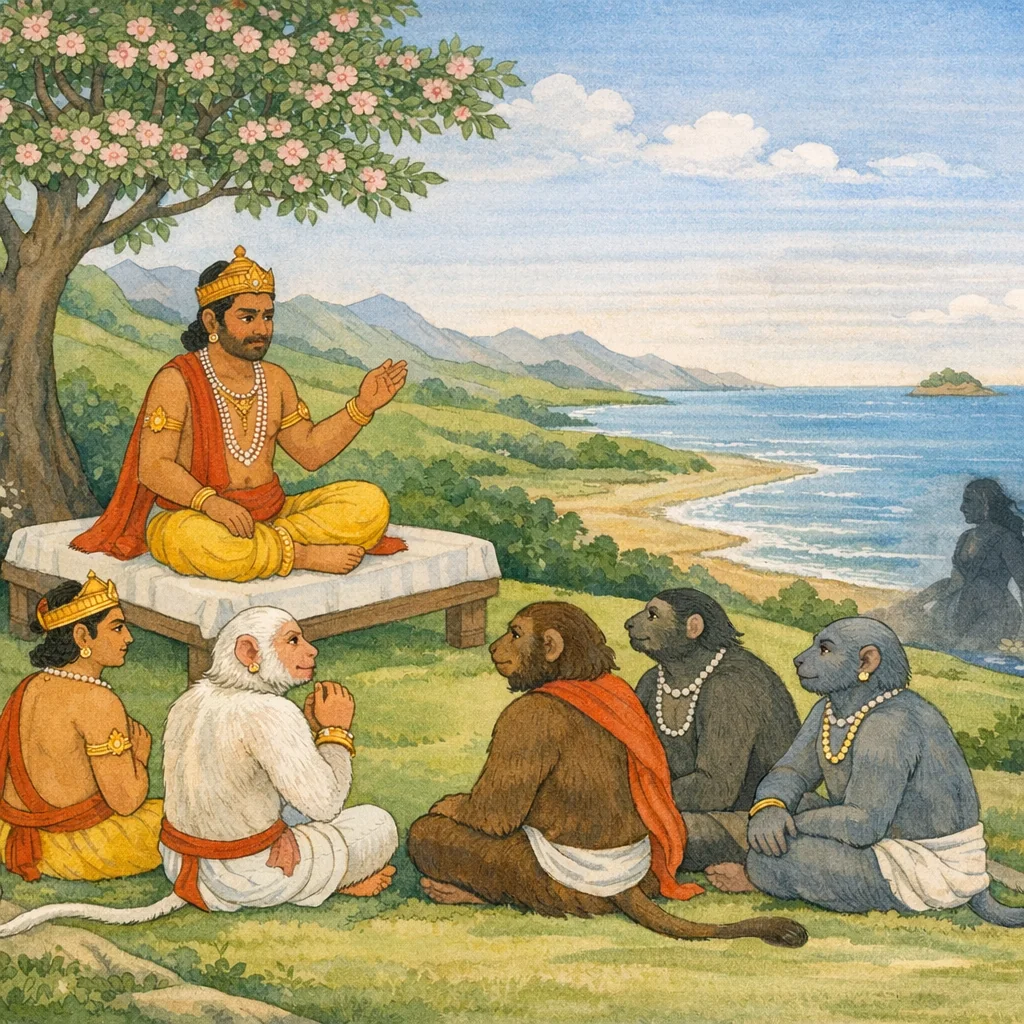
In this sarga, Sugrīva formalizes the southern expedition as a disciplined search-operation. He dispatches an elite vānara host and appoints the mighty Aṅgada as field-leader, naming key captains and specialists—Hanumān, Nīla, and Jāmbavān among them—and urging speed, valor, and orderly execution. He then issues a route-based brief: the party must survey mountain-ranges, forests, rivers, cities, and coastal tracts, searching caves, riverbanks, and hidden places. A long chain of toponyms and waterways is recited—Vindhya, Narmadā, Godāvarī, Kāverī, Tāmraparṇī—carrying the search from inland terrain to littoral and liminal zones. The charge extends into maritime and far-off realms: an island beyond a hundred yojanas is marked as especially significant for its association with Rāvaṇa’s domain. Dangers are specified, including a shadow-seizing rākṣasī (Aṅgārakā/Siṃhikā). Mythic-cosmographic landmarks follow—Mahendra mountain, Pushpitaka mountain, Bhogavatī the city of the nāgas, and Gandharva-guarded sandal forests—culminating in a boundary warning near Yama’s capital and the inaccessibility beyond. Sugrīva concludes with incentives and accountability: return within a month with confirmed news of Sītā and receive prosperity and favor, thereby strengthening morale and responsibility in the mission.
Shlokas
Verse 1
ततः प्रस्थाप्य सुग्रीवस्तन्महद्वानरं बलम्।दक्षिणां प्रेषयामास वानरानभिलक्षितान्।।।।
Then Sugrīva, having marshaled that great vanara host, dispatched select and distinguished monkeys toward the southern quarter.
Verse 2
नील मग्निसुतं चैव हनुमन्तं च वानरम्।पितामहसुतं चैव जाम्बवन्तं महाबलम्।।।।सुहोत्रं च शरारिं च शरगुल्मं तथैव च।गजं गवाक्षं गवयं सुषेणमृषभं तथा।।।।मैन्दं च द्विविदं चैव विजयं गन्धमादनम्।उल्कामुखमसङ्गं च हुताशनसुतावुभौ।।।।अङ्गदप्रमुखान्वीरान्वीर: कपिगणेश्वरः।वेगविक्रमसम्पन्नान्सन्दिदेश विशेषवित्।।।।
Sugrīva, the heroic and discerning lord of the monkey-host, dispatched under Aṅgada’s leadership swift and valiant warriors—Nīla, son of Agni; Hanumān; the mighty Jāmbavān, said to be born of the Grandfather (Brahmā); and also Suhotra, Śarāri, Śaragulma, Gaja, Gavākṣa, Gavaya, Suṣeṇa, Ṛṣabha, Mainda, Dvivida, Vijaya, Gandhamādana, and the two sons of Agni, Ulkāmukha and Asaṅga.
Verse 3
नील मग्निसुतं चैव हनुमन्तं च वानरम्।पितामहसुतं चैव जाम्बवन्तं महाबलम्।।4.41.2।।सुहोत्रं च शरारिं च शरगुल्मं तथैव च।गजं गवाक्षं गवयं सुषेणमृषभं तथा।।4.41.3।।मैन्दं च द्विविदं चैव विजयं गन्धमादनम्।उल्कामुखमसङ्गं च हुताशनसुतावुभौ।।4.41.4।।अङ्गदप्रमुखान्वीरान्वीर: कपिगणेश्वरः।वेगविक्रमसम्पन्नान्सन्दिदेश विशेषवित्।।4.41.5।।
Sugrīva further named Suhotra, Śarāri, Śaragulma, Gaja, Gavākṣa, Gavaya, Suṣeṇa, and Ṛṣabha—valiant vānaras—to be included among those deputed for the southern search.
Verse 4
नील मग्निसुतं चैव हनुमन्तं च वानरम्।पितामहसुतं चैव जाम्बवन्तं महाबलम्।।4.41.2।।सुहोत्रं च शरारिं च शरगुल्मं तथैव च।गजं गवाक्षं गवयं सुषेणमृषभं तथा।।4.41.3।।मैन्दं च द्विविदं चैव विजयं गन्धमादनम्।उल्कामुखमसङ्गं च हुताशनसुतावुभौ।।4.41.4।।अङ्गदप्रमुखान्वीरान्वीर: कपिगणेश्वरः।वेगविक्रमसम्पन्नान्सन्दिदेश विशेषवित्।।4.41.5।।
He appointed Mainda and Dvivida, Vijaya and Gandhamādana, and also the two sons of the Fire-god—Ulkāmukha and Asaṅga.
Verse 5
नील मग्निसुतं चैव हनुमन्तं च वानरम्।पितामहसुतं चैव जाम्बवन्तं महाबलम्।।4.41.2।।सुहोत्रं च शरारिं च शरगुल्मं तथैव च।गजं गवाक्षं गवयं सुषेणमृषभं तथा।।4.41.3।।मैन्दं च द्विविदं चैव विजयं गन्धमादनम्।उल्कामुखमसङ्गं च हुताशनसुतावुभौ।।4.41.4।।अङ्गदप्रमुखान्वीरान्वीर: कपिगणेश्वरः।वेगविक्रमसम्पन्नान्सन्दिदेश विशेषवित्।।4.41.5।।
Sugrīva—the heroic lord of the monkey hosts, discerning and decisive—dispatched the heroes led by Aṅgada, all endowed with speed and valor.
Verse 6
तेषामग्रेसरं चैव महाबलमथाङ्गदम्।विधाय हरिवीराणामादिशद्दक्षिणां दिशम्।।।।
Then he appointed mighty Aṅgada as the leader of the vanguard and directed the heroic monkey-warriors toward the southern quarter.
Verse 7
ये केचन समुद्देशास्तस्यां दिशि सुदुर्गमाः।कपीशः कपिमुख्यानां स तेषां तानुदाहरत्।।।।
And whatever tracts in that quarter were exceedingly hard to reach, the monkey-king described them in detail to the monkey chieftains.
Verse 8
सहस्रशिरसं विन्ध्यं नानाद्रुमलतायुतम्।नर्मदां च नदीं रम्यां महोरगनिषेविताम्।।।।ततो गोदावरीं रम्यां कृष्णवेणीं महानदीम्।वरदां च महाभागां महोरगनिषेविताम्।।।।मेखलामुत्कलां चैव दशार्णनगराण्यपि।आश्ववन्तीमवन्तीं च सर्वामेवानुपश्यत।।।।
Survey the Vindhya range with its thousand-peaked heights, thick with varied trees and creepers, and also the lovely river Narmadā, frequented by mighty serpents.
Verse 9
सहस्रशिरसं विन्ध्यं नानाद्रुमलतायुतम्।नर्मदां च नदीं रम्यां महोरगनिषेविताम्।।4.41.8।।ततो गोदावरीं रम्यां कृष्णवेणीं महानदीम्।वरदां च महाभागां महोरगनिषेविताम्।।4.41.9।।मेखलामुत्कलां चैव दशार्णनगराण्यपि।आश्ववन्तीमवन्तीं च सर्वामेवानुपश्यत।।4.41.10।।
Then search the lovely Godāvarī, the Kṛṣṇaveṇī, and the great river Mahānadī; also the auspicious Varadā, frequented by mighty serpents.
Verse 10
सहस्रशिरसं विन्ध्यं नानाद्रुमलतायुतम्।नर्मदां च नदीं रम्यां महोरगनिषेविताम्।।4.41.8।।ततो गोदावरीं रम्यां कृष्णवेणीं महानदीम्।वरदां च महाभागां महोरगनिषेविताम्।।4.41.9।।मेखलामुत्कलां चैव दशार्णनगराण्यपि।आश्ववन्तीमवन्तीं च सर्वामेवानुपश्यत।।4.41.10।।
Survey and search the Vindhya with its thousand peaks, rich in many trees and creepers, and the lovely river Narmadā, frequented by great serpents. Then proceed to the delightful Godāvarī, to Kṛṣṇaveṇī, to the great river Mahānadī, and also to Varadā and Mahābhāgā—regions haunted by mighty serpents. Observe and search Mekhalā and Utkalā, the towns of Daśārṇa, and also Āśvavantī and Avantī—indeed, search all of them thoroughly.
Verse 11
विदर्भानृषिकांश्चैव रम्यान्माहिषकानपि।तथा वङ्गान्कलिङ्गांश्च कौशिकांश्च समन्ततः।।।।अन्वीक्ष्य दण्डकारण्यं सपर्वतनदीगुहाम्।नदीं गोदावरीं चैव सर्वमेवानुपश्यत।।।।तथैवान्ध्रांश्च पुण्ड्रांश्च चोलान्पाण्ड्यांत्स केरलान्।
Search for Sītā in Vidarbha and the Ṛṣika lands, in the lovely country of Māhiṣaka, and likewise among the Vāṅgas and Kaliṅgas, and throughout the Kauśika region. Having searched the Daṇḍaka forest—with its mountains, rivers, and caves—look carefully also along the Godāvarī river. In the same way, search among the Āndhras, the Puṇḍras, the Colas, the Pāṇḍyas, and the Keralas.
Verse 12
विदर्भानृषिकांश्चैव रम्यान्माहिषकानपि।तथा वङ्गान्कलिङ्गांश्च कौशिकांश्च समन्ततः।।4.41.11।।अन्वीक्ष्य दण्डकारण्यं सपर्वतनदीगुहाम्।नदीं गोदावरीं चैव सर्वमेवानुपश्यत।।4.41.12।।तथैवान्ध्रांश्च पुण्ड्रांश्च चोलान्पाण्ड्यांत्स केरलान्।
Search for Sītā in Vidarbha and the Ṛṣika lands, in the lovely country of Māhiṣaka, and likewise among the Vāṅgas and Kaliṅgas, and throughout the Kauśika region. Having searched the Daṇḍaka forest—with its mountains, rivers, and caves—look carefully also along the Godāvarī river. In the same way, search among the Āndhras, the Puṇḍras, the Colas, the Pāṇḍyas, and the Keralas.
Verse 13
अयोमुखश्च गन्तव्यः पर्वतो धातुमण्डितः।।।।विचित्रशिखर श्श्रीमांश्चित्रपुष्पितकाननः।सचन्दनवनोद्देशो मार्गितव्यो महागिरिः।।।।
You should go to Mount Ayomukha, adorned with mineral ores—splendid, with wondrous peaks and forests bright with many-colored blossoms. That great mountain, rich with tracts of sandalwood groves, must also be searched.
Verse 14
अयोमुखश्च गन्तव्यः पर्वतो धातुमण्डितः।।4.41.13।।विचित्रशिखर श्श्रीमांश्चित्रपुष्पितकाननः।सचन्दनवनोद्देशो मार्गितव्यो महागिरिः।।4.41.14।।
Thereafter you shall behold the divine river Kāverī, whose waters are clear and auspicious; there, it is said, hosts of apsarases sport.
Verse 15
ततस्तामापगां दिव्यां प्रसन्नसलिलां शिवाम्।तत्र द्रक्ष्यथ कावेरीं विहितामप्सरोगणैः।।।।
Thereafter you shall behold the divine river Kāverī, whose waters are clear and auspicious; there, it is said, hosts of apsarases sport.
Verse 16
तस्यासीनं नगस्याग्रे मलयस्य महौजसम्।द्रक्ष्यथाऽदित्यसङ्काशमगस्त्यमृषिसत्तमम्।।।।
On the summit of that Malaya mountain you shall see Agastya, best of seers, seated there—radiant with great splendor, like the sun.
Verse 17
ततस्तेनाभ्यनुज्ञाताः प्रसन्नेन महात्मना।ताम्रपर्णीं ग्राहजुष्टां तरिष्यथ महानदीम्।।।।
Then, having received permission from that noble great-souled sage, pleased with you, you shall cross the mighty river Tāmraparṇī, frequented by crocodiles.
Verse 18
सा चन्दनवनैर्दिव्यै प्रच्छन्ना द्वीपशालिनी।कान्तेव युवति: कान्तां समुद्रमवगाहते।।।।
That river—veiled by lovely sandalwood forests and adorned with islands—enters the ocean, like a beloved young woman going to her beloved.
Verse 19
ततो हेममयं दिव्यं मुक्तामणिविभूषितम्।युक्तं कवाटं पाण्ड्यानां गता द्रक्ष्यथ वानराः।।।।
Thereafter, O vānara warriors, when you arrive you shall behold the Pāṇḍyas’ gate—splendid, fashioned of gold, adorned with pearls and gems, and set firmly in place.
Verse 20
ततस्समुद्रमासाद्य सम्प्रधार्यार्थनिश्चयम्।अगस्त्येनान्तरे तत्र सागरे विनिवेशितः।।।।चित्रनानानगः श्रीमान्महेन्द्र: पर्वतोत्तमः।जातरूपमयः श्रीमानवगाढो महार्णवम्।।।।
Then, upon reaching the ocean, deliberate together and decide the course of action. There, within that region of the sea, Agastya has set a landmark in between.
Verse 21
ततस्समुद्रमासाद्य सम्प्रधार्यार्थनिश्चयम्।अगस्त्येनान्तरे तत्र सागरे विनिवेशितः।।4.41.20।।चित्रनानानगः श्रीमान्महेन्द्र: पर्वतोत्तमः।जातरूपमयः श्रीमानवगाढो महार्णवम्।।4.41.21।।
That excellent mountain Mahendra, splendid with many kinds of colorful trees and radiant as though made of gold, stands in glory and plunges down into the great sea.
Verse 22
नानाविधैर्नगै स्सर्वैलताभिश्चोपशोभितम्।देवर्षियक्षप्रवरैरप्सरोभिश्च सेवितम्।।।।सिद्धचारणसङ्घैश्च प्रकीर्णं समनोरमम्।तमुपैति सहस्राक्षः सदा पर्वसु पर्वसु।।।।
Adorned with all manner of trees and creepers, it is frequented by divine seers, foremost yakṣas, and also by celestial apsarases.
Verse 23
नानाविधैर्नगै स्सर्वैलताभिश्चोपशोभितम्।देवर्षियक्षप्रवरैरप्सरोभिश्च सेवितम्।।4.41.22।।सिद्धचारणसङ्घैश्च प्रकीर्णं समनोरमम्।तमुपैति सहस्राक्षः सदा पर्वसु पर्वसु।।4.41.23।।
Scattered with hosts of siddhas and cāraṇas, it is exceedingly charming and delightful. The thousand‑eyed Indra visits it again and again on every sacred festival day.
Verse 24
द्वीपस्तस्यापरे पारे शतयोजनमायतः।अगम्यो मानुषैर्दीप्तस्तं मार्गध्वं समन्ततः।।।।
Beyond it, on the farther shore, lies a radiant island stretching a hundred yojanas—hard for humans to reach. Search it thoroughly on every side.
Verse 25
तत्र सर्वात्मना सीता मार्गितव्या विशेषतः।स हि देशस्तु वध्यस्य रावणस्य दुरात्मनः।।4.41.25।।राक्षसाधिपतेर्वासस्सहस्राक्षसमद्युतेः।
There Sītā must be sought with one’s whole being, with special care; for that region is the abode of evil‑minded Rāvaṇa, lord of the rākṣasas—one who deserves to be slain, blazing with a splendor like Indra’s.
Verse 26
दक्षिणस्य समुद्रस्य मध्ये तस्य तु राक्षसी।।।।अङ्गारकेति विख्याता छायामाकृष्य भोजिनी।
In the midst of that southern sea is an ogress, famed as Aṅgārakā, who seizes a being’s shadow and devours them.
Verse 27
एवं निस्संशयान्कृत्वा संशयान्नष्टसंशयाः।।।।मृगयध्वं नरेन्द्रस्य पत्नीममिततेजसः।
Thus, resolve uncertainties and become free of doubt; then seek the wife of the king of immeasurable splendor—Rāma.
Verse 28
तमतिक्रम्य लक्ष्मीवान्समुद्रे शतयोजने।।4.41.28।।गिरिः पुष्पितको नाम सिद्धचारणसेवितः।
Having passed beyond that island, in the sea—at a distance of a hundred yojanas—stands a blessed mountain named Puṣpitaka, frequented by siddhas and cāraṇas.
Verse 29
चन्द्रसूर्यांशुसङ्काशस्सागराम्बुसमावृतः।।।।भ्राजते विपुलैश्शृङ्गैरम्बरं विलिखन्निव।
It shines with a radiance like the beams of moon and sun, encircled by the ocean’s waters; with its vast peaks it seems to scratch the sky.
Verse 30
तस्यैकं काञ्चनं शृङ्गं सेवतेऽयं दिवाकरः।।।।श्वेतं राजतमेकं च सेवतेऽयं निशाकरः।न तं कृतघ्नाः पश्यन्ति न नृशंसा न नास्तिकाः।।।।
Of that mountain, the Sun is said to frequent one peak of gold.
Verse 31
तस्यैकं काञ्चनं शृङ्गं सेवतेऽयं दिवाकरः।।4.41.30।।श्वेतं राजतमेकं च सेवतेऽयं निशाकरः।न तं कृतघ्नाः पश्यन्ति न नृशंसा न नास्तिकाः।।4.41.31।।
And the Moon frequents another peak—white and silver. But the ungrateful, the cruel, and the faithless are unable to behold that sight.
Verse 32
प्रणम्य शिरसा शैलं तं विमार्गत वानराः।तमतिक्रम्य दुर्धर्ष स्सूर्यवान्नाम पर्वतः।।।।अध्वना दुर्विगाहेन योजनानि चतुर्दश।
O vānaras, bow your heads to that mountain and continue your search. Beyond it stands the unassailable mountain named Sūryavān, reached by a difficult stretch of fourteen yojanas.
Verse 33
ततस्तमप्यतिक्रम्य वैद्युतो नाम पर्वतः।।।सर्वकामफलैर्वृक्षै स्सर्वकालमनोहरैः।
Then, passing beyond that as well, you will reach the mountain called Vaidyuta, filled with trees that bear wish-fulfilling fruits and remain delightful in every season.
Verse 34
तत्र भुक्त्वा वरार्हाणि मूलानि च फलानि च।।।।मधूनि पीत्वा मुख्यानि परं गच्छत वानराः।
There, eat the choicest roots and fruits, drink the finest honey, and then proceed onward, O vānaras.
Verse 35
तत्र नेत्रमनःकान्तः कुञ्जरो नाम पर्वतः।।।।अगस्त्यभवनं यत्र निर्मितं विश्वकर्मणा।
There is a mountain named Kuñjara, pleasing to both eye and mind; and there stands Agastya’s dwelling, fashioned by Viśvakarman.
Verse 36
तत्र योजनविस्तारमुच्छ्रितं दशयोजनम्।।।।शरणं काञ्चनं दिव्यं नानारत्नविभूषितम्।
That divine dwelling is a yojana in breadth and rises to ten yojanas; it is a golden refuge adorned with many kinds of gems.
Verse 37
तत्र भोगवती नाम सर्पाणामालयः पुरी।।।।विशालकक्ष्या दुर्धर्षा सर्वतः परिरक्षिता।रक्षिता पन्नगैर्घोरैस्तीक्ष्णदष्ट्रैरैर्महाविषैः।।।।सर्पराजो महाप्राज्ञो यस्यां वसति वासुकिः।
There is a city named Bhogavatī—an abode of serpents.
Verse 38
तत्र भोगवती नाम सर्पाणामालयः पुरी।।4.41.37।।विशालकक्ष्या दुर्धर्षा सर्वतः परिरक्षिता।रक्षिता पन्नगैर्घोरैस्तीक्ष्णदष्ट्रैरैर्महाविषैः।।4.41.38।।सर्पराजो महाप्राज्ञो यस्यां वसति वासुकिः।
It has broad corridors and is unassailable, guarded on every side—protected by dreadful serpents with sharp fangs and potent venom. There dwells the wise serpent-king Vāsuki.
Verse 39
निर्याय मार्गितव्या च सा च भोगवती पुरी।।।।तत्र चानन्तरा देशा ये केचन सुसम्वृताः।
Having come out of that city called Bhogavatī, you must search it thoroughly—and also any nearby concealed tracts that are well hidden.
Verse 40
तं च देशमतिक्रम्य महानृषभसंस्थितः।।।।सर्वरत्नमयः श्रीमान् ऋषभो नाम पर्वतः।
After passing beyond that region, there is a vast mountain—R̥ṣabha by name—majestic, bull-like in form, and resplendent with every kind of gem.
Verse 41
गोशीर्षकं पद्मकं च हरिश्यामं च चन्दनम्।।।।दिव्यमुत्पद्यते यत्र तच्चैवाग्निसमप्रभम्।
There grows wondrous sandalwood—gośīrṣa, padmaka, and the dark-green hariśyāma—along with a divine sandalwood that shines with fire-like radiance.
Verse 42
न तु तच्चन्दनं दृष्टवा स्प्रष्टव्यं च कदाचन।।।।रोहिता नाम गन्धर्वा घोरा रक्षन्ति तद्वनम्।
But even upon seeing that sandalwood, you must never touch it; dreadful Gandharvas called the Rohitas guard that forest.
Verse 43
तत्र गन्धर्वपतयः पञ्च सूर्यसमप्रभाः।।।।शैलूषो ग्रामणी श्शिग्रु श्शुभ्रो बभ्रुस्तथैव च।रविसोमाग्निवपुषां निवासः पुण्यकर्मणाम्।।।।
There dwell five lords of the Gandharvas, radiant like the sun—Śailūṣa, Grāmaṇī, Śigru, Śubhra, and Babhru. That region is a habitation of the meritorious, shining with splendor like the sun, the moon, and fire.
Verse 44
तत्र गन्धर्वपतयः पञ्च सूर्यसमप्रभाः।।4.41.43।।शैलूषो ग्रामणी श्शिग्रु श्शुभ्रो बभ्रुस्तथैव च।रविसोमाग्निवपुषां निवासः पुण्यकर्मणाम्।।4.41.44।।
At the very edge of the earth dwell the unassailable ones who have won heaven. Beyond that lies the dread Pitṛ-world, the realm of the Ancestors, which is not for you to enter.
Verse 45
अन्ते पृथिव्या दुर्धर्षास्तत्र स्वर्गजितः स्थिताः।ततः परं न वस्सेव्यः पितृलोक स्सुदारुणः।।।।
At the very edge of the earth dwell the unassailable ones who have won heaven. Beyond that lies the dread Pitṛ-world, the realm of the Ancestors, which is not for you to enter.
Verse 46
राजधानी यमस्यैषा कष्टेन तमसा वृता।एतावदेव युष्माभिर्वीरा वानरपुङ्गवाः।।।।शक्यं विचेतुं गन्तुं वा नातो गतिमतां गतिः।
This is Yama’s capital, shrouded in oppressive darkness. Only up to this point, heroic leaders among the Vānaras, is it possible for you to proceed or to search; beyond this there is no path even for those who move swiftly.
Verse 47
सर्वमेतत्समालोक्य यच्चान्यदपि दृश्यते।।।।गतिं विदित्वा वैदेह्या स्सन्निवर्तितुमर्हथ।
After surveying all this—and whatever else may be seen—once you have learned Vaidehī’s whereabouts, you should then return.
Verse 48
यस्तु मासान्निवृत्तोऽग्रे दृष्टा सीतेति वक्ष्यति।।।।मत्तुल्यविभवो भोगै स्सुखं स विहरिष्यति।
Whoever returns within a month and reports, “Sītā has been seen,” shall dwell happily in enjoyments, possessing prosperity equal to my own.
Verse 49
ततः प्रियतरो नास्ति मम प्राणाद्विशेषतः।।।।कृतापराधो बहुशो मम बन्धुर्भविष्यति।
None will be dearer to me than he—dearer even than my own life. Though he may have erred many times, he shall become my closest kinsman.
Verse 50
अमितबलपराक्रमा भवन्तोविपुलगुणेषु कुलेषु च प्रसूताः।मनुजपतिसुतां यथा लभध्वंतदधिगुणं पुरुषार्थमारभध्वम्।।।।
You are of immeasurable strength and valor, born in lineages rich in virtue. Therefore undertake the highest human endeavor: by whatever means you succeed in finding the king’s daughter (Sītā), accomplish that most excellent quest.
Frequently Asked Questions
The pivotal action is Sugrīva’s conversion of alliance into enforceable duty: he appoints Aṅgada as leader, assigns named commanders, defines the search-scope, and sets a time-bound return condition—balancing compassion and reward with mission accountability.
The upadeśa emphasizes disciplined purposiveness: remove doubt through verification, proceed methodically through known and hidden regions, and align personal valor with collective dharma—service becomes meaningful when guided by clarity, restraint, and responsibility.
A dense itinerary is provided: Vindhya and Narmadā; Godāvarī, Kāverī, and Tāmraparṇī; southern polities (Andhra, Chola, Pāṇḍya, Kerala); mythic sites (Mahendra, Pushpitaka, Bhogavatī, Gandharva-guarded sandal forests), and a maritime hazard (Aṅgārakā/Siṃhikā) in the southern sea.