Sarga 24
वालिवधोत्तरशोकः — Sugriva’s Remorse and Tara’s Lament after Vali’s Death
किष्किन्धाकाण्ड
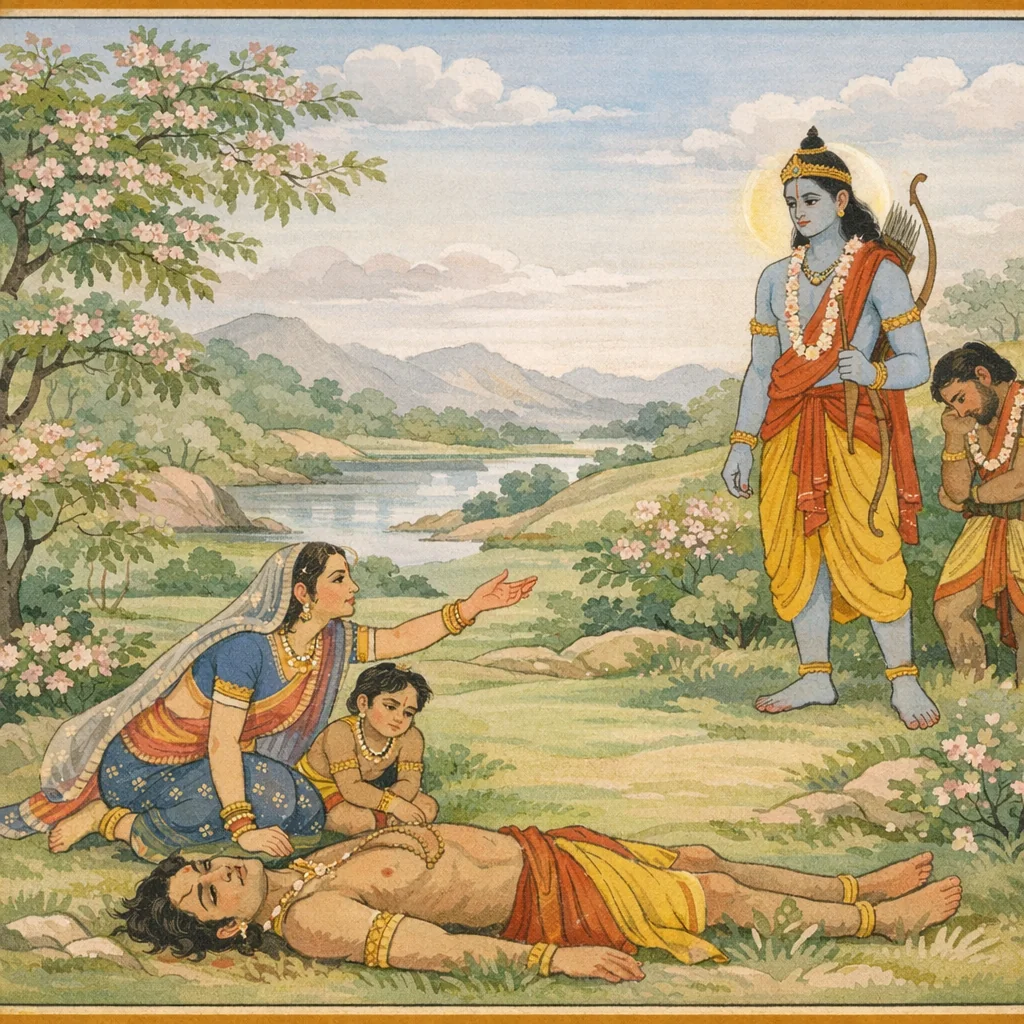
This sarga turns on two grief-filled speeches that sharpen the dharmic stakes of Vāli’s death. First, seeing Tārā drowned in tears, Sugrīva approaches Rāma and confesses a moral collapse: Vāli’s earlier restraint, he admits, showed noble nature, while his own passion, anger, and “kapitva” led to a fratricidal end. He renounces royal pleasures, doubts the worth of honor and regency, and casts his guilt through mythic analogy (Indra’s slaying of Tvaṣṭṛ) and an extended image of the “elephant of sin” striking him. He even asks leave to enter fire as expiation, yet affirms that the Vānara leaders will continue the search for Sītā. Next, Tārā is lifted from Vāli’s body and, beholding Rāma’s regal radiance, shaken yet lucid, begs him to kill her with the same arrow so she may rejoin Vāli, citing śāstra that a wife is inseparable from her husband’s self. Rāma answers with consoling counsel on the providence of the vidhātṛ, the fixed order of the worlds, and the future welfare of Aṅgada; Tārā’s loud wailing then subsides. Thus grief is guided into governance: remorse is acknowledged, social order is steadied, and the epic mission—the search for Sītā—is preserved.
Shlokas
Verse 1
तां चाश्रुवेगेन दुरासदेनत्वभिप्लुतां शोकमहार्णवेन।पश्यंस्तदा वाल्यनुजस्तरस्वीभ्रातुर्वधेनाप्रतिमेन तेपे।।
Then Sugrīva, Vāli’s powerful younger brother, seeing Tārā overwhelmed by an unassailable flood of tears—an ocean of grief—was tormented by the incomparable killing of his brother.
Verse 2
स बाष्पपूर्णेन मुखेन वीक्ष्यक्षणेन निर्विण्णमना मनस्वी।जगाम रामस्य शनैस्समीपंभृत्यैर्वृतसम्परिदूयमानः।।
Tear-faced and deeply sensitive, Sugrīva glanced for a moment and, with a mind weighed down by remorse, slowly approached Rāma, surrounded by his attendants and inwardly suffering.
Verse 3
स तं समासाद्य गृहीतचापमुदात्तमाशीविषतुल्यबाणम्।यशस्विनं लक्षणलक्षिताङ्गमवस्थितं राघव मित्युवाच।।
Approaching the illustrious Rāghava standing with bow in hand—lofty in bearing, his arrows like venomous serpents, his body marked with auspicious signs—Sugrīva addressed him thus.
Verse 4
यथा प्रतिज्ञातमिदं नरेन्द्रकृतं त्वया दृष्टफलं च कर्म।ममाद्य भोगेषु नरेन्द्रपुत्रमनो निवृत्तं सहजीवितेन।।
Just as was promised, O king, you have done the deed—and its result is plainly seen. Yet today, O prince, my mind has turned away from pleasures, and even from life itself.
Verse 5
अस्यां महिष्यां तु भृशं रुदन्त्यापुरे च विक्रोशति दुःखतप्ते।हतेऽग्रजे संशयितेऽङ्गदे चन राम राज्ये रमते मनो मे।।
O Rāma, while this queen (Tārā) weeps bitterly and the city, scorched by grief, cries aloud; while my elder brother lies slain and Aṅgada’s fate is uncertain—my mind finds no delight in the kingdom.
Verse 6
क्रोधादमर्षादतिविप्रधर्षाद्भ्रातुर्वधो मेऽनुमतः पुरस्तात्।हते त्विदानीं हरियूथपेऽस्मिन्सुतीव्रमिक्ष्वाकुकुमार तप्स्ये।।।।
Formerly, out of anger, resentment, and intolerable humiliation, my brother’s death seemed acceptable to me. But now that this leader of the monkey-host has been slain, O prince of Ikṣvāku, I am tormented by piercing pain.
Verse 7
श्रेयोऽद्य मन्ये मम शैलमुख्येतस्मिन्निवासश्चिरमृश्यमूके।यथा तथा वर्तयतस्स्ववृत्त्यानेमं निहत्य त्रिदिवस्य लाभः।।
Today I think it would have been better for me to dwell long on that foremost mountain, Ṛśyamūka, living as best I could by my own means, rather than ‘gaining heaven’ as the reward of having slain him.
Verse 8
न त्वां जिघांसामि चरेति यन्मामयं महात्मा मतिमानुवाच।तस्यैव तद्राम वचोऽनुरूपमिदं पुनः कर्म च मेऽनुरूपम्।।
When the wise, great-souled Vāli said to me, “I will not kill you—go away,” his words, O Rāma, were fitting to his noble nature. But this deed of mine, again, is fitting only to my own (lesser) nature.
Verse 9
भ्राता कथं नाम महागुणस्यभ्रातुर्वधं राघव रोचयेत।राज्यस्य दुःखस्य च वीर सारंविचिन्तयन्कामपुरस्कृतऽस्सन्।।
O Rāghava, O hero—how could a brother ever consent to the killing of a virtuous elder brother, when he reflects on the true substance of kingship and of sorrow? Yet I, driven foremost by desire, failed to reflect so.
Verse 10
वधो हि मे मतो नासीत्स्वमाहात्म्याव्यतिक्रमात्।ममाऽसीद्बुद्धिदौरात्म्यात्प्राणहारी व्यतिक्रमः।।
Truly, killing me did not seem acceptable to him, for it would transgress his own noble nature; but because of the wickedness of my own intention, there occurred a fatal overstepping that took life.
Verse 11
द्रुमशाखावभग्नोऽहं मुहुर्तं परिनिष्टनन्।सान्त्वयित्वा त्वनेनोक्तो न पुनः कर्तुमर्हसि।।
When I was struck down by a tree-branch, I cried out for a while; but he consoled me and said, “It is not proper to do this again.”
Verse 12
भ्रातृत्वमार्यभावश्च धर्मश्चानेन रक्षितः।मया क्रोधश्च कामश्च कपित्वं च प्रदर्शितम्।।
By him, brotherhood, noble conduct, and dharma were safeguarded; but by me were displayed anger, desire, and mere monkey-nature.
Verse 13
अचिन्तनीयं परिवर्जनीयमनीप्सनीयं स्वनवेक्षणीयम्।प्राप्तोऽस्मि पाप्मानमिमं नरेन्द्रभ्रातुर्वधात्त्वाष्ट्रवधादिवेन्द्र:।।
O king, by killing my own brother I have incurred this sin—unthinkable, to be avoided, undesired, and shameful—just as Indra incurred sin by slaying Tvāṣṭra.
Verse 14
पाप्मानमिन्द्रस्य मही जलं चवृक्षाश्च कामं जगृहुः स्त्रियश्च।को नाम पाप्मानमिमं क्षमेतशाखामृगस्य प्रतिपत्तुमिच्छेत्।।।।
The earth, the waters, the trees, and the women willingly took upon themselves a share of Indra’s sin; but who would pardon this sin of a mere monkey, and who would even wish to accept it?
Verse 15
नार्हामि सम्मानमिमं प्रजानांन यौवराज्यं कुत एव राज्यम्।अधर्मयुक्तं कुलनाशयुक्तमेवंविधं राघव कर्म कृत्वा।।
O Rāghava, having done such a deed—bound up with adharma and ruinous to the clan—I do not deserve the people’s honor, nor the rank of heir-apparent; what then of kingship itself?
Verse 16
पापस्य कर्ताऽस्मि विगर्हितस्यक्षुद्रस्य लोकापकृतस्य चैव।शोको महान्मामभिवर्ततेऽयंवृष्टेर्यथा निम्नमिवाम्बुवेगः।।
I have committed a sin—condemned, petty, and harmful to the world; and now a great sorrow overwhelms me, like the rush of rainwater flooding into low ground.
Verse 17
सोदर्यघातापरगात्रवालःसन्तापहस्ताक्षिशिरोविषाणः।एनोमयो मामभिहन्ति हस्तीदृप्तो नदीकूलमिव प्रवृद्धः।।।।
The elephant of sin strikes at me—its tail the slaying of my own brother, its trunk, eyes, head, and tusks made of burning remorse—like a proud elephant grown strong battering a riverbank.
Verse 18
अंहो बतेदं नृवराविषह्यंनिवर्तते मे हृदि साधुवृत्तम्।विवर्णमग्नौ परितप्यमानंकिट्टं यथा राघव जातरूपम्।।
Alas, O best of men—this anguish is unbearable: the good conduct in my heart recedes, as dross drives back the bright gold when it is heated in fire, O Rāghava.
Verse 19
महाबलानां हरियूथपानामिदं कुलं राघव मन्निमित्तम्।अस्याङ्गदप्यापि च शोकतापादर्धस्थितप्राणमितीव मन्ये।।।।
O Rāghava, because of me this very line of mighty leaders among the monkeys seems half-dead—especially Angada, scorched by grief and remorse, as though his life-breath were only half remaining.
Verse 20
सुतस्सुलभ्यस्सुजनस्सुवश्यःकुतस्तु पुत्रस्सदृशोऽङ्गदेन।न चापि विद्येत स वीर देशोयस्मिन्भवेत्सोदरसन्निकर्षः।।
A son who is manageable and helpful can be found; but where is a son equal to Angada? And, O hero, there is no place at all where one can obtain the closeness of a brother.
Verse 21
यद्यङ्गदो वीरवरार्ह जीवेत्जीवेच्छ माता परिपालनार्थम्।विना तु पुत्रं परितापदीनातारा न जीवेदिति निश्चितं मे4.24.21।।
If Angada, worthy of the best of heroes, lives, then his mother may live on for the sake of caring for him; but without her son, Tara—crushed by grief—will not live. This is my firm conviction.
Verse 22
सोऽहं प्रवेक्ष्याम्यतिदीप्तमग्निंभ्रात्रा च पुत्रेण च सख्यमिच्छन्।इमे विचेष्यन्ति हरिप्रवीरास्सीतां निदेशे तव वर्तमानाः।।
I, desiring to preserve friendship with my brother and my son, will enter the blazing fire. Meanwhile, these foremost Vānara leaders, acting under your command, will range about and search for Sītā.
Verse 23
कृत्स्नं तु ते सेत्स्यति कार्यमेतन्मय्यप्रतीते मनुजेन्द्रपुत्रकुलस्य हन्तारमजीवनार्हंरामानुजानीहि कृतागसं माम्।।
O prince among men, even if I should perish, this entire undertaking of yours will be fulfilled. I am a slayer within my own line, sinful and unworthy to live—O Rāma, grant me leave (to die).
Verse 24
इत्येवमार्तस्य रघुप्रवीरःश्रुत्वा वचो वाल्यनुजस्य तस्य।सञ्जातबाष्पः परवीरहन्तारामो मुहूर्तं विमना बभूव।।
Hearing these words of the distressed Sugrīva, Vāli’s younger brother, Rāma—the hero of the Raghu line, slayer of hostile champions—was moved to tears and for a moment became inwardly shaken.
Verse 25
तस्मिन् क्षणेऽभीक्ष्णमवेक्ष्यमाणःक्षितिक्षमावान्भुवनस्य गोप्ता।रामो रुदन्तीं व्यसने निमग्नांसमुत्सुकः सोऽथ ददर्श ताराम्।।
At that moment, Rāma—guardian of the world, patient as the earth—noticed Tārā, sunk in calamity and weeping, repeatedly looking toward him; and he beheld her with anxious concern.
Verse 26
तां चारुनेत्रां कपिसिंहनाथांपतिं समाश्लिष्य तदा शयानाम्।उत्थापयामासुरदीनसत्त्वांमन्त्रिप्रधानाः कपिवीरपत्नीम्।।
Then the chief ministers raised up noble Tārā—beautiful-eyed, wife of the heroic Vānara—who lay clinging to her husband, the lion among monkeys.
Verse 27
सा विस्फुरन्ती परिरभ्यमाणाभर्तुस्सकाशादपनीयमाना।ददर्श रामं शरचापपाणिंस्वतेजसा सूर्यमिव ज्वलन्तम्।।
As she struggled while clinging and was being drawn away from her husband’s side, she saw Rāma holding bow and arrows, blazing with his own radiance like the sun.
Verse 28
सुसंवृतं पार्थिपलक्षणैश्चतं चारुनेत्रं मृगशाबनेत्रा।अदृष्टपूर्वं पुरुषप्रधानमयं स काकुत्स्थ इति प्रजज्ञे।।
Fawn-eyed Tārā recognized him: a preeminent man, never seen by her before, endowed with the marks of royalty and with beautiful eyes—“This is that Kakutstha, Rāma.”
Verse 29
तस्येन्द्रकल्पस्य दुरासदस्यमहानुभावस्य समीपमार्या।आर्ताऽतितूर्णं व्यसनाभिपन्नाजगाम तारा परिविह्वलन्ती।।
Afflicted and overwhelmed by disaster, the noble Tārā—trembling and unsteady—hurried to the presence of that great-souled Rāma, Indra-like and difficult to approach.
Verse 30
सा तं समासाद्य विशुद्धसत्त्वाशोकेन सम्भ्रान्तशरीरभावा।मनस्विनी वाक्यमुवाच तारारामं रणोत्कर्षणलब्धलक्षम्।।
Then Tārā—wise and pure in intent, though her body and mind were shaken by grief—approached Rāma, renowned for martial excellence and unfailing aim, and spoke these words.
Verse 31
त्वमप्रमेयश्च दुरासदश्चजितेन्द्रियश्चोत्तमधार्मिकश्च।अक्षय्यकीर्तिश्च विचक्षणश्चक्षितिक्षमावान्क्षतजोपमाक्षः।।
You are beyond measure and unassailable—self-controlled and foremost among the righteous. Your fame does not perish; you are discerning, patient like the earth, and your eyes are red at the corners—a mark of valor.
Verse 32
त्वमात्तबाणासनबाणपाणिर्महाबलस्संहननोपपन्नः।मनुष्यदेहाभ्युदयं विहायदिव्येन देहाभ्युदयेन युक्तः।।।।
With bow and arrows in hand, you are mighty and built for overpowering force; and though you move in a human frame, you are endowed with a divine splendor of form.
Verse 33
येनैक बाणेन हतः प्रियो मेतेनैव मां त्वं जहि सायकेन।हता गमिष्यामि समीपमस्यन मामृते राम रमेत वाली।।
With the very arrow by which my beloved was slain, strike me down as well. When I am dead I shall go near him—for, O Rāma, Vāli will not find joy without me.
Verse 34
स्वर्गेऽपि पद्मामलपत्रनेत्रस्समेत्य सम्प्रेक्ष्य च मामपश्यन्।न ह्येष उच्चावचताम्रचूडाविचित्रवेषाप्सरसोऽभजिष्यत्।।।।
Even in heaven, lotus-petal-eyed Vāli—arriving and looking about—if he does not see me, will not turn toward those apsarases, splendidly dressed and adorned with varied red blossoms in their hair.
Verse 35
स्वर्गेऽपि शोकं च विवर्णतां चमया विना प्राप्प्यति वीर वाली।रम्ये नगेन्द्रस्य तटावकाशेविदेहकन्यारहितो यथा त्वम्।।
Even in heaven, O hero, Vāli will fall into grief and pallor without me—just as you, on a lovely mountainside, are joyless without the princess of Videha.
Verse 36
त्वं वेत्थ यावद्वनिताविहीनःप्राप्नोति दुःखं पुरुषः कुमारः।तत्त्वं प्रजानन् जहि मां न वालीदुःखं ममादर्शनजं भजेत।।
You know how much sorrow a young man suffers when deprived of his wife. Knowing this truth, kill me—so that Vāli may not endure the pain that arises from not seeing me.
Verse 37
यच्चापि मन्येत भवान्महात्मास्त्रीघातदोषो न भवेत्तु मह्यम्।आत्मेयमस्येति च मां जहि त्वंन स्त्रीवधस्स्यान्मनुजेन्द्रपुत्र।।।।
And if you, great-souled prince, should fear the fault of slaying a woman—let that not apply here. Kill me, thinking, ‘She is his very self’; it will not be counted as woman-slaying, O son of the lord of men.
Verse 38
शास्त्रप्रयोगाद्विविधाच्च वेदादात्माह्यनन्यः पुरुषस्य दाराः।दाराप्रदानान्नहि दानमन्यत्प्रदृश्यते ज्ञानवतां हि लोके।।
By the ordinances of the śāstras and by the Vedas in many forms, a wife is taught to be a man’s non-separate self. Among the wise in this world, no gift is seen greater than giving a wife back to her husband.
Verse 39
त्वं चापि मां तस्य मम प्रियस्यप्रदास्य से धर्ममवेक्ष्य वीरअनेन दानेन न लप्स्यसे त्वमधर्मयोगं मम वीर घातात्।।
And you too, O hero, will ‘give’ me to my beloved—having considered dharma. By this offering, you will not incur any taint of adharma from slaying me.
Verse 40
आर्तामनाथामपनीयमानामेवं विधामर्हसि मां निहन्तुम्।अहं हि मातङ्गविलासगामिनाप्लवङ्गमानामृषभेण धीमता।।विना वरार्होत्तमहेममालिनाचिरं न शक्ष्यामि नरेन्द्र जीवितुम्।इत्येवमुक्तस्तु विभुर्महात्मातारां समाश्वास्य हितं बभाषे।।
O king, you may well slay me—helpless and husbandless as I am. For I cannot live long without that wise bull among the monkeys. Thus implored by Tārā, the great-souled lord consoled her.
Verse 41
आर्तामनाथामपनीयमानामेवं विधामर्हसि मां निहन्तुम्।अहं हि मातङ्गविलासगामिनाप्लवङ्गमानामृषभेण धीमता4.24.40।।विना वरार्होत्तमहेममालिनाचिरं न शक्ष्यामि नरेन्द्र जीवितुम्।इत्येवमुक्तस्तु विभुर्महात्मातारां समाश्वास्य हितं बभाषे4.24.41।।
O king, you may well slay me—helpless and husbandless as I am. For I cannot live long without that wise bull among the monkeys. Thus implored by Tārā, the great-souled lord consoled her.
Verse 42
मा वीरभार्ये विमतिं कुरुष्वलोको हि सर्वो विहितो विधात्रा।तं चैव सर्वं सुखदुःखयोगंलोकोऽब्रवीत्तेन कृतं विधात्रा।।।।
O wife of a hero, do not let your mind fall into despair. The whole world moves according to the ordinance set by the Creator; and people say that every conjunction with happiness and sorrow is made so by that very Disposer.
Verse 43
त्रयोऽहि लोका विहितं विधानंनातिक्रमन्ते वशगा हि तस्य।प्रीतिं परां प्राप्स्यसि तां तथैवपुत्रस्तु ते प्राप्स्यति यौवराज्यम्।धात्रा विधानं विहितं तथैवन शूरपत्नयः परिदेवयन्ति4.24.43।।
Truly, the three worlds do not overstep the order that has been ordained, for they are under His rule. In due time you shall attain supreme peace, and your son shall receive the rank of yuvarāja, heir-apparent. Since the Creator’s ordinance stands thus, the wives of heroes do not lament beyond measure.
Verse 44
आश्वासिता तेन तु राघवेणप्रभावयुक्तेन परन्तपेन।सा वीरपत्नी ध्वनता मुखेनसुवेषरूपा विरराम तारा।।
Consoled by Rāghava—mighty and a scorcher of foes—Tārā, the well-adorned wife of a hero, ceased her loud lamentation.
Frequently Asked Questions
The chapter confronts the dharma-crisis of fratricide and political succession: Sugrīva recognizes his complicity in Vāli’s death, doubts his right to honor or rule, and seeks expiation; simultaneously, Tārā requests death to reunite with Vāli, raising questions about righteous action amid grief and social duty.
The sarga teaches that moral injury must be named and examined (Sugrīva’s confession), yet communal stability requires consolation and acceptance of cosmic order (Rāma’s vidhātṛ-upadeśa). Grief is acknowledged without allowing it to dissolve responsibility toward the living—especially Aṅgada and the continuing Sītā-search.
Kishkindhā’s civic space is implied through references to public wailing and royal legitimacy; Ṛśyamūka is recalled as Sugrīva’s prior refuge. Culturally, the sarga foregrounds śāstric ideas of dāra (wife) as integral to the husband’s self and mythic exempla (Indra–Tvaṣṭṛ) used to interpret sin and its ‘sharing’ in the world.