Sarga 58
सम्पातिवाक्यम् (Sampāti’s Counsel and the Revelation of Laṅkā)
किष्किन्धाकाण्ड
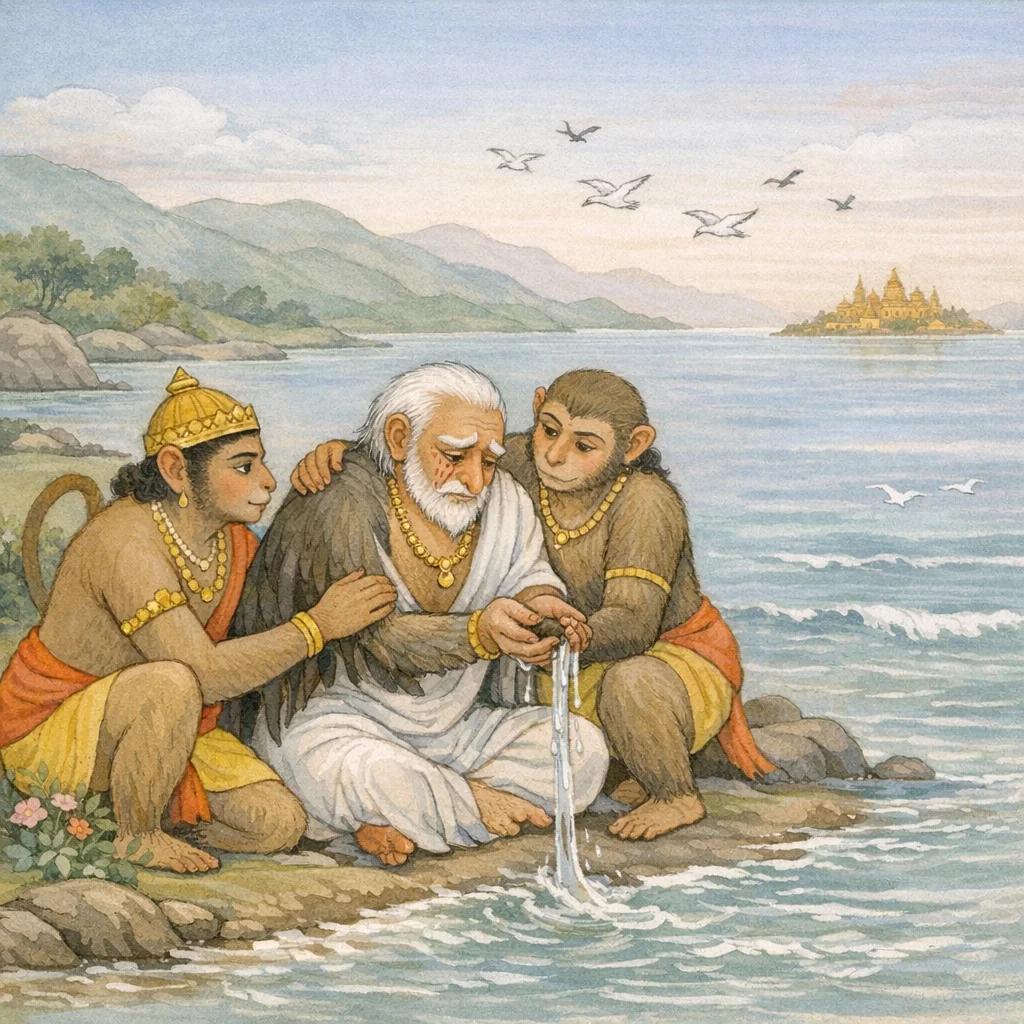
In Sarga 58, the despairing Vānara search-party addresses the loud-voiced vulture Sampāti, who weeps on learning of his younger brother Jaṭāyu’s death. Sampāti recalls an earlier episode: while flying toward the Sun, he shielded Jaṭāyu with his wings, fell upon the Vindhya with his wings burnt, and lived long without news of his brother. Aṅgada and the Vānara leaders demand usable intelligence: if Sampāti knows Rāvaṇa’s dwelling, near or far, he must reveal it. Sampāti declares that though aged and wingless, he can help greatly through speech and knowledge; from the cries of “Rāma” and “Lakṣmaṇa” and from the ornaments cast down, he recognizes the abducted woman as Sītā. He then gives a precise strategic account: Rāvaṇa, son of Viśravas and half-brother of Vaiśravaṇa, resides in Laṅkā—an island-city built by Viśvakarmā—lying a full hundred yojanas across the sea, fortified with golden gates, platforms, mansions, and a radiant wall, and surrounded by the ocean. Sītā is confined in Rāvaṇa’s inner apartments under rākṣasī guard, and Sampāti urges the Vānaras to cross the salt sea swiftly and prove their strength. At the close, Sampāti asks to be taken to the ocean to offer the water-oblation for Jaṭāyu. The Vānaras carry him, he performs the rite, and they return delighted, now possessing decisive intelligence for the mission.
Shlokas
Verse 1
इत्युक्तः करुणं वाक्यं वानरैस्त्यक्तजीवितैः।सबाष्पो वानरान्गृध्रः प्रत्युवाच महास्वनः।।4.58.1।।
Thus addressed with those pitiful words by the monkeys who had abandoned hope of life, the loud-voiced vulture replied to them with tears.
Verse 2
यवीयान्मम भ्राता जटायुर्नाम वानराः।यमाख्यात हतं युद्धे रावणेन बलीयसा।।4.58.2।।
O monkeys, the one you reported as slain in battle by the mighty Rāvaṇa was my younger brother, named Jaṭāyu.
Verse 3
वृद्धभावादपक्षत्वाच्छृण्वंस्तदपि मर्षये।न हि मे शक्तिरस्त्यद्य भ्रातुर्वैरविमोक्षणे।।4.58.3।।
Even after hearing of it, I can only endure it; for now I have no strength—because of old age and winglessness—to exact vengeance for my brother.
Verse 4
पुरा वृत्रवधे वृत्ते परस्परजयैषिणौ।आदित्यमुपयातौ स्वो ज्वलन्तं रश्मिमालिनम्।।4.58.4।।
Long ago, after Vṛtra had been slain, we two—eager to outdo one another—flew up to the Sun, blazing and wreathed in rays.
Verse 5
आवृत्त्याऽकाशमार्गे तु जवेन स्म गतौ भृशम्।मध्यं प्राप्ते दिनकरे जटायुरवसीदति।।4.58.5।।
Ranging the sky-path at tremendous speed, when we reached the Sun at its height, Jatāyu began to falter.
Verse 6
तमहं भ्रातरं दृष्ट्वा सूर्यरश्मिभिरर्दितम्।पक्षाभ्यां छादयामास स्नेहात्परमविह्वलः।।4.58.6।।
Ranging the sky-path at tremendous speed, when we reached the Sun at its height, Jatāyu began to falter.
Verse 7
निर्दग्धपक्षः पतितो विन्ध्येऽहं वानरर्षभाः।अहमस्मिन्वसन्भ्रातुः प्रवृत्तिं नोपलक्षये।।4.58.7।।
O bulls among monkeys, my wings were burnt, and I fell upon the Vindhya. Living here, I have not come to know any news of my brother’s whereabouts.
Verse 8
जटायुषस्त्वेवमुक्तो भ्रात्रा सम्पातिना तदा।युवराजो महाप्राज्ञः प्रत्युवाचाङ्गदस्ततः।।4.58.8।।
When Sampāti, Jatāyu’s brother, had spoken thus, then Aṅgada—the wise heir-apparent—replied.
Verse 9
जटायुषो यदि भ्राता श्रुतं ते गदितं मया।आख्या हि यदि जानासि निलयं तस्य रक्षसः।।4.58.9।।
If you are indeed Jatāyu’s brother, then you have heard what I have said. Tell us—if you know—the dwelling-place of that rākṣasa.
Verse 10
अदीर्घदर्शिनं तं वै रावणं राक्षसाधिपम्।अन्तिके यदि वा दूरे यदि जानासि शंस नः।।4.58.10।।
If you know, tell us of Rāvaṇa, lord of the rākṣasas, who lacks foresight—whether he is near or far.
Verse 11
ततोऽब्रवीन्महातेजा ज्येष्ठो भ्राता जटायुषः।आत्मानुरूपं वचनं वानरान्सम्प्रहर्षयन्।।4.58.11।।
Then the radiant elder brother of Jaṭāyu spoke words befitting himself, gladdening the vānaras.
Verse 12
निर्दग्धपक्षो गृध्रोऽहं हीनवीर्य: प्लवङ्गमाः।वाङ्मात्रेण तु रामस्य करिष्ये साह्यमुत्तमम्।।4.58.12।।
O monkeys, I am a vulture with wings scorched and strength diminished; yet for Rāma I will render the best help I can—through words alone.
Verse 13
जानामि वारुणान्लोकान्विष्णोस्त्रै विक्रमानपि।महासुरविमर्दन्वा श्च ह्यमृतस्य च मन्थनम्।।4.58.13।।
I know the realms of Varuṇa, and also Viṣṇu’s three strides; and I know as well the great tumult between devas and asuras, and the churning that brought forth amṛta, the nectar of immortality.
Verse 14
रामस्य यदिदं कार्यं कर्तव्यं प्रथमं मया।जरया च हृतं तेजः प्राणाश्च शिथिला मम।।4.58.14।।
This duty for Rāma should first be done by me; yet age has stolen my vigor, and my life-breath has grown slack.
Verse 15
तरुणी रूपसम्पन्ना सर्वाभरणभूषिता।ह्रियमाणा मया दृष्टा रावणेन दुरात्मना।।4.58.15।।क्रोशन्ती राम रामेति लक्ष्मणेति च भामिनी।भूषणान्यपविध्यन्ती गात्राणि च विधुन्वती।।4.58.16।।
I saw a young woman, beautiful and adorned with every ornament, being carried off by the evil-minded Rāvaṇa.
Verse 16
तरुणी रूपसम्पन्ना सर्वाभरणभूषिता।ह्रियमाणा मया दृष्टा रावणेन दुरात्मना।।4.58.15।।क्रोशन्ती राम रामेति लक्ष्मणेति च भामिनी।भूषणान्यपविध्यन्ती गात्राणि च विधुन्वती।।4.58.16।।
Crying “Rāma! Rāma!” and “Lakṣmaṇa!”, that noble lady cast down her ornaments and shook her limbs, struggling in anguish.
Verse 17
सूर्यप्रभेव शैलाग्रे तस्याः कौशेयमुत्तमम्।असिते राक्षसे भाति यथा वा तटिदम्बुदे।।4.58.17।।
Her finest silk garment shone—like sunlight on a mountain peak—bright against the dark rākṣasa, like lightning in a cloud.
Verse 18
तां तु सीतामहं मन्ये रामस्य परिकीर्तनात्।श्रूयतां मे कथयतो निलयं तस्य रक्षसः।।4.58.18।।
Because she kept uttering Rāma’s name, I believe she was Sītā. Now listen as I describe the dwelling of that rākṣasa.
Verse 19
पुत्रो विश्रवस स्साक्षाद्भ्राता वैश्रवणस्य च।अध्यास्ते नगरीं लङ्कां रावणो नाम राक्षसः।।4.58.19।।
That rākṣasa named Rāvaṇa—true son of Viśravas and brother of Vaiśravaṇa—dwells in the city of Laṅkā.
Verse 20
इतो द्वीपस्समुद्रस्य सम्पूर्णे शतयोजने।तस्मिन्लङ्कापुरी रम्या निर्मिता विश्वकर्मणा।।4.58.20।।
From here, across the sea, lies an island a full hundred yojanas away; upon it stands the lovely city of Laṅkā, built by Viśvakarman.
Verse 21
जाम्बूनदमयैर्द्वारैश्चित्रैः काञ्चनवेदिकैः।प्रासादैर्हेमवर्णैश्च महद्भिः सुसमा कृता।।4.58.21।।प्राकारेणार्कवर्णेन महता च समान्विता।
It is fashioned with wondrous gates of pure gold, with golden terraces, and with great mansions of golden hue, built in harmonious symmetry—further endowed with a lofty rampart shining like sunlight.
Verse 22
तस्यां वसति वैदेही दीना कौशेयवासिनी।।4.58.22।।रावणान्तःपुरे रुद्धा राक्षसीभिस्सुरक्षिता।जनकस्यात्मजां राज्ञस्तत्र द्रक्ष्यथ मैथिलीम्।।4.58.23।।
There, Vaidehī lives—downcast, clothed in silk—confined within Rāvaṇa’s inner palace and closely guarded by rākṣasī women. There you will behold Maithilī, the royal daughter of King Janaka.
Verse 23
तस्यां वसति वैदेही दीना कौशेयवासिनी।।4.58.22।।रावणान्तःपुरे रुद्धा राक्षसीभिस्सुरक्षिता।जनकस्यात्मजां राज्ञस्तत्र द्रक्ष्यथ मैथिलीम्।।4.58.23।।
There, Vaidehī lives—downcast, clothed in silk—confined within Rāvaṇa’s inner palace and closely guarded by rākṣasī women. There you will behold Maithilī, the royal daughter of King Janaka.
Verse 24
लङ्कायामथ गुप्तायां सागरेण समन्ततः।सम्प्राप्य सागरस्यान्तं सम्पूर्णं शतयोजनम्।।4.58.24।।आसाद्य दक्षिणं तीरं ततो द्रक्ष्यथ रावणम्।तत्रैव त्वरिताः क्षिप्रं विक्रमध्वं प्लवङ्गमाः।।4.58.25।।
Having crossed the full hundred yojanas to the ocean’s farthest limit, you will reach the southern shore. Then you shall behold Rāvaṇa—for Laṅkā is well-guarded and encircled by the sea on every side. There, swiftly and without delay, display your valor, O vānaras.
Verse 25
लङ्कायामथ गुप्तायां सागरेण समन्ततः।सम्प्राप्य सागरस्यान्तं सम्पूर्णं शतयोजनम्।।4.58.24।।आसाद्य दक्षिणं तीरं ततो द्रक्ष्यथ रावणम्।तत्रैव त्वरिताः क्षिप्रं विक्रमध्वं प्लवङ्गमाः।।4.58.25।।
Having crossed the full hundred yojanas to the ocean’s farthest limit, you will reach the southern shore. Then you shall behold Rāvaṇa—for Laṅkā is well-guarded and encircled by the sea on every side. There, swiftly and without delay, display your valor, O vānaras.
Verse 26
ज्ञानेन खलु पश्यामि दृष्ट्वा प्रत्यागमिष्यथ।आद्यः पन्थाः कुलिङ्गानां ये चान्ये धान्यजीविनः।।4.58.26।।द्वितीयो बलिभोजानां ये च वृक्षफलाशिनः।भासास्तृतीयं गच्छन्ति क्रौञ्चाश्च कुररैस्सह।।4.58.27।।श्येनाश्चतुर्थं गच्छन्ति गृध्रा गच्छन्ति पञ्चमम्।
By inner insight I know this: having seen her, you will return. The first aerial course belongs to sparrows and other grain-eating birds; the second to those that feed on offerings and to those that live on tree-fruits. Cocks go by the third, with krauñcas and kuraras; hawks take the fourth, and vultures the fifth.
Verse 27
ज्ञानेन खलु पश्यामि दृष्ट्वा प्रत्यागमिष्यथ।आद्यः पन्थाः कुलिङ्गानां ये चान्ये धान्यजीविनः।।4.58.26।।द्वितीयो बलिभोजानां ये च वृक्षफलाशिनः।भासास्तृतीयं गच्छन्ति क्रौञ्चाश्च कुररैस्सह।।4.58.27।।श्येनाश्चतुर्थं गच्छन्ति गृध्रा गच्छन्ति पञ्चमम्।
By inner insight I know this: having seen her, you will return. The first aerial course belongs to sparrows and other grain-eating birds; the second to those that feed on offerings and to those that live on tree-fruits. Cocks go by the third, with krauñcas and kuraras; hawks take the fourth, and vultures the fifth.
Verse 28
बलवीर्योपपन्नानां रूपयौवनशालिनाम्।।4.58.28।।षष्ठस्तु पन्था हंसानां वैनतेयगतिः परा।वैनतेयाच्च नो जन्म सर्वेषां वानरर्षभाः।।4.58.29।।
The sixth course belongs to the haṃsas—swans endowed with strength and vigor, with beauty and youth. Beyond that lies the supreme course of Vainateya, Garuḍa. Yet none of us is born of Vainateya, O best of vānaras.
Verse 29
बलवीर्योपपन्नानां रूपयौवनशालिनाम्।।4.58.28।।षष्ठस्तु पन्था हंसानां वैनतेयगतिः परा।वैनतेयाच्च नो जन्म सर्वेषां वानरर्षभाः।।4.58.29।।
The sixth course belongs to the haṃsas—swans endowed with strength and vigor, with beauty and youth. Beyond that lies the supreme course of Vainateya, Garuḍa. Yet none of us is born of Vainateya, O best of vānaras.
Verse 30
इहस्थोऽहं प्रपश्यामि रावणं जानकीं तथा।अस्माकमपि सौवर्णं दिव्यं चक्षुर्बलं तथा।।4.58.30।।
From where I stand, I can see both Rāvaṇa and Jānakī. We vultures, too, possess a divine, golden power of sight.
Verse 31
तस्मादाहारवीर्येण निसर्गेण च वानराः।आयोजनशतात्साग्राद्वयं पश्याम नित्यशः।।4.58.31।।
Therefore, O monkeys, by the vigor gained from our sustenance and by our very nature, we always see as far as a hundred yojanas, even across the sea’s expanse.
Verse 32
अस्माकं विहिता वृत्तिर्निसर्गेण च दूरतः।विहिता पादमूले तु वृत्तिश्चरणयोधिनाम्।।4.58.32।।
By nature, our course of movement is ordained to range far. But for those who fight on foot, their range is fixed only to what their feet can traverse.
Verse 33
गर्हितं तु कृतं कर्म येन स्म पशिताशिना।प्रतीकार्यं च मे तस्य वैरं भ्रातृकृतं भवेत्।।4.58.33।।
A shameful deed was done by that flesh-eater; and the enmity born from what he did to my brother now calls for requital from me.
Verse 34
उपायो दृश्यतां कश्चिल्लङ्घने लवणाम्भसः।अभिगम्य तु वैदेहीं समृद्धार्था गमिष्यथ।।4.58.34।।
Find some means to cross the salt ocean; having reached Vaidehī, you will return with your purpose fulfilled.
Verse 35
समुद्रं नेतुमिच्छामि भवद्भिर्वरुणालयम्।प्रदास्याम्युदकं भ्रातुस्स्वर्गतस्य महात्मनः।।4.58.35।।
Lead me, I ask, to the ocean—the abode of Varuṇa. I wish to offer a water-oblation to my brother, that great soul who has gone to heaven.
Verse 36
ततो नीत्वा तु तं देशं तीरं नदनदीपतेः।निर्दग्धपक्षं सम्पातिं वानरास्सुमहौजसः।।4.58.36।।पुनः प्रत्यानयित्वा च तं देशं पतगेश्वरम्।बभूवुर्वानरा हृष्टाः प्रवृत्तिमुपलभ्य ते।।4.58.37।।
Then the mighty monkeys took Sampāti—whose wings were burned away—to that place, to the shore of the lord of rivers.
Frequently Asked Questions
The crisis is mission-failure despair versus renewed duty: the Vānaras, having ‘given up hope of life,’ must decide whether to perish or seek reliable guidance. Sampāti models dharma by offering truthful intelligence and by fulfilling familial duty through water-oblation for Jaṭāyu despite his own incapacity to fight.
Capability is not only physical: even when strength is depleted, one can serve the righteous cause through vāṅ-mātra (authoritative speech), memory, and discernment. The sarga also emphasizes that grief becomes purposeful when disciplined by duty, counsel, and verifiable knowledge.
Laṅkā is mapped as an island-city a full hundred yojanas across the salt sea, fortified and architecturally resplendent (golden gates, platforms, mansions, radiant wall) and traditionally credited to Viśvakarmā. The ocean is framed as Varuṇa’s abode, and the Vindhya appears as Sampāti’s long-term refuge after his fall.