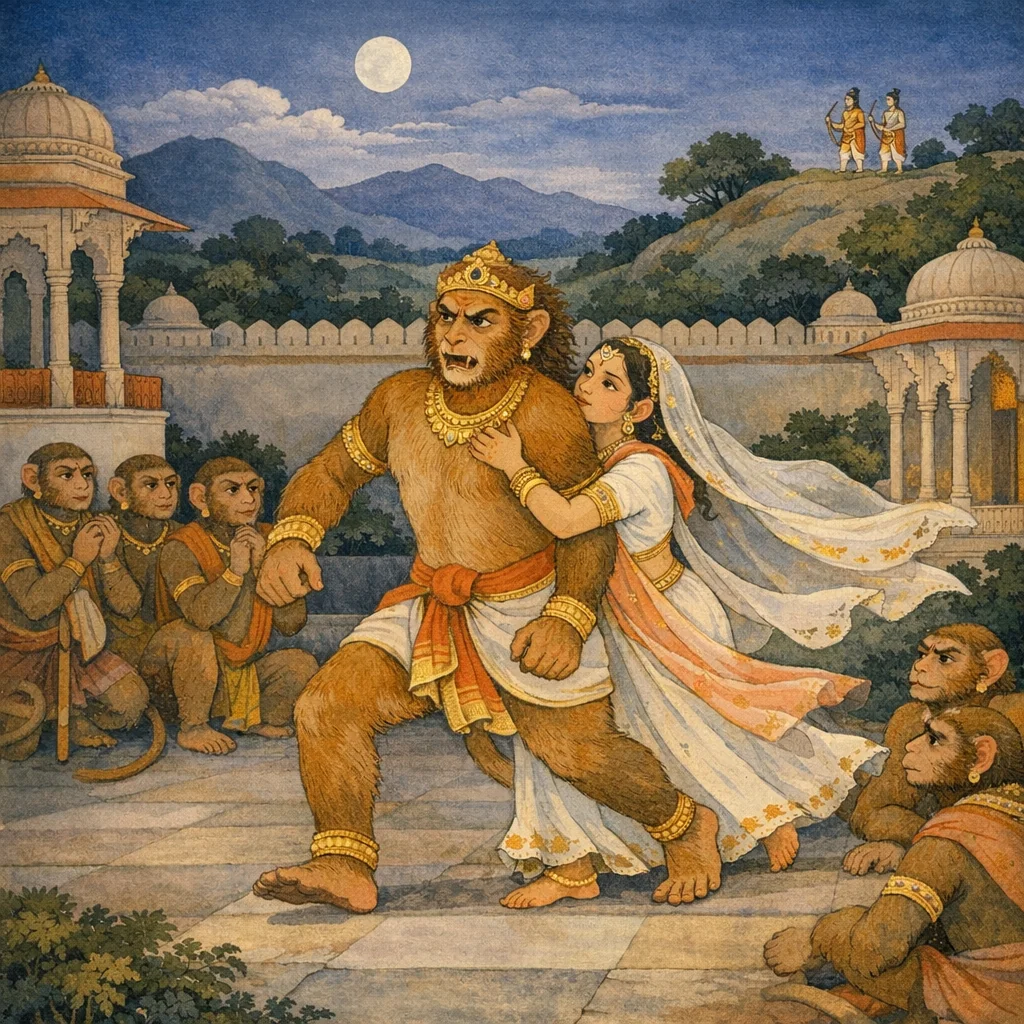
Sarga 15
तारोपदेशः — Tara’s Counsel to Vali on Sugriva’s Roar and Rama’s Alliance
किष्किन्धाकाण्ड
This sarga opens with Vālī hearing Sugrīva’s formidable roar from within the inner chambers, a sound said to shake all beings, and his pride turns into violent anger. He rushes out, fierce as fire, intent on immediate combat. Tārā restrains him in deed and speech: she embraces Vālī, urges self-control, and advises postponing the fight until morning—not from fear, but as sound strategy. She then offers a crucial inference: Sugrīva’s renewed challenge after an earlier defeat implies outside support; such confidence and insolence must have a cause. Citing reports from Aṅgada and the spies, Tārā reveals that Rāma and Lakṣmaṇa—Ikṣvāku princes, invincible in war—have allied with Sugrīva. She praises Rāma’s virtues and warns that enmity with an immeasurable warrior brings ruin to both kingdom and self. Her counsel is reconciliation: consecrate Sugrīva, abandon hostility, honor him with gifts, and cultivate friendship with Rāma. The sarga ends on a tragic note: Vālī, overtaken by adverse fate, rejects this beneficial counsel at the very threshold of destruction.
Shlokas
Verse 1
अथ तस्य निनादं तं सुग्रीवस्य महात्मनः।शुश्रावान्तः पुर गतो वाली भ्रातुरमर्षणः।।
Then Vāli—angered at his brother—heard the great-souled Sugrīva’s roar while he was within the inner apartments.
Verse 2
श्रुत्वा तु तस्य निनदं सर्वभूतप्रकम्पनम्।मदश्चैकपदे नष्टः क्रोधश्चापतितो महान्।।
Hearing that roar which made all creatures tremble, his pride vanished at once—and a great wrath surged upon him.
Verse 3
स तु रोषपरीताङ्गो वाली सन्ध्याकनकप्रभः।उपरक्त इवादित्यस्सद्यो निष्प्रभतां गतः।।
But Vālī, his limbs seized by anger—once radiant like gold at twilight—at once grew dim, like the sun under eclipse.
Verse 4
वाली दंष्ट्राकरालस्तु क्रोधाद्दीप्ताग्निसन्निभः।भात्युत्पतितपद्मस्तु समृणाळ इव ह्रदः।।
Vālī, terrible with bared fangs and, in his wrath, like blazing fire, appeared like a pond whose lotuses have been torn up, leaving only the stalks behind.
Verse 5
शब्दं दुर्मर्षणं श्रुत्वा निष्पपात ततो हरिः।वेगेन चरणन्यासैर्दारयन्निव मेदिनीम्।।
Hearing that unbearable roar, Vālī rushed out at once, striding with such force and speed that it seemed as though he were tearing the earth apart.
Verse 6
तं तु तारा परिष्वज्य स्नेहाद्दर्शितसौहृदाः।उवाच त्रस्तसम्भ्रान्ता हितोदर्कमिदं वचः।।
But Tārā, showing her affection and faithful goodwill, embraced him; anxious and shaken with fear, she spoke these words of prudent counsel.
Verse 7
साधु क्रोधमिमं वीर नदीवेगमिवागतम्।शयनादुत्थितः काल्यं त्यज भुक्तामिव स्रजम्।।
“O hero, this surge of anger has come upon you like a river in flood. Though it is natural to feel it upon rising now, cast it off—like the wise discard a garland already used.”
Verse 8
काल्यमेतेन सङ्ग्रामं करिष्यसि च वानर।वीर ते शत्रुबाहुल्यं फल्गुता वा न विद्यते।।
O monkey-hero, fight him tomorrow at dawn; this delay will neither make you seem weak nor show undue deference to the enemy.
Verse 9
सहसा तव निष्क्रामो मम तावन्न रोचते।श्रूयतां चाभिधास्यामि यन्निमित्तं निवार्यसे।।
Your sudden departure does not please me. Listen—I will tell you the reason for which I am holding you back.
Verse 10
पूर्वमापतितः क्रोधात्स त्वामाह्वयते युधि।निष्पत्य च निरस्तस्ते हन्यमानो दिशो गतः।।
Earlier, in anger, he rushed at you and challenged you to combat; but when he sprang forth, you struck him back and drove him off, and beaten, he fled in every direction.
Verse 11
त्वया तस्य निरस्तस्य पीडितस्य विशेषतः।इहैत्य पुनराह्वानं शङ्कां जनयतीव मे।।
That he—repulsed and especially hurt by you—has come here again to challenge you once more; this indeed stirs suspicion in me.
Verse 12
दर्पश्च व्यवसायश्च यादृशस्तस्य नर्दतः।निनादश्चापि संरम्भो नैतदल्पं हि कारणम्।।
The arrogance and resolve shown by him as he roars—his bellowing and fierce agitation—cannot have a trivial cause behind it.
Verse 13
नासहायमहं मन्ये सुग्रीवं तमिहागतम्।अवष्टब्धसहायश्च यमाश्रित्यैष गर्जति।।
I do not think Sugrīva has come here without help; surely he has secured a supporter—taking refuge in him, he now roars forth his challenge.
Verse 14
प्रकृत्या निपुणश्चैव बुद्धिमांश्चैव वानरः।अपरीक्षितवीर्येण सुग्रीवस्सहनैष्यति।।।।
Sugrīva the monkey is naturally shrewd and intelligent; he will not enter into friendship with an ally whose strength has not been tested.
Verse 15
पूर्वमेव मया वीर श्रुतं कथयतो वचः।अङ्गदस्य कुमारस्य वक्ष्यामित्वा हितं वचः।।
O hero, I have already heard the report as it was recounted by our son, the prince Aṅgada. For your good, I will now tell you those words.
Verse 16
अङ्गदस्तु कुमारोऽयं वनान्तमुपनिर्गतः।प्रवृत्तिस्तेन कथिता चारै राप्तैर्निवेदिता।।
This prince Aṅgada went out into the forest; and the intelligence he received—reported by trustworthy spies—he narrated to me.
Verse 17
अयोध्याधिपतेः पुत्रौ शूरौ समरदुर्जयौ।इक्ष्वाकूणां कुले जातौ प्रथितौ रामलक्ष्मणौ।।सुग्रीवप्रियकामार्थं प्राप्तौ तत्र दुरासदौ।
Rāma and Lakṣmaṇa—renowned sons of the lord of Ayodhyā, born in the Ikṣvāku line—are heroic and hard to overcome in battle. Seeking to do what is dear to Sugrīva, those formidable brothers have arrived there.
Verse 18
तव भ्रातुर्हि विख्यातस्सहायो रणकर्कशः।रामः परबलामर्दी युगान्ताग्निरिवोत्थितः।।
For your brother, Rāma is a renowned ally—fierce in battle—who crushes the enemy’s hosts, rising like the fire at the end of the age.
Verse 19
निवासवृक्षः साधूनामापन्नानां परा गतिः।आर्तानां संश्रयश्चैव यशसश्चैकभाजनम्।।
He is a sheltering tree for the righteous, the highest refuge for those in distress, a support for the afflicted—and the singular vessel of fame.
Verse 20
ज्ञानविज्ञानसम्पन्नो निदेशे निरतः पितुः।धातूनामिव शैलेन्द्रो गुणानामाकरो महान्।।
Endowed with knowledge and discernment, steadfast in obeying his father’s command, he is a great mine of virtues—like a lordly mountain rich in minerals.
Verse 21
तत्क्षमं न विरोधस्ते सह तेन महात्मना।दुर्जयेनाप्रमेयेन रामेण रणकर्मसु।।
Therefore, it is not fitting for you to be at enmity with that great-souled Rāma—immeasurable and hard to conquer in the deeds of war.
Verse 22
शूर वक्ष्यामि ते किञ्चिन्न चेच्छाम्यभ्यसूयितुम्।श्रूयतां क्रियतां चैव तव वक्ष्यामि यद्धितम्।।
O valiant one, I will say a little to you—not out of spite. Let it be heard, and let it be done; I will tell what is for your welfare.
Verse 23
यौवराज्येन सुग्रीवं तूर्णं साध्वभिषेचय।विग्रहं मा कृथा वीर भ्रात्रा राजन्बलीयसा।।
O king, O hero—swiftly consecrate Sugrīva as crown prince. Do not enter into hostility with your brother, who is the stronger side.
Verse 24
अहं हि ते क्षमं मन्ये तेन रामेण सौहृदम्।सुग्रीवेण च सम्प्रीतिं वैरमुत्सृज्य दूरतः।।
I deem it proper for you to cast enmity far away and cultivate affection with Sugrīva, and friendship with that Rāma.
Verse 25
लालनीयो हि ते भ्राता यवीयानेष वानरः।तत्र वा सन्निहस्थो वा सर्वथा बन्धुरेव ते।।
This monkey is your younger brother; he deserves your care. Whether he is there or here, in every way he remains your kin.
Verse 26
न हि तेन समं बन्धुं भुवि पश्यामि कञ्चन।।दानमानादिसत्कारैः कुरुष्व प्रत्यनन्तरम्।वैरमेतत्समुत्सृज्य तव पार्श्वे स तिष्ठतु।।
Truly, I see no relative on earth equal to him. Therefore, give up this enmity; honor him with gifts and esteem, and let him remain by your side.
Verse 27
न हि तेन समं बन्धुं भुवि पश्यामि कञ्चन4.15.26।।दानमानादिसत्कारैः कुरुष्व प्रत्यनन्तरम्।वैरमेतत्समुत्सृज्य तव पार्श्वे स तिष्ठतु4.15.27।।
I see no kinsman on earth equal to him. Therefore abandon this enmity; honor him with gifts and esteem, and let him remain close beside you.
Verse 28
सुग्रीवो विपुलग्रीवस्तवबन्धुस्सदा मतः।भ्रातृस्सौहृदमालम्ब नान्या गतिरिहास्ति ते।।
Sugrīva of broad neck is ever regarded as your own kinsman. Hold fast to brotherly goodwill—here and now, you have no other course.
Verse 29
यदि ते मत्प्रियं कार्यं यदि चावैषि मां हिताम्।याच्यमानः प्रयत्नेन साधु वाक्यं कुरुष्व मे।।
If you wish to do what is dear to me, and if you know me as one who seeks your welfare—then, as I earnestly entreat you, heed my good words.
Verse 30
प्रसीद पथ्यं शृणु जल्पितं हि मेन रोष मेवानुविधातुमर्हसि।क्षमो हि ते कोसलराजसूनुनान विग्रहश्शक्रसमानतेजसा।।
Be calm; listen to my wholesome words. You should not follow anger alone. It is not fitting for you to enter into conflict with the prince of Kosala, whose splendor is like Indra’s.
Verse 31
तदा हि तारा हितमेव वाक्यंतं वालिनं पथ्यमिदं बभाषे।न रोचते तद्वचनं हि तस्यकालाभिपन्नस्य विनाशकाले।।
Then Tārā spoke to Vālī words that were truly beneficial and wholesome. Yet, in the hour of his ruin, seized by adverse time, that counsel did not please him.
Frequently Asked Questions
The dilemma is whether Vālī should respond instantly to provocation (Sugrīva’s roar) with violence, or accept disciplined restraint and political reconciliation; the pivotal action is Tārā’s attempt to prevent rash combat by arguing that Sugrīva’s renewed challenge signals a powerful ally (Rāma).
Anger is treated as a destabilizing force that clouds judgment; wise governance requires timing, verification of causes, and listening to well-intentioned counsel. The sarga also teaches that kinship obligations and prudent alliance-making can be higher imperatives than ego-driven retaliation.
Cultural-political markers include Ayodhyā and Kosala (Rāma’s royal provenance), the Ikṣvāku lineage as legitimacy-signaling genealogy, the antaḥpura as a courtly space of decision, and the institution of yauvarājya (prince-regency consecration) as a mechanism for resolving succession conflict.