Sarga 48
विन्ध्यगुहाविचयः — Searching the Vindhya Caves and the Cursed Forest (Southern Search)
किष्किन्धाकाण्ड
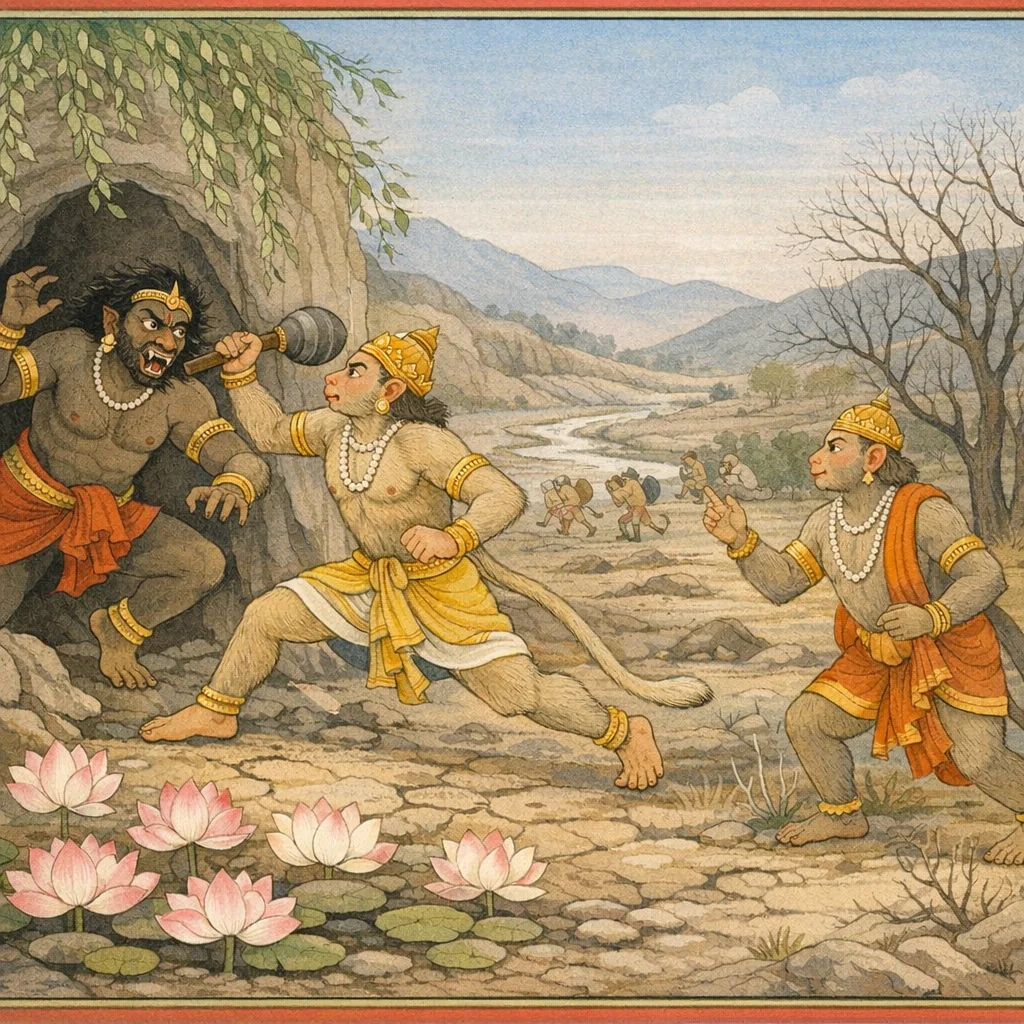
Acting on Sugrīva’s command, Hanumān goes south with Tārā and Aṅgada, leading a coordinated search through the harsh Vindhya terrain. The Vānaras systematically scout caves, dense forest interiors, mountain peaks, river-sources, lakes, and thickets, yet they find no sign of Sītā or her abductor. As they press on, the land grows unnaturally disturbed: rivers run dry, trees stand leafless and fruitless, animals and birds are absent, and lotuses bloom on parched ground—fragrant, yet strangely without bees. Local tradition attributes this to Ṛṣi Kaṇḍu, who, after losing his sixteen-year-old son in the forest, cursed the entire woodland, making it barren and uninhabitable. Entering a dreadful creeper-covered region, the Vānaras face a wicked asura who rushes at them; Aṅgada, mistaking him for Rāvaṇa, strikes him down. After thoroughly searching the mountain caves without finding Sītā, the troop emerges from another terrifying cavern, gathers in seclusion beneath a tree, and sits dejected—an intentional pause that underscores exhaustion, uncertainty, and the discipline required to continue their sacred service.
Shlokas
Verse 1
सह ताराङ्गदाभ्यां तु गत्वा स हनुमान्कपिः।सुग्रीवेण यथोद्दिष्टं तं देशमुपचक्रमे।।।।
Hanumān the monkey, going together with Tārā and Aṅgada, set out toward that region exactly as Sugrīva had instructed.
Verse 2
स तु दूरमुपागम्य सर्वैस्तै: कपिसत्तमैः।विचिनोति स्म विन्ध्यस्य गुहाश्च गहनानि च।।।।पर्वताग्रान्नदीदुर्गान्सरांसि विपुलान्द्रुमान्।वृक्षषण्डांश्च विविधान्पर्वतान्घनपादपान्।।।।
Going far ahead with all those foremost monkeys, he searched the Vindhya region—its caves and its impenetrable tracts. They combed mountain peaks, river-guarded strongholds, lakes, great trees, varied clusters of trees, and mountains thick with vegetation.
Verse 3
स तु दूरमुपागम्य सर्वैस्तै: कपिसत्तमैः।विचिनोति स्म विन्ध्यस्य गुहाश्च गहनानि च।।4.48.2।।पर्वताग्रान्नदीदुर्गान्सरांसि विपुलान्द्रुमान्।वृक्षषण्डांश्च विविधान्पर्वतान्घनपादपान्।।4.48.3।।
They searched mountain-peaks, river-guarded strongholds, lakes, vast trees, many kinds of clustered groves, and mountains thickly covered with forest.
Verse 4
अन्वेषमाणास्ते सर्वे वानरास्सर्वतो दिशम्।न सीतां ददृशुर्वीरा मैथिलीं जनकात्मजाम्।।।।
Searching in every direction, all the heroic Vānara warriors did not find Sītā—Maithilī, the daughter of Janaka.
Verse 5
ते भक्षयन्तो मूलानि फलानि विविधानि च।अन्वेषमाणा दुर्धर्षान्यवसं स्तत्र तत्र ह।।।।
Eating roots and various fruits as they went, those unassailable Vānaras continued the search and camped here and there along the way.
Verse 6
स तु देशो दुरन्वेषो गुहागहनवान्महान्।निर्जलं निर्जनं शून्यं गहनं रोमहर्षणम्।।।।
That region was vast and difficult to search—full of deep caves and thickets—waterless, uninhabited, desolate, impassable, and terrifying.
Verse 7
त्यक्त्वा तु तं तदा देशं सर्वे वै हरियूथपाः।तादृशान्यप्यरण्यानि विचित्य भृशपीडिताः।।।।देशमन्यं दुराधर्षं विविशु श्चाकुतो भयाः।
Leaving that region, all the leaders of the Vānara hosts—having searched even such forests and being sorely strained—fearlessly entered another land, hard to assail.
Verse 8
यत्र वन्ध्यफला वृक्षा विपुष्पाः पर्णवर्जिताः।।।।निस्तोयास्सरितो यत्र मूलं यत्र सुदुर्लभम्।
They came to a place where trees bore no fruit, no flowers, and no leaves; where rivers were waterless; and where even roots were very hard to obtain.
Verse 9
न सन्ति महिषा यत्र न मृगा न च हस्तिनः।।।।शार्दूलाः पक्षिणो वापि ये चान्ये वनगोचराः।
In that place there were no buffaloes, no deer, no elephants—no tigers, no birds, and none of the other creatures that roam the forest.
Verse 10
न यत्रवृक्षा नौषध्यो न वल्ल्यो नापि वीरुधः।।।।स्निग्धपत्रास्स्थले यत्र पद्मिन्यः फुल्लपङ्कजाः।प्रेक्षणीयास्सुगन्धाश्च भ्रमरैश्चापिवर्जिताः।।।।
In that place there were no trees, no medicinal herbs, no creepers, and no vines at all.
Verse 11
न यत्रवृक्षा नौषध्यो न वल्ल्यो नापि वीरुधः।।4.48.10।।स्निग्धपत्रास्स्थले यत्र पद्मिन्यः फुल्लपङ्कजाः।प्रेक्षणीयास्सुगन्धाश्च भ्रमरैश्चापिवर्जिताः।।4.48.11।।
There, on dry ground, lotus-plants with glossy leaves bore fully blossomed lotuses—beautiful and fragrant, yet strangely devoid of bees.
Verse 12
कण्डुर्नाम महाभागस्सत्यवादी तपोधनः।महर्षिः परमामर्षी नियमैर्दुष्प्रधर्षणः।।।।
There was a great sage named Kaṇḍu—truth-speaking and rich in ascetic power; a mahārṣi of fierce temper, unassailable because of his strict observances.
Verse 13
तस्य तस्मिन्वने पुत्रो बालष्षोडशवार्षिकः।प्रणष्टो जीवितान्ताय क्रुद्धस्तत्र महामुनिः।।।।
In that very forest his son—a mere boy of sixteen years—was lost and met his end; and there the great sage became enraged.
Verse 14
तेन धर्मात्मना शप्तं कृत्स्नं तत्रमहद्वनम्।अशरण्यं दुराधर्षं मृगपक्षिविवर्जितम्।।।।
Cursed by that righteous sage, the entire great forest there became shelterless and forbidding, emptied even of beasts and birds.
Verse 15
तस्य ते काननान्ताश्च गिरीणां कन्दराणि च।प्रभवनि नदीनां च विचिन्वन्ति समाहिताः।।।।
With minds intent and gathered, they searched the forest tracts, the mountain caves, and even the very sources of the rivers.
Verse 16
तत्र चापि महात्मानो नापश्यञ्जनकात्मजाम्।हर्तारं रावणं वापि सुग्रीवप्रियकारिणः।।।।
Yet even there, those great-hearted ones—intent on pleasing Sugrīva—did not see Janaka’s daughter, nor did they find Rāvaṇa, her abductor.
Verse 17
ते प्रविश्याऽशु तं भीमं लतागुल्मसमावृतम्।दद्दृशुः क्रूरकर्माणमसुरं सुरनिर्भयम्।।।।
Entering at once that dreadful place overgrown with creepers and bushes, they saw an Asura of cruel deeds—one who feared not even the gods.
Verse 18
तं दृष्ट्वा वानरा घोरं स्थितं शैलमिवापरम्।गाढं परिहितास्सर्वे दृष्ट्वा तान्पर्वतोपममान्।।।।
Seeing that dreadful one standing firm like another mountain, all the monkeys braced themselves; and he, seeing them—mountain-like in their own strength—stood facing them.
Verse 19
सोऽपि तान्वानरान्सर्वान् नष्टा स्स्थेत्यब्रवीद्बली।अभ्यधावत सङ्कृद्धो मुष्टिमुद्यम्य संहितम्।।।।
He too, the mighty one, said to all those monkeys, “You are finished!” And, inflamed with rage, he rushed at them, raising his clenched fist.
Verse 20
तमापतन्तं सहसा वालिपुत्रोऽङ्गदस्तदा।रावणोऽयमिति ज्ञात्वा तलेनाभिजघान ह।।।।
Then Aṅgada, Vāli’s son, suddenly met the onrushing foe; thinking, “This is Rāvaṇa,” he struck him with the palm of his hand.
Verse 21
स वालिपुत्राभिहतो वक्त्राच्छोणितमुद्वमन्।असुरोऽभ्यपतद्भूमौ पर्यस्त इव पर्वतः।।।।
Struck by Vāli’s son, the demon spewed blood from his mouth and crashed to the ground, like a mountain hurled down.
Verse 22
तेऽपि तस्मिन्निरुच्छवासे वानरा जितकाशिनः।व्यचिन्वन्प्रायशस्तत्र सर्वं तद्गिरिगह्वरम्।।।।
When he lay lifeless, the monkeys—having overcome the foe—searched there, almost everywhere, through that mountain cavern.
Verse 23
विचितं तु ततः कृत्वा सर्वे ते काननं पुनः।अन्यदेवापरं घोरं विविशुर्गिरिगह्वरम्।।।।
Having searched that place, all of them again moved through the forest and entered yet another dreadful mountain cavern.
Verse 24
ते विचित्य पुनः खिन्ना विनिष्पत्य समागताः।एकान्ते वृक्षमूले तु निषेदुर्दीनमानसाः।।।।
Searching yet again, weary and disappointed, they came out and gathered together; in a secluded spot beneath a tree, dejected at heart, they sat down.
Frequently Asked Questions
The pivotal action is mission-faithfulness under severe uncertainty: despite terrifying, resource-poor terrain and no immediate results, the Vānaras continue systematic search. Aṅgada’s mistaken identification of the asura as Rāvaṇa also highlights the ethical risk of acting on incomplete knowledge, resolved here by prioritizing troop safety and forward progress.
The chapter teaches that disciplined service (seva) must persist even when outcomes are delayed, and that moral causality can imprint itself onto geography: Ṛṣi Kaṇḍu’s grief and curse render the forest lifeless, making the landscape a reminder that human conduct and inner states can be narrated as cosmic-environmental order or disorder.
Key landmarks include the Vindhya mountain system with its impenetrable caves and mountain-caverns, waterless rivers and their sources, and a cursed forest marked by absence of fauna and abnormal lotus growth on dry ground—features used as navigational and interpretive cues in the southward search-map.