Sarga 8
मैत्रीप्रतिज्ञा-वैरकारणप्रश्नः (Friendship Vow and Inquiry into the Cause of Enmity)
किष्किन्धाकाण्ड
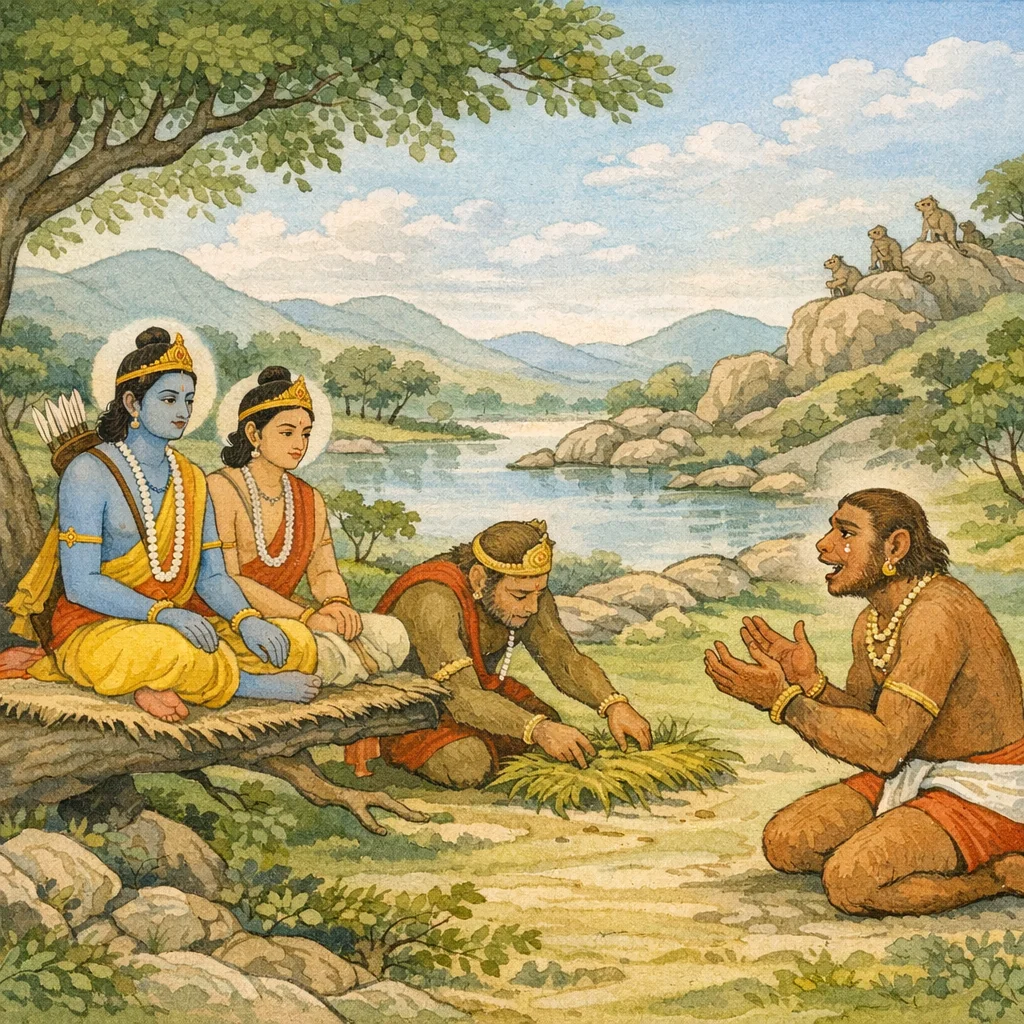
In this sarga, Sugriva, pleased by Rama’s words, addresses him with humility, with Lakshmana as witness. In the forest they arrange seats from sala branches: Sugriva spreads a branch for Rama to sit upon, while Hanuman respectfully seats Lakshmana. Sugriva then, with affection and a voice shaken by joy and sorrow, recounts his misery: his brother Vali drove him from the kingdom, seized his wife, bound his friends, and repeatedly sought his death. Out of fear he dwells on Mount Rishyamuka, protected by the monkey hosts led by Hanuman. He proclaims the sanctity of friendship—one may forsake wealth, pleasure, even the body for a friend—and recalls how their bond was made firm before the sacred fire by the giving of the hand. Tears fill his eyes and for a moment he cannot speak; mastering himself, he declares that only Vali’s destruction will end his suffering. Rama, knower of dharma, promises as if with a smile: the mark of a friend is beneficence, the mark of an enemy is harm—“today itself I shall slay Vali.” He describes his arrows, feathered with kanka plumes and like Mahendra’s thunderbolt. Then Rama asks to hear the true cause of the enmity and assures him that, after weighing strength and weakness, he will act; Sugriva, delighted, begins to explain the origin of the feud.
Shlokas
Verse 1
परितुष्टस्तु सुग्रीवस्तेन वाक्येन वानरः।लक्ष्मणस्याग्रतो राममिदं वचनमब्रवीत्।।
Pleased by those words, Sugrīva, lord of the Vānaras, spoke thus to Rāma in Lakṣmaṇa’s presence.
Verse 2
सर्वथाऽहमनुग्राह्यो देवतानां न संशयः।उपपन्न गुणोपेतस्सखा यस्य भवान्मम।।
In every way I have become worthy of the gods’ favor—there is no doubt—since you, endowed with fitting virtues, have become my friend.
Verse 3
शक्यं खलु भवेद्राम सहायेन त्वयाऽनघ।सुरराज्यमपि प्राप्तुं स्वराज्यं किं पनः प्रभो ।।
O Rāma, O sinless lord—supported by you, one could attain even the sovereignty of the gods; what then need be said of my own kingdom?
Verse 4
सोऽहं सभाज्यो बन्धूनां सुहृदां चैव राघव।यस्याग्निसाक्षिकं मित्रं लब्धं राघववंशजम्।।
O Rāghava, since I have gained you—born in the Rāghava line—as a friend in a pact witnessed by the sacred fire, I have become worthy of equal honor among my kinsmen and my well-wishers.
Verse 5
अहमप्यनुरूपस्ते वयस्यो ज्ञास्यसे शनैः।न तु वक्तुं समर्थोऽहं स्वयमात्मगतान्गुणान्।।
In time you will come to know that I too am a friend worthy of you; yet I am not fit to speak myself of the virtues that belong to me.
Verse 6
महात्मनां तु भूयिष्ठं त्वद्विधानां कृतात्मनाम्।निश्चला भवति प्रीतिर्धैर्यमात्मवतामिव।।
Among great-souled, self-mastered men like you, affection is especially steady—firm like the patient endurance of the disciplined.
Verse 7
रजतं वा सुवर्णं वा वस्त्राण्याभरणानि च।अविभक्तानि साधूनामवगच्छन्ति साधवः।।
Silver or gold, garments and ornaments—true friends understand that among the virtuous such possessions are not divided as ‘mine’ and ‘yours’.
Verse 8
आढ्यो वापि दरिद्रो वा दुःखितस्सुखितोऽपि वा।निर्दोषो वा सदोषो वा वयस्यः परमा गतिः।।
Be he wealthy or poor, distressed or happy, faultless or even at fault—a friend remains the highest refuge for a friend.
Verse 9
धनत्यागस्सुखत्यागो देहत्यागोऽपि वा पुनः।वयस्यार्थे प्रवर्तन्ते स्नेहं दृष्टवा तथाविधम्।।
Seeing such friendship, people act for a friend’s sake—ready to relinquish wealth, forsake comforts, and again even stake their very life.
Verse 10
तत्तथेत्यब्रवीद्रामस्सुग्रीवं प्रियवादिनम्।लक्ष्मणस्याग्रतो लक्ष्म्या वासवस्येव धीमतः।।
Then Rāma replied to the pleasing-spoken Sugrīva, “So be it; it is exactly so,” before wise Lakṣmaṇa, radiant like Vāsava (Indra).
Verse 11
ततो रामं स्थितं दृष्ट्वा लक्ष्मणं च महाबलम्।सुग्रीवस्सर्वतश्चक्षुर्वने लोलमपातयत्।।
Then, seeing Rāma standing there with the mighty Lakṣmaṇa, Sugrīva cast his restless gaze all around the forest, scanning every side.
Verse 12
स ददर्श ततस्सालमविदूरे हरीश्वरः।सुपुष्पमीषत्पत्राढ्यं भ्रमरैरुपशोभितम्।।
Then the lord of the Vānaras saw, not far away, a śāla tree—laden with blossoms, lightly rich in leaves, and made lovely by hovering bees.
Verse 13
तस्यैकां पर्णबहुलां भङ्क्त्वा शाखां सुपुष्पिताम्।सालस्यास्तीर्य सुग्रीवो निषसाद सराघवः।।
Breaking off a single flowering branch of that śāla tree, rich with leaves, Sugrīva spread it out as a seat and sat down there together with Rāghava (Rāma).
Verse 14
तावासीनौ ततो दृष्ट्वा हनूमानपि लक्ष्मणम्।सालशाखां समुत्पाट्य विनीतमुपवेशयत्।।
Seeing the two seated, Hanūmān too tore off a śāla branch and, with reverence, seated the obedient Lakṣmaṇa upon it.
Verse 15
सुखोपविष्टं रामं तु प्रसन्नमुदधिं यथा।फलपुष्पसमाकीर्णे तस्मिन् गिरिवरोत्तमे।।ततः प्रहृष्टस्सुग्रीवश्लक्ष्णं मधुरया गिरा।उवाच प्रणयाद्रामं हर्षव्याकुलिताक्षरम्।।
Rāma sat at ease upon that finest of mountains, strewn with fruits and flowers, serene like the calm ocean.
Verse 16
सुखोपविष्टं रामं तु प्रसन्नमुदधिं यथा।फलपुष्पसमाकीर्णे तस्मिन् गिरिवरोत्तमे4.8.15।।ततः प्रहृष्टस्सुग्रीवश्लक्ष्णं मधुरया गिरा।उवाच प्रणयाद्रामं हर्षव्याकुलिताक्षरम्4.8.16।।
Then Sugrīva, delighted, spoke to Rāma in gentle, sweet words—his syllables tumbling in excitement, born of affection.
Verse 17
अहं विनिकृतो भ्रात्रा चराम्येष भयार्दितः।ऋष्यमूकं गिरिवरं हृतभार्यस्सुदुःखितः।।
“Betrayed by my brother, I wander here, tormented by fear—on this great Ṛśyamūka mountain—my wife stolen away, and I am sunk in grief.”
Verse 18
सोऽहं त्रस्तो भये मग्नो वसाम्युद्भ्रान्तचेतनः।वालिना निकृतो भ्रात्रा कृतवैरश्च राघव।।
“So I live terrified, drowning in fear, my mind unsettled. Deceived by my brother Vālin, I have become his declared enemy, O Rāghava.”
Verse 19
वालिनो मे भयार्तस्य सर्वलोकाभयङ्कर।ममापि त्वमनाथस्य प्रसादं कर्तुमर्हसि।।
I am tormented by fear because of Vālin. O you who can strike terror into all worlds, you should grant your favor even to me—helpless and without refuge.
Verse 20
एवमुक्तस्तु तेजस्वी धर्मज्ञो धर्मवत्सलः।प्रत्युवाच स काकुत्स्थस्सुग्रीवं प्रहसन्निव।।
Thus addressed, the radiant Rāma—knower and lover of dharma—replied to Sugrīva with a gentle, reassuring smile.
Verse 21
उपकारफलं मित्रमपकारोऽरिलक्षणम्।अद्यैव तं हनिष्यामि तव भार्यापहारिणम्।।
A friend is known by the fruit of help; harming others is the mark of an enemy. This very day I will kill him—the one who carried off your wife.
Verse 22
इमे हि मे महावेगा पत्रिणस्तिग्मतेजसः।कार्तिकेयवनोद्भूताश्शरा हेमविभूषिताः।।कङ्कपत्रपरिच्छन्ना महेन्द्राशनिसन्निभाः।सुपर्वाणस्सुतीक्ष्णाग्रास्सरोषा भुजगा इव।।
For here are my arrows—swift, feathered, blazing in power—said to have arisen from Kārttikeya’s reed-bed and adorned with gold. Covered with kaṅka-feathers, they are like Indra’s thunderbolt: well-jointed, razor-tipped, and fierce like enraged serpents.
Verse 23
इमे हि मे महावेगा पत्रिणस्तिग्मतेजसः।कार्तिकेयवनोद्भूताश्शरा हेमविभूषिताः4.8.22।।कङ्कपत्रपरिच्छन्ना महेन्द्राशनिसन्निभाः।सुपर्वाणस्सुतीक्ष्णाग्रास्सरोषा भुजगा इव4.8.23।।
For here are my arrows—swift, feathered, blazing in power—said to have arisen from Kārttikeya’s reed-bed and adorned with gold. Covered with kaṅka-feathers, they are like Indra’s thunderbolt: well-jointed, razor-tipped, and fierce like enraged serpents.
Verse 24
भ्रातृसंज्ञममित्रं ते वालिनं कृतकिल्बिषम्।शरैर्विनिहतं पश्य विकीर्णमिव पर्वतम्।।
Behold Vāli—called ‘brother’ yet your foe, stained by wrongdoing—struck down by my arrows, shattered like a mountain rent asunder.
Verse 25
राघवस्य वचश्श्रुत्वा सुग्रीवो वाहिनीपतिः।प्रहर्षमतुलं लेभे साधु साध्विति चाब्रवीत्।।
Hearing Rāghava’s words, Sugrīva, lord of the monkey hosts, was filled with boundless joy and cried, “Well said! Well said!”
Verse 26
राम शोकाभिभूतोऽहं शोकार्तानां भवान्गतिः।वयस्य इति कृत्वा हि त्वय्यहं परिदेवये।।
O Rāma, I am overcome by sorrow; you are the refuge of the grief-stricken. Taking you as my friend, I pour out my lament to you.
Verse 27
त्वं हि पाणिप्रदानेन वयस्यो मेऽग्निसाक्षिकम्।कृतः प्राणैर्बहुमतस्सत्येनापि शपामि ते।।
By the clasping of hands, with fire as witness, you have become my friend—dearer to me than life itself. By truth itself I swear this to you.
Verse 28
वयस्य इति कृत्वा च विस्रब्धः प्रवदाम्यहम्।दुःखमन्तर्गतं यन्मे मनो हरति नित्यशः4.8.28।।
And since I regard you as a friend, I speak with confidence: a sorrow hidden within me continually torments my mind.
Verse 29
एतावदुक्त्वा वचनं बाष्पदूषितलोचनः।बाष्पोपहतया वाचा नोच्चैश्शक्नोति भाषितुम्।।
Having said only this much, his eyes clouded with tears; his voice choked by sobs, he could not speak aloud any further.
Verse 30
बाष्पवेगं तु सहसा नदीवेगमिवागतम्।धारयामास धैर्येण सुग्रीवो रामसन्निधौ।।
But Sugrīva, before Rāma, steadied with patience the sudden rush of tears that came like the surge of a river.
Verse 31
सन्निगृह्य तु तं बाष्पं प्रमृज्य नयने शुभे।विनिश्श्वस्य च तेजस्वी राघवं वाक्यमब्रवीत्।।
Restraining those tears, wiping his bright eyes, and drawing a deep breath, the radiant Sugrīva spoke these words to Rāghava (Rāma).
Verse 32
पुराऽहं वालिना राम राज्यात्स्वादवरोपितः।परुषाणि च संश्राव्य निर्धूतोऽस्मि बलीयसा।।
Formerly, O Rāma, Vāli tore me from my own kingship; after making me hear harsh words, that stronger one drove me out.
Verse 33
हृता भार्या च मे तेन प्राणेभ्योऽपि गरीयसी।सुहृदश्च मदीया ये संयता बन्धनेषु ते।।
By him my wife—dearer to me even than life—was taken away; and those friends of mine were seized and kept in bondage.
Verse 34
यत्नवांश्च सुदुष्टात्मा मद्विनाशाय राघव।बहुशस्तत्प्रयुक्ताश्च वानरा निहता मया।।
O Rāghava, that utterly wicked one made repeated efforts to destroy me; and many monkeys dispatched by him were slain by me.
Verse 35
शङ्कया त्वेतया चेह दृष्ट्वा त्वामपि राघव।नोपसर्पाम्यहं भीतो भये सर्वे हि बिभ्यति।।
And so, O Rāghava, seeing even you here, I did not come near—afraid because of this suspicion; for when fear is present, all beings indeed tremble.
Verse 36
केवलं हि सहाया मे हनुमत्प्रमुखास्त्विमे।अतोऽहं धारयाम्यद्य प्राणान् कृच्छ्रगतोऽपि सन्।।
Only these—led by Hanumān—are my helpers; therefore, even though I have fallen into hardship, I keep my life today.
Verse 37
एते हि कपयस्स्निग्धा मां रक्षन्ति समन्ततः।सह गच्छन्ति गन्तव्ये नित्यं तिष्ठन्ति च स्थिते।।
For these monkeys, tender in affection, guard me on every side; they go with me when I must go, and when I halt they ever stand watch.
Verse 38
सङ्क्षेपस्त्वेष मे राम किमुक्त्वा विस्तरं हि ते।स मे ज्येष्ठो रिपुर्भ्राता वाली विश्रुतपौरुषः।।
This is my account in brief, O Rāma—why should I speak at length? Vāli, my elder brother, famed for prowess, has become my enemy.
Verse 39
तद्विनाशाद्धि मे दुःखं प्रणष्टं स्यादनन्तरम्।सुखं मे जीवितं चैव तद्विनाशनिबन्धनम्।।
Only with his destruction will my sorrow vanish at once; my happiness—and even my life—depend upon that very destruction.
Verse 40
एष मे राम शोकान्तश्शोकार्तेन निवेदितः।दुःखितस्सुखितो वापि सख्युर्नित्यं सखा गतिः।।
O Rāma, I, stricken with grief, have laid before you the end of my sorrow. In distress or in happiness, for a friend, a friend is ever the refuge.
Verse 41
श्रुत्वैतद्वचनं रामस्सुग्रीवमिदमब्रवीत्।किं निमित्तमभूद्वैरं श्रोतुमिच्छामि तत्त्वतः।।
Hearing these words, Rāma said to Sugrīva: “For what reason did this enmity arise? I wish to hear the truth of it in full.”
Verse 42
सुखं हि कारणं श्रुत्वा वैरस्य तव वानर।अनन्तरं विधास्यामि सम्प्रधार्य बलाबलम्।।
O Vānara, after hearing the cause of your enmity and weighing strength and weakness, I will act at once to secure your welfare.
Verse 43
बलवान् हि ममामर्षश्श्रुत्वा त्वामवमानितम्।वर्तते हृदयोत्कम्पी प्रावृड्वेग इवाम्भसः।।
Indeed, hearing that you have been humiliated, my indignation rises powerfully; my heart trembles in agitation, like waters driven by the force of the rainy season.
Verse 44
हृष्टः कथय विस्रब्धो यावदारोप्यते धनुः।सृष्टश्च हि मया बाणो निरस्तश्च रिपुस्तव।।
Speak freely and with confidence, even with gladness, while I string my bow; for once my arrow is released, your enemy will surely be struck down.
Verse 45
एवमुक्तस्तु सुग्रीवः काकुत्स्थेन महात्मना।प्रहर्षमतुलं लेभे चतुर्भिस्सह वानरैः।।
Thus addressed by the great-souled Kakutstha, Sugrīva—together with the four Vānaras—was filled with immeasurable joy.
Verse 46
ततः प्रहृष्टवदनस्सुग्रीवो लक्ष्मणाग्रजे।वैरस्य कारणं तत्त्वमाख्यातुमुपचक्रमे।।
Then Sugrīva, his face bright with joy, began to recount to Lakṣmaṇa’s elder brother the true facts—the real cause of the enmity.
Frequently Asked Questions
The key action is Rama’s public commitment to remove Sugriva’s oppressor (Vali) as an expression of sakhya-dharma, while simultaneously insisting on understanding the factual cause of the enmity and weighing bala–abala (strengths and constraints). The dilemma balances loyalty to an ally with due inquiry and proportionate action.
Friendship is framed as a moral refuge across conditions—wealth/poverty, joy/sorrow, innocence/fault—implying that ethical solidarity is not transactional. Rama’s response models dharmic agency: compassion that listens, and power that acts only after clarity about causes and consequences.
The narrative foregrounds ऋश्यमूकगिरिः as Sugriva’s refuge-space shaped by fear of Vali, and a forest setting marked by a flowering सालवृक्ष used as improvised seating—small material details that map the scene’s ecology and court-like protocol in exile.