Sarga 12
द्वादशः सर्गः — Rama’s Proof of Power, the First Duel, and the Identification Mark (Kishkindha Kanda, Sarga 12)
किष्किन्धाकाण्ड
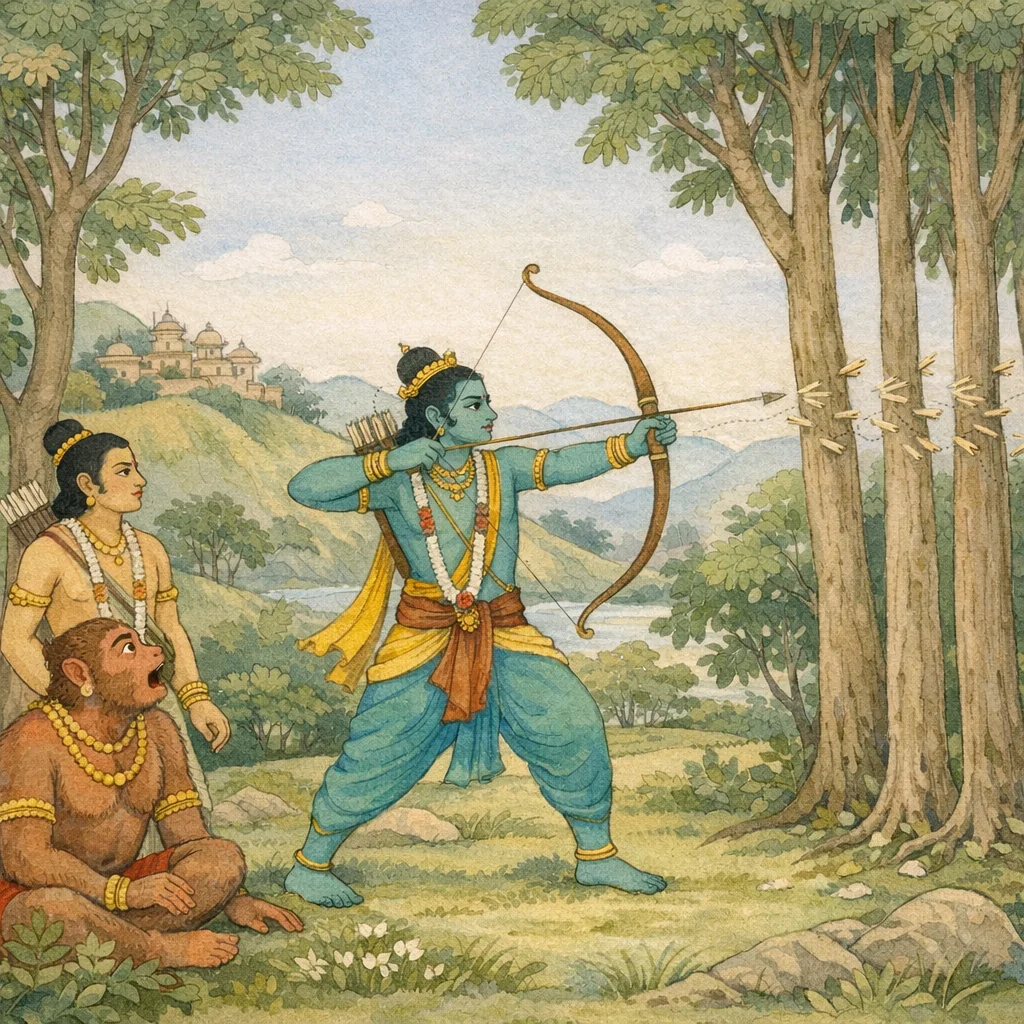
In Sarga 12, the narrative moves from proof to action. Rama confirms Sugriva’s trust by taking up his bow and displaying peerless archery: a single gold-adorned arrow pierces seven sāla trees, a mountain mass, and the earth, then returns to the quiver—pratyaya, a decisive proof of his competence and a deterrent to the foe. Strengthened by this, Sugriva asks for immediate action against Vali. Rama agrees and directs him to challenge Vali at Kishkindha. The duel begins, painted with cosmic similes like sunrise and the clash of planets, yet Rama withholds the fatal shot because he cannot distinguish the identical brothers in ornaments, form, gait, voice, and valor. Defeated and bloodied, Sugriva retreats to the cursed Matanga-grove, where Vali halts in fear of the sage’s curse. Sugriva reproaches Rama, and Rama answers in dharma: to kill by mistake one who seeks protection is a grave sin, and misidentification would ruin their shared aim. Renewing his promise, Rama establishes a practical remedy—an identification mark. Lakshmana fastens a blooming gajapuṣpī creeper around Sugriva’s neck, and Sugriva, radiant and resolute, returns with Rama toward Vali-ruled Kishkindha to resume the decisive confrontation.
Shlokas
Verse 1
एतच्च वचनं श्रुत्वा सुग्रीवेण सुभाषितम्।प्रत्ययार्थं महातेजा रामो जग्राह कार्मुकम्4.12.1।।
Hearing Sugriva’s well-spoken words, the radiant Rama took up his bow, to establish trust and confidence in his promise.
Verse 2
स गृहीत्वा धनुर्घोरं शरमेकं च मानदः।सालमुद्दिश्य चिक्षेप ज्यास्वनैः पूरयन्दिशः। 4.12.2।।
Rāma—the humbler of hostile pride—took up his fearsome bow and a single arrow; aiming at the śāla tree, he released it, and the twang of the bowstring filled the quarters.
Verse 3
स विसृष्टो बलवता बाणस्स्वर्णपरिष्कृतः।भित्त्वा सालान् गिरिप्रस्थं सप्त भूमिं विवेश ह4.12.3।।
Released with mighty force, that arrow—adorned with gold—split through the seven sāla trees, pierced the mountain-face, and entered into the earth.
Verse 4
प्रविष्टश्च मुहूर्तेन धरां भित्त्वा महाजवः।निष्पत्य च पुनस्तूर्णं स्वतूणीं प्रविवेश ह4.12.4।।
In a moment, that arrow—of tremendous speed—pierced the earth, sprang forth again, and swiftly returned into its own quiver.
Verse 5
तान्दृष्ट्वा सप्त निर्भिन्नान्सालान्वानरपुङ्गवः।रामस्य शरवेगेन विस्मयं परमं गतः4.12.5।।
Seeing those seven sāla trees pierced through by the speed of Rāma’s arrow, the foremost of monkeys was filled with the greatest astonishment.
Verse 6
स मूर्ध्ना न्यपतदभ्मौ प्रलम्बीकृतभूषणः।सुग्रीवः परमप्रीतो राघवाय कृताञ्जलिः4.12.6।।
Overjoyed, Sugrīva—his ornaments hanging down—fell to the ground with head bowed, and with folded hands paid reverence to Rāghava (Rāma).
Verse 7
इदं चोवाच धर्मज्ञं कर्मणा तेन हर्षितः।रामं सर्वास्त्रविदुषां श्रेष्ठं शूरमवस्थितम्4.12.7।।
Delighted by that deed, he spoke these words to Rāma, steadfast there: a knower of dharma, the foremost among all who understand weapons, and a valiant hero.
Verse 8
सेन्द्रानपि सुरान्सर्वांस्त्वं बाणैः पुरुषर्षभ।समर्थस्समरे हन्तुं किं पुन र्वालिनं प्रभो 4.12.8।।
O best of men, O lord—on the battlefield you are able to strike down even the gods, Indra included, with your arrows; how much more, then, Vāli?
Verse 9
येन सप्तमहासाला गिरिर्भूमिश्च दारिताः।बाणेनैकेन काकुत्स्थ स्थाता ते को रणाग्रतः4.12.9।।
O Rāma of the Kakutsthas—who could stand before you in the forefront of battle, you who with a single arrow pierced seven mighty śāla trees, and even the mountain and the earth?
Verse 10
अद्य मे विगतश्शोकः प्रीतिरद्य परा मम।सुहृदं त्वां समासाद्य महेन्द्रवरुणोपमम्4.12.10।।
Today my sorrow has departed; today my joy is supreme—having gained you as a friend, one comparable to Indra and Varuna.
Verse 11
तमद्यैव प्रियार्थं मे वैरिणं भ्रातृरूपिणम्।वालिनं जहि काकुत्स्थ मया बद्धोऽयमञ्जलिः4.12.11।।
Therefore, even today—O Kakutstha—slay Vali, my enemy who bears the form of a brother, for my sake; with folded hands I entreat you.
Verse 12
ततो रामः परिष्वज्य सुग्रीवं प्रियदर्शनम्।प्रत्युवाच महाप्राज्ञो लक्ष्मणानुगतं वचः4.12.12।।
Then the very wise Rama embraced Sugriva, pleasing to behold, and replied with words in accord with Lakshmana’s counsel.
Verse 13
अस्माद्गच्छेम किष्किन्धां क्षिप्रं गच्छ त्वमग्रतः।गत्वा चाह्वय सुग्रीव वालिनं भ्रातृगन्धिनम्4.12.13।।
From here we shall go to Kishkindha; go quickly in front. Having gone, O Sugriva, challenge Vali—your ‘brother’ only in name.
Verse 14
सर्वे ते त्वरितं गत्वा किष्किन्धां वालिनः पुरीम्।वृक्षैरात्मानमावृत्य व्यतिष्ठन्गहने वने4.12.14।।
All of them hurried to Kishkindha, Vali’s capital; then, concealing themselves behind trees, they waited in the dense forest.
Verse 15
सुग्रीवो व्यनदद्घोरं वालिनोऽऽह्वानकारणात्।गाढं परिहितो वेगान्नादैर्भिन्दन्निवाम्बरम्4.12.15।।
To summon Vali, Sugriva tightened his garment firmly and let out a fearsome roar—his cries seeming to split the sky.
Verse 16
तं श्रुत्वा निनदं भ्रातुः क्रुद्धो वाली महाबलः।निश्चक्राम सुसंरब्धो भास्करोऽस्ततटादिव4.12.16।।
Hearing his brother’s roar, the mighty Vali—enraged and vehement—burst forth like the sun rising from beyond the western ocean’s edge.
Verse 17
ततस्सुतुमुलं युद्धं वालिसुग्रीवयोरभूत्।गगने ग्रहयोर्घोरं बुधाङ्गारकयोरिव4.12.17।।
Then a fiercely tumultuous battle arose between Vāli and Sugrīva—like a dreadful clash of planets in the sky, as of Mercury and Mars.
Verse 18
तलैरशनिकल्पैश्च वज्रकल्पैश्च मुष्टिभिः।जघ्नतुस्समरेऽन्योन्यं भ्रातरौ क्रोधमूर्छितौ4.12.18।।
In the battle, the two brothers—stupefied by rage—struck each other with palms and feet like thunder, and with fists like thunderbolts.
Verse 19
ततो रामो धनुष्पाणिस्तावुभौ समुदीक्ष्यतु।अन्योन्यसदृशौ वीरावुभौ देवाविवाश्विनौ4.12.19।।
Then Rāma, bow in hand, carefully observed the two heroes—so alike in appearance, like the twin Aśvins among the gods.
Verse 20
यन्नावगच्छत्सुग्रीवं वालिनं वापि राघवः।ततो न कृतवान्बुद्धिं मोक्तुमन्तकरं शरम्4.12.20।।
Because Rāghava could not clearly tell whether it was Sugrīva or Vāli, he did not form the resolve to release the death-dealing arrow.
Verse 21
एतस्मिन्नन्तरे भग्नस्सुग्रीवस्तेन वालिना।अपश्यन्राघवं नाथमृश्यमूकं प्रदुद्रुवे4.12.21।।
Meanwhile, beaten back by Vāli, Sugrīva—failing to see Rāghava, his protector—fled swiftly toward Ṛśyamūka.
Verse 22
क्लान्तो रुधिरसिक्ताङ्गः प्रहारैर्जर्झरीकृतः।वालिनाऽभिद्रुतः क्रोधात्प्रविवेश महावनम्4.12.22।।
Exhausted, his limbs drenched in blood and shattered by blows, Sugrīva—pursued in wrath by Vāli—entered the great forest-grove, the revered region of Matanga.
Verse 23
तं प्रविष्टं वनं दृष्ट्वा वाली शापभयार्दितः।मुक्तो ह्यसि त्वमित्युक्त्वा स निवृत्तो महाद्युतिः4.12.23।।
Seeing him enter that grove, Vāli—tormented by fear of the sage’s curse—said, “You have indeed escaped,” and the radiant one turned back.
Verse 24
राघवोऽसि सह भ्रात्रा सह चैव हनूमता।तदेव वनमागच्छत्सुग्रीवो यत्र वानरः4.12.24।।
Rāghava too—along with his brother and with Hanumān—came to that very grove where Sugrīva the vānara was.
Verse 25
तं समीक्ष्यागतं रामं सुग्रीवस्सहलक्ष्मणम्।ह्रीमान्दीनमुवाचेदं वसुधामवलोकयन्4.12.25।।
Seeing Rāma arrive with Lakṣmaṇa, Sugrīva—ashamed and downcast—spoke these words piteously, his gaze lowered to the ground.
Verse 26
आह्वयस्वेति मामुक्त्वा दर्शयित्वा च विक्रमम्।वैरिणा घातयित्वा च किमिदानीं त्वया कृतम्4.12.26।।
After telling me, “Challenge him,” and after displaying your prowess, why have you now let the enemy strike me—what is this that you have done?
Verse 27
तामेन वेलां वक्तव्यं त्वया राघव तत्त्वतः।वालिनं न निहन्मीति ततो नाहमितो व्रजे4.12.27।।
At that very time, Rāghava, you should have told me the truth: “I will not kill Vāli.” Then I would not have gone out from here at all.
Verse 28
तस्य चैवं ब्रुवाणस्य सुग्रीवस्य महात्मनः।करुणं दीनया वाचा राघवः पुनरब्रवीत्4.12.28।।
As the great-souled Sugrīva spoke in that piteous and humble voice, Rāghava (Rāma) replied again with compassion.
Verse 29
सुग्रीव श्रूयातां तात क्रोधश्च व्यपनीयताम्।कारणं येन बाणोऽयं न मया स विसर्जितः4.12.29।।
Sugrīva, dear friend—listen, and set aside your anger. I will tell you the reason why I did not release this arrow.
Verse 30
अलङ्कारेण वेषेण प्रमाणेन गतेन च।त्वं च सुग्रीव वाली च सदृशौ स्थः परस्परम्4.12.30।।
Sugrīva, in ornaments, attire, bodily build, and even in movement, you and Vālī resemble each other closely.
Verse 31
स्वरेण वर्चसा चैव प्रेक्षितेन च वानर।विक्रमेण च वाक्यैश्च व्यक्तिं वां नोपलक्षये4.12.31।।
O monkey, in voice, radiance, appearance, prowess, and speech, I cannot discern any clear distinction between the two of you.
Verse 32
ततोऽहं रूपसादृश्यान्मोहितो वानरोत्तम।नोत्सृजामि महावेगं शरं शत्रुनिबर्हणम्4.12.32।।
Therefore, O best of monkeys, bewildered by your similarity in form, I did not let fly the swift arrow that would have destroyed the enemy.
Verse 33
जीवितान्तकरं घोरं सादृश्यात्तु विशङ्कितः।मूलघातो न नौ स्याद्धि द्वयोरपि कृतो मया4.12.33।।
Because of that resemblance I was anxious: with a terrible, life-ending shot, I might have struck at the very root of our cause—harming either of you—and thus ruined the interests of both.
Verse 34
त्वयि वीरे विपन्ने हि अज्ञानाल्लाघवान्मया।मौढ्यं च मम बाल्यं च ख्यापितं स्यात्कपीश्वर4.12.34।।
O lord of monkeys, if you—the brave one—had come to harm because of my ignorance and rashness, my folly and childishness would have been exposed.
Verse 35
दत्ताभयवधो नाम पातकं महदुच्यते।अहं च लक्ष्मणश्चैव सीता च वरवर्णिनी4.12.35।।त्वदधीना वयं सर्वे वनेऽस्मिन् शरणं भवान्।
To kill one who has been granted protection is said to be a great sin. I, Lakṣmaṇa, and Sītā of lovely complexion—all of us here in this forest depend upon you; you are our refuge.
Verse 36
तस्माद्युध्यस्व भूयस्त्वं मा मा शङ्केश्च वानर4.12.36।।एतन्मुहूर्ते सुग्रीव पश्य वालिनमाहवे।निरस्तमिषुणैकेन वेष्टमानं महीतले4.12.37।।
Therefore, O monkey, go again and fight—do not doubt me. In this very moment, Sugrīva, you will see Vālī in battle struck down by a single arrow and writhing upon the ground.
Verse 37
तस्माद्युध्यस्व भूयस्त्वं मा मा शङ्केश्च वानर4.12.36।।एतन्मुहूर्ते सुग्रीव पश्य वालिनमाहवे।निरस्तमिषुणैकेन वेष्टमानं महीतले4.12.37।।
Therefore, O monkey, go again and fight—do not doubt me. In this very moment, Sugrīva, you will see Vālī in battle struck down by a single arrow and writhing upon the ground.
Verse 38
अभिज्ञानं कुरुष्व त्वमात्मनो वानरेश्वर।येन त्वामभिजानीयां द्वन्द्वयुद्धमुपागतम्4.12.38।।
O lord of monkeys, place upon yourself a clear sign of recognition, so that I may distinguish you when you have entered the duel.
Verse 39
गजपुष्पीमिमां फुल्लामुत्पाट्य शुभलक्षणाम्।कुरु लक्ष्मण कण्ठेऽस्य सुग्रीवस्य महात्मनः।।4.12.39।।
O Lakṣmaṇa, pluck this blossoming gajapuṣpī creeper of auspicious marks and place it upon the neck of the great-souled Sugrīva.
Verse 40
ततो गिरितटे जातामुत्पाट्य कुसुमाकुलाम्।लक्ष्मणो गजपुष्पीं तां तस्य कण्ठे व्यसर्जयत्4.12.40।।
Then Lakṣmaṇa plucked that gajapuṣpī, grown on the mountain-slope and laden with blossoms, and fastened it upon Sugrīva’s neck.
Verse 41
स तया शुशुभे श्रीमान् लतया कण्ठसक्तया।मालयेव बलाकानां ससन्ध्य इव तोयदः4.12.41।।
Adorned with that creeper fastened about his neck, the fortunate Sugrīva shone—like a rain-cloud at twilight, garlanded as it were with a line of white cranes.
Verse 42
विभ्राजमानो वपुषा रामवाक्यसमाहितः।जगाम सह रामेण किष्किन्थां वालिपालिताम्4.12.42।।
Radiant in form and intent on fulfilling Rāma’s words, he went together with Rāma to Kiṣkindhā, the city ruled by Vāli.
Frequently Asked Questions
Rama faces a dharma-critical choice: whether to release a deadly arrow during the Vali–Sugriva duel when the combatants are indistinguishable. He refrains to avoid wrongful killing and the moral fault of harming the protected ally, prioritizing certainty and ethical legitimacy over immediate tactical success.
Power must be governed by discernment: even justified ends require correct identification, proportional means, and fidelity to promises of protection. The sarga teaches that restraint under ambiguity is not weakness but moral intelligence, and that trust in alliances is strengthened by transparent reasoning and corrective planning.
Key landmarks include Kishkindha (the political center), Rishyamuka (Sugriva’s refuge zone), and Matanga’s grove where a curse-bound boundary limits Vali’s pursuit. These locations function as a strategic map: capital (objective), mountain refuge (fallback), and prohibited grove (sanctuary enforcing restraint).