Sarga 62
संपाति-उपदेशः / Sampati Instructed and the Search Mission Foretold
किष्किन्धाकाण्ड
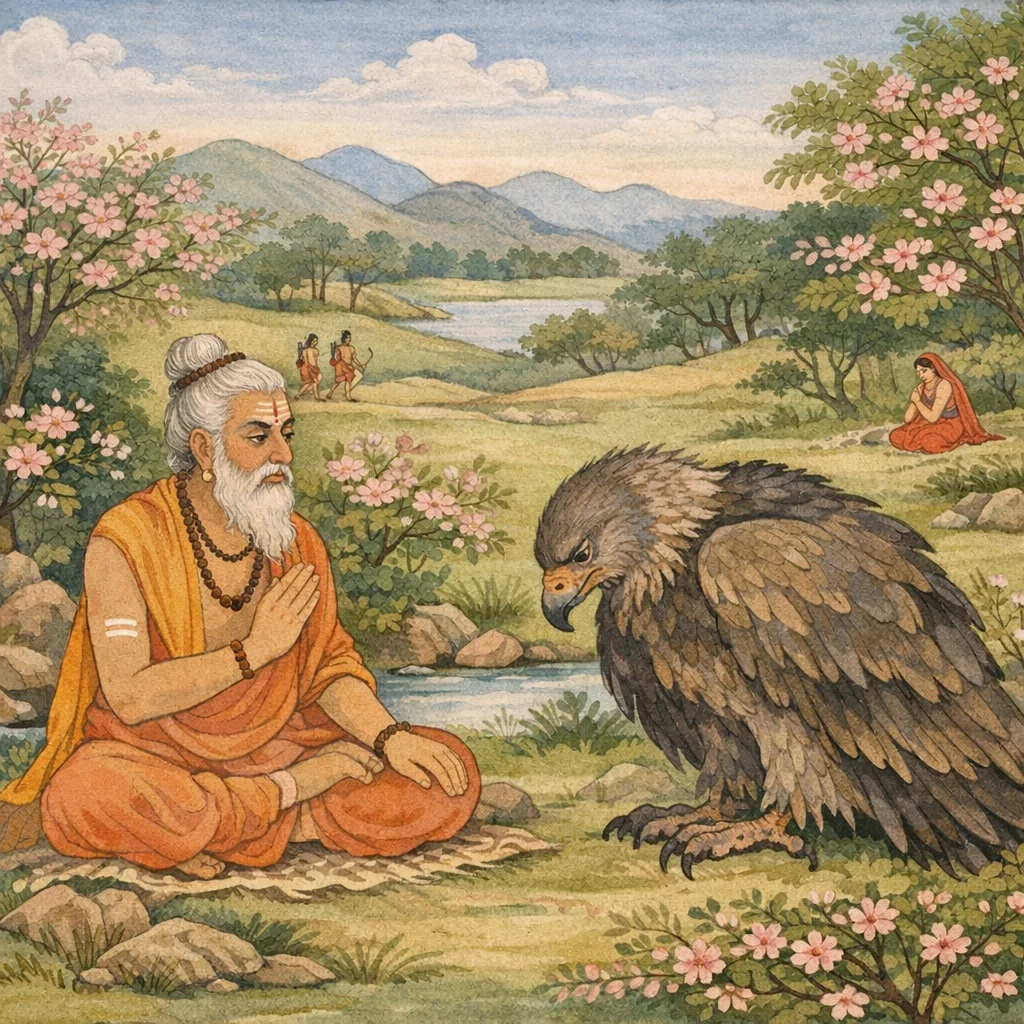
Sarga 62 unfolds as counsel and prophecy, centered on Sampāti’s grief at having lost his wings and on his destined usefulness in the search for Sītā. After an emotional outburst and a brief silence, a venerable muni—revealed at the close as a self-realized mahārṣi—assures Sampāti of restoration: new wings and feathers, renewed vision and life, and the return of valor, prowess, and strength. The sage sets this boon within a wider itihāsa-purāṇa horizon, foretelling Daśaratha’s advent and Rāma’s birth, Rāma’s forest exile with Lakṣmaṇa, and Rāvaṇa’s abduction of Sītā from Jana-sthāna. Sītā’s steadfast refusal of pleasure and food is emphasized, followed by Indra’s gift of nectar-like sustenance; Sītā then ritually offers a portion upon the earth for Rāma, voicing a dedication that reaches across distance and uncertainty. The muni instructs that vānaras, Rāma’s messengers, will arrive seeking Sītā, and Sampāti must convey this knowledge to them; until then he should remain, await the proper time and place, and serve the welfare of the world. The chapter ends with the sage’s wish to behold Rāma and Lakṣmaṇa, coupled with detachment from prolonged life, underscoring ascetic renunciation alongside mission-critical guidance.
Shlokas
Verse 1
एवमुक्ता मुनिश्रेष्ठ मरुदं दुःखितो भृशं। अथ ध्यात्वा मुहूर्तं तु भगवानिदमब्रवीत्।।4.62.1।।
When I had spoken thus to that best of sages, crying out in deep distress, the holy one reflected for a moment and then spoke these words.
Verse 2
पक्षौ तु ते प्रपक्षौ च पुनरन्यौभविष्यतः।प्राणाश्च चक्षुषी चैव विक्रमश्च बलं च ते।।4.62.2।।
You will regain new wings and pinions once more; and you will also recover your life-breath, eyesight, prowess, and strength.
Verse 3
पुराणे सुमहत्कार्यं भविष्यति मया श्रुतं।दृष्टं मे तपसा चैव श्रुत्वा च विदितं मम4.62.3।।
In the ancient accounts I have heard that a very great deed will be accomplished; and by the power of my austerity I have also perceived it—having heard, I have come to know it with certainty.
Verse 4
राजा दशरथो नाम कश्चिदिक्ष्वाकुनन्दनः।तस्य पुत्रो महातेजा रमोनाम भविष्यति।।4.62.4।।
In the Ikṣvāku lineage there will be a king named Daśaratha; and to him will be born a son of great splendor, named Rāma.
Verse 5
अरण्यं च सह र्भात्रा लक्ष्मणेनगमिष्यति।अस्मिन्नर्थे नियुक्त स्सन्पित्रा सत्यपराक्रमः।।4.62.5।।
Commissioned by his father for this very purpose, Rāma—whose valor is grounded in truth—will go to the forest together with his brother Lakṣmaṇa.
Verse 6
नैऋतो रावणो नाम तस्य भार्यां हरिष्यति।राक्षसेन्द्रो जनस्थनादवध्य स्सुरदानवैः4.62.6।।
A rākṣasa lord named Rāvaṇa will abduct his wife from Janasthāna—one who is said to be invincible even to gods and dānavas.
Verse 7
सा च कामैः प्रलोभ्यन्ती भक्ष्यै:भोज्यैश्च मैथिली।नभोक्ष्यति महाभागा दुःखे मग्ना यशस्विनी।।4.62.7।।
Though tempted with pleasures, foods, and delicacies, that noble Maithilī—famed and sunk in sorrow—will not partake.
Verse 8
परमान्नंतु वैदेह्या ज्ञात्वा दास्यति वा सः।यदन्नममृतप्रख्यं सुराणामपिदुर्लभम्4.62.8।।
Knowing that Vaidehī is not eating, he will provide her a supreme food—nectar-like nourishment, difficult to obtain even for the gods.
Verse 9
तदन्नं मैथिलीप्राप्य विज्ञायेन्द्रादिदंत्विति।अग्रमुदृत्य रामाय भूतले निर्वपिष्यति।।4.62.9।।
Receiving that food, Maithilī (Sītā) understood, “This has been given by Indra.” Taking out a generous portion, she would place it upon the ground as an offering for Rāma, wherever he might be upon the earth.
Verse 10
यदि जीवति मे भर्ता लक्ष्मणेन सह प्रभुः।देवत्वं गच्छ्तो र्वापि तयो रन्नमिदंत्विति4.62.10।।
“If my lord and husband is alive together with Lakṣmaṇa—or even if they have gone to the state of the gods—may this food be for them to partake.” Thus will Sītā speak.
Verse 11
एष्यन्त्यन्वेषका स्तस्या रामदूताः प्लवांगमाः। आख़्येया राम महीषी त्वया तेभ्यो विहंगम4.62.11।।
Searchers will come for her—monkeys, Rāma’s messengers. O bird, you must tell them of Rāma’s queen.
Verse 12
सर्वथा हि नगन्तव्यमीदृशः क्व गमिष्यसि।देशकालौ प्रतीक्षस्व पक्षौ त्वं प्रतिपत्स्यसे4.62.12।।
By all means do not depart in this condition—where could you go? Wait for the proper place and time; your wings will be restored to you.
Verse 13
नोत्सहेयमहंकर्तुमध्यैव त्वां सपक्षकम्।इहस्थ स्त्वं तु लोकानां हितं कार्यं करिष्यसि।।4.62.13।।
I am not inclined to restore your wings right now, along with your companions. Stay here; remaining here, you will accomplish a work that benefits the worlds.
Verse 14
त्वयापि खलु तत्कार्यं तयोश्चनृपपुत्रयोः।ब्राह्मणानां सुराणां च मुनीनां वासवस्य च।।4.62.14।।
Truly, that task is to be carried out by you—not only for those two princely sons, but also for the brāhmaṇas, the gods, the sages, and for Vāsava (Indra) as well.
Verse 15
इच्छाम्यहमपिद्रष्टुं भ्रातरौ रामलक्ष्मणौ।नेच्छेचिरं धारयुतुं प्राणां स्त्यक्ष्ये कलेबरं।महर्षि स्त्वब्रवीदेवं दृष्टतत्वार्थदर्शनः।।4.62.15।।
I too wish to behold the brothers Rāma and Lakṣmaṇa. Yet I do not desire to sustain my life for long; I shall relinquish this body.” Thus spoke the great rishi, a seer who had realized the truth of reality.
Frequently Asked Questions
The pivotal action is the sage’s decision to withhold immediate restoration of Sampāti’s wings, directing him instead to remain in place and prioritize loka-hita—becoming an information node for Rāma’s searchers rather than pursuing personal mobility.
Power and recovery are framed as instruments of duty: tapas-born insight, renunciation, and service converge so that personal suffering (Sampāti’s loss) is repurposed into ethically guided assistance for a larger righteous mission.
Jana-sthāna is named as the abduction locus, and the ritual act of offering food upon the earth (bhū-tale) is emphasized, presenting a cultural model of dedication and communication across distance through offering and vow.